Query fan-out is the process where an AI search engine takes one user prompt and breaks it into several smaller searches, called sub-queries or synthetic queries, that can run in parallel. Instead of one literal web search, Google AI Mode and ChatGPT explore different angles of the question at once, read the results, and combine them into one cited answer.
Since GPT-5.6 arrived in August 2026, more than half of ChatGPT prompts that search the web run two or more of these searches, and Deep Search in AI Mode can run hundreds for a single report.
Fan-out also explains why a page can rank well and still miss the citation, or get cited for a question it never targeted. Google’s and OpenAI’s own documentation and the largest public studies point to the same shift: pages now compete for the searches the AI writes, not only the prompt the user typed.
One prompt, many searches: query fan-out in plain words
Put simply, fan-out is a search plan the AI writes for itself: a list of related searches built from one prompt, run at the same time or one after another, with one answer assembled from what comes back. Google uses the term for AI Overviews and AI Mode. OpenAI describes the same behavior in ChatGPT without using the name.
Google’s own example makes it concrete:
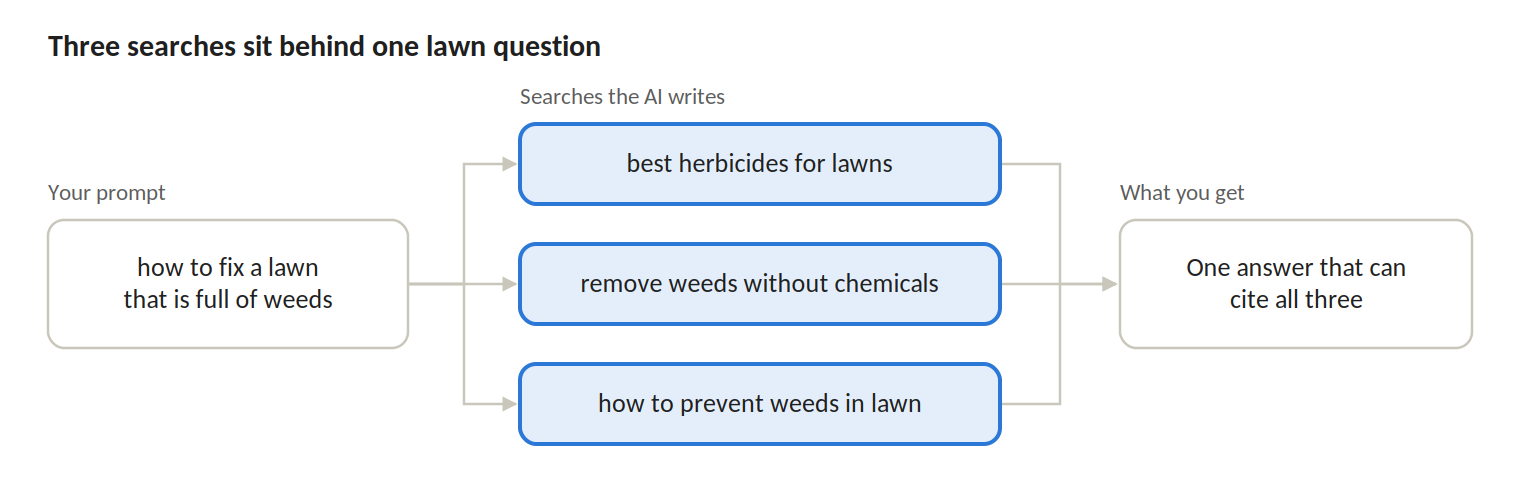
Each of those searches has its own results, and the final answer can cite a page from any of them. That is how a page can be cited for a question it never targeted.
Fan-out vs query rewriting vs decomposition
These three terms often get mixed up, so here is how I use them in this article:
- Query rewriting: one prompt becomes one better search query.
- Query fan-out: one prompt becomes several search queries.
- Decomposition: the research term for splitting a multi-part question into smaller questions, each answered before the final reply.
OpenAI’s wording shows how thin the line is. ChatGPT rewrites a prompt into “one or more targeted queries.” One query is rewriting. More than one is fan-out.
Where the term came from
Google attached the name to AI Mode when it launched the experiment on March 5, 2025. At Google I/O in May 2025, it described AI Mode as breaking a question into subtopics and issuing “a multitude of queries simultaneously.” The idea is older than the label: letting a language model rewrite a question before searching improves what retrieval finds.
The problem fan-out solves
Fan-out exists because the questions people ask AI tools often hide several questions at once, and one search rarely covers all of them. A prompt like “Which project tool fits a 10-person agency on a tight budget?” carries a category, a team size, a budget and an unspoken comparison. A single search would favor one of those angles and miss the rest.
Splitting the prompt lets the engine check each angle on its own. Google says this also lets its AI features show “a wider and more diverse set of helpful links” than a classic web search.
Inside a fan-out: from your prompt to a cited answer
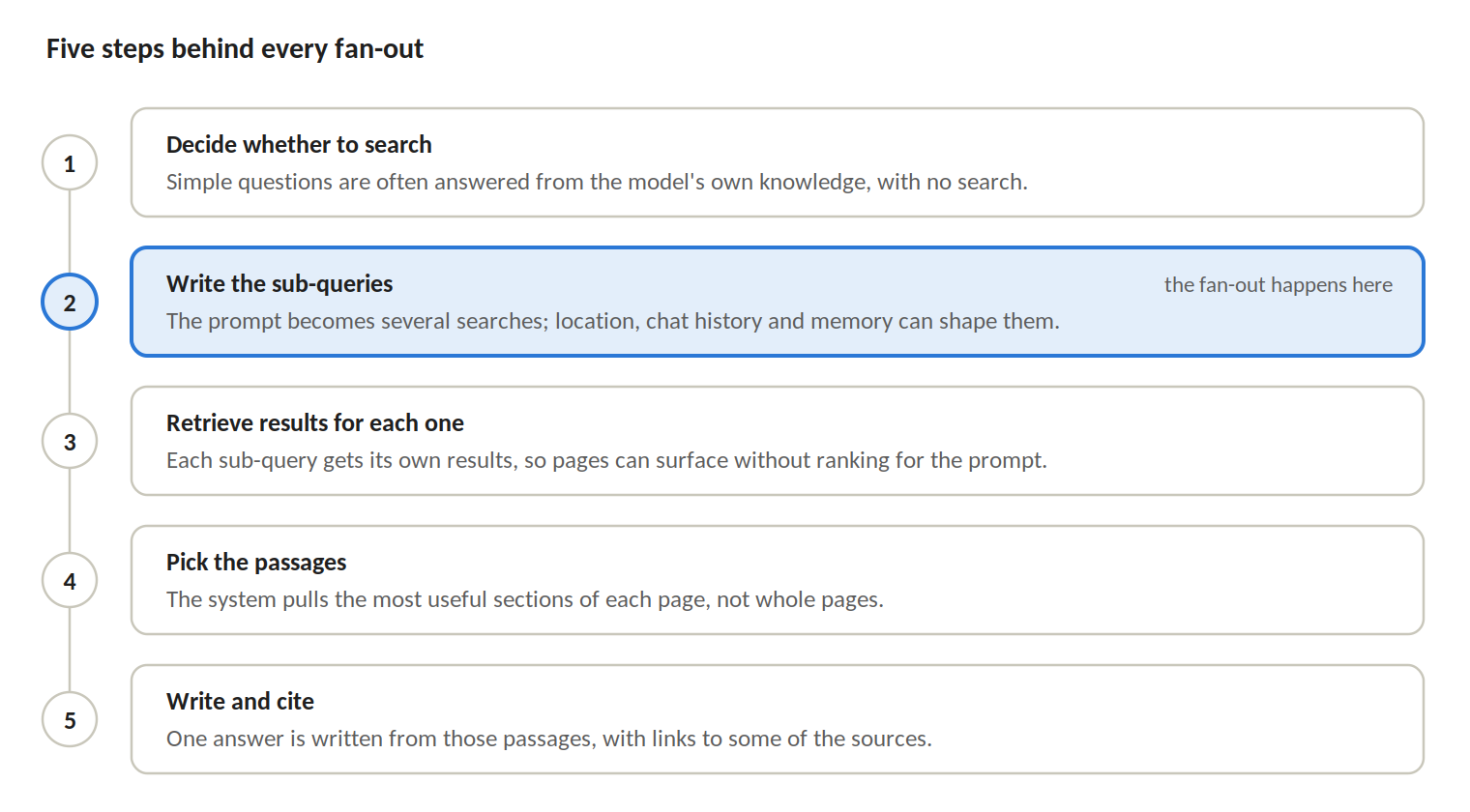
Every engine builds it a little differently, but the process follows the same five steps:
The sub-queries engines write on your behalf
Most sub-queries fall into seven predictable types. Here is how they could look for the prompt “best running shoes for flat feet”:
| Type | What It Does | Example |
|---|---|---|
| Reformulation | Rephrases the prompt | running shoes for overpronation |
| Related topic | Covers a neighboring subtopic | arch support insoles for running |
| Implicit question | Answers what the user didn’t ask | do flat feet need stability shoes |
| Comparison | Weighs the options | stability vs neutral running shoes |
| Freshness | Looks for recent information | best running shoes for flat feet 2026 |
| Next step | Anticipates the follow-up | how to break in new running shoes |
| Scoped to one site | Searches a single trusted domain | site:brand.com stability shoes |
These are illustrative examples, not captured queries. The last type is the newest. Since August 2026, ChatGPT often uses the site: operator, a search command that limits results to one website, to check a brand’s own pages directly.
Google AI Mode: many searches, none of them public
Google describes AI Mode as breaking a question into subtopics and searching for each one at once across multiple data sources. AI Overviews may use the same technique. Since Google I/O 2026, AI Mode has run on a custom version of Gemini, with Gemini 3.5 Flash as the default model.
Three points matter most:
- Google publishes no list of sub-queries. Nobody outside Google can see which searches AI Mode ran for a given answer.
- Deep Search goes much further. Google says this research mode uses the same technique “taken to the next level” and can issue hundreds of searches for one report.
- The searches run on regular Google Search. Google’s May 2026 guide says its generative AI features are “rooted in our core Search ranking and quality systems,” and a page must be indexed and eligible for a snippet to appear.
Google doesn’t publish an average number of searches per prompt. Across 1,600 test runs through the Gemini API with Google Search grounding, most prompts triggered two to four searches, and some triggered none. The API is a close relative of AI Mode, not AI Mode itself, so read that number as a rough guide.
ChatGPT: from a couple of searches to many
ChatGPT search typically rewrites your prompt into one or more targeted queries, then may send more specific ones after reading the first results. Your approximate location and, when turned on, saved memories can shape those queries.
Until mid-2026, that usually meant two or three searches. Across 5 million fan-outs from April 2026, ChatGPT averaged 2.1 searches per prompt, against 1.4 for Perplexity and 6.8 for Grok. ChatGPT also liked to add words such as “best,” “comparison” and “reviews” to what users typed.
The GPT-5.6 shift in August 2026
The GPT-5.6 rollout in early August 2026 changed that pattern. Since the new model became the default, ChatGPT runs more rounds of searching and points far more searches at single websites:
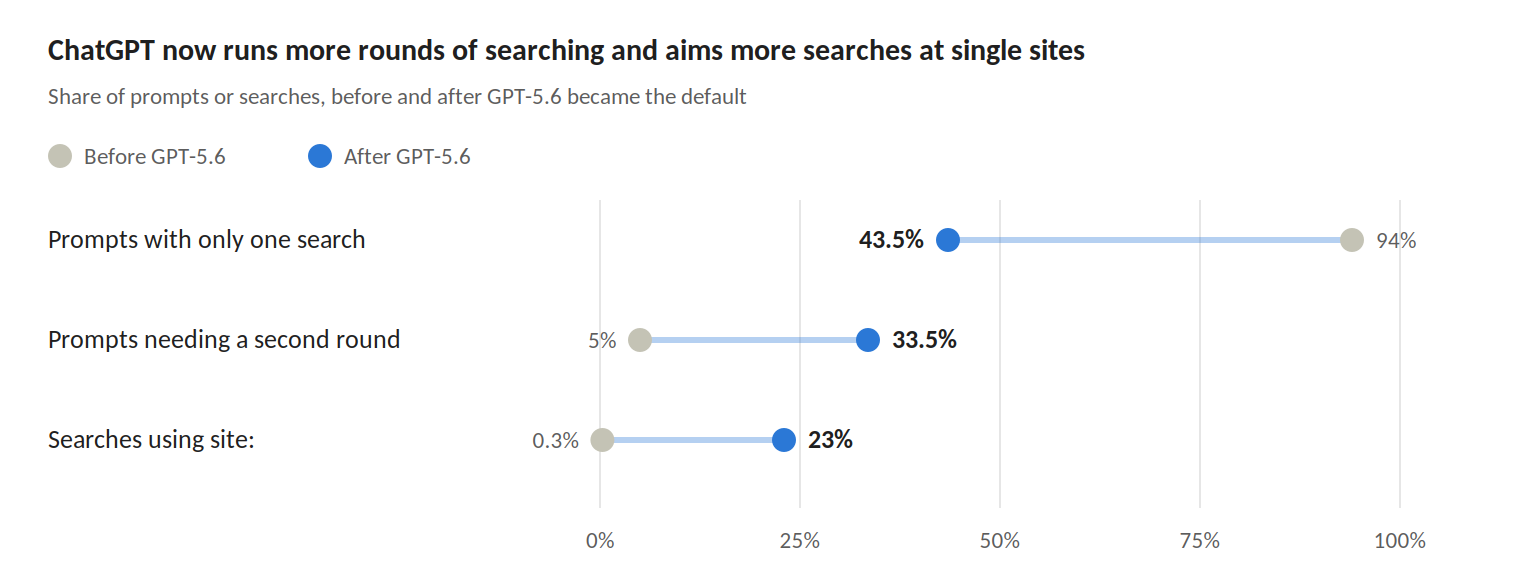
The average number of sources ChatGPT retrieved also roughly doubled, from about 12 to 24. Many of the single-site searches point at brand websites: across 15 million ChatGPT fan-outs, 76% of site: searches targeted a company’s own website.
Why studies report such different numbers
The published figures after GPT-5.6 don’t agree. Some data shows more than half of searching prompts running two or more searches, while free-tier data shows about 1.6 searches per searching response. The gap comes from what each dataset measured, not from errors in the data:
- App or API. Some data comes from OpenAI’s API, a developer tool that may not behave like the ChatGPT app.
- Free or paid model. Across 66.6 million free, logged-out responses on GPT-5.6 Luna, only 14.4% searched at all.
- Type of prompt. Some prompts trigger several searches and others none at all, so two datasets with different prompt sets will report different averages.
Before comparing two fan-out numbers, check the model, the access method and the prompts behind each one.
AI Mode and ChatGPT, side by side
Both engines fan out, but they differ in scale, in transparency and in the sources they reach for:
| Factor | Google AI Mode | ChatGPT |
|---|---|---|
| Name for it | Google calls it “query fan-out” | OpenAI describes the behavior without the name |
| Searches per prompt | Not published; “a multitude,” and hundreds in Deep Search | About 1.6 per searching response in free-tier data after GPT-5.6 |
| Where it searches | Google’s own Search index | OpenAI’s search providers, plus site: searches on single domains |
| Can you see the queries? | No | Partly, through APIs and browser tools |
| Latest change | Gemini 3.5 Flash became the default in May 2026 | GPT-5.6 in August 2026 brought more rounds and more site: searches |
Seeing the hidden searches for yourself
You can see some fan-out queries, but never the full picture for Google. Here is what each surface shows:
- Google AI Mode and AI Overviews: no published queries. You can only record which pages get cited.
- ChatGPT: some browser extensions can show the searches ChatGPT ran behind an answer.
- APIs: the Gemini, OpenAI and Claude APIs return the searches they ran, though an API run is not the same as the consumer app.
- Perplexity Pro Search: shows how it broke your question down, right in the interface.
Whatever you collect, run the same prompt several times. Across repeated runs, only about 27% of fan-out queries stayed the same, and 66% appeared just once. The exact wording changes, but the topics hold steady: about 90% of fan-outs fell into four or fewer topic groups.
Where this leaves SEO and AI visibility
Fan-out means you compete for the searches the AI writes, not only for the prompt the user typed. Three points follow from the research:
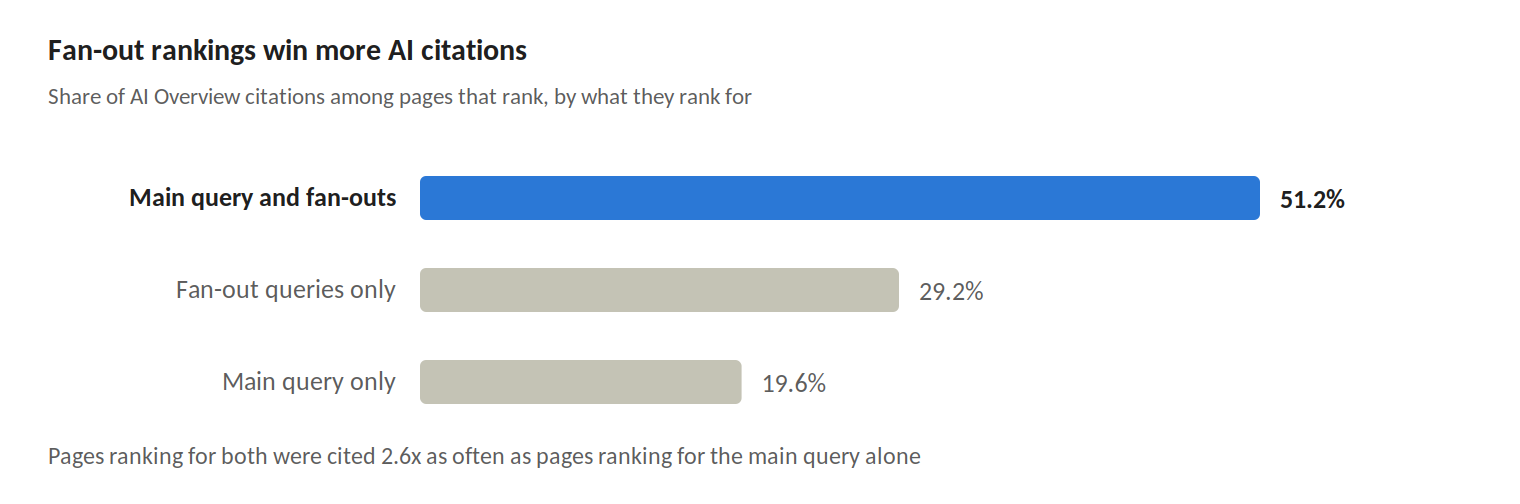
- Ranking for sub-queries counts. Across 10,000 keywords, pages ranking for both the main query and its fan-out queries were 161% more likely to be cited in AI Overviews than pages ranking for the main query alone. That is a correlation, not proof of cause.
- Each section should stand on its own. Different sub-queries can pull different passages from the same page, so every section needs to answer its question without leaning on the rest.
- One strong page beats many thin ones. Google’s May 2026 guide warns that making separate pages for every fan-out variation, mainly to influence rankings or AI answers, can break its scaled content abuse policy, the spam rule against mass-producing low-value pages. And since GPT-5.6 favors official sites, your own pricing, product and help pages need clear, public answers.
FAQs
Does Google AI Overviews use query fan-out too?
Yes. Google says AI Overviews can use it too, but they give a shorter, single summary than AI Mode.
Can a page get cited in AI answers without ranking in the top 10?
Yes. Many cited pages don’t rank in the top 10, so ranking helps but isn’t required.
Does query fan-out change for prompts in other languages?
Often, yes. ChatGPT frequently adds English searches to prompts written in other languages.
Do I need llms.txt or special markup to show up in fan-out results?
Not for Google. Its guide says llms.txt, special schema and rewritten content aren’t needed; normal SEO basics are enough.

Farhan khan
Farhan is an SEO writer covering content strategy, search visibility, and brand discovery across search engines and AI platforms.