When people ask tools like ChatGPT, Gemini, or Google’s AI features for product recommendations, they rarely ask about one brand alone. They compare options, ask which company is better, or look for the best solution for a specific need. That makes competitor visibility just as important as tracking your own brand mentions.
For example, if someone searches for “best project management software for a small team,” your brand may be mentioned alongside Asana, Monday.com, or ClickUp. If those competitors appear in more answers, appear earlier, or receive stronger recommendations, they have a larger share of that conversation.
Comparing AI brand mentions helps you see where competitors are being included, how they are being described, and which sources support their visibility. It also shows where your brand is missing, giving you specific gaps to investigate instead of relying on assumptions.
Set Up a Fair Competitor Comparison
Before comparing mentions, make sure every brand is being tested under the same conditions. Using different prompts or platforms can make one competitor look more visible simply because it received more opportunities to appear.
- Choose 3–5 relevant competitors: Focus on brands targeting the same audience or search intent.
- Create one shared prompt set: For example, use “best project management tools for small teams” for every brand.
- Use the same AI platforms: Compare results from the same platforms rather than mixing different sources.
- Run prompts consistently: Keep the wording, location, language, and testing period as consistent as possible.
For example, if you compare your brand with Asana, ClickUp, and Monday.com, run the same 20–30 prompts for all four brands. This gives you a cleaner basis for understanding which brands are actually appearing more often.
Tools for Comparing AI Brand Mentions With Competitors
These tools can make competitor tracking easier, especially when you’re comparing the same prompts across several brands. The right choice depends on whether you need deeper comparisons, source analysis, or simple historical tracking.
| Article Step | Recommended Tool | What It Does |
|---|---|---|
| Fair Competitor Comparison | Ahrefs Brand Radar / Semrush AI Toolkit | Compares your brand and competitors using the same prompts and conditions. |
| Check Brand Position | Profound | Shows whether your brand is a top recommendation, leading option, or secondary mention. |
| Find Competitor Sources | Ahrefs Brand Radar | Identifies URLs and publications frequently cited for competitors. |
| Find Prompt Gaps | Semrush AI Toolkit | Finds prompts where competitors appear but your brand doesn’t. |
| Track Changes Over Time | SE Ranking | Stores past results to track changes in competitor visibility. |
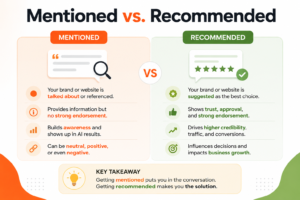
Difference Between Being Mentioned and Being Recommended
A brand can appear in an answer without receiving the same level of attention as its competitors. Look at how each brand is presented, not just whether it appears.
Check Where the Brand Appears
A brand mentioned first or included in the main recommendation usually has more prominence than one added at the end.
- Example:
“For small businesses, HubSpot is a strong choice, followed by Zoho and Salesforce.”
Here, HubSpot gets stronger positioning even though all three brands are mentioned.
See What the Brand Is Known For
AI answers often connect brands with specific features, audiences, or use cases.
- Example:
Your brand may be described as “best for startups,” while a competitor is associated with “advanced reporting for enterprise teams.” This shows how each brand is positioned.
Separate Recommendations from Simple Mentions
Being listed does not always mean being recommended.
- Example:
“Popular options include A, B, and C.”
This is weaker than:
“For beginners, B is the better choice because it is easier to use.”
Compare the Language Used
Pay attention to the words surrounding each brand.
- Example:
“Reliable,” “cost-effective,” and “easy to use” create a stronger impression than a neutral mention such as “another option available in this category.”
Find the Sources Giving Competitors an Edge
The sources behind competitor mentions can reveal a lot about why they keep appearing in AI answers. Looking at these citations helps you spot trusted publications, reviews, and other websites that may be strengthening their visibility.
Look at Competitor Citations
Check which websites, publications, reviews, or directories are cited when competitors appear in answers.
Spot Repeated Sources
If the same publication or platform keeps appearing for one competitor, it may be contributing to that brand’s visibility.
Compare Your Source Coverage
Look for sources that mention competitors but rarely mention your brand.
- Example
If Competitor A is repeatedly supported by industry publications and review sites while your brand has fewer third-party mentions, the gap may be related to source coverage, not just your website content.
Where Are Competitors Showing Up That You Aren’t?
A competitor comparison can reveal more than who appears more often in AI answers. It can show the specific prompts, topics, and customer questions where competitors are getting visibility while your brand is being left out. Looking at these gaps helps you understand where your current content, authority, or brand presence may be falling short.
The goal is not to copy everything your competitors are doing. Instead, use the comparison to identify patterns worth addressing and find areas where your brand has a realistic opportunity to become more visible.
Find Missing Prompts
Start by reviewing the prompts where competitors are mentioned but your brand does not appear. Look for patterns across related queries instead of treating every missing mention as a separate issue. If your competitors repeatedly show up for questions around pricing, alternatives, or specific use cases, that may point to a broader visibility gap.
Group Similar Gaps
Organize missing mentions into clear themes such as pricing, features, use cases, industries, product comparisons, and customer needs. Grouping similar prompts makes it easier to understand whether the problem is limited to one subject or affects an entire area of your visibility.
For example, if competitors appear across several prompts about a particular product feature while your brand is missing from all of them, the issue may be bigger than a single prompt. It could indicate that your brand lacks enough relevant content, third-party coverage, or clear information around that topic.
Look for Repeated Competitor Presence
Pay close attention to competitors that consistently appear across several related prompts. A single mention may not tell you much, but repeated visibility across a topic suggests that the competitor has stronger signals around that subject.
Track which brands appear most often and the types of questions in which they are consistently recommended. This can help you identify the areas where competitors have built stronger visibility and where your brand may need to strengthen its presence.
Compare Coverage Across Topics
Compare your brand’s coverage with competitors across different topic groups. You may find that your brand performs well for product-specific questions but has limited visibility for informational, comparison, or problem-focused searches.
This comparison can also reveal opportunities outside your core product terms. If competitors are being mentioned when users ask about broader industry problems or solutions, those topics may be worth adding to your content and AEO strategy.
Separate Important Gaps from Minor Ones
Not every missing mention needs immediate action. Prioritize gaps around your main products, target customers, high-value topics, and buying-related queries. Focus first on repeated gaps in comparison, recommendation, and high-intent prompts, as these are more likely to affect visibility and customer consideration.
Turn Competitive Gaps into Priorities
Once the gaps are clear, focus on the ones that can make a meaningful difference to your brand visibility rather than trying to fix everything at once.
Start with gaps connected to your core products, important customer questions, and topics where competitors appear repeatedly. Then review whether the missing visibility is related to weak content coverage, limited third-party references, unclear product information, or a lack of useful answers around a specific topic.
Prioritize opportunities based on business relevance, competitor strength, frequency of the gap, and how closely the topic matches your target audience. This gives your team a practical list of areas to work on instead of a long collection of competitor observations.
Keep the Competitive Picture Up to Date
A single comparison only shows what is happening at one point in time. Repeating the same checks helps you see whether competitors are gaining visibility, losing ground, or changing how they appear in AI answers.
| What to Monitor | What to Compare | Why It Matters |
|---|---|---|
| Brand mentions | Mentions gained or lost | Shows changes in overall visibility |
| Prompt coverage | Topics where each brand appears | Reveals new competitive gaps |
| Mention position | First, middle, or last placement | Shows changes in prominence |
| Recommendations | How often brands are recommended | Helps measure the quality of visibility |
| Citations | New and recurring sources | Shows which sources are influencing visibility |
| Competitors | New brands appearing in results | Helps identify emerging competition |
Run the same prompts on a consistent schedule and keep previous results for comparison. This makes it easier to spot meaningful changes instead of reacting to isolated differences in individual AI answers.
Final Thoughts
Comparing AI brand mentions with competitors is not just about counting how many times each brand appears. The useful insights come from looking at mention frequency, positioning, supporting sources, topic coverage, and competitive gaps together.
A consistent comparison process helps you understand where competitors are gaining attention and where your brand has room to improve. Over time, these findings can guide content updates, source-building efforts, and broader AI visibility strategies.
