Family1st
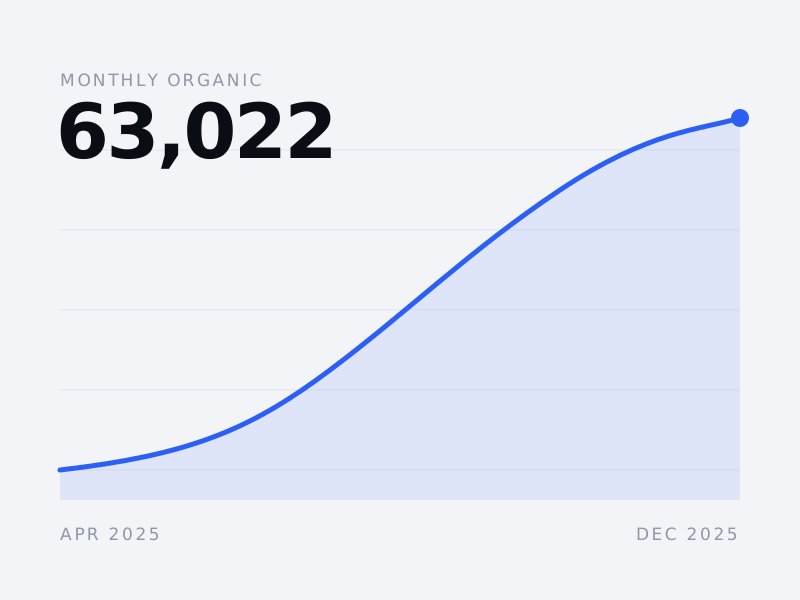
Consumer GPS tracking. Full-scope SEO across nine months. 2,246 referring domains and $158,967 in monthly organic traffic value by close.
Ranking first decides nothing if the shortlist was written before anyone reached the results page. We fix the layers that decide whether a machine can name you at all.
Answer engines read the web search engines index. Splitting the two disciplines across two suppliers duplicates the foundation work and leaves the handover unowned.
All servicesGPS and telematics, cybersecurity, healthcare, hosting and B2B software. We publish the brief and the approach on every engagement. Figures appear only once the client has confirmed them in writing, which is why some of these read as scope rather than outcome.
Consumer GPS tracking. Full-scope SEO across nine months. 2,246 referring domains and $158,967 in monthly organic traffic value by close.
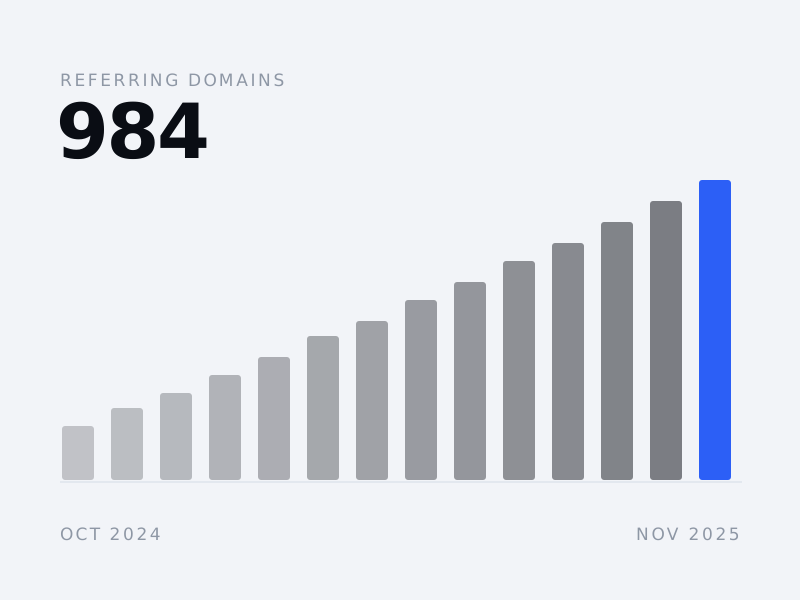
Fleet tracking and ELD. Fourteen-month full-scope programme. Held 89.1% of entity-level organic traffic against adjacent brands.
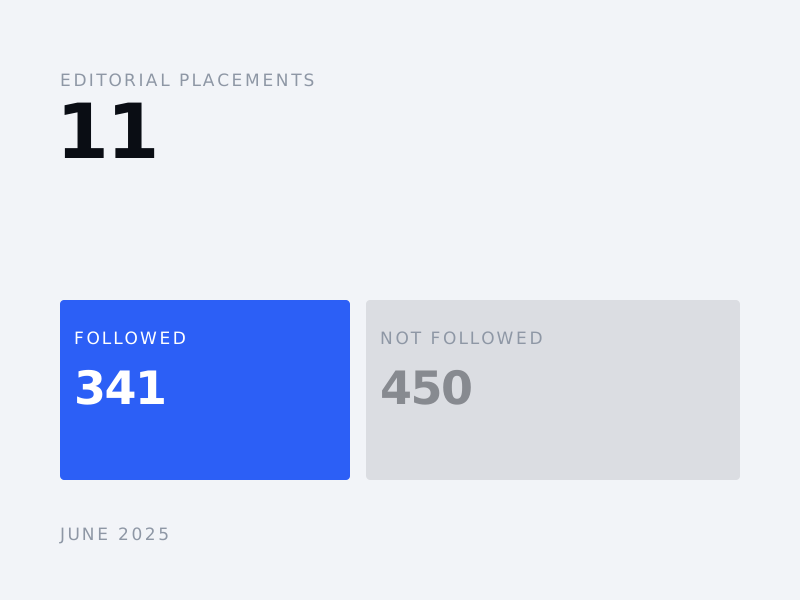
AI creative engine. Referring domains 312 to 348 across June 2025, added to the followed share of a majority-nofollow profile.
Tell us the queries and prompts that matter commercially. We will show you where you stand across six answer engines before you commit to anything.
Or read the methodologyEvery agency can produce a flattering number. Far fewer will tell you what they refuse to do, who does the work, and when they will hand your money back. These are checkable before you sign.
A hard cap, not a guideline. The person who scopes your engagement runs it. There is no handover to a junior delivery team after the sale, which is why we decline more work than we take.
We do not buy, exchange, or place links on inventory that exists to sell them. This costs us volume every month and it is not negotiable. Ask any agency you are evaluating to put the same sentence in writing.
No twelve-month lock-ins. If the work is not moving we say so in the monthly review, with the diagnosis, rather than presenting a chart that avoids the question.
Rankings and recommendation share in one review, measured weekly across six answer engines. You see which one is constraining growth, including when the answer is neither and the problem is your pricing.
A stack, not a checklist. Each layer depends on the one below it, so structure deployed before identity resolves is attributed to a brand the model cannot name.
Be understood. Who are you, and who are you for? Models only surface brands they can disambiguate.
Be reinforced. Do others describe you the way you describe yourself? The consensus wins, not your copy.
Be trained on. Are you present in the corpora models actually learn from and retrieve?
Be remembered. Retrieval reads structure, not prose. Every claim needs a machine-extractable form.
Be credible. A model can know you exist and still decline to recommend you. This is the gap.
Five phases, the same for every client. The layers are what we optimise; this is how.
A fixed prompt set across ChatGPT, Claude, Perplexity, Gemini, AI Overviews and Copilot, each query mapped to a buyer-intent cluster. Alongside it: technical health, content inventory and link profile.
We measure both pillars before recommending anything, because the constraint is frequently not where a client assumes it is.
We quantify the three deficits that keep a brand out of AI answers: content gaps where models cannot extract a passage, entity deficits where you are unresolvable, and corpus gaps where competitors are cited and you are not. Every deficit carries an estimated lift.
A 90-day roadmap sequenced by leverage rather than by month or by client comfort. Content pillars, schema deployment, entity claims and authority placements, each scoped with an owner, a cost and an expected effect. Assumptions are written down so your team can challenge them.
One senior strategist owns delivery, supported by writers, entity specialists and an analyst working against the roadmap. We ship every week. Your team owns approvals; we own velocity.
Continuous measurement across rankings and recommendation share. Weekly scans detect drift from model updates within days rather than quarters, with intervention protocols agreed in advance.

The person who scopes your engagement is the person who runs it. We publish who that is before you sign, along with what they have shipped and what they have got wrong.
Aditya founded RankingBite on a position he has been arguing publicly since before it was comfortable: that search optimisation stopped being a Google-only discipline, and that the brands winning the next decade will be the ones a model can name without being prompted. He took that talk, Why SEO Is Not About Google Anymore, to the WordCamp Bhopal 2025 stage.
He runs the diagnostics himself and owns the engagements nobody else wants to scope. He also publishes the assumptions behind every roadmap, so clients can argue with the reasoning rather than the invoice.
Saying this costs us enquiries. It also means the conversations we do have start honestly, and it saves you a discovery call that was never going to go anywhere.
See what a good fit looks likeTechnical corrections register in weeks. Content and authority compound over two to three quarters. If the board needs numbers by the end of this one, paid channels will serve you better and we will say so on the first call.
Any agency guaranteeing monthly link counts is buying them. We acquire editorially, which means volume varies with your category and the news cycle. We will give you an expected range and never a promise.
We would rather ship six pages worth quoting than thirty worth nothing. If the brief is priced per article, the agencies who win it are the ones drafting with a model, and you will be rewriting that content within a year.
Sometimes the diagnostic shows the problem is pricing, product, or a sales process losing qualified traffic. We will tell you that, point you at whoever fixes it, and decline the engagement. It has happened, and it will happen again.
Each one gets its own programme. What is compliant, competitive or even publishable in one vertical frequently is not in another.
All industriesAnswered plainly, including where the answer is no.
No, and no one credibly can. Model outputs are probabilistic and change with each release. What we can do is fix the conditions that make recommendation likely, resolvable identity, extractable claims, corroborating sources, and measure the change against a fixed prompt set.
Partly, and we would rather say so. The foundation is shared. What is genuinely new is entity resolution as a prerequisite, extractability as a content requirement, and recommendation share as a measure.
Yes. Ranking remains the entry condition for most citation, and organic clicks still convert. Anyone telling you rankings are obsolete is selling the new thing rather than measuring it.
Technical corrections can register in weeks. New content usually stabilises over three to six months. Anyone promising position one inside a month is describing a keyword nobody searches.
Diagnostic and baseline in the first fortnight, foundation and entity fixes through the first month, then content and authority work sequenced by whichever gap the baseline showed to be largest.