

Answer Engine Optimization (AEO) is the process of improving how a brand’s expertise, products, and content appear in AI-generated answers and answer-driven search experiences. For B2B companies, an effective AEO strategy helps potential buyers discover, evaluate, and compare solutions across platforms such as ChatGPT, Gemini, and Perplexity.
The shift toward AI-assisted research is already visible in buyer behavior. A Gartner survey of 645 B2B buyers found that 45% had used generative AI, primarily to research vendors and products. This makes AI search visibility an increasingly relevant consideration for B2B marketing teams.
This guide outlines a practical 90-day AEO strategy for B2B teams, covering the key actions, implementation stages, and performance measures needed to improve AI search visibility. RankingBite combines SEO and AI visibility strategies to help businesses strengthen their presence across traditional and AI-powered search.
The 90-Day AEO Roadmap at a Glance
This 90-day AEO strategy gives B2B brands a structured approach to improving visibility across AI answer engines. It moves from identifying visibility gaps to implementing content and technical improvements, then measuring results and planning the next quarter.
| Phase | Timeline | Key Focus |
|---|---|---|
| Phase 1: Baseline and Gap Analysis | Days 1–21 | Test buyer prompts, audit existing content, benchmark competitors, and identify opportunities. |
| Phase 2: Brand Clarity and Content Planning | Days 22–35 | Define brand entities, map buyer questions to pages, and identify evidence gaps. |
| Phase 3: Content and Technical Execution | Days 36–70 | Improve priority pages, strengthen supporting evidence, fix technical issues, and review updates. |
| Phase 4: Measurement and Next Steps | Days 71–90 | Retest prompts, compare visibility metrics, review traffic, and plan the next quarter. |
The roadmap helps teams prioritize improvements systematically rather than publishing more content without a clear objective. Results will vary by brand, competition, and AI platform, so progress should be measured against an initial baseline.
Phase 1: Establish Your Baseline and Find Visibility Gaps (Days 1–21)
Establish your brand’s current AI visibility, review technical accessibility, and identify gaps that need attention. Use the findings to create a prioritized action plan for the next phases.
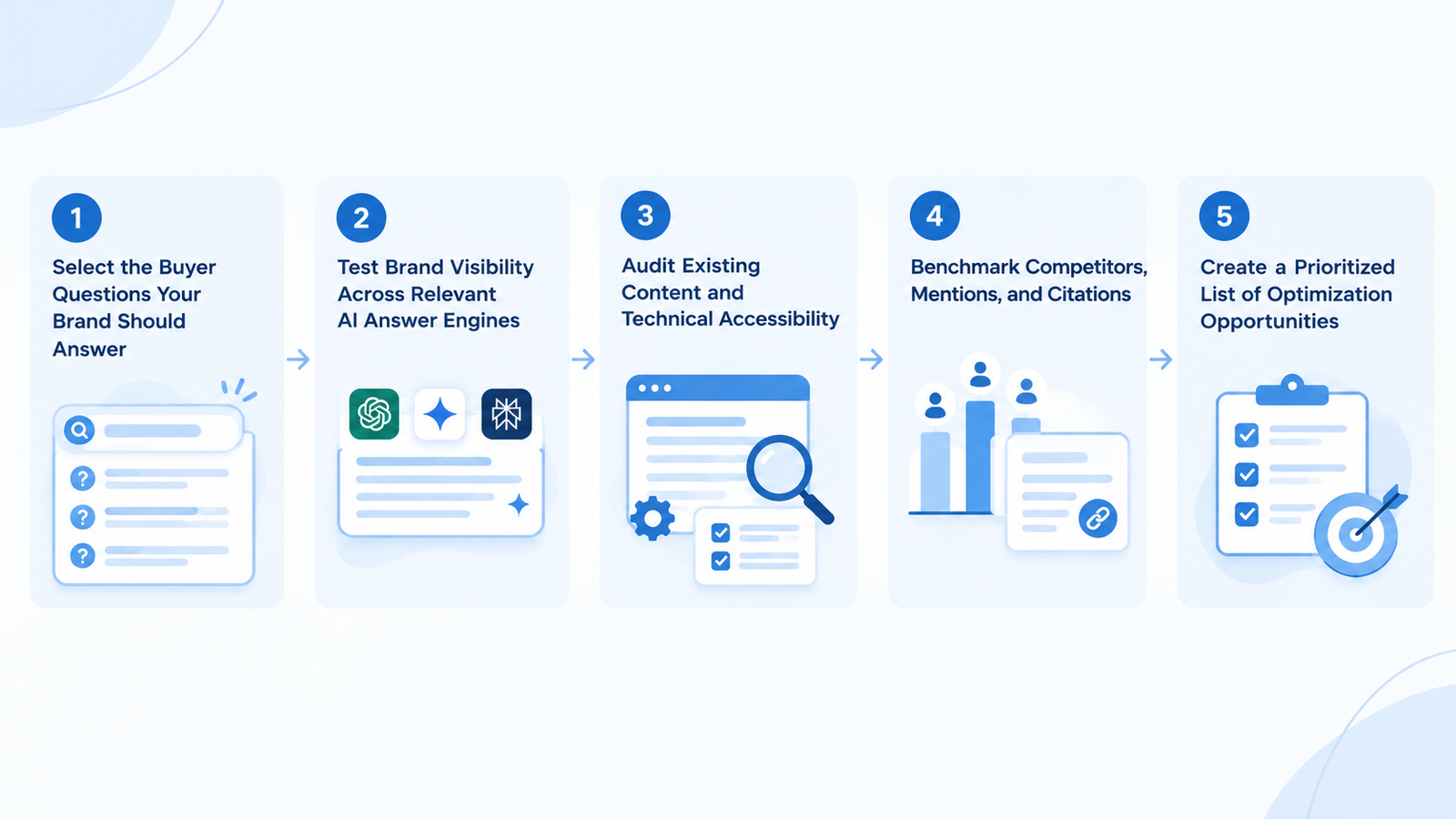
Select the Buyer Questions Your Brand Should Answer
Choose relevant buyer questions based on your core offerings, target industries, customer needs, and CRM insights.
Test Brand Visibility Across Relevant AI Answer Engines
Run selected prompts across ChatGPT, Gemini, and Perplexity. Record whether your brand appears and which pages or sources are referenced.
Audit Existing Content and Technical Accessibility
Review key landing pages, Google Search Console, GA4, crawlability, and indexing to identify content and technical issues.
Benchmark Competitors, Mentions, and Citations
Identify key competitors and review which brands and sources appear for your selected buyer questions.
Create a Prioritized List of Optimization Opportunities
Document the main content, technical, and brand visibility gaps. Rank each opportunity by business impact and implementation effort to guide the next phase.
Phase 2: Strengthen Brand Clarity and Content Coverage (Days 22–35)
Once the initial audit is complete, clarify how your brand, products, and expertise should be represented across AI answer engines. Map buyer questions to relevant pages, identify missing evidence, and prioritize updates based on business value.
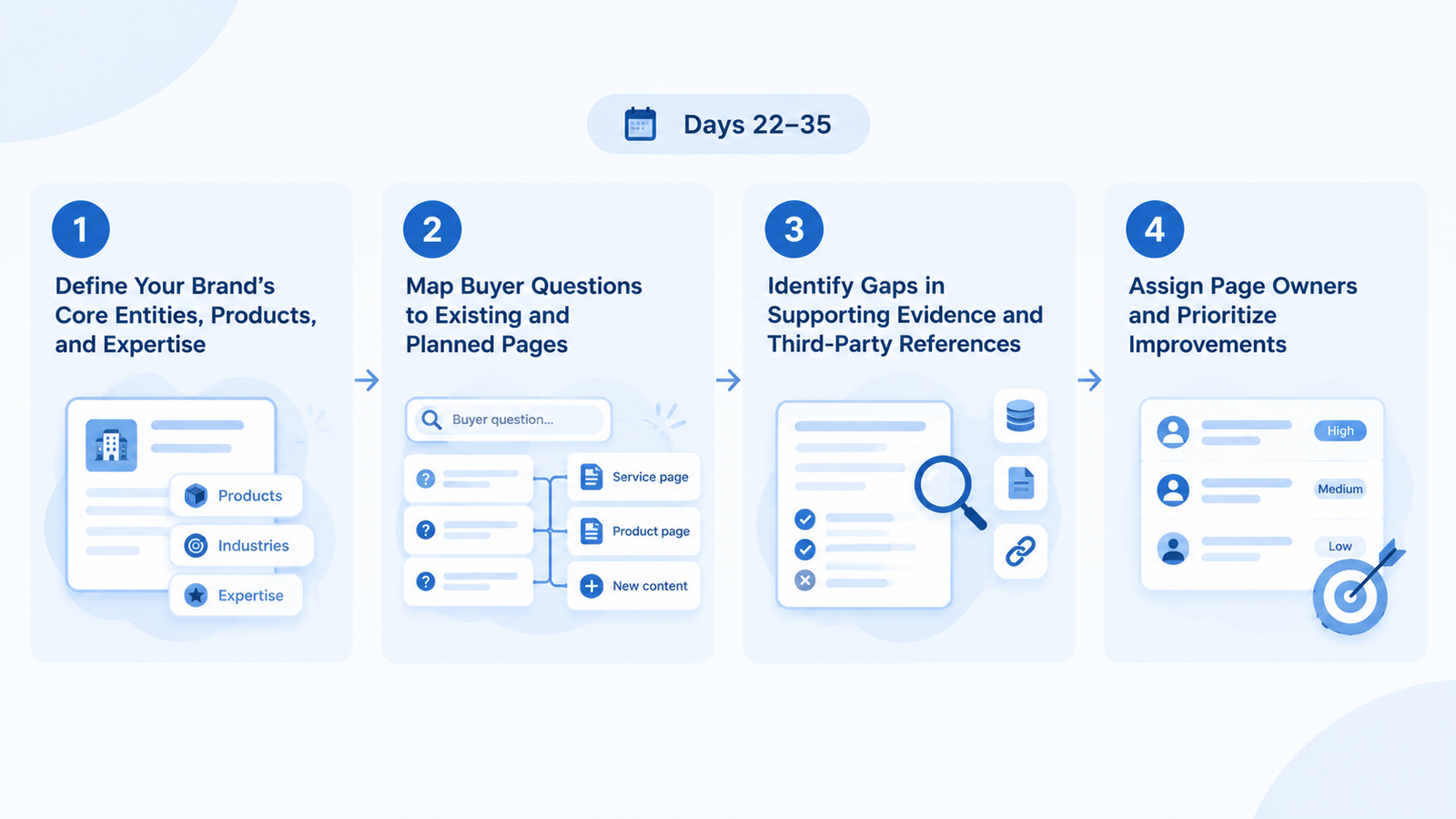
Define Your Brand’s Core Entities, Products, and Expertise
- Document your brand name, core services, products, target industries, and key differentiators.
- Keep company descriptions and product details consistent across your website and trusted profiles.
- Practical step: Create a brand reference sheet with approved descriptions, product names, and key facts.
Map Buyer Questions to Existing and Planned Pages
- Match priority buyer questions to relevant service pages, product pages, and supporting content.
- Identify questions that existing pages answer poorly or do not address.
- Practical step: Build a content map with each buyer question, its target URL, and any required new content.
Identify Gaps in Supporting Evidence and Third-Party References
- Check whether important claims are supported by original data, case studies, expert insights, or credible sources.
- Review relevant industry publications, partner directories, and third-party mentions for missing brand information.
- Practical step: Create an evidence gap list showing which claims need stronger support or additional credible references.
Assign Page Owners and Prioritize Improvements
- Assign each priority page to a content, SEO, or subject-matter expert.
- Rank updates by buyer relevance, business impact, and implementation effort.
- Practical step: Maintain an action tracker with the target URL, required update, owner, priority, and deadline.
Phase 3: Execute the AEO Content and Technical Plan (Days 36–70)
Implement the prioritized tasks by updating key pages,Content Audit, resolving technical issues, and improving the information available about your brand.
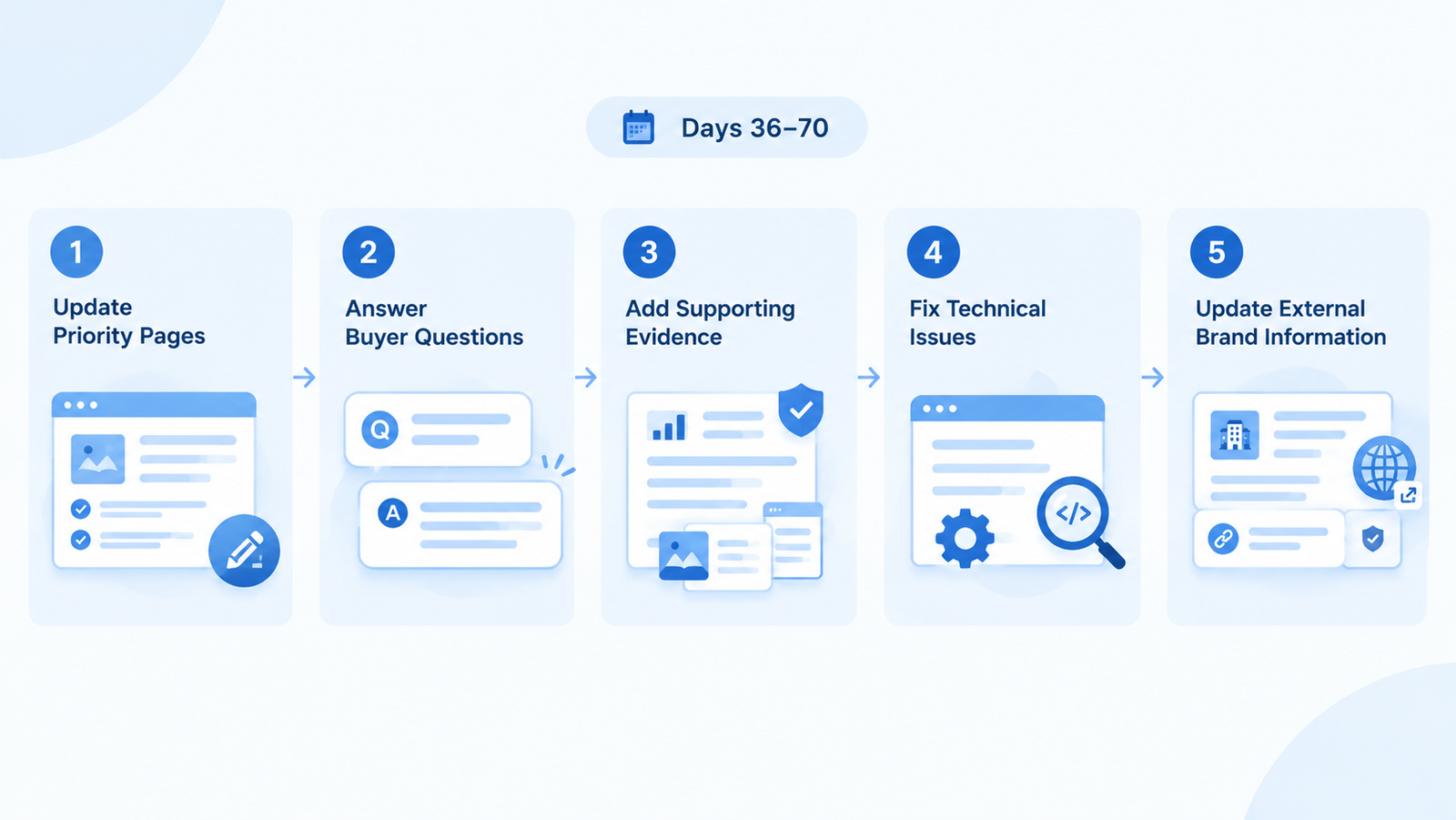
- Update priority pages: Improve key product, service, and informational pages. Example: Add missing pricing details and use cases to a SaaS product page.
- Answer buyer questions: Add clear answers to relevant questions on existing pages. Example: Explain how automated threat detection works on a cybersecurity service page.
- Add supporting evidence: Include relevant data, case studies, and expert insights. Example: Publish a customer case study demonstrating measurable product outcomes.
- Fix technical issues: Resolve crawling, indexing, internal linking, and structured data errors.Google recommends maintaining foundational SEO practices for AI Search features, including crawl accessibility, helpful content, internal linking, and structured data that matches visible page content. Example: Correct an incorrect canonical tag and fix broken internal links.
- Update external brand information: Correct outdated details on relevant industry directories and partner websites. Example: Update your company’s description and product information on a relevant industry directory.
Phase 4: Evaluate Results and Plan the Next Quarter (Days 71–90)
Evaluate the impact of your AEO improvements by comparing results with the initial baseline. Use these findings to identify successful changes, address remaining gaps, and plan the next quarter’s priorities.

Repeat the Original Prompt Tests
Run the same buyer-focused prompts across ChatGPT, Gemini, and Perplexity to check whether your brand’s visibility has changed. Keep the prompts and testing method consistent for a fair comparison.
Compare Brand Mentions and Citations Against the Baseline
Compare brand mentions, website citations, and competitor visibility with the results recorded during Phase 1. Identify which queries show improvement and where your brand remains absent.
Review Referral Traffic and Available Conversion Data
Check analytics for visits from AI platforms and review available conversion data, such as demo requests, enquiries, or sign-ups. Use these metrics to understand whether AI referrals contribute to business outcomes.
Identify Successful Changes and Unresolved Gaps
Review which content updates and technical fixes produced measurable improvements. Document remaining visibility gaps, underperforming pages, and questions where competitors continue to appear.
Build the Next 90-Day Optimization Backlog
Prioritize the next set of improvements based on business impact, visibility gaps, and implementation effort. Assign owners and deadlines to tasks such as updating key pages, adding supporting evidence, and resolving technical issues.
How to Allocate Time and Resources to Your AEO Strategy
Allocate resources based on your team’s capacity, business priorities, and current AEO needs. Focus on high-impact tasks and assign clear responsibilities to keep the 90-day plan manageable.
- Prioritize high-value buyer questions and pages based on business needs.
- Assign responsibilities to SEO specialists, content writers, developers, and subject-matter experts.
- Divide the 90-day timeline into research, implementation, and review phases.
- Use existing tools and workflows where possible to manage costs.
- Set realistic deadlines and allocate time for content updates, technical fixes, and team reviews.
- Review workloads regularly and adjust priorities based on available resources.
How to Measure AEO Progress in 90 Days
Measure AEO progress by comparing results with your initial baseline. Track these metrics throughout the 90-day period to identify improvements and prioritize the next steps.
- Brand mentions: Test the same buyer prompts across ChatGPT, Gemini, and Perplexity. Record how often your brand appears.
- Citation rate: Track how frequently AI answers cite your website as a source.
- Competitor visibility: Compare your brand’s mentions and citations with competitors using the same prompts.
- AI referral traffic: Use GA4 to review visits from AI platforms and identify engagement or conversions.
- Prompt coverage: Track how many relevant buyer questions return your brand in AI answers.
- Content performance: Review updated pages in Google Search Console for changes in impressions, clicks, and CTR.
- Monthly comparison: Compare results at the start, around Day 45, and on Day 90. Document improvements, remaining gaps, and priorities for the next quarter.
Practical tip: Keep the prompts, AI platforms, and testing method consistent across each review. AI answers can change between tests, so treat the results as directional indicators rather than guaranteed measures of performance.
A Worked Example: Applying the AEO Roadmap to a B2B SaaS Brand
Consider a project management SaaS company that wants to improve its visibility when buyers compare software solutions through AI platforms.
Days 1–21: Identify Visibility Gaps
The team tests prompts such as “What is the best project management software for remote teams?” across ChatGPT, Gemini, and Perplexity. It finds that competitors appear in several answers while its own brand is rarely mentioned.
Days 22–35: Plan Content Improvements
The team reviews its product pages and discovers missing use cases, limited comparison information, and inconsistent product descriptions. It maps these gaps to specific pages and assigns responsibility for updates.
Days 36–70: Implement Priority Changes
The company improves its product and comparison pages, adds answers to common buyer questions, includes relevant customer evidence, and fixes technical SEO issues that affect page accessibility.
Days 71–90: Evaluate Progress
The team repeats the original prompt tests and compares brand mentions and citations with its initial findings. It also reviews AI referral traffic and identifies queries that still need attention.
Next Quarter: Refine the Strategy
The team prioritizes remaining gaps, updates underperforming pages, and explores new content opportunities based on buyer needs. This creates a repeatable process for improving AEO based on observed results rather than assumptions.
Common Reasons AEO Strategies Fail
AEO strategies can underperform when teams target the wrong questions, overlook brand credibility, or focus on activity instead of results. Common mistakes include:
- Tracking too few or irrelevant prompts: Limited testing can give an incomplete picture of brand visibility and miss important buyer questions.
- Publishing content without addressing gaps: Producing more pages without meeting user needs can waste resources and add little value.
- Ignoring brand consistency and external evidence: Conflicting brand information and unsupported claims can make it harder to establish a clear, credible brand presence.
- Expecting guaranteed AI citations: AI responses vary across platforms and queries, so expecting consistent citations can lead to unrealistic performance goals.
- Measuring activity instead of outcomes: Counting published pages or completed tasks does not show whether brand visibility, qualified traffic, or conversions have improved.
Frequently Asked Questions About AEO Strategy
How is AEO different for B2B and B2C businesses?
B2B AEO focuses on detailed buyer research, vendor comparisons, and industry expertise, while B2C AEO often addresses product discovery, everyday questions, and purchase decisions.
Can AEO support lead generation for B2B companies?
Yes. Appearing in AI answers during vendor research can introduce your brand to potential buyers. Track qualified referral traffic, demo requests, and enquiries to assess its business value.
Who should manage an AEO strategy within a company?
AEO usually requires collaboration between SEO specialists, content teams, developers, and subject-matter experts. A dedicated owner should coordinate priorities and monitor progress.
How often should businesses review their AEO strategy?
Review performance monthly and conduct a broader assessment each quarter. Increase monitoring when launching products, updating important pages, or entering new markets.
Does AEO require paid tools?
No. Teams can begin with manual prompt testing, website analytics, Google Search Console, and spreadsheets. Paid tools may help automate tracking and competitor comparisons as the strategy expands.
Conclusion
A successful AEO strategy requires clear brand positioning, helpful content, strong technical foundations, and consistent performance tracking. A 90-day roadmap helps B2B brands identify visibility gaps, improve priority pages, and measure changes in AI mentions, citations, and referral traffic.
While results vary across platforms, regular testing helps businesses understand what works and where further improvements are needed. RankingBite combines SEO and AI visibility strategies to help businesses strengthen their online presence and build a measurable approach to answer engine optimization.