

Ranked “best X” lists and head-to-head comparisons earn the strongest return on buying-intent searches in 2026, because AI can summarize a definition but cannot make a purchase decision for the buyer. AI systems lift the numbered list into answers, and the tested comparison behind it makes that list worth citing.
A buyer who once opened six tabs now asks one question, “best CRM for a 20-person sales team,” and reads a sourced AI recommendation. That decision still needs what a summary cannot hold: tested tradeoffs, real pricing, honest exclusions and a clear verdict on who each product suits. Definitions get absorbed; judgments get cited.
The sections below cover why the format performs, how AI picks comparison pages, how to build and structure them, which mistakes block citations and how they fit an SEO and Answer Engine Optimization (AEO) cluster.
Why Does Comparison and “Best X” Content Perform Better in the AI Era?
AI search rewards ranked lists and comparisons because a summary can close a definition but cannot close a buying decision. The format did not get better; the competition got worse. A summary can finish a definition, so definitions stopped paying. A summary cannot finish a decision, so decisions are where the click stayed, and the ranked list is the shape that decision arrives in.
Commercial Intent Drives Better Business Outcomes
Commercial queries sit one step from a purchase. A searcher typing “best project management software for agencies” has a budget, a problem and a shortlist forming. A searcher typing “what is project management software” sits five steps back and may never buy anything.
Same topic, entirely different economics. Content budgets that chase search volume fund the second group and then wonder why the pipeline is empty.
Why AI Recommends Comparison Content
Buying prompts need structured evaluation, and comparison pages already hold it, so AI systems pull them into answers. AI systems answer those prompts by retrieving sources that hold criteria, tradeoffs, use cases and verdicts.
A definition page offers a model nothing it cannot generate itself. A tested comparison offers judgments the model has no way to produce alone, and that gap is why the format gets pulled into answers.
The data shows format tracking intent. A 2026 study of 75,000 AI answers and more than 1 million citations across ChatGPT, AI Mode and Perplexity found that articles won 45.5% of citations on informational queries, while listicles won 40.9% on commercial queries. Product pages led on transactional and navigational queries. Google’s May 2026 AI features guide also names unique, expert-led content as a primary driver of visibility, and a comparison built on real testing fits that description.
Why Comparison Content Converts Better Than Informational Content
Readers who land on a comparison page arrive with a decision pending, which is why they convert. They want the shortlist narrowed and the reasoning shown, and when a page does both, the next click is a pricing page or a demo form.
The traffic AI absorbed, the definition readers, was rarely converting anyway. Losing it costs sessions, not revenue.
Example: Informational vs Commercial Queries
Four queries from one CRM topic do four different jobs:
| Query | Intent | AI Behavior | Business Value |
|---|---|---|---|
| “What is CRM” | Informational | AI Overview answers the question completely | Near zero |
| “Best CRM software” | Commercial | AI Overview summarizes options, but users still compare before choosing | High |
| “HubSpot vs Salesforce” | Commercial comparison | Needs feature-level comparison, so detailed content holds value | Highest |
| “HubSpot pricing” | Transactional | Users need current pricing details from the source | Highest |
“What is CRM” carries the biggest search volume in the set, and it is the only query that stopped paying. Most content plans still lead with it.
How Does AI Select Comparison Content for Recommendations?
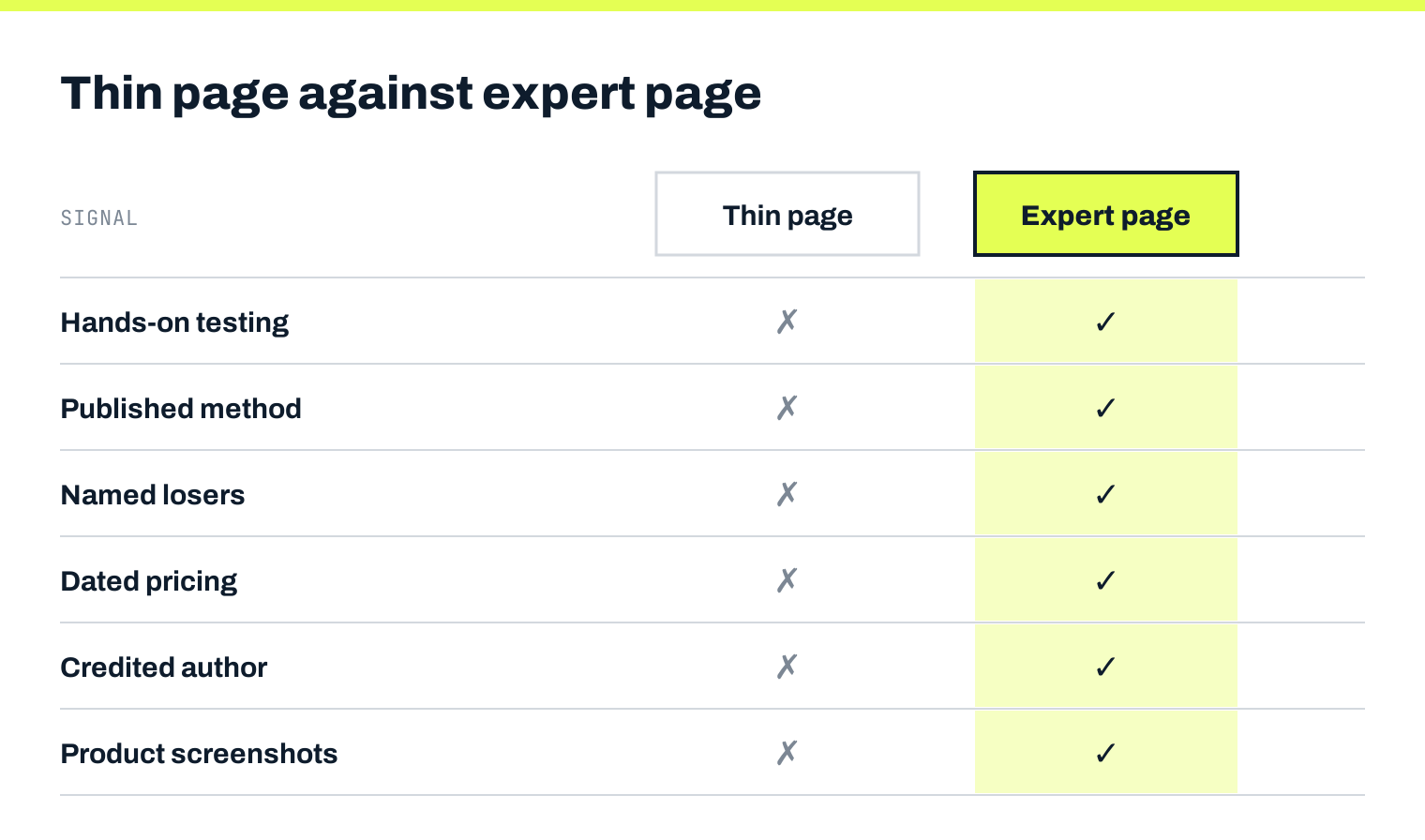
AI systems cite comparison pages that hold something a model cannot write itself: tested evidence, original findings and clear verdicts. Ranking position matters less than that test, and every signal below is a version of it. Pages that fail it fail for the same reason: they are built from information the model already has.
Signals That Increase AI Citations
Six characteristics separate a cited comparison from an ignored one:
- Evidence-backed claims. “Faster onboarding” is an adjective. “Onboarding took three days versus two weeks” is a claim a model can lift and attribute.
- Original insights. Testing, methodology and findings the model cannot assemble from existing pages.
- Comparison tables. A table row survives summarization intact, while a paragraph rarely does.
- Fresh information. Pricing and features change constantly, so an outdated comparison is a wrong comparison.
- E-E-A-T (experience, expertise, authoritativeness and trust). Named authors with verifiable credentials and a real organization behind the page.
- First-hand product experience. Screenshots from inside the product, workflow-level detail and limitations only a user would know.
The last signal carries the most weight and is the easiest to fake badly. A feature list rewritten from a vendor site reads very differently from an account of what broke during setup.
Example: Thin Affiliate Page vs Expert Comparison
Two pages target “best email marketing tools.”
The first lists eight products with feature bullets pulled from vendor sites, five-star ratings for every option and affiliate links. Nothing was tested, nothing is excluded, and every product is “great for growing businesses.”
The second tests four products against stated criteria, publishes the methodology, names which product lost and why, includes deliverability results from real sends and recommends against one option for a specific use case. The first page contains no information a model lacks. The second contains findings that exist nowhere else, and both retrieval systems and readers treat it accordingly.
How Do You Build Comparison Pages That Earn Trust and Citations?
Three practices earn both reader trust and AI citations: a clear evaluation framework, objective scoring of every product and evidence behind every recommendation. All three come down to showing the work, and none of them is a writing exercise; each happens before the first draft.
Define a Clear Evaluation Framework
State the criteria before the verdicts. Five to seven criteria work best, chosen for the reader’s decision rather than the products’ strengths.
Then publish the weighting. If ease of setup matters more than feature depth for the audience, say so and explain why. A framework the reader can disagree with is a framework the reader can trust.
Compare Products Objectively
Objectivity is not neutrality. Neutrality gives every product four stars and helps nobody.
Objectivity means the same tests, criteria and scrutiny for every option, followed by a clear verdict. Name what each product does badly, including the one recommended, because a comparison with no losers is an advertisement. When the publisher’s own product is in the comparison, that scrutiny applies to it hardest: name where it loses and do not hand it the top spot.
Support Recommendations With Evidence
Every verdict needs its receipt on the page:
- Pricing with tiers, dates and what changes between them
- Test conditions and methodology
- Screenshots or output from real use
- Named limitations and the use cases each product fails
- The date the comparison was last verified
Evidence is also what makes a page citable. A claim with a number attached gets quoted, and an adjective gets ignored.
Example: Two Help Desk Comparisons
Take two help desk tools compared for a support team of ten.
The weak version is a feature table with “yes” across the board and a conclusion that both are excellent choices depending on needs. The strong version runs both tools for two weeks with real tickets and publishes the setup time, the number of steps to build one automation, what the migration broke, which tool the team preferred and the exact price at ten seats after discounts. It concludes that one tool fits teams with a technical admin and the other does not.
Same products, but only the second version answers the question. It gives a model something to cite and a buyer something to act on.
What Is the Ideal Structure for “Best X” and Comparison Pages?
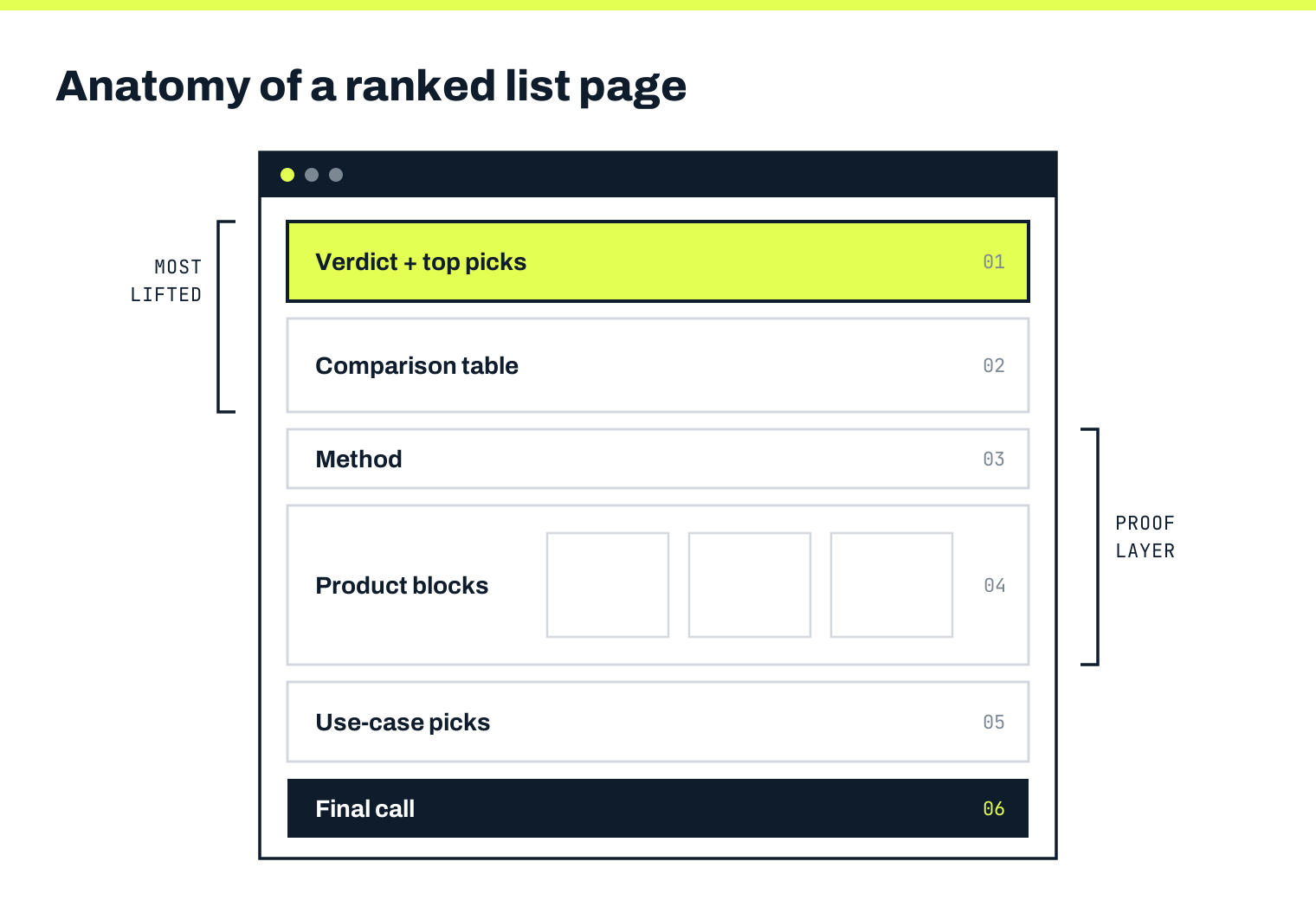
The ideal structure puts the verdict first and the evidence underneath it. Six elements, in this order, cover what both readers and AI systems look for.
Essential Page Elements
- Quick answer. The verdict in the first 100 words, followed by a numbered list of picks. Rank them rather than listing them, because a numbered top-N structure is what gets extracted. Name the winner, who it suits and the exception.
- Comparison table. Products as rows, criteria as columns, with real values rather than checkmarks. This block is the most likely to be extracted.
- Evaluation methodology. What was tested, how, over what period and what was excluded. Place it high, because it makes everything below it credible.
- Product summaries. One block per product covering strengths, weaknesses, pricing and the buyer it fits, in the same structure for every product.
- Best for different use cases. “Best for small teams,” “best for enterprise,” “best on a budget.” This section maps directly to how buying prompts get phrased.
- Final recommendation. A stated position, with the conditions under which it changes.
The use-case section deserves extra attention. Buying prompts rarely ask “which is best.” They ask “which is best for a 12-person agency running client retainers,” and a page organized around use cases answers the prompt as written.
Which Mistakes Prevent AI Recommendations?
Thin affiliate content, self-ranking, missing criteria, unsupported rankings and outdated pricing keep a page out of AI answers. Four of them make a page easy to ignore. The newest one makes a page a target, and that difference matters, because being ignored costs a citation while being targeted can cost the site its visibility.
Thin Affiliate Content
Feature lists rewritten from vendor pages, universal praise and affiliate links add no original information. Retrieval has no reason to prefer the page over the vendor site it copied.
Self-Ranking the Publisher’s Own Product
Publishing a “best X” list that places the publisher’s own product at #1 is now risky. After the December 2025 core update, sites running self-serving ranked listicles at scale saw sharp visibility drops, concentrated in blog and comparison sections.
The line is simple. Honest comparison content that names real competitors and gives each a genuine downside is safe, even when the publisher is one of the options. Ranking itself first in its own roundup is not. Earning a place inside a credible third party’s “best X” list compounds; manufacturing one does not.
Missing Evaluation Criteria
A ranking with no stated basis is an opinion in a table. Readers cannot check it, and neither can a retrieval system. Criteria come first and verdicts second, and that order is what makes the page credible.
Unsupported Rankings
“We recommend X” with nothing behind it fails both readers and AI systems. Every position in the ranking needs a reason tied to a criterion and evidence tied to the reason. A ranking that cannot answer “how do you know?” will not earn a citation either.
Outdated Comparisons
Pricing changes, features ship and products get acquired. A comparison with 2024 pricing is not stale content; it is wrong content, and being wrong on a buying page costs more than being absent. Set a verification schedule and publish the date of the last check.
How Does Comparison Content Fit Into an SEO and AEO Strategy?
Comparison pages are the middle layer of a search strategy, taking readers from informational pages and passing buyers to transactional ones. A single page does not earn citations on its own; it earns them through what links to it, what it links to and where else the brand appears. Most teams skip this part because it is not writing, and it explains why their best comparison page still loses to a weaker one on a stronger site.
Connect Informational and Commercial Content
Informational content stopped being a traffic engine and became a routing layer. A “what is CRM” page will keep losing clicks to the AI Overview, but it can still hand the readers it does get to “best CRM software,” which hands them to “HubSpot pricing.” Each page serves the next question.
Earn Placement in Third-Party Lists
A brand’s own comparison is half the play. The other half is appearing inside credible third-party roundups, which carry citation weight a brand cannot manufacture on its own domain.
Three things earn that placement: original data or testing that a roundup author wants to cite, direct outreach to publications already ranking for the buying prompts, and a real fit with the category being pitched. A pitch to a list the brand does not belong on fails before anyone reads it.
Strengthen the Content Cluster
Comparison pages sit in the middle of the content cluster and carry the most weight. They receive links from informational pages above and send links to product and pricing pages below. Depth on one commercial topic (comparisons, alternatives, use cases and pricing) also signals the topical coverage that single pages cannot.
Guide Users Toward Transactional Pages
Every comparison page needs an exit that converts. Link to pricing from the pricing row, to the demo from the verdict and to the migration guide from the section about switching. Place each link where the question arises, not in a block at the bottom.
Measure Performance Beyond Rankings
Four numbers show how a comparison page performs:
- Conversions and assisted conversions, not sessions
- Citation rate on buying prompts across AI Overviews, AI Mode, ChatGPT and Perplexity, tracked through citation visibility reporting
- Branded search growth, which citations produce even without clicks
- Click-through from the comparison to transactional pages
Citation is not a vanity metric for this format. It is distribution.
Internal Linking Strategy for Comparison Pages
Four rules keep the cluster connected:
- Descriptive anchors. “HubSpot vs Salesforce comparison,” not “read more.” The anchor tells readers and retrieval systems what sits on the other side.
- Informational pages link up to commercial pages. Every definition page routes to the comparison that serves the next question.
- Comparison pages link down to transactional pages. Pricing, demo, signup and migration.
- Comparison pages link across to each other. “Best X” links to “X vs Y,” which links to “X alternatives.” That lateral web is the cluster.
A CRM cluster shows how the three layers connect:

Informational pages absorb the AI losses and route what survives. Commercial pages earn the citations and carry the buying prompts, and transactional pages close. Budget follows that order in reverse, with the most investment in the bottom two layers and the least at the top.
FAQ
1. What is comparison content in SEO?
Comparison content evaluates two or more products against stated criteria and reaches a verdict. It covers “X vs Y” pages, “best X” roundups and “X alternatives” pages, all aimed at buyers choosing between options.
2. Should comparison pages or product pages be created first?
Product and pricing pages come first, because comparison pages need somewhere to send buyers. Comparisons come next and informational content last, the reverse of how most content plans get built.
3. How often should comparison and “best X” content be updated?
Quarterly at minimum, and immediately when pricing or major features change. Publish the last-verified date so readers and retrieval systems can both see it.
4. How many products should a “best X” list include?
Enough to cover the main buyer segments, usually 5 to 10. Every product on the list should be tested, because one untested entry weakens the credibility of the whole ranking.
Conclusion
Comparison and “best X” content is the strongest investment for commercial intent, because it sits where the click survived and the decision still happens. Traditional search rewards it because buyers search this way and convert here. AI search rewards it because a tested comparison contains judgments no model can generate.
The requirements are the same for both systems. State the framework before the verdict, test what the page claims, name the losers and keep pricing current with a visible verification date. Done well, one page serves SEO and AEO at the same time.