Entity Optimization: Build a Strong AI-Ready Brand in 2026
Search engines and AI assistants are changing how they understand information. Instead of relying only on keywords, they increasingly identify entities; people, organizations, products,…
Search engines and AI assistants are changing how they understand information. Instead of relying only on keywords, they increasingly identify entities; people, organizations, products, places, and concepts and the relationships between them. This shift means that simply mentioning your brand name across the web is no longer enough. AI also looks for clear, consistent signals that confirm who you are, what you do, and how you’re connected to other trusted sources.
This is where entity optimization comes in. It helps search engines and AI systems recognize your brand as a distinct, trustworthy entity by connecting information from your website, structured data, authoritative mentions, and official profiles.
Modern AI search systems don’t simply retrieve pages containing matching keywords. They attempt to identify real-world entities and understand relationships between them. This helps AI answer questions using connected knowledge rather than isolated web pages.
In this guide, you’ll learn what entities are, entity optimization matter for AI search, and practical ways to strengthen your brand’s entity signals with entity optimization so AI-powered platforms can understand and reference your business more accurately.
What Is an Entity?
An entity is a unique, identifiable thing that AI and search engines can recognize, such as a person, company, product, place, or concept. Unlike keywords, entities have a clear identity and context, making them easier for AI to understand.
Example: The keyword “Apple” could mean the fruit or Apple Inc. AI uses surrounding context – such as “iPhone” or “iOS” to identify the correct entity.
Keyword vs. Entity
| Keyword | Entity |
|---|---|
| A word or phrase used in search | A uniquely identifiable person, company, product, place, or concept |
| Can have multiple meanings | Has one clear identity and context |
| Example: Apple | Example: Apple Inc. |
Why Entity Optimization Matters for AI Search
Entity Optimization helps AI-powered search go beyond matching keywords by helping it identify entities and understand how they relate to other information. Strong entity signals help AI recognize your brand accurately, making it more likely to appear in AI-generated answers and search results.
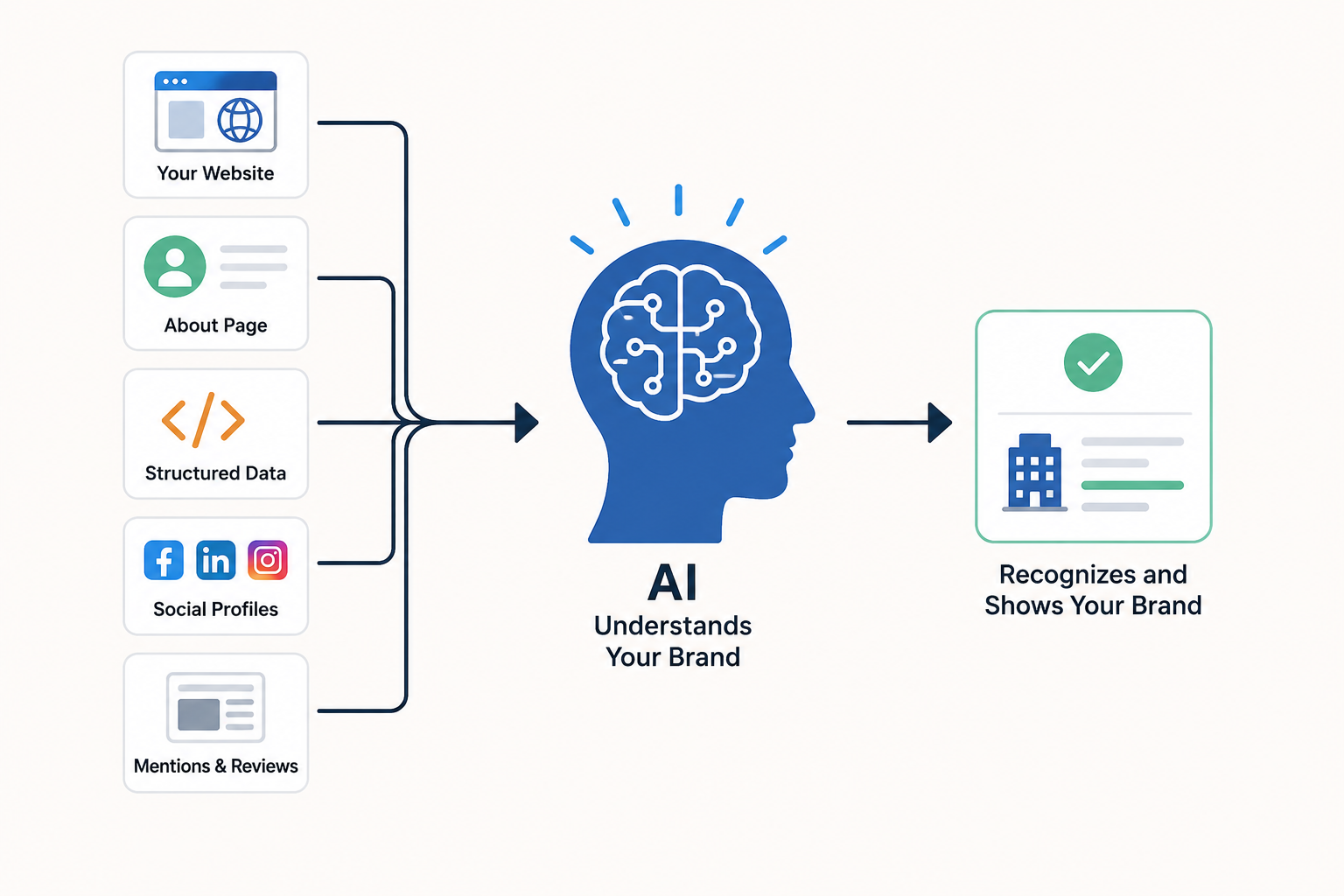
How AI Understands Brands
AI connects these signals into an entity graph, linking your website, Organization schema, authors, official profiles, and trusted mentions into a single identifiable entity instead of treating them as unrelated pieces of information.
How AI Disambiguates Brands with Similar Names
Consistent signals such as your brand name, logo, website URL, business details, and Organization schema help AI distinguish your business from others with similar names.
When these details remain consistent across your website and trusted third-party sources, AI can disambiguate your brand with greater confidence
How Strong Entity Signals Help Your Brand
Clear entity signals improve AI’s confidence in your brand’s identity. This can lead to more accurate brand recognition, better visibility in AI-powered search experiences, and fewer chances of being confused with another business.
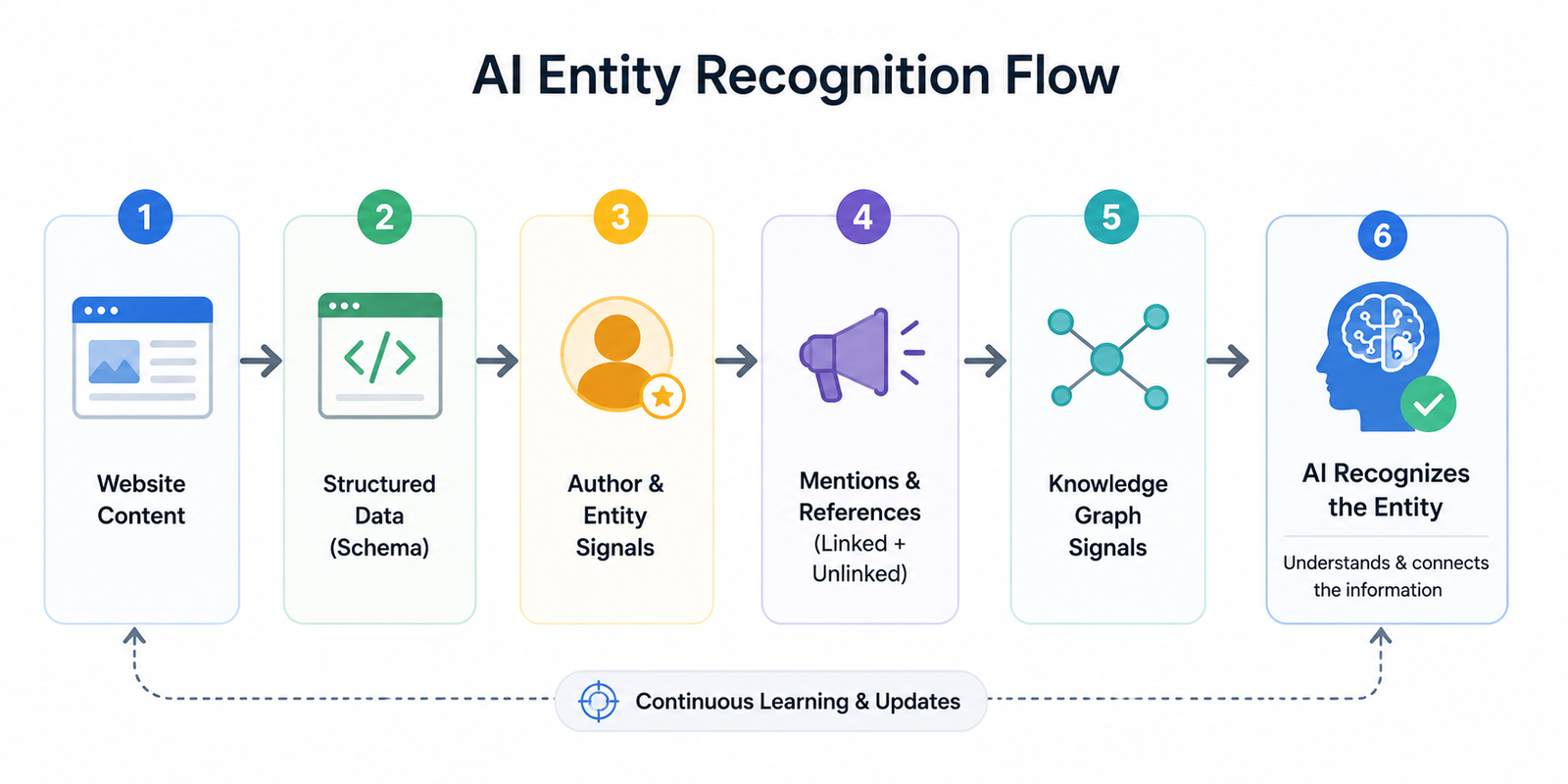
Practical Ways to Improve Your Brand’s Entity Signals
Create an Entity Home: Your About Page
Your About page should be the central source of information about your brand. Clearly explain who you are, what your business does, your expertise, products or services, leadership, contact information, and links to your official profiles. A well-structured About page gives AI systems a reliable source for understanding your brand.
A strong About page should include:
- Brand name
- Business overview
- Mission and expertise
- Founders or leadership
- Products or services
- Contact information
- Official social profiles
Use Organization and Author Schema
Add Organization and Author schema to help AI understand your business and the people behind your content. Using a unique @id together with sameAs links creates an entity graph that connects your website with trusted external profiles, making it easier for AI systems to recognize the same organization across multiple sources.
Example :
{
“@context”: “https://schema.org”,
“@type”: “Organization”,
“@id”: “https://www.example.com/#organization”,
“name”: “Example Company”,
“url”: “https://www.example.com”,
“sameAs”: [
“https://www.linkedin.com/company/example”,
“https://twitter.com/example” ]
}
Build Author Profile Pages
Create dedicated author pages that include the author’s name, job title, biography, experience, areas of expertise, published articles, and official profiles. This strengthens both E-E-A-T signals and author entity recognition.
Keep Brand Information Consistent Across the Web
Use the same brand name, logo, website URL, contact information, and business details across your website, business directories, and social profiles. Consistent information helps AI distinguish your brand from businesses with similar names.
Build Content Around Your Brand and Its Attributes
Build content that reinforces your brand’s expertise instead of only targeting keywords. Publish resources such as product pages, service pages, case studies, founder interviews, original research, industry insights, and company updates to strengthen your entity signals.
Earn Mentions on Trusted Site
Gain mentions from reputable websites, news outlets, industry publications, and communities. Even unlinked brand mentions can strengthen your brand’s online identity when they come from trusted sources.
Should Your Brand Be Listed on Wikidata or Wikipedia?
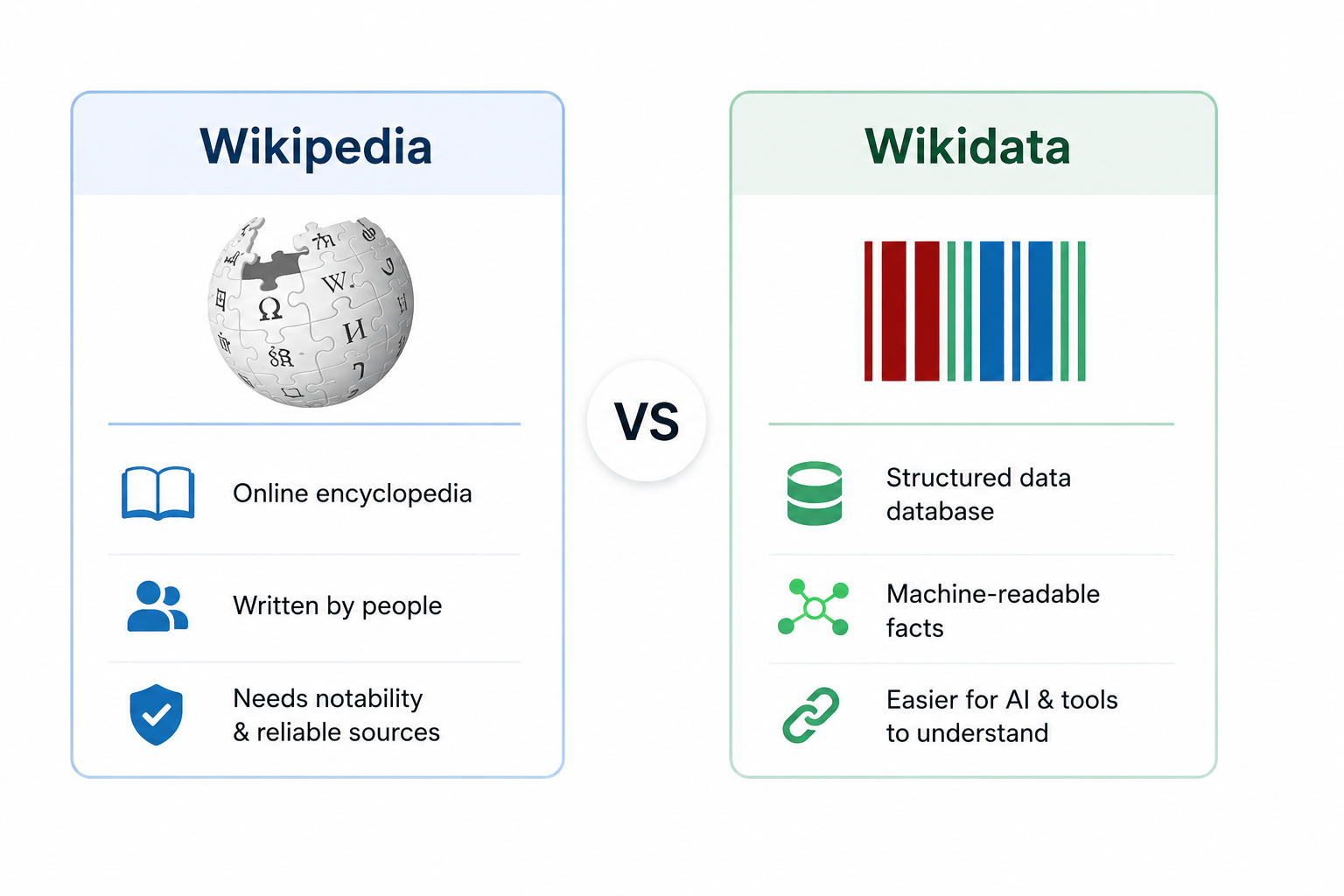
Not every brand needs a Wikipedia page, and you can’t create one simply for SEO. Wikipedia has strict notability and sourcing requirements, so only brands with significant independent coverage are likely to qualify.
Wikidata, is a structured knowledge base that stores factual information about entities. If your brand meets its inclusion guidelines and can be supported with reliable sources, a Wikidata entry can help make your brand’s information more structured and easier for AI systems to interpret.
The goal isn’t to get listed on either platform; it’s to build a well-defined brand entity with accurate, consistent information across the web.
“Wikipedia asks whether your brand is notable. Wikidata asks whether your brand can be “described using serious and publicly available references.” One is a wall. One is a door. Most brands only try the wall.” — Wikidata:Notability
How to Measure Your Brand’s Entity Presence
Since entity optimization primarily improves AI understanding rather than directly increasing citations, focus on measuring entity recognition instead of citation counts. Look for improvements in Knowledge Panel eligibility, structured data validation, brand consistency, and how accurately AI systems identify your business.
Check for a Knowledge Panel
Search for your brand name on Google. A Knowledge Panel indicates that Google has recognized your brand as an entity, though not every entity receives one.
Query the Knowledge Graph API for Your Brand
Use Google’s Knowledge Graph Search API to see whether your brand appears in its publicly accessible knowledge graph. While it’s not a complete view of Google’s internal Knowledge Graph, it can provide useful signals about entity recognition.
Ask the AI Platforms Directly
Ask AI tools like ChatGPT, Gemini, Claude, or Perplexity about your brand. Check whether they correctly identify your business and provide accurate, consistent information.
Audit Your Brand SERP
Review the search results for your brand name. Look for consistent branding, accurate business information, trusted mentions, official profiles, and any confusion with similarly named brands.
Common Entity Optimization Mistakes
- Inconsistent Brand Data Across Profiles: Keep your brand name, logo, website, and business details consistent across all platforms.
- A Thin or Missing About Page: Create a detailed About page that clearly explains your brand, expertise, and services.
- Schema That Contradicts Visible Content: Ensure your structured data matches the information users see on the page.
- Chasing a Knowledge Panel as the Goal: Focus on building strong entity signals instead of trying to get a Knowledge Panel.
- Treating Entity Work as a One-Time Project: Regularly update your brand information, schema, and online profiles to keep entity signals accurate.
FAQs
- How long does entity optimization take to show results?
Entity optimization is a long-term process. Depending on your brand and online presence, it may take weeks or months to see noticeable improvements.
- Can I get a Knowledge Panel for my brand?
No. You cannot request a Knowledge Panel directly. It appears when search engines have enough trusted information to recognize your brand as an entity.
- Does my brand need a Wikipedia page to be recognized by AI?
No. A consistent website, structured data, trusted mentions, and official profiles are often enough to build strong entity signals.
- What if another company has the same brand name as mine?
Use consistent branding, Organization schema, official profiles, and clear business details to help AI distinguish your brand.
- Do unlinked brand mentions count?
Yes. Mentions on trusted websites can strengthen your brand’s entity signals, even if they do not include a backlink.
- Is entity optimization the same as schema markup?
No. Schema markup is one part of entity optimization. Entity optimization also includes consistent branding, trusted mentions, author signals, and clear brand information.
Final Thoughts
Entity optimization helps AI systems understand who your brand is, what it does, and how it connects to other trusted entities across the web.
While it does not directly guarantee AI citations, it improves machine understanding, reduces ambiguity, and strengthens the signals AI uses to recognize your business.
Combined with high-quality content, technical SEO, and authoritative mentions, entity optimization creates a stronger foundation for long-term visibility in AI-powered search.

Shanya
Hi, I'm Shanya, an SEO and content writer at RankingBite. I specialize in creating SEO-focused content around search, AI, cybersecurity, and digital marketing. I enjoy turning complex topics into clear, useful content that helps brands build visibility, connect with their audience, and grow their digital presence.