How to Choose an AI Search Agency for Your Healthcare Brand
Choosing an AI-search agency for a healthcare brand requires more than comparing prices, content packages, or ranking promises. Evaluate clinical governance, entity management, citation…
Choosing an AI-search agency for a healthcare brand requires more than comparing prices, content packages, or ranking promises. Evaluate clinical governance, entity management, citation tracking, technical SEO, third-party visibility, privacy practices, and asset ownership before signing a contract.
Look for an agency with a documented clinical review process, healthcare experience, transparent AI citation reporting, and realistic expectations around AI recommendations.
Why Hiring for Healthcare AI Visibility Is Different
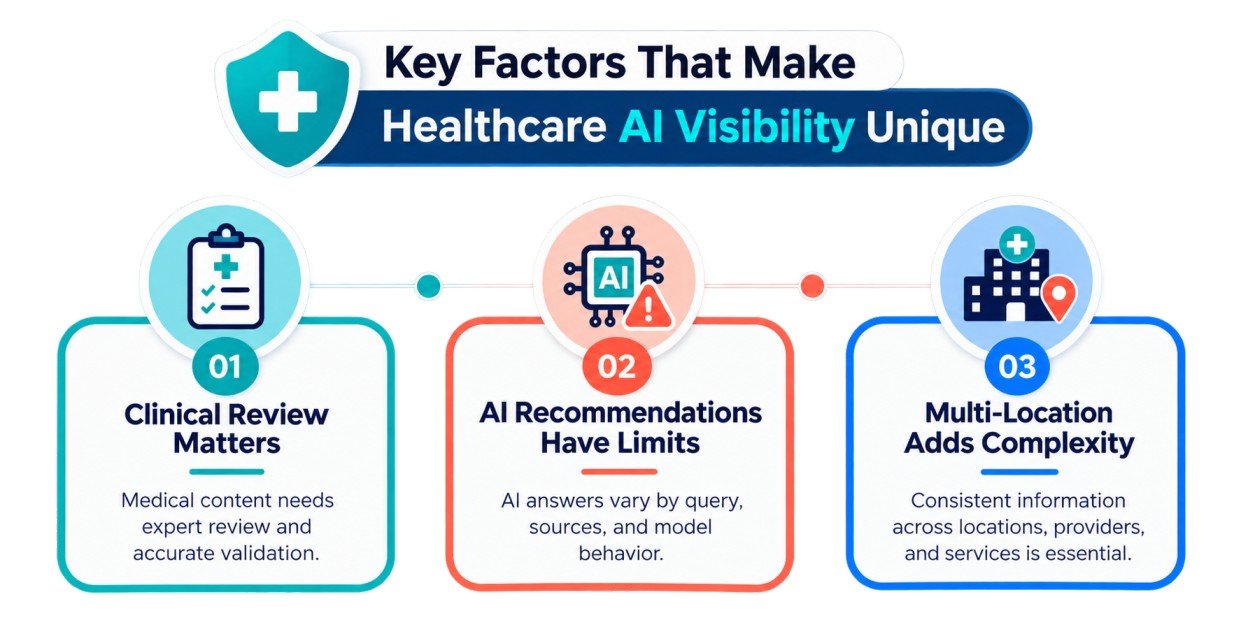
Healthcare AI search requires more oversight than general AI-search work. Medical content needs appropriate review, patient information needs careful handling, and AI-generated answers do not follow a predictable recommendation formula.
An agency without healthcare experience might focus on traffic, rankings, or content volume while overlooking clinical accuracy and provider information.
Three areas deserve particular attention.
Clinical Review Cannot Be Skipped
Healthcare content often includes medical claims, treatment information, and provider guidance. Your agency should have a clear process for clinical review before publication.
Ask:
- Who reviews medical content?
- What credentials does the reviewer have?
- When does clinical review happen?
- Who approves changes?
- How are corrections handled?
A fixed publishing schedule should never take priority over appropriate clinical review.
AI Recommendations Are Not Guaranteed
No agency controls the output of ChatGPT, Perplexity, Gemini, or other AI platforms.
AI answers depend on the query, available sources, retrieval systems, model behavior, and other factors. An agency promising guaranteed recommendations or rankings is setting an expectation it does not control.
A stronger agency focuses on improving the information and sources available to AI systems, then measures whether your brand appears accurately.
Multi-Location Brands Create More Complexity
A single clinic with one location has fewer entity-management challenges than a healthcare group operating across multiple cities.
Multi-location organizations need consistent information for:
- Organization name
- Locations
- Providers
- Specialties
- Services
- Addresses
- Affiliations
- Credentials
Your agency should understand how these entities relate to each other and how conflicting information across the web is handled.
What a Healthcare AI-Search Agency Should Actually Do
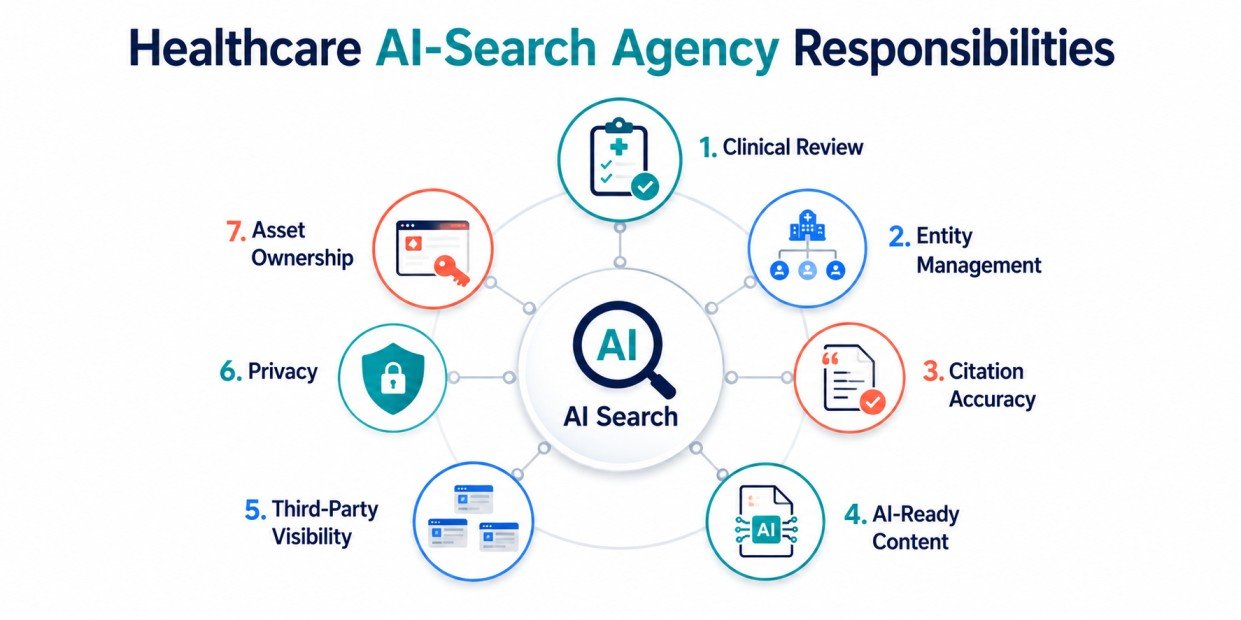
Before hiring an agency, evaluate these areas.
Clinical Authorship and Review Governance
Look for named, qualified authors and a documented medical review process.
The agency should explain:
- Who writes the content
- Who reviews medical claims
- How revisions are approved
- How outdated medical information is updated
Ask:
“Who has final approval before healthcare content is published?”
Entity Management
Look for:
- Consistent organization information
- Accurate provider profiles
- Location management
- Appropriate structured data
- Clear provider-to-organization relationships
- Resolution of duplicate or conflicting information
Ask:
“How do you handle entity conflicts when the same provider or organization appears across multiple websites?”
Citation and Description Accuracy
Do not measure AI visibility through traffic or rankings alone.
Your reporting should track whether AI systems:
- Mention your brand
- Cite your website
- Cite relevant external profiles
- Describe your services correctly
- Identify your providers correctly
- Associate your organization with the correct locations
- Mention competitors instead of your brand
Ask:
“Show me an example of how you track citation accuracy for a healthcare client.”
Content for AI Retrieval
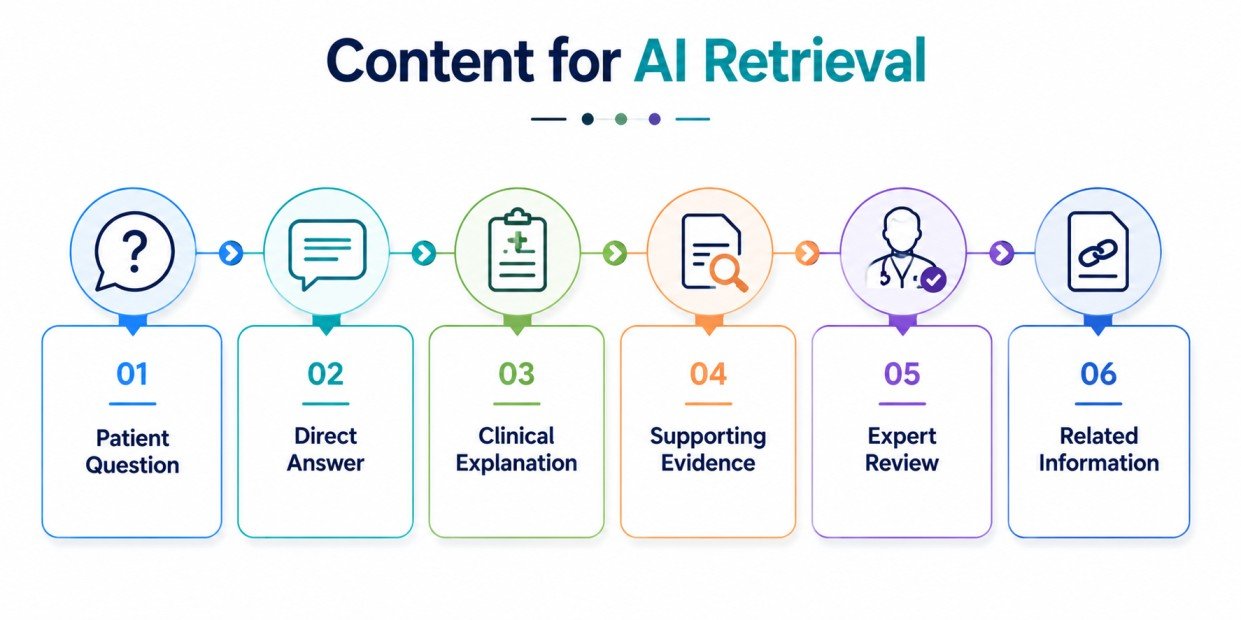
Healthcare content should answer specific patient questions clearly.
A useful structure is:
Patient question → Direct answer → Clinical explanation → Supporting evidence → Expert review → Related information
The goal is to make important information clear, well-structured, and easy to verify.
Third-Party Visibility
Your website is one source AI systems might retrieve.
Ask whether the agency evaluates relevant:
- Healthcare directories
- Medical organizations
- Professional associations
- Academic sources
- Healthcare publications
- Provider profiles
- Reputable third-party websites
The agency should explain why each source matters for your target queries instead of promising a large number of generic placements.
Privacy and Data Handling
Healthcare agencies should have a clear process for information used in AI visibility monitoring.
Ask:
- What data enters your reporting system?
- Is patient information collected?
- Where is the data stored?
- Who has access?
- What happens to the data after the contract ends?
Your measurement process should avoid unnecessary patient information.
Asset Ownership
You should retain control over your digital assets.
Confirm ownership of:
- Website
- Domain
- Content
- Analytics accounts
- Search Console
- Business profiles
- Structured data
- Tracking data
- AI visibility reports
Ask:
“What happens to our content, accounts, tracking setup, and schema if we end the contract?”
Get the answer in writing.
Questions to Ask Before Hiring
Ask these during the first call:
- How do you measure AI citation visibility?
- Which AI search platforms do you monitor?
- Who reviews our clinical content?
- What credentials does the clinical reviewer have?
- How do you manage healthcare entities across multiple locations?
- How do you identify inaccurate provider information?
- Do you have a redacted citation report from a healthcare client?
- How do you handle patient privacy during AI visibility monitoring?
- Do you guarantee recommendations or rankings?
- What happens to our website, content, schema, and accounts if we stop working with you?
- Which third-party sources do you target, and why?
- How often will we receive AI visibility reports?
The quality of the answers matters more than the number of services listed in the proposal.
Red Flags to Avoid
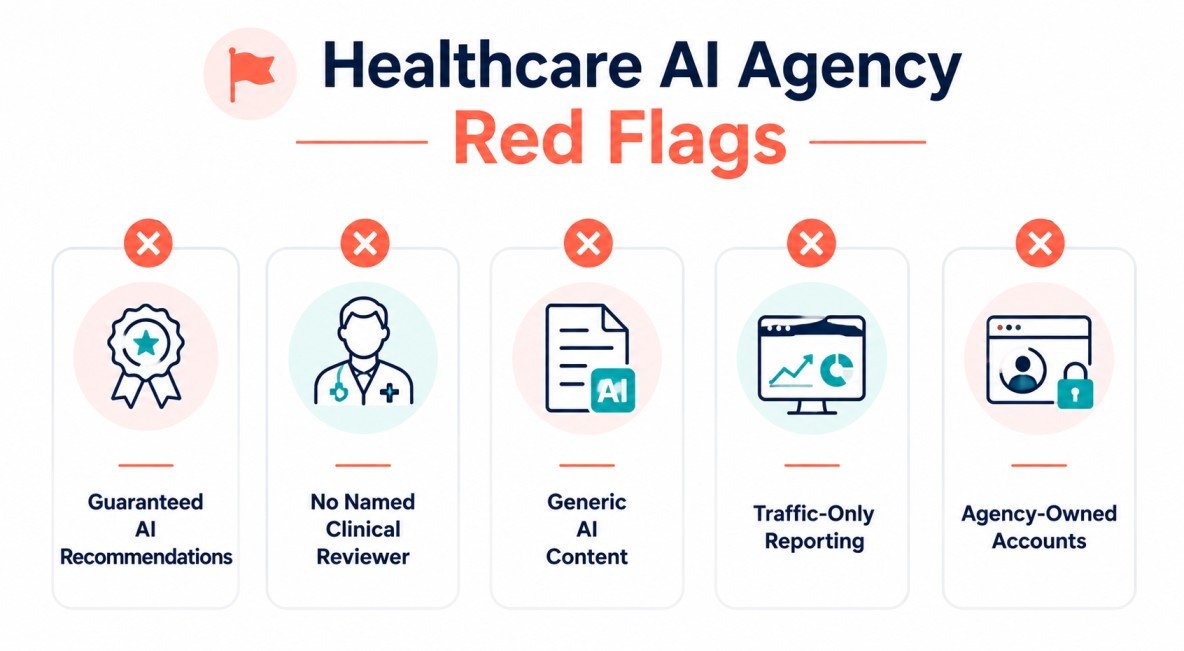
Guaranteed AI Recommendations
No agency controls whether ChatGPT, Perplexity, or another AI system recommends a specific healthcare provider.
Treat guaranteed recommendation claims as a serious red flag.
No Named Clinical Reviewer
If an agency publishes healthcare content without identifying who reviews medical claims, ask for its clinical governance process before moving forward.
Generic AI Content Without Clinical Review
AI-assisted writing still needs appropriate healthcare review. Content volume should not replace clinical oversight.
Reporting Only Traffic and Rankings
Traffic and rankings remain useful SEO metrics, but they do not show whether AI systems mention or accurately describe your organization.
Your reporting should include AI visibility and citation metrics alongside traditional SEO metrics.
Agency-Owned Domains or Accounts
Avoid arrangements where the agency owns critical assets needed for your ongoing marketing.
Your organization should retain access and ownership during and after the engagement.
How to Compare AI-Search Agencies
Use the same criteria for every agency you evaluate.
| Factor | What to Look For | Score |
|---|---|---|
| Clinical governance | Named reviewer and documented approval process | /10 |
| Healthcare experience | Relevant healthcare clients and proven workflows | /10 |
| Entity management | Provider, location, specialty, and organization management | /10 |
| AI measurement | Citation, mention, and description-accuracy tracking | /10 |
| Content structure | Clear, focused, clinically reviewed content | /10 |
| Third-party visibility | Relevant directories and authoritative sources | /10 |
| Technical SEO | Crawlability, indexability, internal linking, structured data | /10 |
| Privacy | Clear data-handling and monitoring process | /10 |
| Reporting | Transparent and actionable reporting | /10 |
| Ownership | Your organization retains website, content, and account ownership | /10 |
Score every agency using the same criteria. A high content score should not compensate for poor clinical governance or unclear ownership.
How to Score Agencies Before Hiring
Give each agency a score from 1 to 10 for every category above.
Total score = Sum of all category scores
For example:
- Clinical governance: 9/10
- Healthcare experience: 8/10
- Entity management: 9/10
- AI measurement: 8/10
- Content: 9/10
- Third-party visibility: 7/10
- Technical SEO: 8/10
- Privacy: 9/10
- Reporting: 8/10
- Ownership: 10/10
Total: 85/100
Use the same scoring method for every agency on your shortlist. This gives you a consistent basis for comparing proposals, processes, and capabilities.
What Results Should You Expect?
Healthcare AI-search work involves several types of changes, and they follow different timelines.
Technical fixes, content updates, authorship improvements, and profile corrections follow different timelines from third-party editorial coverage and broader brand references.
A realistic agency should explain which outcomes it expects to influence directly and which depend on external platforms.
Useful outcomes to monitor include:
- More accurate brand descriptions
- More accurate provider information
- Increased citation frequency
- Increased visibility for priority questions
- Improved coverage across target AI platforms
- Fewer outdated or incorrect mentions
- Stronger visibility for specific specialties or locations
Being recommended by name is a possible outcome, but it should not be treated as a guaranteed deliverable.
Frequently Asked Questions
- Can an agency guarantee that we’ll be recommended by ChatGPT?
No. AI-generated answers depend on the query, retrieval process, and model behavior, none of which any agency controls. - How long does healthcare AI-search work take?
It varies by task. Technical fixes move faster than third-party editorial placements. - Does healthcare AI-search replace traditional SEO?
No. It works alongside traditional SEO, not instead of it. - What is the most important question to ask an agency?
“Who reviews our healthcare content before publication, and what does that process look like?” - Should I choose an agency based on its promised AI citation numbers?
No. Ask how those numbers are calculated before trusting them.
Making the Decision
There is no single best AI-search agency for every healthcare organization.
Choose based on your specific requirements.
If clinical review capacity is your main constraint, prioritize strong governance.
If you operate across multiple locations, prioritize entity management.
If you already perform well in traditional search but rarely appear in AI answers, prioritize citation measurement, content structure, and source visibility.
If provider information is frequently outdated online, prioritize profile and entity management.
Whichever agency you choose, evaluate it using the same framework. Compare its processes, healthcare expertise, measurement methods, reporting, privacy practices, and ownership terms before making your decision.
The right agency should give you a clear process, measurable objectives, realistic expectations, and ownership of the assets your healthcare brand depends on.

Farhan khan
Farhan is an SEO writer covering content strategy, search visibility, and brand discovery across search engines and AI platforms.