SEO is not dead. The optimization target split.
For twenty years there was one target: rank in a list, earn a click. In 2026 that target became two. You now optimize to be retrieved, pulled out of the index by a model assembling an answer, and to be cited inside that answer. Ranking is still how retrieval happens. It just stopped being where the story ends.
This is why the “SEO is dead” headlines misread their own evidence. The traffic didn’t evaporate; it reallocated, moving away from top-funnel summaries, toward deeper questions, branded search, and citations that build demand without a click.. Google confirmed the mechanics in its May 15, 2026 Search Central guide: AI Overviews and AI Mode run on Google’s core ranking and quality systems, and there is no separate AI index. Not retrieved means not cited. Your SEO work is the input to both targets.
This article covers what changed, how AEO and GEO fit, what still works, what’s finished, and a workflow for both targets. Where a topic deserves its own treatment, we link out.
What Has Changed in SEO in 2026?
Not the ranking layer. Everything above it. Google still ranks pages using the same core systems, but a summary now sits between the ranking and the reader, and the reader often stops there. That single insertion is what reshaped the funnel, the metrics, and the definition of a win.
Search Engines Have Become Answer Engines
Search engines find documents; answer engines produce answers. Google does both from one index via two mechanisms:
- RAG (grounding): the model pulls live pages from the Search index and summarizes them with citations, not from training data.
- Query fan-out: one question expands into many sub-queries, so a deep page surfaces for questions you never explicitly targeted.
Both point the same way: depth and indexation beat exact-match targeting. And because answers are stitched from several sources, being one of five citations is a more achievable goal than being #1, a wider door, not a narrower one.
Google AI Overviews and AI Mode
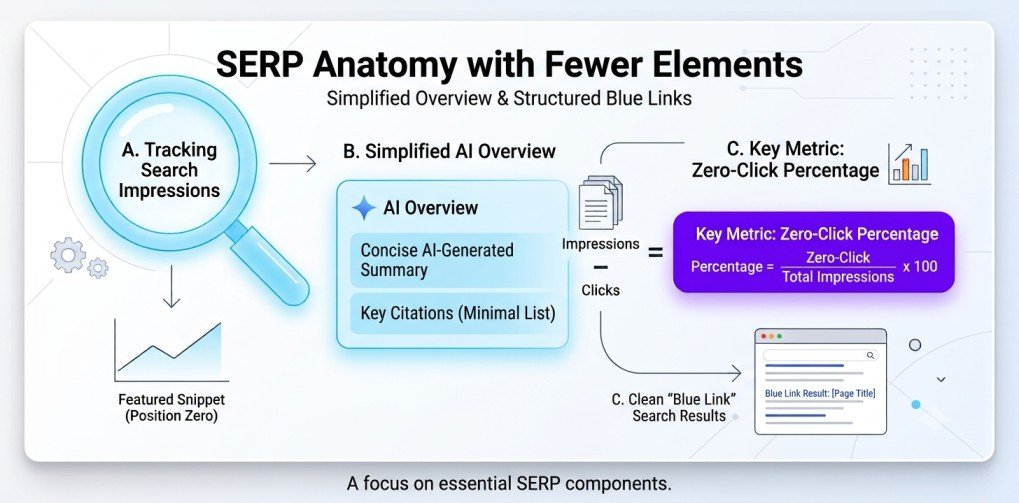
Two surfaces, two different games.
AI Overviews sit above the blue links, which still exist below. They trigger heavily on informational queries and rarely on transactional ones. 2026 benchmarks put e-commerce trigger rates in low single digits, while B2B tech and health run far higher. Translation: your money pages are largely untouched.
AI Mode replaces the SERP with a Gemini conversation. No links below: cited or invisible. Overlap between the two is low. 2026 analyses found only a small share of AI Mode URLs also appear in AI Overview citations. Winning one doesn’t win the other.
ChatGPT and Perplexity form a third layer with their own retrieval logic. Google’s guidance binds Google only.
How User Search Behavior Has Changed
Three shifts, each with a note on where the value went.
- Queries got longer and conversational. Short-tail lists cover less of reality; long-tail and question intent is now where the volume lives.
- Top-funnel clicks moved. Pew measured a ~47% relative drop in click rate across 68,000 queries when an overview appears; Ahrefs found ~34.5% for position 1 across 300,000 keywords; SparkToro/Datos put zero-click above half of US searches. What those numbers describe is a summary layer absorbing questions that never converted anyway.
- The clicks that survive are better. Whoever clicks after reading a summary already knows the basics. They want depth, proof, price, a decision. Fewer visits, higher intent per visit.
Explained With a Real Example
“How much protein do I need per day.” In 2019: ten links, a click, a bounce. In 2026: the overview gives the 0.8g/kg baseline, notes athletes and older adults, cites five sources, nobody clicks.
Now watch where the value went. “Is 1.6g/kg too much for a beginner lifter over 40” is the follow-up the overview created. Specific, commercial, hard to answer generically, and exactly where a source gets cited and clicked. The overview didn’t destroy the demand. It stripped out the shallow half and handed you the rest, pre-qualified.
How is SEO Different from AEO and GEO?
What is Traditional SEO?
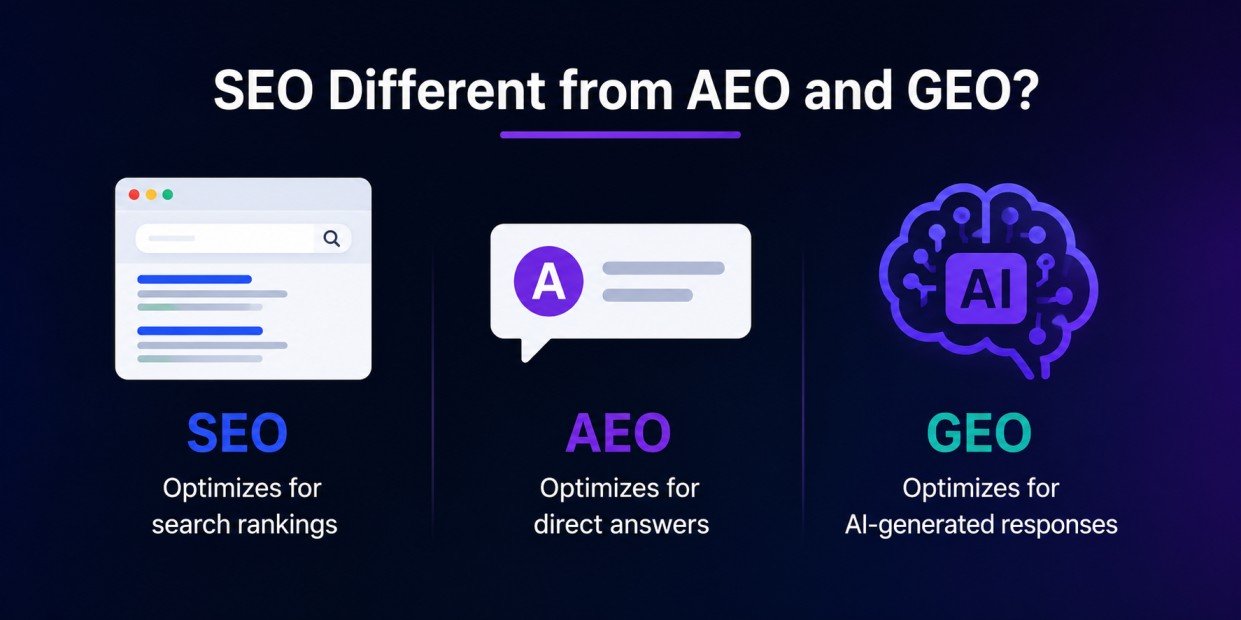
Making a site crawlable, indexable and rankable in a list. Pillars: technical health, relevance, authority. Target: position. Payoff: a click.
What is Answer Engine Optimization (AEO)?
Optimizing to be the answer: direct answers up front, question-shaped headings, self-contained passages a machine can lift cleanly. It grew out of featured snippets and voice search.
What Is Generative Engine Optimization (GEO)?
Optimizing to be cited by generative systems. Its root is a 2023 Princeton / IIT Delhi / Allen AI paper by Aggarwal et al. (KDD 2024) finding that quotable statistics, cited sources and authoritative language raise citation likelihood, not keyword density.
SEO vs AEO vs GEO Comparison
| SEO | AEO | GEO | |
|---|---|---|---|
| Target | Rank in the list | Be the extracted answer | Be a cited source |
| Surface | Blue links | Snippets, Voice, PAA | AI Overviews, AI Mode, ChatGPT |
| Unit | Page | Passage | Claim / Entity |
| Metric | Position, CTR | Snippet ownership | Citation rate, Share of Voice |
| Wins on | Relevance + Authority | Clarity + Structure | Uniqueness + Credibility |
Why Modern SEO Includes All Three
Here’s the part the acronym industry undersells. Google’s 2026 guide is explicit: optimizing for generative AI search is optimizing for the search experience, and thus still SEO. It named tactics to skip: llms.txt, “chunking,” AI-specific markup, and inauthentic mentions. Google later clarified that llms.txt neither helps nor hurts Google Search and is completely fine to keep for other systems that read it. The guide also confirmed that its full spam catalog now applies to AI responses, so gaming AI answers carries ranking-level risk.
Which is the strategic point: an AEO-only shop is selling you a lens as if it were a discipline. The target split is real. The work underneath it isn’t separate. Technical foundation, entity clarity, original content, and authority feed both targets at once, and anyone optimizing only for the citation half is building on someone else’s rankings.
How Google AI Overviews Are Reshaping Rankings
Nothing below is about rankings falling. Every effect in this section happens to pages that still rank exactly where they did last year, which is precisely what makes the pattern so easy to misread as a penalty.
Zero-Click Search
Not new. The scope is. Zero-click now exceeds half of US Google searches, concentrated on informational intent. Navigational and transactional queries stay largely intact, which is where most revenue already lived.
Changes in Organic Clicks
The signature is impressions flat or up, clicks and CTR down. Not a penalty, just your page ranking while the answer is consumed above it. SISTRIX (March 2026) showed position-one CTR on AI-feature queries falling from ~27% to as low as 11%.
But read the second number. Seer Interactive data shows brands cited inside an overview earn meaningfully higher CTR than uncited ones. The pool shrank; citation claims a bigger slice of it. And #1 no longer guarantees inclusion; positions 11–20 get cited when they answer the sub-query better. That’s a ranking system that got more winnable, not less.
Impact on SEO Strategy
Diagnose before you overhaul. Informational clicks falling while branded and transactional hold steady is AI absorption, not a core update hit. Different problem, different fix. Re-segment your keyword portfolio by AI exposure. And stop reporting sessions as your only number, or you’ll book a loss in a year your visibility grew.
What Still Works in SEO in 2026?
Almost all of it. The fundamentals weren’t replaced; they got stricter, and now serve two readers at once: a ranking system and a model hunting extractable claims.
SEO in 2026 Framework
Five layers, each dependent on the one below: (1) technical foundation → (2) trustworthy content → (3) AI search optimization → (4) balance across targets → (5) measurement beyond rankings.
Build a Strong Technical Foundation
Not retrieved means not cited, so this layer is load-bearing for both targets. Non-negotiable: crawlable, server-rendered content; clean IA and internal linking; fast, stable pages; structured data (Google says schema isn’t required for AI features but is still a good idea); clean DOM and accessibility semantics, increasingly read by AI agents.
Create Helpful, Trustworthy Content
Google’s guide leans on one phrase: non-commodity content. The test: if a model could generate this paragraph without reading my page, why cite my page?
Commodity content summarizes the internet and has zero citation value. Non-commodity content carries what only you have: original data, first-hand experience, a real point of view, named expertise. “In our 2026 audit of 400 sites, 61% failed X” is citable. “X is important for SEO” is not.
Optimize for AI Search Experiences
Habits, not hacks: a direct answer within the first ~100 words of each section; question-shaped H2s; quotable specifics instead of adjectives; tables and step lists where genuinely warranted; one deep page per task instead of five cannibals; freshness with substance, not date changes.
Balance Traditional SEO and AI Optimization
Query Type
AI Exposure
Play
Informational, Top-Funnel
High
Citation strategy; accept lower CTR; measure brand lift.
Comparison, “Best X for Y”
Medium
Original testing, real differentiation, own the click.
Transactional, Product, Local
Low
Classic SEO + CRO, protected revenue.
Branded, Navigational
Low
Defend it; your AI-era safety net.
Track citation rate per surface, share of voice on priority prompts, branded search volume, AI referral traffic, conversion rate per visit (it should be rising), and GSC segmented by query type.
What No Longer Works in SEO?
Keyword stuffing. Retrieval evaluates meaning. Information density matters; keyword density reads as low quality to the exact models deciding citations.
Thin AI-generated content. Machine summaries competing inside machine summaries is a closed loop commodity by definition. Scaled content abuse policy now covers AI responses, and a demoted site is excluded from the citation pool entirely.
Mass link building. Same risk as ever, less payoff: citation leans on trust and topical authority, not link counts. A few genuine references beat 500 directory links.
Publishing without original experience. The guide written by someone who never did the thing is now worthless, not merely weak. The machine writes it free. E-E-A-T’s “Experience” pillar is the moat.
Which SEO Strategies Matter Most in 2026?
Build brand authority. The most durable asset; branded search is the one query class AI can’t intercept. PR, community and referenced research are SEO work now.
Optimize for entities. Consistent NAP, Organization/Person schema, sameAs links, a real About page, credentialed bylines. A model that can’t resolve who you are won’t stake an answer on you.
Create AI-friendly content. Clear, direct, structured, specific, written for humans. Answer up front, one idea per paragraph, real numbers.
Refresh existing content. The highest-ROI work most teams skip; RAG favors current pages. Per top page: still true, still first, still specific, still differentiated?
Measure AI visibility alongside rankings. Track a 30–50 prompt set monthly. Whoever gets cited instead of you is your content roadmap.
Why Real Brands Still Win in AI Search
A real brand is not a branding exercise. It is a set of facts a machine can verify: one name, real people, corroborating mentions, a physical presence where relevant. Sites that only exist as sites fail every one of those checks, which is the whole advantage.
Entity Clarity Builds Trust
Citing you is a small reputational bet. A brand with one canonical name, defined offerings, identified people and corroborating profiles is a safe bet; one that exists only as a website isn’t. Schema doesn’t create clarity; it makes clarity readable.
Brand Mentions Across the Web
Generative systems ingest text, not just link graphs, so unlinked mentions are a signal in their own right. Press, forums, Reddit and YouTube build corroboration, and both Reddit and YouTube rank among the most-cited domains in AI answers. The caveat Google added: inauthentic mentions are on the ignore list. Manufactured buzz is spam with extra steps.
Local Authority Signals
Google’s guidance names Business Profiles and Merchant Center feeds as direct inputs into AI responses for local and shopping queries, and local intent triggers overviews less often, so it stays click-rich. Consistent citations, real reviews, real photos, real hours. Boring; works.
Market-Scoped URLs with Real Differences
If /uk/, /in/ and /au/ differ only by a currency symbol, you’ve built three commodity pages, and a model answering “best X in India” has no reason to pick a page that says nothing Indian. Market URLs earn their existence through real local pricing and tax, regulation, case studies, support and availability. That’s non-commodity content at the market level.
Hreflang Beyond Translation
Hreflang decides which version to serve; it isn’t a strategy, and eight translations of one page are eight commodity pages. The 2026 version: hreflang for correctness (reciprocal tags, correct codes, self-referencing, valid x-default), localization for relevance (local framing, local competitors, local regulation), and local entity presence (address, reviews, press, partners).
A Step-by-Step SEO Strategy for Traditional Search and AI Search
One workflow, two targets.
- Audit AI exposure. Top 100-200 queries: overview triggered, cited, ranking? Segment GSC to separate AI absorption from an algorithm hit.
- Build a prompt set. The 30-50 questions buyers actually ask; run them across AI Overviews, AI Mode, ChatGPT and Perplexity, and log who’s cited.
- Fix the foundation. Indexation, rendering, IA, internal links, speed, schema.
- Find your non-commodity angle. If a model could write it, don’t publish. Go get something first.
- Restructure for extraction. Answer in 100 words, question headings, specifics, one page per task.
- Build entity and brand signals. Schema, credentials, GBP and Merchant Center, earned mentions.
- Refresh quarterly. Update data, sharpen answers, merge cannibals, cut fluff.
- Protect click-rich surfaces. Transactional, comparison, local, branded. Invest in CRO, since conversion rate now does the work volume used to.
- Measure the full picture, monthly.
- Loop. Re-run steps 1–2 quarterly; the surfaces are still moving.
Frequently Asked Questions
Will traffic return to 2022 levels?
For top-funnel informational content, likely no; that volume is structurally reallocated. The realistic goal is a smaller, higher-intent base plus visibility in AI answers, branded search and direct visits.
How do I know if I’m cited?
Run your prompt set manually and log it, or use AI visibility tools. Search Console shows impressions and clicks, never whether an overview appeared or whether you were inside it.
Should I block AI crawlers?
A business tradeoff, not a moral one. Blocking prevents summarization and removes you from the citation pool, and on Google the AI surfaces share the Search index, so opting out has Search implications most publishers won’t accept.
Optimize separately for ChatGPT and Perplexity?
Separate measurement, not separate content. The underlying wins travel across platforms, but citation behavior differs enough that Google isn’t a reliable proxy.
Does AI-assisted writing hurt rankings?
The method isn’t the issue, the output is. Policies target scaled content abuse, not tools. AI as the source of the insight produces commodity content that fails on merit.
Impressions up, clicks down. Am I penalized?
Almost certainly not; that’s the absorption signature. Check whether the drop is confined to informational queries while branded and transactional hold.
How long until I appear in AI answers?
Nobody should give you a number. Citation patterns stabilized through 2026, favoring sustained topical authority over one-off pushes. Plan in quarters.
Is schema required?
For Google, no, but still recommended, because it clarifies what your page and organization are. Keep schema. llms.txt does nothing for Google’s AI features, though it may still have narrow utility for other AI systems and developer-doc sites.
Conclusion
Search changed shape, not purpose. One target became two, rank and citation, and both are fed by the same index, the same ranking systems, the same quality signals. What made a page worth ranking still makes it worth citing.
What changed: answer engines took the top of the funnel; zero-click became the majority; rank stopped guaranteeing visibility; commodity content lost its last value; original experience and entity clarity became the moat; measurement needs rebuilding around citation, brand and conversion.
What didn’t: technical health, genuine helpfulness, real authority, and knowing your audience better than your competitors do. Google’s own guidance is blunt about it: no separate AI playbook, no magic file, no parser trick. Just SEO, held to a higher standard, aimed at two targets instead of one.
So don’t ask “how do I get into the AI answer?” Ask: if someone who genuinely needed what we offer searched this, would our page be the best answer they could find? Answer yes, consistently, with things only you can say, and the machines will keep quoting you.

Farhan khan
Farhan is an SEO writer covering content strategy, search visibility, and brand discovery across search engines and AI platforms.