
Why You Should Prioritize AI Engines Instead of Tracking Them All

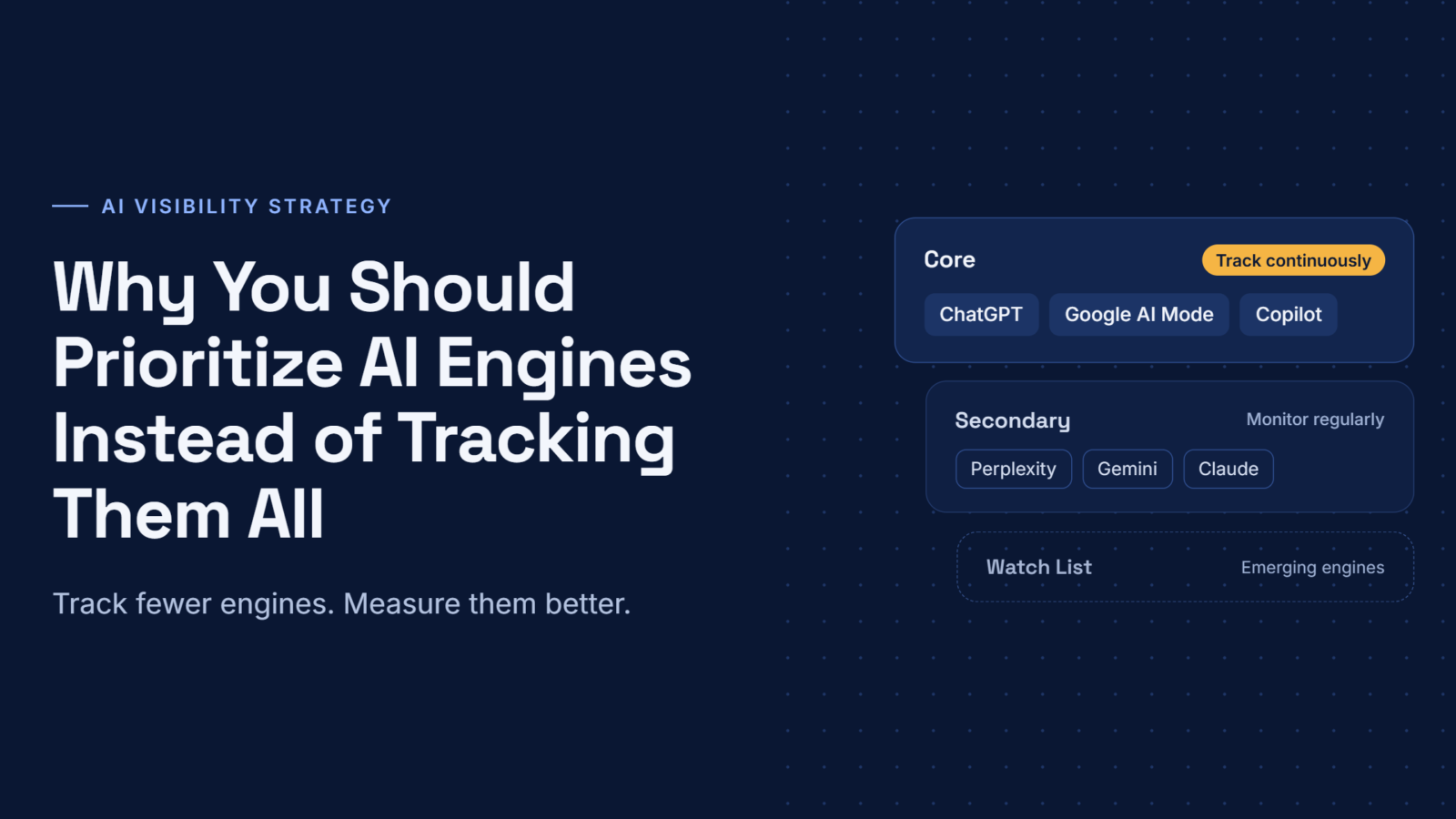
Prioritizing a few AI engines produces more reliable visibility data than tracking every assistant. Each engine has its own audience, retrieval method, and influence on buying decisions. Spreading effort across all of them creates shallow, inconsistent data. Focusing on the engines your customers actually use gives clearer trends and more actionable decisions.
The traffic data makes this a real constraint, not a hypothetical one. A handful of engines sends almost all AI referral traffic. In BrightEdge’s August 2026 data, ChatGPT, Gemini, Perplexity, and Claude together accounted for more than 99% of AI referrals.
ChatGPT’s own share shows how fast that split moves: it fell to a 2026 low of 89.5% in April, then climbed back to 95.1% by August. The engines that matter stay few, but their relative weight changes within months. Your tracking set needs regular review, not a one-time decision.
Is Complete AI Visibility Possible?
No. Complete AI visibility does not exist, so the goal is representative coverage, not exhaustive monitoring. New AI assistants launch regularly, existing platforms update their models, and answers vary between users, prompts, and points in time. Even the largest enterprises cannot monitor every AI-powered surface continuously.
Instead of aiming for perfect coverage, define a tracking set that reflects where your target audience actually searches for information. For many organizations, consistently monitoring four or five high-impact AI engines is far more valuable than covering dozens of platforms sporadically.
The pace of change is why “complete” coverage is a moving target. Claude’s web visits grew roughly 855% year over year, to about 952 million in May 2026. That lifted its share of AI chatbot web visits from 1.6% to about 9%. Over the same period, ChatGPT’s traffic stayed roughly flat while its share fell. The ranking of “engines that matter” can shift within a single reporting year.
How Does Over-Tracking Create Noise Instead of Insights?
Every engine you add multiplies the work of measurement, and low-value engines dilute the metrics that matter. Each additional platform adds prompts to test, responses to review, competitors to compare, and datasets to maintain. When those platforms contribute little traffic or influence for your audience, they add variability without adding insight.
Over-tracking often leads to:
- More time spent collecting data than analyzing it
- Inconsistent reporting across platforms with different behaviors
- Difficulty spotting meaningful trends, because low-priority engines add variability
- Larger reporting dashboards with fewer actionable insights
Most teams gain more from deeper, more consistent measurement on a smaller set of important engines than from monitoring every platform at a superficial level.
Why Is De-Prioritizing an Engine a Strategic Choice?
Choosing not to track an AI engine is a resource-allocation decision, not a decision to ignore AI search. It rests on business goals, audience behavior, and expected return.
The right priorities differ by business. A B2B software company selling to enterprise IT teams may prioritize Microsoft Copilot, because it is built into Microsoft 365 workflows. A publisher targeting researchers may focus on Perplexity. A consumer brand may emphasize ChatGPT and Google AI Mode, because they reach broad, high-intent audiences.
De-prioritizing an engine means its expected business value does not justify continuous monitoring today. Review that decision periodically as AI adoption, customer behavior, and product capabilities evolve. A tracking strategy should grow alongside your business rather than cover every platform from day one.
Which AI Engines Matter for Different Audiences?
The right AI engines to track are the ones where your customers discover information and make decisions, not the ones with the most headlines. Each engine serves different user behaviors. Your tracking priorities should reflect your audience, buying journey, and business goals.
ChatGPT: Broad Consumer Discovery
ChatGPT is the broadest AI discovery platform. Users ask it everything from educational questions and product recommendations to travel planning and software comparisons. It often shapes the awareness and consideration stages.
Its reach is still the largest in the category. ChatGPT has about 900 million weekly active users. According to Similarweb, it accounted for 57% of AI chatbot web visits in August 2026, down from nearly 80% a year earlier.
Include ChatGPT in your core tracking set when you want to measure brand presence in general informational, commercial, and comparison prompts. It is especially relevant for consumer brands, SaaS companies, publishers, and content-led businesses.
Google AI Overviews and AI Mode: High-Intent Search Journeys
Google’s AI surfaces sit inside traditional search, where users often have a clear goal or purchase intent. Typical prompts compare products, find services, research local businesses, or solve a specific problem before a decision.
These surfaces are now a mainstream part of search. Similarweb data shows AI Overviews on about 43% of Google queries, and Google says they reach more than 2.5 billion users a month. AI Mode, the conversational experience users can enter from an Overview, passed 1 billion monthly users in May 2026.
Track AI Overviews and AI Mode when your customers search with commercial or local intent. They matter most for ecommerce, local businesses, and any brand that already depends on Google organic traffic.
Gemini: Google Ecosystem Users
Gemini is the second-largest AI referral source after ChatGPT in most 2026 datasets. In Q1 2026, BrightEdge found Gemini sent more referrals than Perplexity, Claude, Meta AI, DeepSeek, and Grok combined. Its reach comes from integration across Android, Chrome, and Google Workspace.
Track Gemini when your audience works inside Google’s ecosystem or uses Android heavily.
Perplexity: Research-Driven Decision Making
Perplexity attracts users who want detailed, source-backed answers rather than quick summaries. Its audience includes professionals, researchers, students, journalists, and buyers comparing several options.
Its share of AI referral traffic is small and falling. StatCounter data put Perplexity at 7.91% of AI chatbot referrals in June 2026, down to 4.31% by August. Its value lies in who uses it, not how many.
Track Perplexity when your buyers do detailed, multi-source research before deciding, as in B2B technology, professional services, and technical products. For most consumer brands, it belongs in the Secondary tier.
Microsoft Copilot: Enterprise and Workplace Users
Microsoft Copilot is built into Microsoft 365 and Windows, which makes it especially relevant for enterprise employees. Users rely on it for business research, document creation, data analysis, and decision support inside their daily workflows.
That integration is turning into paid adoption. Microsoft 365 Copilot passed 20 million paid seats in fiscal Q3 FY2026 (Jan–Mar 2026), up from 15 million one quarter earlier.
Track Copilot when you sell to enterprise teams, IT buyers, or organizations standardized on Microsoft 365.
Claude: Professional and Technical Users
Claude sends far less referral traffic than ChatGPT, but it is the fastest-growing major assistant, and its visitors convert well. An Exposure Ninja analysis from March 2026 found Claude-referred visitors converted at 16.8%, ahead of ChatGPT at 14.2%.
Track Claude when you sell to developers, technical teams, or knowledge workers.
Key takeaway: You do not need every AI engine in your reporting from day one. Choose the platforms that match your audience’s behavior, monitor them consistently, and add engines only when they become relevant to your customers.
How Do You Decide Which AI Engines Belong in Your Tracking Set?
Choose engines by where your customers research, how much each engine affects business outcomes, and how much your team can measure well. No universal list fits every business. A smaller, consistently monitored set usually gives more reliable insights than broad but inconsistent coverage.
Start with where your customers ask questions
Begin with customer behavior, not AI market share. Ask where your prospects research products, compare vendors, or seek recommendations before deciding. For example:
- Consumer brands often benefit most from ChatGPT and Google AI Mode, which support broad discovery and purchase research.
- B2B technology companies may get more value from ChatGPT, Microsoft Copilot, Perplexity, and Claude, where professionals research solutions.
- Healthcare, finance, and education organizations should consider platforms known for detailed, source-backed answers when their audience values authoritative information.
The goal is to monitor the engines that influence your customers’ decisions, not every platform available.
Prioritize engines by business impact, not popularity
The most talked-about engine is not always the one that matters most for your business. An engine earns a place in your tracking program by influencing awareness, consideration, or purchasing decisions. Evaluate each engine with these questions:
- Does our target audience actively use this platform?
- Does it influence the prompts that matter to our business?
- Can visibility on this engine affect leads, sales, or brand perception?
- Will tracking it help us make better marketing decisions?
When most answers are no, the engine belongs on a watch list, not in core reporting.
This matters because visibility and traffic quality are not the same thing. In a benchmark of 312 B2B technology companies, AI-referred visitors converted at 14.2%, compared with 2.8% for Google organic traffic. Cross-industry studies show a smaller gap, but the direction is consistent. A smaller engine that reaches the right audience can outperform a larger one that does not.
Balance tracking depth against available resources
Every engine you add increases the work of keeping measurement high quality. More platforms mean more prompts to test, more responses to analyze, and more data to validate. For most teams, a focused approach means:
- Defining a core tracking set of the highest-priority engines
- Measuring those engines with a consistent prompt library and reporting cadence
- Reviewing other AI platforms periodically to see whether they have become relevant to your audience
This produces cleaner benchmarks and clearer trends than tracking every engine superficially. As your business and resources grow, you can expand without compromising reporting quality.
When Should You Expand Your AI Engine Coverage?
Expand coverage only when your current program is stable and a new engine will improve decisions. Adding engines too early stretches resources across more platforms than your team can monitor consistently, which lowers data quality. The objective is better decisions, not larger dashboards.
Signs your tracking program has matured
A mature program produces consistent data that stakeholders trust and use. You may be ready to expand when you can:
- Run the same prompt library across your core engines on a regular schedule
- Track Citation Rate, Share of Voice, Citation Position, and Sentiment consistently over time
- Identify meaningful trends instead of reacting to one-off fluctuations
- Explain why visibility changed and what actions to take
When your team is still refining prompts, measurement methods, or reporting cadence, improving the current program will deliver more value than adding a platform.
How to add new engines without sacrificing data quality
Integrate a new engine into your existing process so comparisons stay meaningful:
- Add one AI engine at a time.
- Use the same core prompt set whenever possible.
- Compare results against your existing benchmarks before creating new KPIs.
- Confirm that the new engine provides insights that influence business decisions.
An engine that generates little relevant data or rarely reaches your audience suits periodic monitoring, not continuous reporting.
Review priorities as customer behavior changes
The platforms that matter today may not be the ones that matter next year. Review your priorities regularly with these questions:
- Are our customers using different AI assistants than six months ago?
- Has a new AI engine become important in our industry or region?
- Are we seeing meaningful referral traffic, citations, or brand mentions from new platforms?
- Do our tracking priorities still match our marketing and business goals?
Treat your tracking set as a living framework. Expand coverage when customer behavior changes, and reduce focus when an engine becomes less relevant.
How Do You Build an AI Engine Tracking Strategy That Evolves?
Sort engines into Core, Secondary, and Watch List tiers, then review those tiers on a fixed schedule. This spends resources where they deliver the most business value while staying flexible as platforms and audiences change.
Create a Core, Secondary, and Watch List
| Priority | Purpose | Typical Examples |
|---|---|---|
| Core | Track continuously; these platforms have the greatest impact on your audience and business goals. | ChatGPT, Google AI Mode, Microsoft Copilot |
| Secondary | Monitor regularly with a smaller prompt set or lower reporting frequency. | Perplexity, Gemini, Claude, industry-specific AI assistants |
| Watch List | Observe periodically to spot growing relevance without significant investment. | New or emerging AI search platforms |
These examples are typical starting points. Your own tiers should follow your audience: a B2B software company may put Perplexity or Claude in Core, while a consumer brand may move Copilot to Secondary.
Review and adjust on a regular cadence
Review priorities on a schedule, not only when a new engine launches:
- Monthly: check for significant visibility changes across your core engines.
- Quarterly: decide whether secondary platforms should move into your core set.
- Annually: reassess your entire engine portfolio against business goals, audience behavior, and resources.
Focus on actionable insights instead of maximum coverage
The success of an AI visibility program is not measured by the number of platforms you monitor — it is measured by whether the data improves marketing and business decisions. A focused strategy should answer:
- Which AI engines influence our target customers the most?
- Where is our visibility improving or declining?
- Which competitors are gaining ground on the platforms that matter?
- Which content or optimization efforts will have the greatest impact?
An engine that doesn’t help answer these questions doesn’t belong in your regular reporting.
Frequently Asked Questions
How many AI engines should a business realistically track?
Most teams get the best results from a core set of four or five high-impact engines, monitored consistently. Broad but shallow coverage across every platform produces less reliable data. The right number depends on where your audience actually researches and buys.
Which AI engine should I prioritize first?
Start with the engine your audience uses most for research and purchasing decisions — not the one with the most media attention. Consumer brands often start with ChatGPT and Google AI Mode. B2B and enterprise sellers often get more value from ChatGPT, Copilot, Perplexity, and Claude.
How often should I review my AI engine tracking priorities?
Review monthly for visibility changes in core engines, quarterly to decide whether secondary platforms deserve promotion, and annually for a full portfolio reassessment. The AI landscape shifts fast enough that a fixed tracking list goes stale within a year.
Is it a mistake to ignore smaller AI engines like Perplexity?
Not necessarily. A smaller engine can still deserve dedicated tracking when it reaches a high-value, well-matched audience — for example, research-driven B2B or technical buyers. Prioritize by business impact, not raw traffic volume alone.
What is the risk of trying to track every AI engine at once?
Data quality suffers. Spreading fixed time and resources across too many platforms means shallower prompt sets, less consistent measurement, and noisier trend data. The result is a larger dashboard with fewer actionable insights.