Position zero didn’t disappear. It split into a citation model.For years, winning a featured snippet meant one thing. Your page became the single answer Google pulled above the organic results.Now, AI Overviews, ChatGPT, and Perplexity pull from several sources at once. The old prize slot works differently now.
Understanding that shift matters more than mourning the old one. This piece is written for readers who already know how snippets work. It skips the basics and goes straight to what’s different, what’s the same, and what to do about it.
Position Zero, Quick Refresher
A featured snippet is a short answer box Google displays above organic results, pulled from one page. Despite the “position zero” nickname, Google Search Console reports it as position one.
Google’s own Search Console documentation confirms this directly: a featured snippet links to its source page, so it typically counts as position one, not a separate tier above the results.That single detail explains most of the confusion around the term. People treated it as a slot outside the normal ranking system. Google never did.
Example: A search like “what is a canonical tag” often triggers a one-sentence definition snippet, pulled entirely from one page, with that page also ranking at position one below it.
Meet the AI Citation
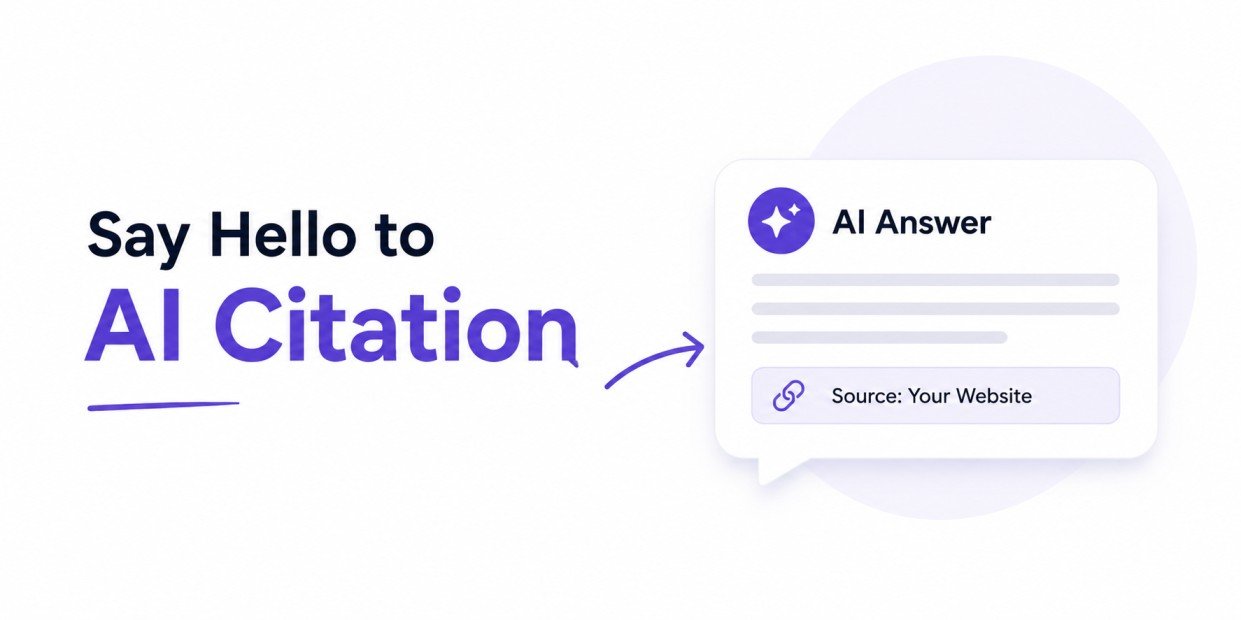
An AI citation is a reference to a source inside an AI-generated answer. Unlike a snippet, it isn’t tied to one URL.AI Overviews, ChatGPT, and Perplexity often cite several pages in a single response. No single page “owns” the answer the way a snippet holder did.
The core difference is structural. A snippet extracts one passage from one page. A citation synthesizes an answer from multiple pages and links back to several of them.This changes what “winning” even means. There’s no longer one seat at the table. There’s a set of seats, and a page just needs to earn one of them.
Ask an AI Overview a comparison question, for example, and it might cite one page for pricing, another for reviews, and a third for setup instructions. Each source is doing part of the job, not all of it.
Example: Ask an AI Overview a comparison question, and it might cite one page for pricing, another for reviews, and a third for setup instructions. Each source is doing part of the job, not all of it.
Here’s the shape of that difference, laid out simply:
FEATURED SNIPPET AI CITATION
[Page A] ──► Answer Box [Page A] ─┐
[Page B] ─┼─► Synthesized Answer
[Page C] ─┘ (cites A, B, and C)
One source. One box. Several sources. One answer, several links.
How AI Overviews Differ From Featured Snippets
Featured snippets pull one passage, verbatim, from one page. AI Overviews generate a new summary in their own words, drawing on multiple pages at once.
A few concrete differences:
- Source count: One page for a snippet. Several pages for an AI Overview.
- Content origin: A snippet reproduces your exact wording. An AI Overview paraphrases and blends wording across sources.
- Position: A snippet occupies a fixed slot, technically position one. An AI Overview has no equivalent single “slot” to win, since it cites a set of sources rather than crowning one.
- Click behavior: Both reduce clicks for simple queries. AI Overviews tend to satisfy more complex, multi-part questions without a click at all.
None of this means snippets vanished. Google still shows them for simple, direct queries.
But for anything requiring synthesis across sources, comparisons, multi-step processes, or questions with several valid angles, AI Overviews have taken that space. The simpler the question, the more likely a snippet still shows up. The more layered the question, the more likely it routes to an AI Overview instead.
The Shift From One Winner to Many Sources
The shift didn’t happen overnight. It didn’t happen by accident either.Google’s AI Overviews, built on the earlier Search Generative Experience, rolled out to handle queries that needed more than a single extracted passage.
To be specific about that lineage: Google introduced Search Generative Experience as an experimental, opt-in feature in 2023. In 2024, it rebranded and relaunched that same underlying feature as AI Overviews, rolling it out to all users by default. AI Overviews isn’t a separate system from SGE. It’s SGE’s public, permanent form.
Around the same time, Perplexity and ChatGPT’s browsing features introduced their own citation models. Each pulls from multiple pages to build one answer, rather than lifting a single passage wholesale. The pattern across all three: less reliance on a single “correct” page, more reliance on assembling an answer from several trusted ones.
A page no longer needs to be the definitive source. It needs to be one of several credible ones an AI system is willing to draw from.
This is a meaningful shift in how visibility works. Under the old model, second place got nothing. Under the citation model, being one of four or five sources still counts as a real win.It also changes how competitive a query feels. A snippet query had one visible outcome to track. A citation query has several, and each one is a separate opportunity rather than a single pass-or-fail result.
Carried Over: Answer-First, Extractable Content
Some of what worked for snippets still works for citations, because the underlying mechanic hasn’t changed. Machines still prefer content they can lift cleanly.
Answer-first paragraphs. Leading with the direct answer, before context or examples, still helps both snippet extraction and AI citation. Systems reward the section that gets to the point first.
Extractable, self-contained sections. Content that makes sense pulled out of context, without needing the rest of the page, still gets used more often. This holds true for snippets and AI systems alike.
Clear entity and attribute definitions. Naming what something is, plainly, in the first sentence under a heading, still signals to both systems that this section answers a specific question.
Structured data. Schema markup that clarifies your page’s structure still helps machines parse and trust your content, whether the destination is a snippet box or an AI answer.
None of these habits need to be relearned. If your content already performs well for snippets, that same foundation carries directly into AI citation.Think of it as the same muscle, applied to a wider set of outcomes. The writing discipline hasn’t changed. Only what it earns you has.
Left Behind: The Single-Slot Model
Not everything made the jump from snippets to citations. Some habits that used to win a snippet spot now do nothing, or worse, waste the effort that could go somewhere useful.
The tricky part is that these habits don’t fail loudly. A page doesn’t get penalized for using them. It just quietly stops earning the visibility it used to, while a team keeps repeating a tactic built for a system that no longer works that way.
Here’s what to leave behind, and why holding onto it costs more than it seems.
The one-winner model. A snippet had one holder. A citation set can include five or more sources for a single query. There’s no single “spot” to fight for anymore, and treating it that way misreads how the new system works.
Example: A query like “best running shoes for flat feet” used to have one snippet holder. The same query in an AI Overview might now cite a running-shoe brand’s own guide, a podiatrist’s blog, and a review roundup, all in the same answer.
Snippet-specific formatting tricks. Bolding trigger phrases or engineering a passage’s exact length to match Google’s old extraction patterns has far less effect on whether an AI system chooses to cite you. These were always narrow, mechanical hacks, and they don’t transfer.
The click-through assumption. Snippets already reduced clicks for simple queries. AI Overviews push that further, often fully resolving a question without sending the user anywhere at all.
Exact keyword-to-slot matching. Snippets rewarded matching a specific query’s exact phrasing. AI citation rewards broader topical coverage across a cluster of related questions, not one keyword match.
Letting go of these habits matters as much as keeping the ones that still work. Chasing a single-slot mindset in a multi-source system wastes effort that could go toward topical depth instead.
Teams that keep optimizing purely for snippet-style wins often miss where the real gains have moved. Coverage across a topic cluster now matters more than perfecting one passage.
Position Zero vs. AI Citation, Side by Side
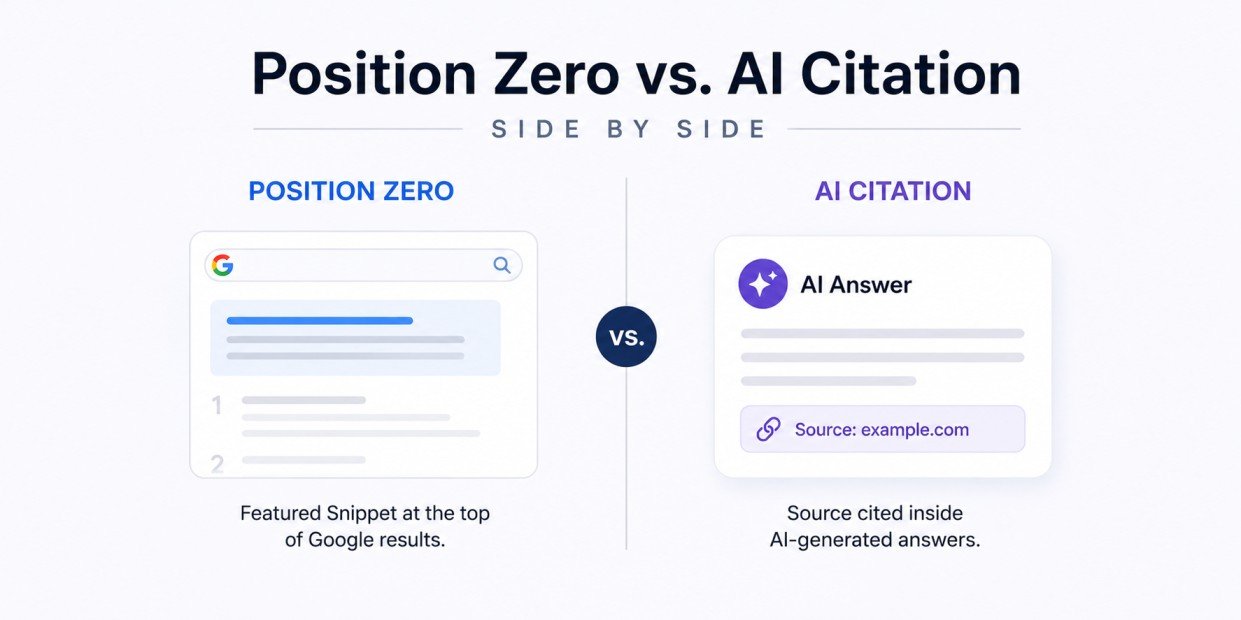
| Mechanic | Featured Snippet | AI Citation |
|---|---|---|
| Source Count | One page | Multiple pages |
| Content Origin | Verbatim extract | Synthesized, paraphrased |
| Selection Logic | Best single passage match | Best set of credible sources |
| Visibility Signal | Snippet ownership | Inclusion in the cited set |
| How to “Win” It | Match query format exactly | Build topical depth across related queries |
| User Click Behavior | Reduced for simple queries | Reduced further, even for complex queries |
FAQ
1.Are featured snippets still showing in search results?
Yes. Google still shows them for simple, direct queries, though AI Overviews now handle more complex, multi-part searches.
2.Do AI Overviews pull from the same pages that used to hold the featured snippet?
Sometimes, but not automatically. AI Overviews evaluate a broader set of credible pages rather than defaulting to whichever page held the snippet.
3.Can more than one site be cited for the same AI answer?
Yes. That’s the core difference from snippets. A single AI answer routinely cites several sources at once.
4.Does losing a featured snippet mean losing AI visibility too?
Not necessarily. The two are evaluated differently. A page can lose a snippet and still be cited in an AI Overview, or hold a snippet and be left out of an AI answer entirely.
Conclusion
Position zero’s core idea, that machines reward clear, extractable, answer-first content, never went away. What changed is the prize itself. It’s no longer one slot to win. It’s a set of trusted sources to be part of.
The skills that built strong snippets still apply. The target has just moved from winning a single spot to earning a place in the group an AI system is willing to cite. That’s a better game to play, in some ways. There’s room for more than one winner now, as long as the content earns its place there.

Farhan khan
Farhan is an SEO writer covering content strategy, search visibility, and brand discovery across search engines and AI platforms.