AI search does not evaluate content the same way traditional search engines do. Instead of only looking at rankings or keywords, AI systems analyze whether a page contains reliable information, clear answers, identifiable entities, and enough context to use as part of a generated response. That means content that performs well in search results may still have limited visibility in AI-generated answers if it lacks these signals.
Knowing how to run a content audit for AEO helps you evaluate existing content through a different lens. Instead of asking, “Does this page rank?” you begin asking, “Can AI easily understand, verify, and reuse this page?” This shift helps content teams identify pages that deserve more attention and pages that no longer support their AI visibility goals.
This article explains how to run a content audit for AEO using a practical assessment method. You’ll learn when an audit is needed, how to organize your content inventory, what to measure on every page, how to score content consistently, and how to decide whether a page should be kept, improved, merged, or removed. It also includes a checklist you can use to make future audits faster and more consistent.
Understanding an AEO Content Audit
A Content Audit for AEO is a structured review of your existing content to see whether it is ready for AI-powered search. Instead of focusing only on rankings or traffic, it checks whether your pages are clear, trustworthy, well-organized, and easy for AI systems to understand.
Unlike a traditional content audit, an AEO audit looks beyond SEO performance. It measures how well a page communicates information so AI can accurately interpret and use it when generating answers.
| Traditional Content Audit | Content Audit for AEO |
|---|---|
| Reviews SEO performance. | Reviews AI readiness. |
| Focuses on rankings and traffic. | Focuses on answer quality and clarity. |
| Measures search performance. | Measures how easily AI can understand the content. |
| Identifies pages to optimize for SEO. | Identifies pages suitable for AI visibility. |
The purpose of a Content Audit for AEO is simple: evaluate your existing content and identify which pages are ready for AI search, which need improvements, and which may no longer provide enough value. This creates a clear starting point before making any content updates or refreshes.
Signs It’s Time to Audit Your Content for AEO
A Content Audit for AEO should not be a one-time task. As your website grows and AI search continues to evolve, some pages may become outdated, incomplete, or less useful for AI-generated answers. Reviewing your content regularly helps you identify these pages before they affect your overall visibility.
Here are some common situations that indicate it’s time to run a Audit for AEO:
- Your content is no longer accurate. Information, statistics, or references may have changed over time, making the page less reliable.
- You have multiple pages covering the same topic. Similar content can create confusion and make it harder to determine which page should be the primary resource.
- Older pages receive little attention. Pages that haven’t been reviewed for a long time may no longer meet current quality expectations.
- Your website has grown significantly. As more content is published, it becomes harder to know which pages still provide value and which need attention.
- You are preparing a content refresh or website update. Running a Content Audit for AEO first helps you make informed decisions instead of updating every page unnecessarily.
Auditing at the right time allows you to review your content with a clear purpose and prioritize the pages that need attention most.
Build an AEO Content Inventory Before You Start
Before you begin a Content Audit for AEO, create a complete list of the pages you want to review. Working from an organized inventory helps you audit content consistently and ensures no important pages are overlooked.
List Every Page
Start by collecting all indexable pages on your website, including blogs, landing pages, guides, FAQs, product pages, and other important resources. Every page that could appear in search should be part of your inventory.
Categorize Your Content
Group each page based on a few key details, such as:
- Content type
- Primary topic
- Search intent
- Last updated date
- Current status (Active, Outdated, Duplicate, or Under Review)
This makes it easier to compare similar pages and review them more efficiently.
Organize Everything in One Place
Store your inventory in a spreadsheet or another tracking tool. Having all your content in one place gives you a clear overview before you start the Content Audit for AEO and makes scoring and prioritizing pages much easier later in the process.
The Five-Part AEO Audit Framework
A Content Audit for AEO should follow a consistent framework so every page is evaluated using the same standards. Instead of relying on guesswork, review each page across the five areas below. These measurements help you understand how well a page supports AI visibility without deciding how to improve it.
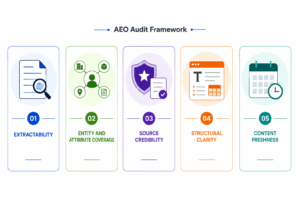
Extractability
This measures how easily AI can identify the main information on a page. During the audit, check whether the primary answer, key points, and supporting details are clearly presented instead of being scattered throughout the content.
Entity and Attribute Coverage
Review whether the page clearly identifies the important people, organizations, products, places, or concepts related to the topic. Also check if important attributes, such as features, characteristics, or specifications, are included consistently.
Source Credibility
Assess whether the information is supported by reliable and verifiable sources. During the audit, simply note if citations, references, or evidence are present and whether they are still relevant.
Structural Clarity
Look at how the information is organized. Review whether headings, lists, tables, and sections make the content easy to follow and understand without evaluating how they should be rewritten.
Content Freshness
Check when the page was last reviewed and whether the information is still accurate. The goal is to identify content that may need attention later, not to update it during the audit.
Create a Simple Scoring System for Every Page
Once you’ve reviewed a page, assign it a score. A scoring system makes your Content Audit for AEO more consistent and helps you compare pages without relying on personal judgment.
Score Each Audit Area
Rate each of the five audit areas on a simple scale.
| Audit Area | Score |
|---|---|
| Extractability | 1–5 |
| Entity and Attribute Coverage | 1–5 |
| Source Credibility | 1–5 |
| Structural Clarity | 1–5 |
| Content Freshness | 1–5 |
A score of 1 means the page needs significant attention, while 5 means it performs well in that area.
Calculate the Overall Score
Add the individual scores to get a total for each page.
| Total Score | Priority |
|---|---|
| 21–25 | Strong |
| 16–20 | Good |
| 11–15 | Needs Review |
| 5–10 | High Priority |
This gives you a quick way to identify which pages require the most attention during your Content Audit for AEO.
Use the Scores to Compare Pages
When every page follows the same scoring system, it becomes much easier to spot your strongest content, identify weaker pages, and prioritize future actions based on consistent data rather than assumptions.
Identify the Pages That Deserve Immediate Attention
After scoring your content, the next step in your Content Audit for AEO is deciding where to focus first. Not every page needs immediate attention, so prioritize the ones that can have the biggest impact.
High-Value Pages
Start with pages that support your most important business goals, such as pillar pages, service pages, or key educational resources. These pages often have the greatest potential to be referenced in AI-generated answers.
Low-Scoring Pages
Pages with the lowest audit scores should be reviewed first. A low score indicates that multiple areas need attention and the page may not be performing well for AI visibility.
Outdated Content
Content that hasn’t been reviewed for a long time may contain outdated information, broken references, or incomplete details. These pages should be prioritized during your audit.
Overlapping Content
If several pages cover the same topic, review them together. Similar content can make it difficult to determine which page should be treated as the primary resource.
Evergreen Content
Pages designed to stay relevant over time deserve regular attention. Keeping these resources accurate and complete helps maintain their long-term value in AI search.
Decide What to Keep, Improve, Merge, or Remove
Once your Content Audit for AEO is complete, decide what action each page should receive. The goal is to make clear decisions based on your audit results, not assumptions.
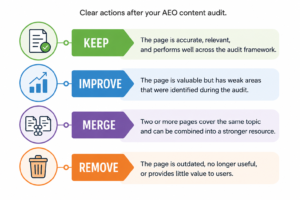
Making these decisions helps you organize your content more effectively and creates a clear action plan after the Content Audit for AEO. The actual updates or refreshes can be handled in your content maintenance process.
Find Content Gaps That AI Search Cannot Answer
A Content Audit for AEO also helps you identify content your website is missing. These gaps highlight opportunities to create new content that better answers user queries and strengthens your overall topic coverage.
| Content Gap | What to Look For |
|---|---|
| Missing Topics | Important topics your website doesn’t cover. |
| Unanswered Questions | Common user questions without clear answers. |
| Weak Supporting Content | Pillar pages with few or no supporting articles. |
| Missing Entity Coverage | Important entities that are missing or rarely mentioned. |
| Incomplete Topic Coverage | Topics that are missing important subtopics or details. |
Finding these gaps helps you build a stronger content plan based on real opportunities rather than guesswork.
Common AEO Audit Mistakes That Waste Time
A good audit follows a clear and consistent process. Avoiding these common mistakes will help you make better content decisions.
Auditing Without Clear Criteria
Using different standards for different pages leads to inconsistent results.
Example: Two reviewers give the same page completely different ratings.
Reviewing Only High-Traffic Pages
Low-traffic pages can still provide valuable information.
Example: Skipping an FAQ page because it has fewer visitors.
Treating Every Page the Same
Different types of content should be evaluated differently.
Example: Reviewing a blog post and a service page using the same expectations.
Ignoring Duplicate Content
Multiple pages covering the same topic can create confusion.
Example: Three articles answer the same question with nearly identical information.
Skipping Regular Audits
Content can become outdated over time.
Example: A guide hasn’t been reviewed for years, even though the information has changed.
FAQs
- Can a small website benefit from an AEO content audit?
Yes, Regular audits help websites of any size improve AI readiness and content quality.
- Should audit scores be reviewed regularly?
Yes, Periodic reviews help track improvements and identify new content issues.
- Can a page receive a high score without backlinks?
Yes, AEO audits focus on content quality, clarity, and trust signals rather than backlinks.
- Should newly published pages be included in an AEO audit?
Yes, Early evaluation helps ensure new content meets AI visibility standards.
- Can AI-ready content reduce future content maintenance?
Yes, Well-structured, accurate content typically requires fewer major updates over time.
