

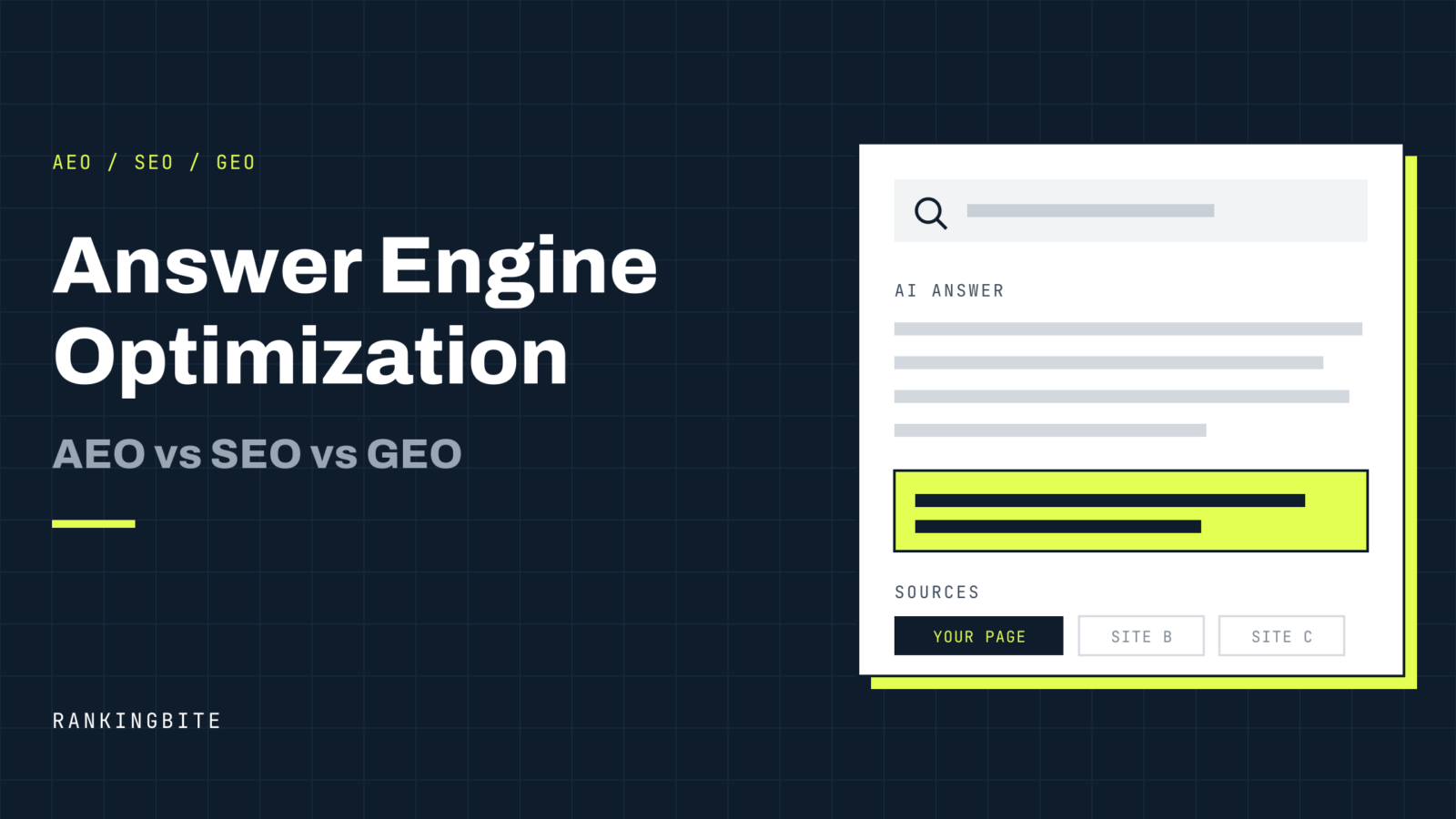
Answer engine optimization (AEO) is the practice of shaping content so AI systems such as Google AI Overviews, ChatGPT and Perplexity can lift it, trust it and quote it as a direct answer. Search engine optimization (SEO) earns a ranked link, generative engine optimization (GEO) earns a mention inside an AI-written response, and AEO earns the answer itself.
That difference now decides visibility at scale. Google AI Overviews alone passed 2.5 billion monthly users in May 2026, so a growing share of searchers read the answer before any link.
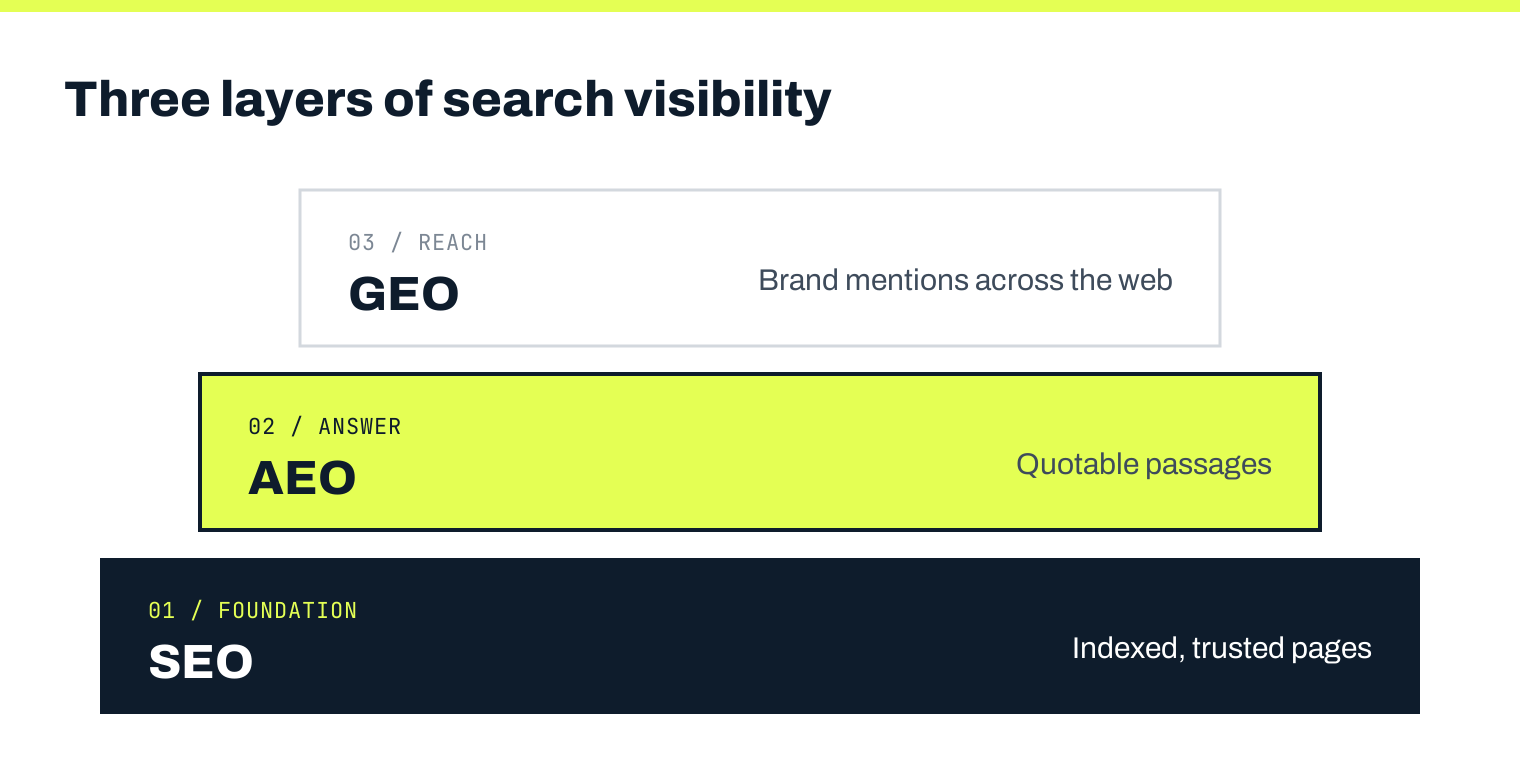
Each method rewards a different unit of content: SEO a page, AEO a passage, GEO a brand. All three share one technical base, so the real decision is the order of work, not one method over the others.
What Does AEO Mean in Search?
Answer engine optimization is the work of making a page the source an AI system quotes when it replies to a question directly. An answer engine is any system that returns a finished answer instead of a list of links, such as Google AI Overviews and AI Mode, ChatGPT search, Perplexity, Gemini, Claude, Copilot and voice assistants like Siri and Alexa.
The term is older than AI chatbots. It first described featured snippets and voice search, where an assistant read out one answer taken from one page. Large language models (LLMs) widened the job: a single AI answer now blends several sources, and every cited link is a fresh chance for a brand to be seen.
Why Should Brands Care About AEO?
Brands should care because searchers increasingly get the full answer on the results page, and the brand named inside that answer wins the attention a top ranking used to win. Google AI Mode crossed 1 billion monthly users by July 2026, and the Gemini app reached 950 million monthly users in the same period.
Clicks fall when an AI summary appears. In March 2025 browsing data from 900 US adults, searchers clicked a traditional result in only 8% of visits with an AI summary, against 15% of visits without one. A source link inside the summary got clicked in just 1% of those visits.
Those numbers make the citation itself the prize. Being named in the answer builds recall and trust even without a click, while a page that ranks under the summary competes for a click rate that nearly halves (8% against 15%).
How Does AEO Work?
Answer engines choose sources in three stages: they retrieve candidate pages from a search index, expand the question into related searches, and then extract the passages that answer each part best. This pattern is called retrieval-augmented generation (RAG), where a language model writes from documents fetched at query time instead of from memory alone.
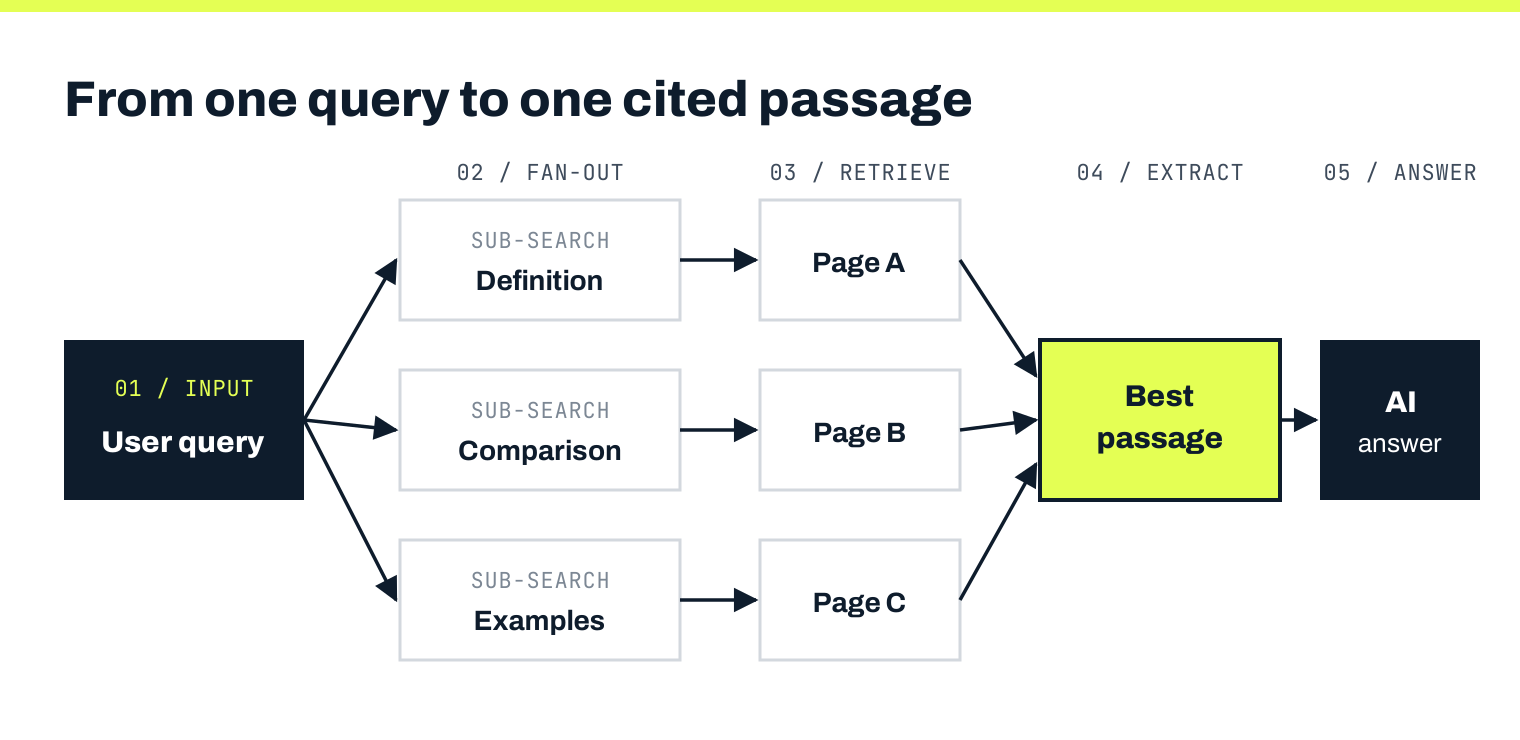
Retrieval decides who enters the race. A page must be crawled, indexed and allowed to show a snippet, and Google AI Overviews and AI Mode add no further eligibility rules on top of that (official guidance, December 2025).
Expansion widens the pool. Through query fan-out, the engine splits one question into several sub-searches across subtopics, which explains why a page can be cited for a question it never targeted.
Extraction picks the winning lines. The engine reads candidates at passage level and keeps text that answers a sub-question cleanly, carries a specific fact and comes from a source it trusts. A 50-word paragraph with the answer, a number and a date is far easier to lift than the same fact buried in a long story.
What Is the Difference Between AEO, SEO and GEO?
AEO, SEO and GEO differ in what they try to win: SEO wins a ranked link, AEO wins the quoted answer, and GEO wins a mention inside an AI-written reply. SEO has shaped organic search since the late 1990s, while GEO entered the vocabulary through a November 2023 research paper presented at KDD 2024, the Knowledge Discovery and Data Mining conference.
| Factor | SEO | AEO | GEO |
|---|---|---|---|
| Main goal | Rank a page in search results | Become the direct answer | Get mentioned inside AI-written answers |
| Where it shows | Google and Bing results pages | Featured snippets, AI Overviews, voice assistants | ChatGPT, Perplexity, Gemini, Google AI Mode |
| Output | Blue link with title and snippet | One extracted passage or spoken answer | New answer blended from several sources |
| Content unit | Whole page | Single passage | Brand or entity across the web |
| Success metric | Rankings, clicks, organic traffic | Snippet wins, AI citations | Brand mentions, share of AI answers |
| Origin | Late 1990s | Featured snippet and voice era | November 2023 research |
AEO and SEO split at the finish line. SEO counts position and clicks on a results page, while AEO counts whether a passage gets lifted and shown as the answer, often above the first organic link. A page can rank fifth and still supply the quoted answer, or rank first and never be quoted.
AEO and GEO split on how the answer gets built. AEO targets engines that extract a passage close to word for word, and GEO targets engines that write a new reply from several sources, where brand facts and third-party mentions matter more than one paragraph. Mentions beyond the brand’s own site drive that side, which is where generative search work begins.
Should Businesses Choose SEO, AEO or GEO?
Businesses do not have to pick one, because the three methods stack on the same base. SEO gets a page indexed and trusted, AEO makes its passages easy to quote, and GEO spreads the brand’s facts across the sources AI systems read. AI Overviews often do both extraction and generation at once, so the AEO and GEO labels frequently describe the same work.
The order of work still changes by business type. Four examples show how priorities usually shift (illustrative, not research findings):
- Local businesses: SEO and the Google Business Profile first, then AEO for service and pricing questions.
- SaaS companies: AEO for how-to and comparison questions, then GEO for mentions on review and community sites.
- Ecommerce stores: SEO for product and category pages, then AEO for buying-guide questions.
- Publishers: AEO first, since question-led articles are the content answer engines quote most directly.
How Do You Optimize Content for AEO?
Content gets quoted more often when every section opens with a clear answer backed by facts an engine can verify. Five habits cover most of the work:
- Answer first: Open each section with a 40 to 60 word answer that restates the question in new words, then add detail, examples and data below it.
- Checkable facts: Add numbers, dates, quotations and links to original research. In tests on generative engines, quotations lifted source visibility by about 41%, statistics by 31% and cited sources by 27%, while keyword stuffing cut it by 8% (November 2023 study).
- Entity and author signals: Show who wrote the page and why they know the subject, and keep brand facts identical across the site, profiles and directories. These signals feed Experience, Expertise, Authoritativeness and Trustworthiness (E-E-A-T).
- Crawlable pages: Keep pages indexable, fast and free of nosnippet or max-snippet:0 directives on text meant for answers, since those directives also keep a passage out of AI Overviews. Structured data helps only when it matches the visible text; no special schema is required.
- Scheduled refresh: Update figures and dates on a fixed cycle, such as every quarter (illustrative), so a fresher page does not replace an outdated one.
FAQs
How long does AEO take to show results?
Pages that already rank often start appearing in AI answers within weeks of a rewrite. New sites usually need several months to earn the trust signals answer engines rely on.
Is AEO the same as AIO or LLMO?
AIO (AI optimization) and LLMO (large language model optimization) are broad labels for any work aimed at AI systems. AEO is narrower and focuses on winning the direct answer to a specific question.
Can a small website get cited in AI answers?
Yes. Answer engines quote passages rather than whole domains, so a small site with a precise, well-sourced answer can be cited beside much larger brands.
Does blocking AI crawlers remove a site from AI Overviews?
No. Blocking Google-Extended limits use of content for Gemini models but leaves Google Search and AI Overviews untouched; only Googlebot rules and snippet controls change that.