To appear in ChatGPT answers, your business needs entity authority: consistent structured data, third-party mentions beyond your own website, and content that directly answers real questions. This is not traditional SEO. It’s Generative Engine Optimization, or GEO.
More buyers now ask ChatGPT for a recommendation before they open Google. The businesses that show up aren’t necessarily the biggest, they’re the ones ChatGPT can find, verify, and quote with confidence.
The Two Ways ChatGPT Finds Businesses
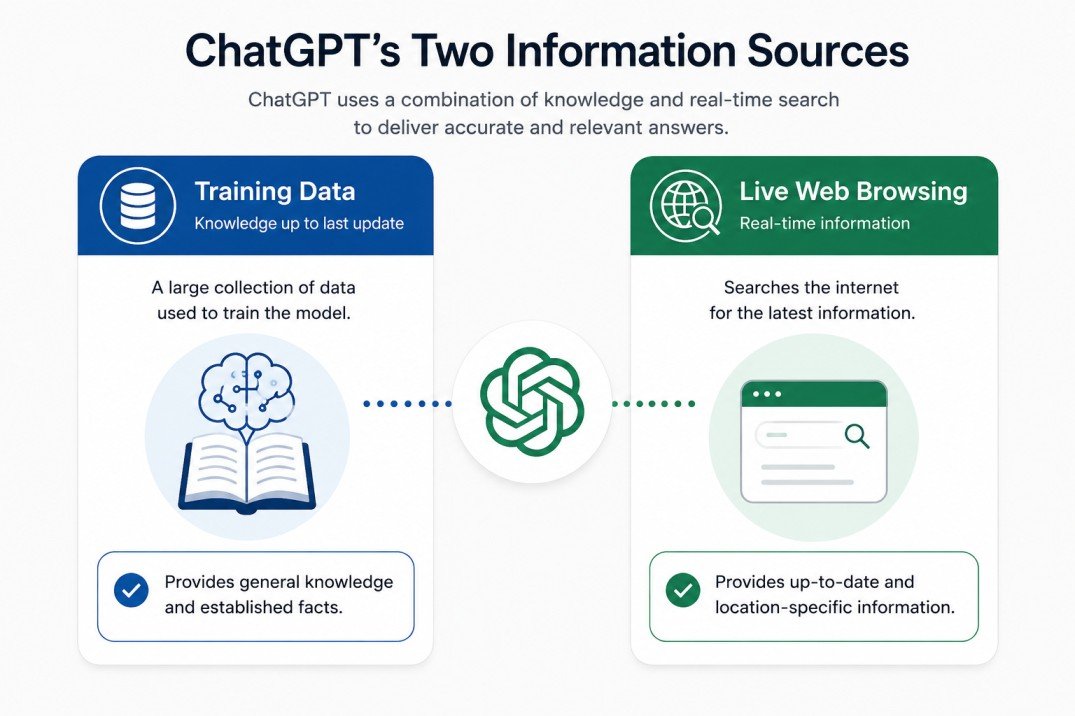
ChatGPT pulls from two sources: its training data and live web browsing.
Training data is a frozen snapshot of the web up to a cutoff date. It gives ChatGPT baseline knowledge of well-established brands, built up over time through repeated, consistent mentions across many independent sources. This layer changes slowly and can’t be fast-tracked, since it only updates when a new model version is trained.
Live browsing works differently. When search is enabled, ChatGPT queries Bing in real time and builds its answer from what it retrieves. According to a 2026 market analysis, ChatGPT relies on the Bing Search API for 92% of its real-time searches.
That single fact changes where optimization effort should go: Bing visibility, not just Google visibility, directly shapes whether ChatGPT can find and cite a business.
This live layer is the one most businesses can realistically influence. Content published this month can affect ChatGPT’s answers within weeks, once Bing indexes it and ChatGPT’s browsing mode picks it up.
ChatGPT does not rank pages the way Google does. It evaluates entities, recognized businesses and concepts, based on how consistently and credibly they appear across sources. A business mentioned the same way on five independent sites carries more weight than one with a single, unverified claim on its own homepage.
Signals ChatGPT Checks Before Citing You
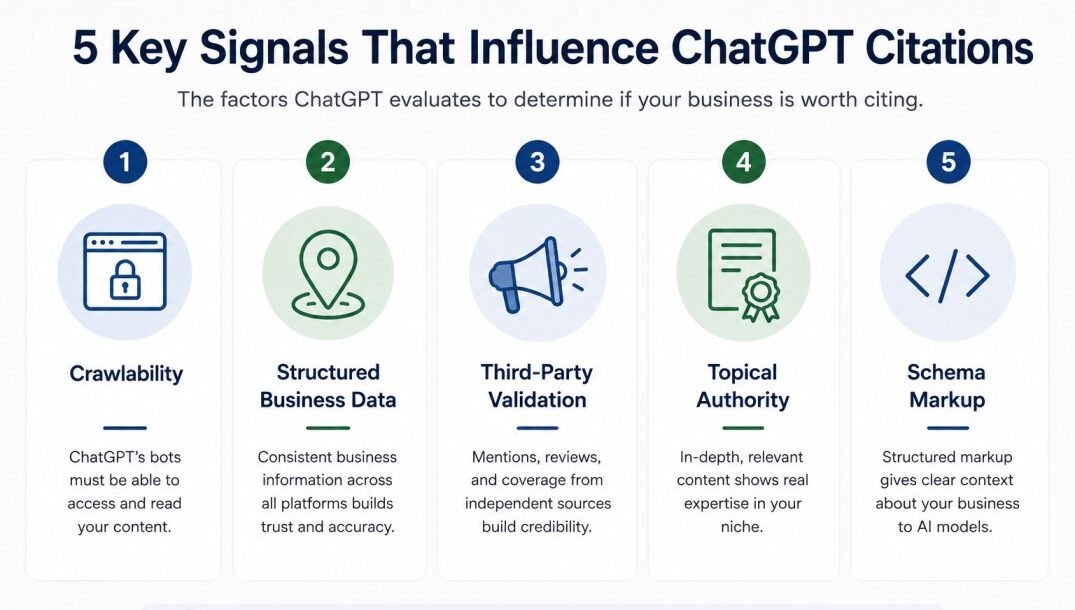
Crawlability. GPTBot and OAI-SearchBot need access. A blocked robots.txt file, or key information locked inside images or PDFs, makes a business invisible regardless of content quality.
Structured business data. Name, address, services, and credentials need to match exactly across your website, Google Business Profile, Bing Places, and industry directories. Inconsistencies create doubt about which version is accurate.
Third-party validation. Mentions from sources other than your own website carry more weight. Press coverage, directory listings, and third-party reviews all count as independent evidence.
Topical authority. Deep, specific expertise content outperforms generic service pages. A business publishing detailed guides on its actual specialty gets cited more often than one with a one-line description.
Schema markup. Organization, LocalBusiness, and FAQ schema give ChatGPT (via Bing) explicit, unambiguous information about what a business does and where it operates. Without it, the model has to infer these details from unstructured text, which increases the chance of error or omission.
A business missing even one of these five signals tends to underperform, since ChatGPT weighs them together rather than crediting strength in one area for weakness in another.
Structuring Content ChatGPT Can Quote
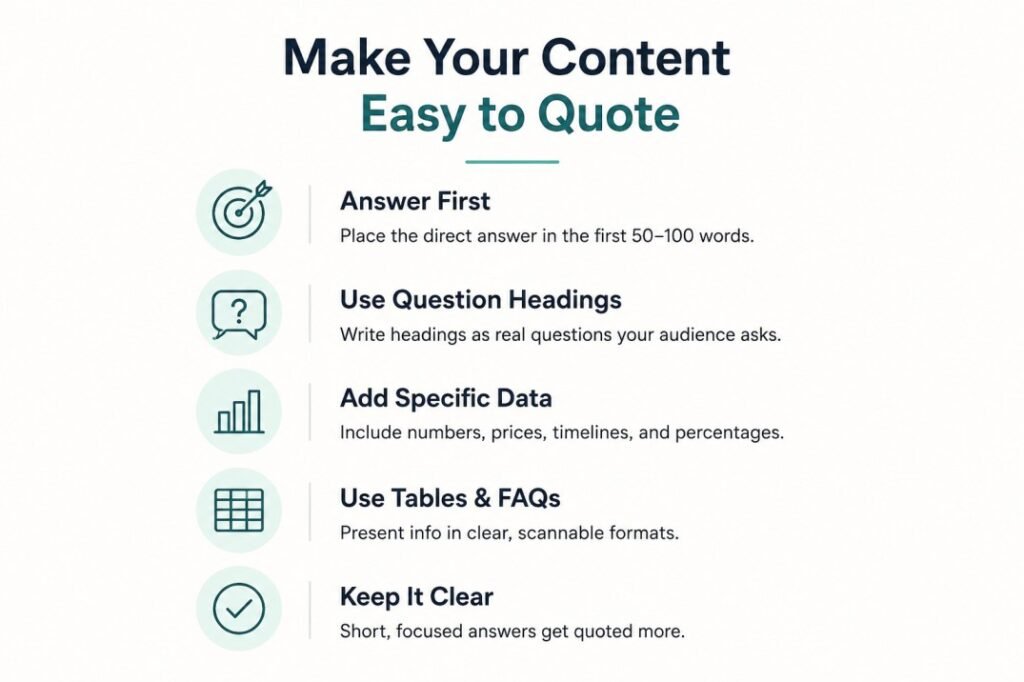
Lead with the direct answer. ChatGPT often pulls its response from the first 50 to 100 words of a page, so answers buried under a long introduction are less likely to get quoted.
Use headings phrased as real questions, not generic labels. ChatGPT maps user prompts to page sections, so a heading like “How much does X cost in Y city?” is more extractable than “Our Services.”
Include concrete data: prices, timelines, percentages. Vague claims like “quality service” give the model nothing to repeat. A specific number does.
Add comparison tables and FAQ sections where relevant. Both formats package information in clean, quotable chunks.
Length matters less than clarity. A short page that answers one question precisely often gets cited over a long page that buries the same answer among unrelated information.
Your Step-by-Step Action Plan
- Audit your current visibility. Search your business name and core service terms in ChatGPT. Note what appears and what doesn’t, and save the results as a baseline to compare against later.
- Fix entity inconsistencies. Make sure your name, address, and service details are identical everywhere you’re listed, from your website to your social profiles.
- Build your Bing presence. Claim your Bing Places listing and submit your sitemap to Bing Webmaster Tools, since this directly feeds ChatGPT’s live browsing layer.
- Create direct-answer content. For every question a potential customer might ask ChatGPT, publish a page that answers it in the first paragraph, not buried further down.
- Earn third-party mentions. Pursue press coverage, expert commentary opportunities, and listings in relevant directories your competitors already appear in.
- Implement schema markup. Add Organization, LocalBusiness, and FAQPage schema across your site to remove ambiguity about what your business does.
- Monitor monthly. Track your ChatGPT citations on a regular schedule and adjust based on what’s actually getting picked up, since results shift as content gets indexed.
Realistic Timeline by Starting Point
There’s no fixed timeline, but starting position matters:
- Strong existing web presence: 4 to 8 weeks to initial citations
- Moderate presence: 8 to 12 weeks
- New or low-visibility businesses: 12 to 16 weeks or longer
A single mention in a respected publication often accelerates citations faster than months of on-site content alone.
A Before-and-After Example
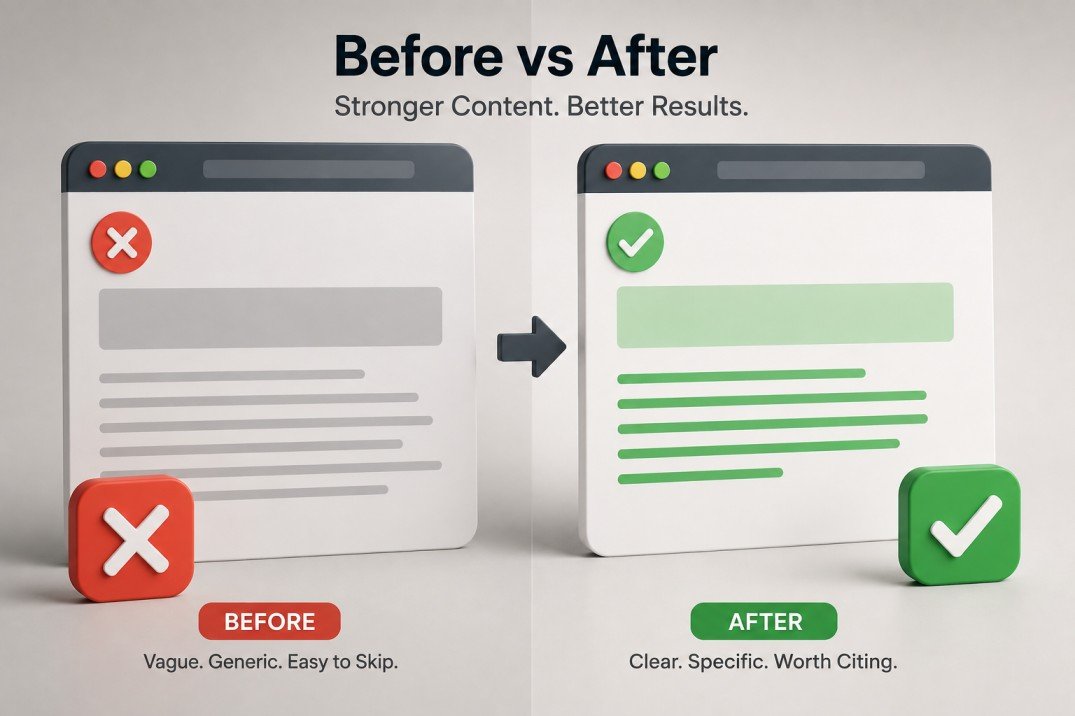
Weak: “We provide expert dental care with a focus on patient comfort and modern technology.”
Strong: “Dental cleaning in Austin, TX starts at $120. Same-day appointments available. Board-certified dentists, open Saturdays.”
The second version gives ChatGPT a price, a location, and a specific offer it can repeat directly in an answer. The first gives it nothing quotable, no matter how well it’s written. This single rewrite, applied across a homepage and top service pages, is often the fastest visible change a business can make.
How RankingBite Approaches This
RankingBite maps the entity signals across a business’s website, Bing presence, and third-party mentions before recommending where to focus first. Rather than treating GEO as generic content production, the work starts by identifying exactly which signals are missing for a specific business and category, then closes those gaps in priority order.
This matters because businesses in the same category rarely share the same gap. One might have strong content but no third-party mentions. Another might have solid press coverage but a blocked robots.txt file undoing all of it. Treating every business the same way tends to fix the wrong problem first.
FAQs
Does ChatGPT Plus improve my visibility?
No. It’s a subscription tier, not a visibility factor. Citations depend on entity authority, not which plan a user has.
Can I submit my site directly to ChatGPT?
No. There’s no submission mechanism like Google Search Console. Visibility builds through entity signals and Bing indexing.
Is GEO the same as SEO?
No. SEO targets ranking algorithms. GEO targets the entity and authority signals AI models use to decide what to cite.
Do I need to optimize for Bing specifically?
Yes. ChatGPT’s browsing mode relies heavily on Bing, so Bing visibility directly affects ChatGPT citation odds.
How do I check if I’m already mentioned?
Search your core service terms and location in ChatGPT across a few sessions, since responses can vary.
Does my industry affect how fast I get cited?
Yes. Categories with active third-party coverage, reviews, or press tend to see faster results than niches with little independent content to draw from.
Is a single blog post enough to get cited?
Rarely. One well-structured page can get cited for a narrow question, but consistent visibility across broader queries needs multiple pages and outside validation working together.
What happens if my robots.txt is blocking GPTBot?
ChatGPT cannot read or cite your site at all until it’s unblocked, regardless of how strong the content or third-party mentions are. This is usually the first thing worth checking.

Farhan khan
Farhan is an SEO writer covering content strategy, search visibility, and brand discovery across search engines and AI platforms.