Search is no longer limited to traditional results pages. People now use AI tools to find information, compare brands, and get direct answers, which has led to terms like GEO, AEO, and AI-SEO becoming common in the industry.
The problem is that these terms can overlap. One agency may call its services GEO, while another uses AEO or AI-SEO for work that looks very similar. That makes it difficult to know what you actually need.
The right choice depends on where you want your brand to appear, how your audience searches, and what the agency will actually work on. This guide breaks down the differences between GEO, AEO, and AI-SEO so you can understand which type of agency fits your goals.
In a 2025 Pew Research Center analysis of 68,879 Google searches, 18% produced an AI-generated summary. The study also found that 60% of searches beginning with question words such as “who,” “what,” “when,” or “why” produced an AI summary
GEO vs AEO vs AI-SEO: What’s the Difference?
GEO, AEO, and AI-SEO are often used together, but they focus on different parts of the search experience. The main difference comes down to where your brand needs to be visible and how people are finding information.
GEO (Generative Engine Optimization) focuses on how a brand appears in responses generated by platforms such as ChatGPT, Perplexity, Gemini, and other AI search experiences. This can include brand mentions, citations, and how a company or product is represented in an answer.
AEO (Answer Engine Optimization) focuses on providing clear answers to specific questions. It can involve structuring content so that search engines and answer-focused platforms can easily understand, extract, and present the information.
AI-SEO is a broader approach. It brings traditional SEO practices together with strategies designed for AI-powered search. This can include technical SEO, content optimization, search intent, entity signals, and monitoring how a brand appears across newer search experiences.
The three can overlap, but the work involved is not always the same. An agency calling itself a GEO agency may focus heavily on AI citations, while an AEO agency may concentrate more on answer-focused content. An AI-SEO agency may cover both alongside traditional search optimization.
| Approach | Main Focus | Typical Goal |
|---|---|---|
| GEO | Generative AI visibility | Earn mentions and citations in AI responses |
| AEO | Direct answers | Make content easier to extract and surface as answers |
| AI-SEO | Search across traditional and AI experiences | Build broader visibility across changing search environments |
Understanding this difference makes it easier to decide what type of agency fits your current search goals.
When Do You Need a GEO Agency?
A GEO agency makes sense when your main concern is how your brand appears in generative AI responses. Traditional rankings may show where your website appears in search results, but they do not necessarily tell you whether AI platforms mention or cite your brand when users ask relevant questions.
A GEO-focused agency typically looks at the prompts people use to research products, services, and brands. It may also examine which sources AI platforms rely on and where your brand is missing from those responses.
You may need a GEO agency if:
- Your competitors appear in AI responses while your brand does not.
- Your brand is rarely mentioned or cited by AI platforms.
- AI tools provide incomplete or inaccurate information about your company.
- You want to track visibility across platforms such as ChatGPT, Perplexity, or Gemini.
- You want to understand which buyer-intent prompts lead to your brand being mentioned.
- Your existing SEO strategy is not addressing visibility in generative AI search.
When Do You Need an AEO Agency?
Not every search starts with a product name or a short keyword. Someone might search “How does payroll software work?”, “What should I look for in payroll software?”, or “Is payroll software worth it for a small business?” They are looking for an answer before they are ready to choose a brand.
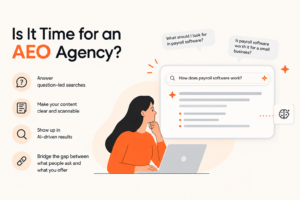
That is where AEO becomes relevant. The focus is on the questions your audience asks and whether your content gives a clear answer that search systems can easily understand. This can involve improving existing pages, creating question-led content, and making important information easier to find.
An AEO agency could be useful if your business:
- Relies heavily on informational or question-based searches.
- Has content that is useful but does not answer key questions clearly.
- Wants to improve visibility in answer-focused search experiences.
- Has gaps between the questions customers ask and the content available on the site.
- Needs help restructuring content around specific search questions.
- Wants to make its existing content more useful for conversational searches.
When Do You Need an AI-SEO Agency?
An AI-SEO agency may be a good fit when:
- You want to improve visibility across both traditional and AI-powered search.
- Your current SEO strategy needs to account for changing search behavior.
- You need technical SEO and content work as part of the same strategy.
- Your website performs well in traditional search but has limited visibility in AI search.
- You want to bring SEO, content, and AI-search efforts under one broader strategy.
- You need ongoing measurement across different search environments.
AI-SEO takes a wider view of search rather than focusing on one specific format. The work can include technical SEO, content optimization, search intent, entity signals, and efforts to improve how your brand is understood across newer search experiences.
Traditional rankings also do not tell the whole story anymore. An Ahrefs study of 300,000 keywords found that the presence of an AI Overview was associated with a 58% lower average click-through rate for the top-ranking page in December 2025.
This approach can also be useful when your business is already investing in SEO but wants to adapt that work for the way search is changing. Instead of starting a completely separate strategy, an agency can identify where existing SEO work can support visibility in AI-powered search.
The important thing is to look beyond the term AI-SEO when comparing agencies. Different agencies may use the label for different services, so check what they actually include, which platforms they work with, and how they measure progress.
Can One Agency Handle GEO, AEO, and AI-SEO?
Yes. An agency can offer GEO, AEO, and AI-SEO as part of the same service, especially when the goal is to build visibility across different search experiences.
The three areas can overlap. Content created for AEO may also support visibility in AI-generated answers, while technical SEO and entity work can contribute to how search systems understand a brand.
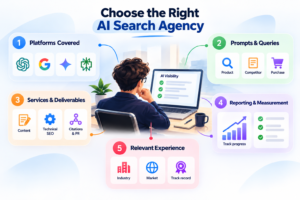
What matters is not whether an agency uses all three terms, but what it actually does under each service. Before hiring, look at the platforms covered, the type of optimization included, the prompts or queries being tracked, and how results are reported.
How to Choose the Right AI Search Agency
Choosing an AI search agency is not just about finding one that uses terms like GEO, AEO, or AI-SEO. The same label can cover very different services, so it is worth looking at what the agency will actually do, measure, and report.
Platform coverage matters because AI search experiences do not behave exactly like traditional search. Pew Research Center found that users who encountered an AI summary clicked a traditional search result in 8% of visits, compared with 15% when no AI summary appeared.
Platforms Covered
Start by checking which AI and search platforms the agency works with. This should match the platforms your audience uses and the markets you care about. Ask whether they monitor platforms such as ChatGPT, Google AI Overviews, Perplexity, Gemini, or others relevant to your business.
Prompts and Queries Tracked
Ask how the agency chooses the prompts and queries it monitors. A useful strategy should go beyond a few generic searches and include queries that reflect how potential customers research your products, services, competitors, and industry.
The prompts should also reflect different stages of the buying journey, giving you a clearer picture of where your brand appears during research and comparison.
Services and Deliverables
Get a clear picture of what is included in the work. Depending on the agency, this could cover content updates, technical SEO, entity optimization, citation opportunities, brand mentions, digital PR, or other visibility work.
Make sure the proposal explains what the agency will actually deliver rather than relying on broad terms.
Reporting and Measurement
Find out how progress will be measured and how often you will receive updates. Reports should show the areas being monitored and meaningful changes over time, rather than simply listing activities completed by the agency.
Relevant Experience
Industry experience can also matter, particularly if your business operates in a specialised or competitive market. Look at the type of companies the agency has worked with and whether that experience is relevant to your goals.
GEO vs AEO vs AI-SEO: Which One Do You Need?
There is no single approach that fits every business. The right choice depends on how your audience searches, where you want your brand to appear, and what parts of your current search strategy need attention.
- GEO: Consider this when your priority is increasing brand mentions, citations, and visibility in generative AI responses.
- AEO: Consider this when your priority is providing direct answers to question-based searches and improving visibility in answer-focused search experiences.
- AI-SEO: Consider this when you want a broader strategy that combines traditional SEO with work focused on AI-powered search.
These approaches can also work together. A business may use AEO to improve how its content answers common questions while using GEO to monitor how the brand appears in AI-generated responses. At the same time, technical SEO and content improvements can support both efforts.
The agency’s name should therefore not be the deciding factor on its own. Look at the actual scope of work, platforms covered, prompts being tracked, deliverables, and reporting process. This gives you a clearer idea of whether the agency’s approach matches what your business needs.
FAQs
Is GEO the same as AEO?
No, GEO focuses more on visibility, mentions, and citations in generative AI responses, while AEO focuses on providing clear answers to specific questions.
Is AI-SEO broader than GEO?
Yes, AI-SEO generally covers a wider search strategy that can combine traditional SEO with optimization for AI-powered search experiences.
Can one agency provide all three?
Yes, Some agencies offer GEO, AEO, and AI-SEO together, although the exact services and scope can vary between agencies.
How do I evaluate an AI search agency?
Look at its platforms, tracked prompts, services, deliverables, reporting process, and relevant experience before choosing an agency.
