

AI SEO is the practice of optimizing content to rank in Google and get cited by AI platforms like ChatGPT, Gemini, Perplexity, and Google AI Overviews. To do both, make your pages crawlable, answer questions directly, keep your brand information consistent, and earn credible mentions on trusted sites. This matters because AI platforms now shape how people discover brands and make buying decisions.
Key Takeaways
- Ranking in Google is still the foundation; AI features draw on the same search index.
- Getting cited by AI adds a second job: making your content the clearest, most trustworthy answer.
- Measure both with rankings, AI referral traffic, and regular prompt tests.
What Is AI SEO?
AI SEO is the practice of optimizing content so it ranks in search engines and gets cited by AI tools, such as Google AI Overviews, AI Mode, ChatGPT, Gemini, and Perplexity. The term also covers using AI tools to do SEO work faster.
Traditional SEO aims to get a page listed high in search results. AI SEO keeps that goal and adds another: getting your page, or your brand, named inside the AI answer itself. You will also see the labels GEO (generative engine optimization), used mostly for chat tools like ChatGPT, and AEO (answer engine optimization), used mostly for direct answers like AI Overviews. They overlap heavily, and most businesses need both.
AI for SEO vs. SEO for AI
| Factor | AI for SEO | SEO for AI |
|---|---|---|
| Goal | Do SEO work faster | Get cited in AI answers |
| Examples | Keyword research, content briefs, audits | Answer-first content, entity clarity, brand mentions |
| Where results show | Google rankings and organic traffic | AI Overviews, AI Mode, ChatGPT, Gemini, Perplexity |
| Main risk | Generic, low-value content | Being left out of AI answers |
How Do You Rank in Google in the AI Era?
You rank in Google by making your pages easy to crawl, matching them to what searchers want, and proving your expertise. These basics matter even more now, because Google’s AI features rely on the same index and core ranking systems as regular search, as Google explains in its guide to generative AI features.
A page must be indexed and eligible to appear in Search before it can be cited, but it does not need to rank at the top for a particular query: Google notes that links in its AI features can differ from traditional rankings.
1. Make Your Pages Crawlable and Indexable
Google can only rank pages it can find and read. Check Search Console’s indexing report for your key pages, remove accidental noindex tags, fix broken links, and make sure pages load quickly on mobile. One technical mistake can hide your most valuable page from both search results and AI features.
2. Target Search Intent, Not Just Keywords
A keyword shows what people type; intent shows what they want. Someone searching “website redesign cost” wants prices, not a history of web design. Study the pages already ranking for your target term and note their format, whether guides, comparisons, or price lists, then build the page that serves that need best. Collect the real questions your sales and support teams hear, since these reveal intent that keyword tools miss.
3. Optimize Each Page’s On-Page Elements
Put your main keyword in the title tag, the H1, and the first paragraph, written naturally. Use clear, question-based subheadings, a descriptive meta description, and internal links to related pages on your site. These signals tell Google what the page covers and how it fits into the rest of your content.
4. Show Real Experience and Expertise
Google rewards content that shows first-hand experience and genuine expertise. Add a named author with real credentials, include examples from your own work, and keep facts current. Google’s guidance puts unique, non-commodity content at the top of its list, so a page that only repeats what competitors say has little reason to rank above them.
5. Build Topical Authority
One page rarely ranks for a competitive topic on its own. Create a pillar page and link it to supporting pages on each sub-topic, such as an AI SEO guide linking to a guide on LLM optimization. Earn links and mentions from trusted sites in your industry. Together, these show Google that your site is a reliable source on the subject.
How Do You Get Cited by AI?
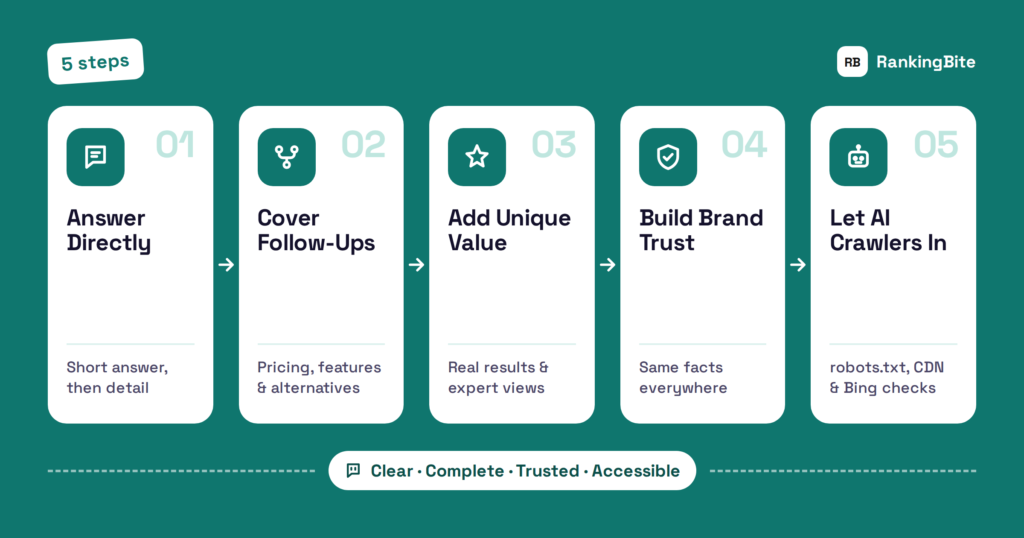
Getting cited is the second half of an AI SEO strategy. You earn AI citations by making your content the clearest, most complete, and most trustworthy answer to a question, and by making sure AI tools can access it. Ranking helps your page become a candidate; these steps help it get chosen.
1. Answer the Question Directly
AI tools look for passages they can use as an answer. Put a short, direct answer right under each heading, then add the detail. Around 40 to 60 words is a useful editorial guideline, not a verified requirement. Compare a weak opening, “Timelines can vary for many reasons,” with a strong one, “A website redesign usually takes 8 to 12 weeks, depending on page count.” The second can be quoted as-is.
2. Cover the Follow-Up Questions
Google says AI Overviews and AI Mode may use a technique called query fan-out: one question, such as “best CRM for a small agency,” is split into related searches about pricing, features, and alternatives, and the answer draws on results across them. Pages that answer these follow-up questions, or a cluster of pages that covers them, give AI more chances to cite you.
3. Add What AI Cannot Copy
If your page says what every other page says, an AI summary can replace it without citing you. Include what only your business can offer: client results, price ranges you actually quote, screenshots, and expert commentary. These details make your page the source worth naming.
4. Make Your Brand Easy to Recognize
AI tools describe brands more confidently when the facts about them match everywhere. Keep your name, services, and contact details identical across your website, Google Business Profile, LinkedIn, and directories. Earn mentions on review sites and publications your buyers trust, since chat tools like ChatGPT and Perplexity draw on sources well beyond your own site.
5. Let AI Crawlers In
Check that AI search crawlers are allowed in both robots.txt and your CDN or firewall. OpenAI’s crawler documentation explains that sites blocking OAI-SearchBot will not be shown in ChatGPT search answers. Microsoft Copilot uses Bing’s index, so verify your site in Bing Webmaster Tools too. Schema markup helps search engines understand your content, but it does not directly increase AI citations, and Google limits FAQ rich results to a small set of authoritative sites.
What Is Algorithmic Authorship and How Does It Affect AI Citations?
Algorithmic authorship is a writing approach that structures content so search engines and AI systems can understand, extract, and reuse it accurately. It focuses on how each sentence is written, not just what the page covers. Content written this way is easier for AI to quote correctly, which makes it a stronger candidate for citation.
Algorithmic authorship uses two types of statements, and strong pages combine both:
- Factual statements: Data, definitions, research findings, and verifiable claims that AI systems extract as reliable facts for objective questions. Example: “A website redesign usually takes 8 to 12 weeks for a site with 20 to 40 pages.”
- Opinion statements: Expert interpretations, comparisons, and recommendations that AI systems use for subjective questions, such as which option suits a specific need. Example: “For agencies with fewer than 10 clients, a lightweight CRM is usually a better fit than an enterprise platform.”
How Does Micro-Semantics Support Algorithmic Authorship?
Micro-semantics is the precise meaning of individual words, phrases, and sentences within content. Clear terminology, named entities, and unambiguous statements help AI systems understand how concepts relate to each other and reduce the risk of being misquoted.
Before: “Our solution helps businesses improve results quickly.”
After: “RankingBite’s AI visibility check shows which buyer questions name your brand in ChatGPT, Gemini, and Google AI Overviews.”
The second sentence names the entity, the product, the outcome, and the platforms, so an AI system can reuse it without guessing what it means.
How to Apply Algorithmic Authorship
- Start each section with a direct statement that answers the heading.
- Name entities instead of using vague terms like “our solution” or “this tool.”
- Use specific numbers when you have a verifiable source.
- Keep one idea per sentence so each line can stand on its own.
- Label opinions clearly as recommendations, so AI systems can separate them from facts.
Does Ranking on Google Still Get You Cited by AI?
Ranking on Google improves your chances of being cited by AI, but it does not guarantee a citation. Clear writing helps AI quote your content, but where your page ranks still decides whether AI considers it at all. Google’s AI features draw on the same index as regular search, yet they choose sources differently. A page ranking first for a query can still be missing from the AI Overview for that same query.
- Rankings and citations are related, not identical: A two-year study by Seer Interactive found that organic search and AI traffic behave differently, so measure them separately.
- Passage clarity decides the citation: AI systems pull specific passages, not whole pages. A page that buries its answer under a long introduction gives AI less to quote than one that answers in the first sentence.
- Start with high-ranking, uncited pages: Find pages already on Google’s first page but missing from relevant AI answers. These pages have already earned Google’s trust, so improving their clarity and relevance is often the fastest win.
How Do Google AI Overviews, Gemini, ChatGPT, and Perplexity Differ?
Each AI platform draws on different sources, so one tactic rarely works everywhere. Google documents its approach; the others share less, so treat the right-hand column as practical guidance rather than proven rules.
| Platform | Where sources come from | Important visibility considerations |
|---|---|---|
| Google AI Overviews and AI Mode | Google’s search index, expanded by query fan-out | Indexing, strong rankings across the topic, clear answers |
| Gemini | Google Search when it looks things up; the app’s source selection can differ from AI Overviews | SEO fundamentals and a clearly defined brand entity |
| ChatGPT | OpenAI’s search crawler and partner search results | Crawler access, relevance to the query, consistent brand information |
| Perplexity | Live web search with its own crawler | Crawlable, current, well-sourced pages |
How Can You Use AI for SEO?
AI tools help businesses streamline SEO tasks, from keyword research and content planning to identifying optimization opportunities. However, human expertise remains essential for accuracy, originality, and content quality.
- Keyword research and search intent: Use AI to identify relevant keywords, understand search intent, and discover questions your target audience is asking.
- Content planning and optimization: Generate content briefs, organize article outlines, and identify opportunities to improve existing pages.
- Competitor and content gap analysis: Compare competing articles to find missing topics, unanswered questions, and opportunities for more useful content.
- Technical SEO analysis: Use AI to analyze crawl reports, identify broken links, and flag potential indexing or on-page issues.
How Do You Measure AI SEO Results?
Measure AI SEO by tracking rankings, AI referrals, citations, and business outcomes together, because no single metric shows the full picture.
- Rankings and Search Console: Track positions, impressions, and click-through rates, especially on queries that show AI Overviews.
- AI referral traffic: Segment visits from chatgpt.com, perplexity.ai, gemini.google.com, and copilot.microsoft.com in analytics.
- Prompt tests: Run 20 to 30 of your top buyer questions in each assistant regularly and record whether your brand is named, linked, and described accurately.
- Leads and conversions: Compare how AI-referred visitors convert with other traffic.
Manual prompt tests are samples: results vary by session, location, and platform, so judge progress by trends over several weeks.
When Should You Hire an AI SEO Agency?
Hiring an AI SEO agency makes sense when your website ranks on Google but struggles to appear in AI-generated answers, or when your team lacks the resources to manage SEO and AI visibility together.
Signs You May Need an AI SEO Agency
- Declining organic traffic: Your Google impressions remain stable, but organic clicks are decreasing.
- Low AI search visibility: Competitors appear in ChatGPT, Gemini, or Google AI Overviews while your brand is missing.
- Limited internal resources: Your team struggles to manage technical SEO, content optimization, and regular AI visibility testing.
- Difficulty measuring AI citations: You lack a clear way to track brand mentions, citations, and performance across AI platforms.
What Should You Look for in an AI SEO Agency?
- An integrated strategy covering Google rankings and AI search visibility.
- Content optimization, brand authority building, and technical SEO support.
- Regular reporting on AI citations, prompt testing, and organic search performance.
- Clear explanations of how SEO improvements connect to business goals.
How RankingBite Can Help
RankingBite helps businesses improve Google rankings and visibility across ChatGPT, Gemini, Perplexity, and Google AI Overviews. Our AI visibility check identifies where your brand currently appears, where competitors are gaining visibility, and which improvements to prioritize.
Conclusion
Ranking in Google and getting cited by AI are two goals built on the same foundation. Make your pages crawlable, match search intent, and show real expertise to rank. Then answer questions directly, cover the follow-up questions, and build a recognizable brand to get cited. Test your priority questions regularly to see what’s working. Every AI answer that names your brand puts you in front of buyers who are already comparing options. To see where your brand stands today, start with RankingBite’s AI visibility check.
Frequently Asked Questions About AI SEO
Is AI SEO different from traditional SEO?
AI SEO builds on traditional SEO rather than replacing it. Google’s AI features run on Search infrastructure, so indexing, relevance, and quality still matter. The difference is an added goal: being quoted inside AI answers, not just ranked below them.
What is the difference between GEO and AEO?
GEO usually focuses on getting cited by chat tools like ChatGPT and Perplexity. AEO focuses on winning direct answers, such as featured snippets and AI Overviews. The two overlap heavily, and most businesses benefit from both.
Do schema markup or llms.txt files help you get cited by AI?
Neither guarantees a citation. Schema helps search engines understand eligible content, and Google says no special markup or AI-specific files, such as llms.txt, are needed for its AI features.
Should you block AI crawlers on your website?
Not if you want AI visibility. OpenAI says sites that block OAI-SearchBot will not appear in ChatGPT search answers. GPTBot, which collects training data, is controlled separately.
How long does AI SEO take to show results?
There is no reliable timeline, because rankings take time to build, AI answers change from run to run, and updated pages must be recrawled first. Track trends over several months rather than expecting quick wins.