
Best Generative Engine Optimization Tools: 10 Compared

The best generative engine optimization tools are Profound, Peec AI, Otterly.AI, AthenaHQ, Semrush AI Toolkit, Ahrefs Brand Radar, SE Visible, Writesonic, Scrunch and HubSpot AEO. Each one tracks where your brand appears in AI answers and shows what to fix first.
Your next customer won’t scroll through 10 blue links. They’ll read a Google AI Overview or ask ChatGPT, Perplexity or Gemini, and get one answer naming 3 or 4 brands. A brand missing from that answer loses the buyer before a single click.
That’s why Generative Engine Optimization (GEO) now sits next to SEO in every serious search strategy. Traditional rank trackers can’t see inside AI answers.
The stakes are high. A Peec AI study of 500,000 business-intent prompts found AI Overviews on 88.5% of decision-stage prompts. A Semrush study found the average AI search visitor is worth 4.4x the average organic visitor, based on conversion rate.
We compared the 10 best GEO tools across 3 categories to help you pick the right one.
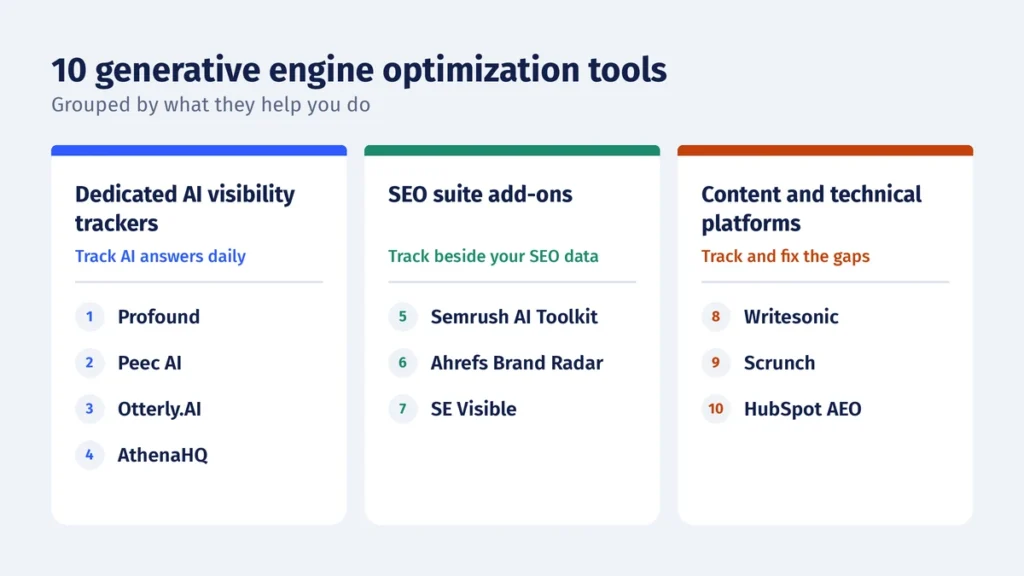
10 Best GEO Tools at a Glance
| # | Tool | Best For | AI Engines Tracked | Starting Price | Free Trial |
|---|---|---|---|---|---|
| 1 | Profound | Enterprise brands | 3 on trial, up to 9–10 | Custom quote | 7 days |
| 2 | Peec AI | Small marketing teams | 3 (more as add-ons) | $95/mo, 50 prompts | Yes (duration unlisted) |
| 3 | Otterly.AI | Solos and SMBs | 3 of 7 | $29/mo, 20–21 prompts | 7 days |
| 4 | AthenaHQ | Turning gaps into tasks | Up to 11 | $295/mo, 3,600 credits | Free tier (300 credits) |
| 5 | Semrush AI Toolkit | Existing Semrush users | 4 | $99/mo, 25 prompts | None (for standalone toolkit) |
| 6 | Ahrefs Brand Radar | Prompts from real search data | Up to 6–7 | $199/mo, 50 prompts | None (free plan excluded) |
| 7 | SE Visible | Agency reporting | 5 (6 on Agency) | $89/mo, 75 prompts | 10 days (14 on some pages) |
| 8 | Writesonic | Content teams | 3 below Enterprise (8 on Enterprise) | $79/mo, 50 prompts | 7 days |
| 9 | Scrunch | Technical GEO | 4 of 9 (Core plan) | $250/mo, 125 prompts | 7 days |
| 10 | HubSpot AEO | Budget teams wanting briefs | 3 | $50/mo, 25 prompts | 28 days |
Prices checked November 2026.
Dedicated AI Visibility Trackers
Dedicated trackers are built only for AI search. They show where your brand appears, what AI says about it, and which competitors win instead. Start here if you want daily tracking across several AI engines.
1. Profound: Best for Enterprise Brands
Profound gives enterprise brands the widest view of AI search. One dashboard tracks up to 9–10 answer engines, including ChatGPT, Perplexity, Gemini, Claude, Copilot, DeepSeek and Google AI Overviews, and shows the exact pages each engine cites.
- Engines: 3 on trial, up to 9–10
- Price: custom quote
- Free trial: 7 days, capped at 50 fixed prompts
- G2 rating: 4.5/5
Pros: broadest engine coverage; URL-level citations reveal which websites AI trusts in your industry; enterprise security with SSO and SOC 2 compliance.
Cons: no public pricing since mid-September 2026, when Profound dropped its $99 Starter and $399 Growth plans; the trial covers only 3 engines.
2. Peec AI: Best Value for Small Teams
Peec AI gives small teams daily AI tracking without a sales call. It runs your prompts across ChatGPT, Perplexity and Google AI Overviews and condenses the results into one visibility score. Its mentions feed shows the real AI answers that name your brand and the competitors recommended instead.
- Engines: 3 (more as add-ons)
- Price: $95/month for 50 prompts
- Free trial: yes (duration unlisted)
- G2 rating: 4.7/5
Pros: daily tracking on every plan; unlimited users; real AI answers, not just a score.
Cons: Gemini, Claude and Google AI Mode cost extra; lower plans allow 1 project in 1 country.
3. Otterly.AI: Best Low-Cost Option
Otterly.AI is the cheapest way on this list to start tracking how AI engines mention your brand. The base plan covers 3 of the 7 engines it supports. Every plan carries the full feature set; only the prompt count changes.
- Engines: 3 of 7
- Price: $29/month for 20–21 prompts
- Free trial: 7 days
- G2 rating: 4.7/5
Pros: lowest entry price; all features on every plan; quick setup.
Cons: extra engines are paid add-ons; monitoring only, with no content tools.
4. AthenaHQ: Best for Turning Data Into Action
AthenaHQ turns each gap in AI search into a task your team can work on, across up to 11 AI engines. Its Action Center writes your GEO to-do list, and GA4 and Shopify connections tie each visibility win to traffic and revenue, a step most trackers skip.
- Engines: up to 11
- Price: $295/month for 3,600 credits
- Free trial: free tier (300 credits)
- G2 rating: 4.9/5
Pros: clear task list; revenue attribution; the most engines of any self-serve plan here.
Cons: credit-based billing makes monthly cost hard to forecast; the self-serve plan covers 1 country.
SEO Suites With AI Visibility Add-Ons
These SEO platforms now track AI mentions next to the keywords, rankings and backlinks you already monitor. They fit best when your team already pays for Semrush, Ahrefs or SE Ranking.
5. Semrush AI Toolkit: Best for Semrush Users
Semrush AI Toolkit brings AI search tracking into a platform many SEO teams use daily, reporting mentions, share of voice and sentiment against competitors. Its Prompt Research tool groups real AI questions by topic, so one page can target several prompts at once.
- Engines: 4
- Price: $99/month for 25 prompts
- Free trial: none (for standalone toolkit)
- G2 rating: 4.4/5 (full Semrush platform)
Pros: AI and SEO data in one dashboard; finds the prompts your audience uses.
Cons: per-user pricing adds up for larger teams; fewer engines than dedicated trackers.
6. Ahrefs Brand Radar: Best for Real Search Data
Ahrefs Brand Radar builds its tracked prompts from real search behaviour instead of guesswork. It covers up to 6–7 AI platforms, including Google AI Overviews, ChatGPT, Perplexity and Gemini. Pair its mention data with Ahrefs backlinks to find the cited sites worth pitching.
- Engines: up to 6–7
- Price: $199/month for 50 prompts
- Free trial: none (free plan excluded)
- G2 rating: 4.5/5 (full Ahrefs platform)
Pros: prompts based on real searches; strong Google and ChatGPT coverage; backlink data reveals sites worth pitching.
Cons: the highest starting price among the SEO add-ons; no free trial.
7. SE Visible: Best for Agencies
SE Visible attaches SEO data to every cited source, which helps agencies prove results. It tracks 5 AI engines, including ChatGPT, Gemini, Google AI Mode and AI Overviews, with a 6th on the Agency plan. At about $1.19 per prompt, it has the lowest entry cost per prompt on this list.
- Engines: 5 (6 on Agency)
- Price: $89/month for 75 prompts
- Free trial: 10 days (14 on some pages)
- G2 rating: not listed
Pros: most prompts for the price; traffic and backlink data behind every citation; daily tracking across 42 countries.
Cons: the 6th engine needs the Agency plan; classic SEO needs a separate SE Ranking plan.
Content and Technical Optimization Platforms
Tracking shows where you’re missing. These platforms help you fix it with better content, crawler-ready pages or ready-made briefs. Pick from this group if you want to close gaps, not just measure them.
8. Writesonic: Best for Content Teams
Writesonic lets content teams find lost AI prompts and publish fixes in one tool. Its AI Traffic Analytics also shows which pages AI crawlers visit most.
- Engines: 3 below Enterprise (8 on Enterprise)
- Price: $79/month for 50 prompts
- Free trial: 7 days
- G2 rating: 4.7/5
Pros: tracking and writing in one tool; combines SEO and GEO work.
Cons: only 3 engines below Enterprise; the Action Center starts on higher tiers.
9. Scrunch: Best for Technical GEO
Scrunch serves AI-friendly versions of your pages to crawlers while tracking your brand across engines; human visitors see the site unchanged. It suits complex or JavaScript-heavy sites.
- Engines: 4 of 9 (Core plan)
- Price: $250/month for 125 prompts
- Free trial: 7 days
- G2 rating: 3.6/5
Pros: better AI readability without a site rebuild; multi-brand workspaces; 5 user seats included.
Cons: the Core plan covers only 4 of 9 engines; the lowest G2 rating on this list.
10. HubSpot AEO: Best Budget Option With Recommendations
HubSpot AEO pairs low-cost AI tracking with a content brief for every recommendation. For each prompt, it shows the AI answer, competitor results and what to publish next.
- Engines: 3 (ChatGPT, Perplexity, Gemini)
- Price: $50/month for 25 prompts
- Free trial: 28 days
- Free option: HubSpot AI Search Grader for a one-time check
- G2 rating: 4.4/5
Pros: a content brief with every recommendation; shows which sites drive AI citations; affordable for small teams.
Cons: no Google AI Overviews, AI Mode or Claude tracking; setup takes about 1 month, per G2 reviewers.
G2 ratings were checked in October 2026 and may change.
Which GEO Tool Fits Your Team?
The right GEO tool depends on your budget, the AI engines your buyers use, and whether you need tracking alone or help fixing gaps. Use this table to find your starting point:
| Team type | Start with | Why |
|---|---|---|
| Solo consultant or small business | Otterly.AI or HubSpot AEO | Lowest entry prices ($29 and $50/month); HubSpot adds content briefs |
| Small in-house marketing team | Peec AI | Daily tracking and unlimited users from $95/month |
| Team already on an SEO suite | Semrush AI Toolkit, Ahrefs Brand Radar or SE Visible | AI visibility data beside your existing SEO data |
| Agency with many clients | SE Visible or Scrunch | Lowest cost per prompt (about $1.19); multi-brand workspaces |
| Content-led team | Writesonic | Tracking and content writing in one tool |
| Team that wants a clear action plan | AthenaHQ | Gaps turn into tasks, across up to 11 AI engines |
| Team that wants to test before paying | HubSpot AEO or AthenaHQ | 28-day free trial; free tier with 300 credits |
| Enterprise brand | Profound | Up to 9–10 engines, SSO and SOC 2 |
What Should You Ask a GEO Tool Vendor Before Buying?
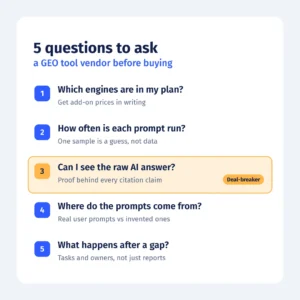
Ask every vendor to show how its data is collected, not just what its dashboard reports. Two tools can track the same prompt and report different results, depending on how often they sample answers and where their prompts come from. These 5 questions expose the difference:
- Which AI engines does my plan include, and what does each extra engine cost? Many tools list every engine on their website but include only 3 in the entry plan. Get the engine list and add-on prices in writing.
- How many times is each prompt run, and how often? AI answers change between runs, so one sample per prompt is a guess, not a measurement. Be wary of weekly checks or vague answers.
- Can I see the raw AI answer behind a reported citation? Without the original answer, you can’t check whether the tool’s citation data is accurate. Charts and scores alone aren’t proof.
- Where do the prompts come from, and how often are they updated? Real user prompts show what buyers ask; invented prompts show what the vendor guessed. A good vendor can tell you which is which.
- What happens after the tool finds a gap? A gap that sits on a dashboard changes nothing until someone owns the fix. Look for tasks, owners or integrations, not just reports.
Run a Manual Baseline First
Before paying for any tool, measure your current AI visibility by hand. It takes about an afternoon:
- Pick 15–20 buying-intent prompts that match your most important pages, such as “best [category] for [audience]” or “[your brand] vs [competitor].”
- Run each prompt in ChatGPT, Perplexity and Google AI Overviews, twice per engine, because answers vary between runs.
- Record 3 things in a spreadsheet: whether your brand is mentioned, which URLs are cited, and which competitors appear.
The baseline tells you whether you have a visibility gap worth paying to fix. It also gives you a benchmark: if a tool’s trial report disagrees with your manual results, ask the vendor why.
Connect Your Analytics During the Trial
Connect Google Search Console and GA4 during the free trial, so AI visibility data sits next to real traffic. Judge results by trends over several weeks, not single checks, because AI answers shift from day to day. A tool that can’t connect visibility to traffic leaves you guessing about return on investment.
Be Sceptical of “AI Markup” Promises
Google’s guide to generative AI features in Search says there is no special markup or schema needed to appear in AI Overviews or AI Mode, and no need for files such as llms.txt. Be wary of any tool that sells schema as a shortcut to AI citations. Structured data still helps with rich results and helps search engines read your facts, but citations come from content AI engines can quote and from mentions on the sites they trust.
How Did We Compare These GEO Tools?
We scored each tool on 5 criteria, using its published plans, pricing pages and G2 reviews:
- Engine coverage: which AI engines the entry plan includes and which cost extra.
- Per-engine reporting: whether you see results engine by engine, not only a blended score.
- Citation detail: whether you see the exact URLs each engine cites.
- Actionability: whether gaps turn into tasks or content, or stay as numbers.
- Agency fit and setup: multi-client workspaces, white-label reports and time to the first useful insight.
Scoring follows our audit methodology.
Want to Know Where Your Brand Stands in AI Search?
A GEO tool shows you the gaps. Closing them takes content AI engines can quote, mentions on the sites they trust, and pages their crawlers can read.
RankingBite’s GEO audit shows which buying prompts you win, which you lose to competitors, and the fixes that will move your brand into AI answers first.
FAQs About Generative Engine Optimization Tools
Do I need a GEO tool if I already use an SEO platform?
Not always. Semrush, Ahrefs and SE Ranking offer AI visibility add-ons. Choose a dedicated tool for more engines, daily tracking or deeper citation data.
How many prompts should I track?
Start with 15–50 prompts that match real buying questions, such as category queries (“best CRM for startups”) and comparisons (“tool A vs tool B”). Multiply by each market.
Can a GEO tool tell me why AI recommends my competitor?
Yes. Most GEO tools show the sources AI engines cite in each answer, including the pages behind a competitor’s mention. That list tells you which review sites, articles or forums to target.
What should I do after a GEO tool finds a visibility gap?
Start with the sources AI already cites. Update your pages with clear answers, statistics and structured data, then pitch the sites AI trusts most for mentions.