

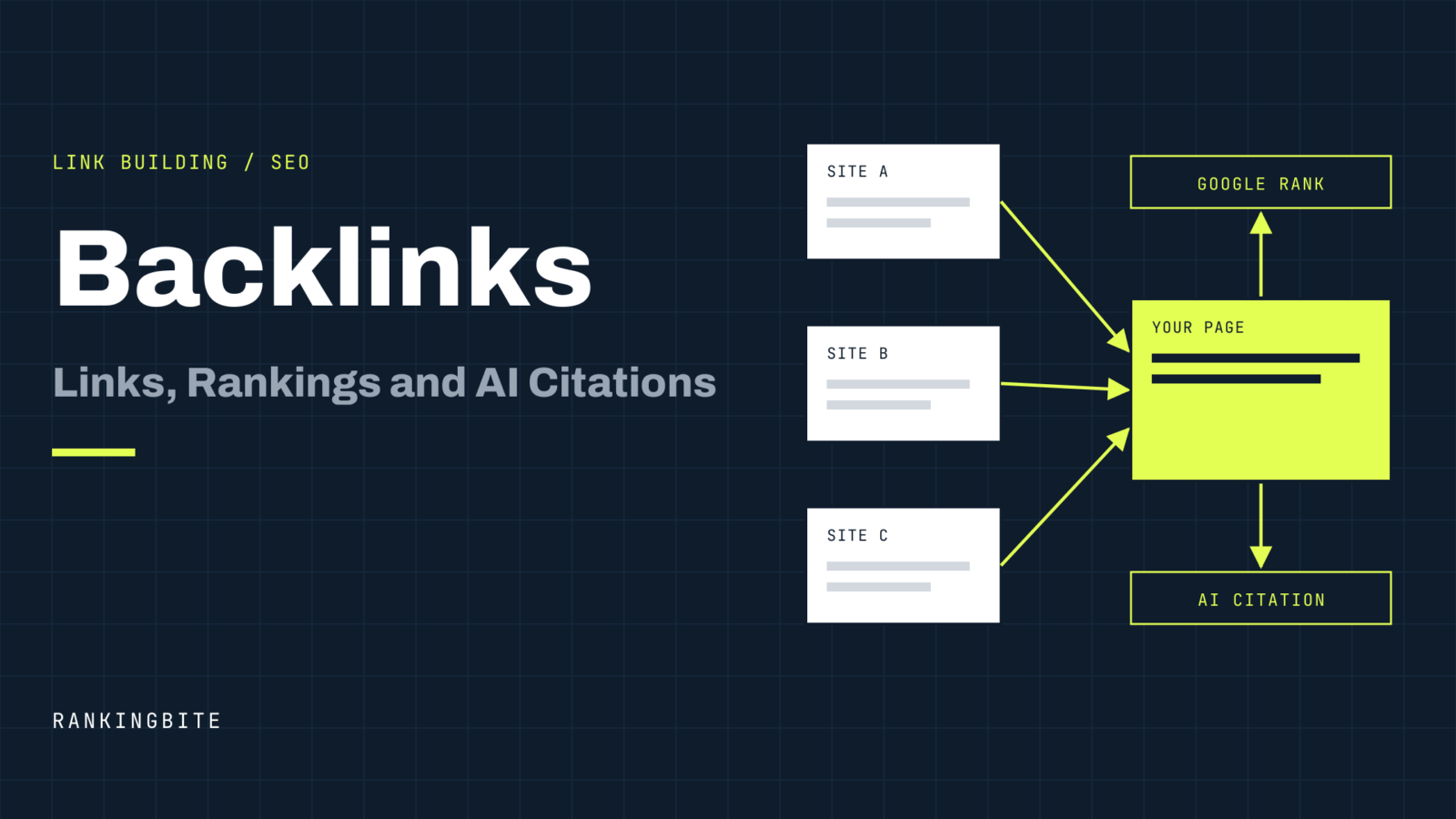
Backlinks are clickable links on one website that point to a page on another website, and search systems read them as signals of trust and relevance. Google has counted these links since its PageRank method was published in 1998, treating each relevant link as a vote for the page it points to.
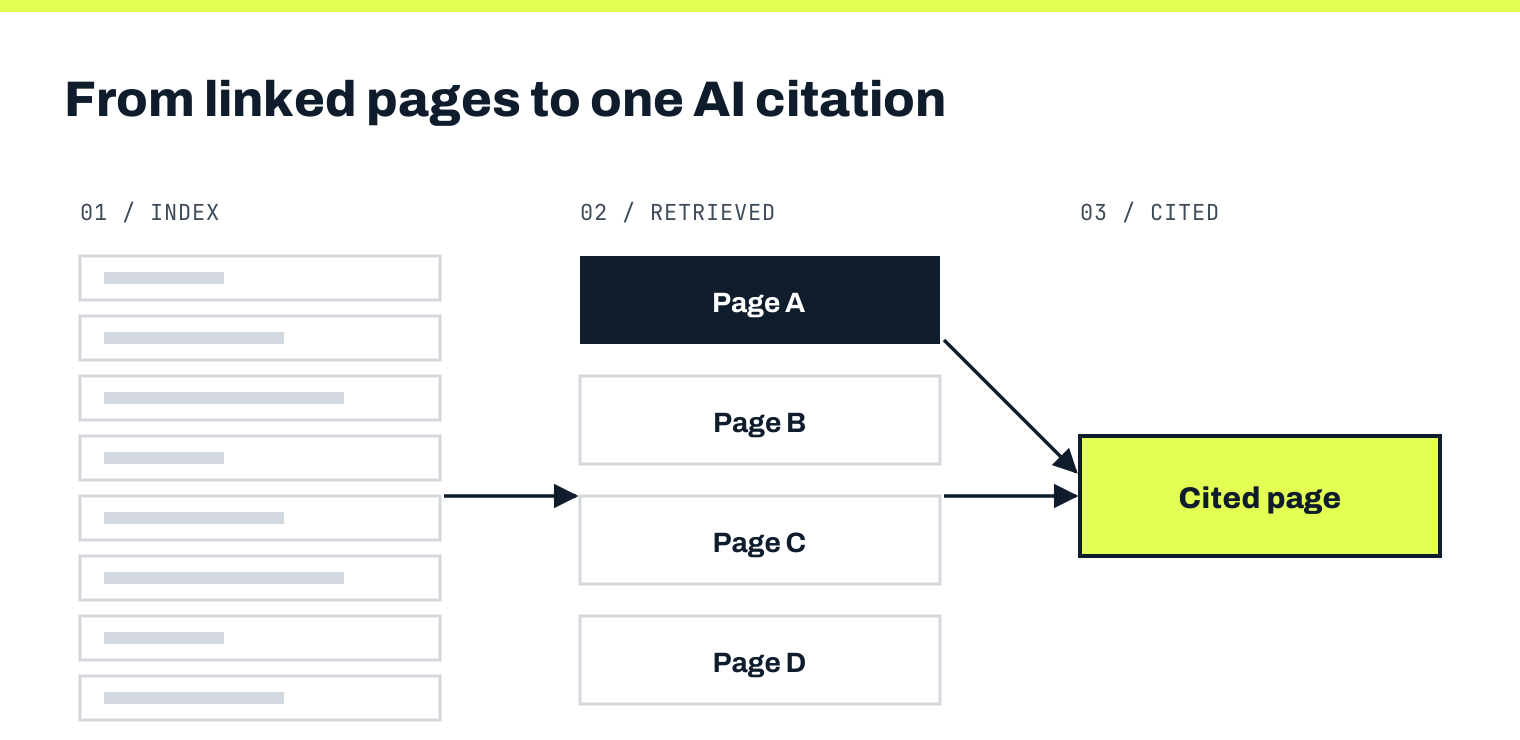
AI search uses backlinks in a different way. Answer engines such as Google AI Overviews and ChatGPT search first retrieve a short list of pages, then cite a few, and a page with strong links is more likely to make that list.
Link type, such as dofollow or nofollow, along with relevance and the page a link sits on, decides how much weight it carries. The signals that lift a Google ranking only partly overlap with the ones that earn an AI citation.
How Does a Backlink Connect Two Websites?
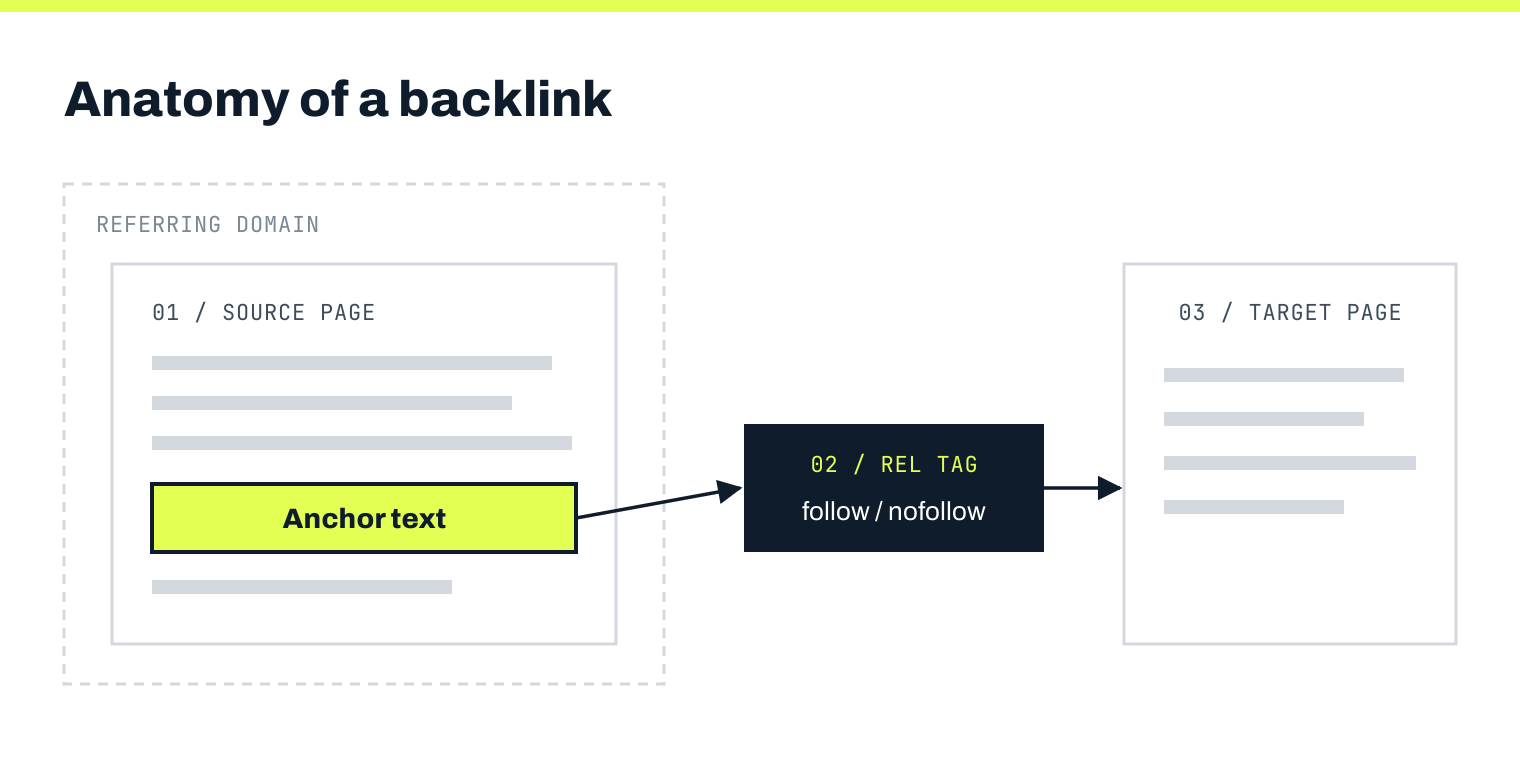
A backlink joins a source page on one site to a target page on another through a clickable piece of text called anchor text. The HyperText Markup Language (HTML) link can also carry a rel attribute, a short tag such as nofollow or sponsored that tells search engines how to treat it. A referring domain is the whole website that sends one or more backlinks, so 40 links from one site still count as a single referring domain.
What Types of Backlinks Exist?
Backlinks fall into six common types, and each one sends a different signal to Google. Since September 10, 2019, Google has read the rel attributes as hints rather than strict commands, so a nofollow link can still be considered.
| Type | Rel attribute | How Google treats it | Example |
|---|---|---|---|
| Followed | None | Passes ranking signals | A blog cites a study in its text |
| Nofollow | rel=”nofollow” | Treated as a hint, usually not followed | A link the site owner does not vouch for |
| Sponsored | rel=”sponsored” | Marked as paid, generally not followed | A paid product placement |
| User-generated | rel=”ugc” | Treated as a hint for user content | A link in a forum post or comment |
| Editorial | None | Strongest trust signal | A news article citing a brand’s data |
| Spam | Varies | Ignored or treated as a policy violation | Links from link farms or bought networks |
How Do Backlinks Work in Google Search?
Google uses backlinks to discover new pages and to judge how trusted and relevant a page is, with each link acting as a weighted vote. A link from a relevant, trusted page carries far more weight than a link from an unrelated or low-quality site.
That weight has shrunk over time. In April 2024, a Google search analyst said the system needs “very few links to rank pages” and that links had become less important over the years. Buying links or swapping them at scale to manipulate rankings breaks Google’s link spam policy and can end in ignored links or a manual action.
Which Backlinks Does Google Value Most?
Google values links that a site chose to give, on a page about the same subject, placed inside the main content. Four signals separate a useful link from a weak one:
- Relevance: The linking page covers a topic close to the target page.
- Editorial choice: An editor added the link on merit, not for payment or exchange.
- Contextual placement: The link sits inside body text, not in a footer, sidebar or sitewide template.
- Natural anchor text: The clickable words describe the page or name the brand instead of repeating an exact-match keyword.
Links from spam directories, private blog networks (PBNs) and comment sections rarely help, and a repeated pattern of them can trigger a manual action.
How Do Backlinks Work in AI Search?
In AI search, backlinks work mostly through retrieval: they help a page rank in the search index an answer engine queries, and only retrieved pages can be cited. Google AI Overviews and AI Mode pull their sources from Google’s own index, so the link signals behind a Google ranking also shape which pages these features see.
ChatGPT search shows how much retrieval rank matters. In data collected from June to September 2026, ChatGPT cited 43.8% of the pages it ranked first in its own search, against 12.2% of pages ranked 6 to 10 and 3.5% of pages ranked 11 to 20. Every page it cited came from that retrieved set, and its rankings rarely matched the top 10 of Google or Bing.
Which Backlinks Help Pages Get Cited by AI?
Links from many independent, trusted websites help most, because they lift a page in retrieval and show that third parties stand behind it. In the same 2026 citation study, pages with one standard deviation more referring websites earned 22.7% more AI citations. That figure is a correlation rather than proof of cause, since the links were measured after the citations.
Third-party coverage carries extra weight. A September 2025 comparison of ChatGPT, Perplexity and Gemini found a strong bias toward earned media, meaning independent articles and reviews, over brand-owned pages and social posts. A backlink inside a news story or industry review therefore does double duty: it passes a ranking signal and places the brand inside the sources AI engines prefer to quote.
Raw site authority matters less than expected. Once the number of cited pages was controlled, higher authority did not raise citations per page, so one strong page on a relevant site beats a homepage link from a big but unrelated domain. Checking which domains AI engines already cite for a topic shows where a new link would count most, a core step in citation visibility work.
Dofollow vs Nofollow Backlinks: Which One Counts?
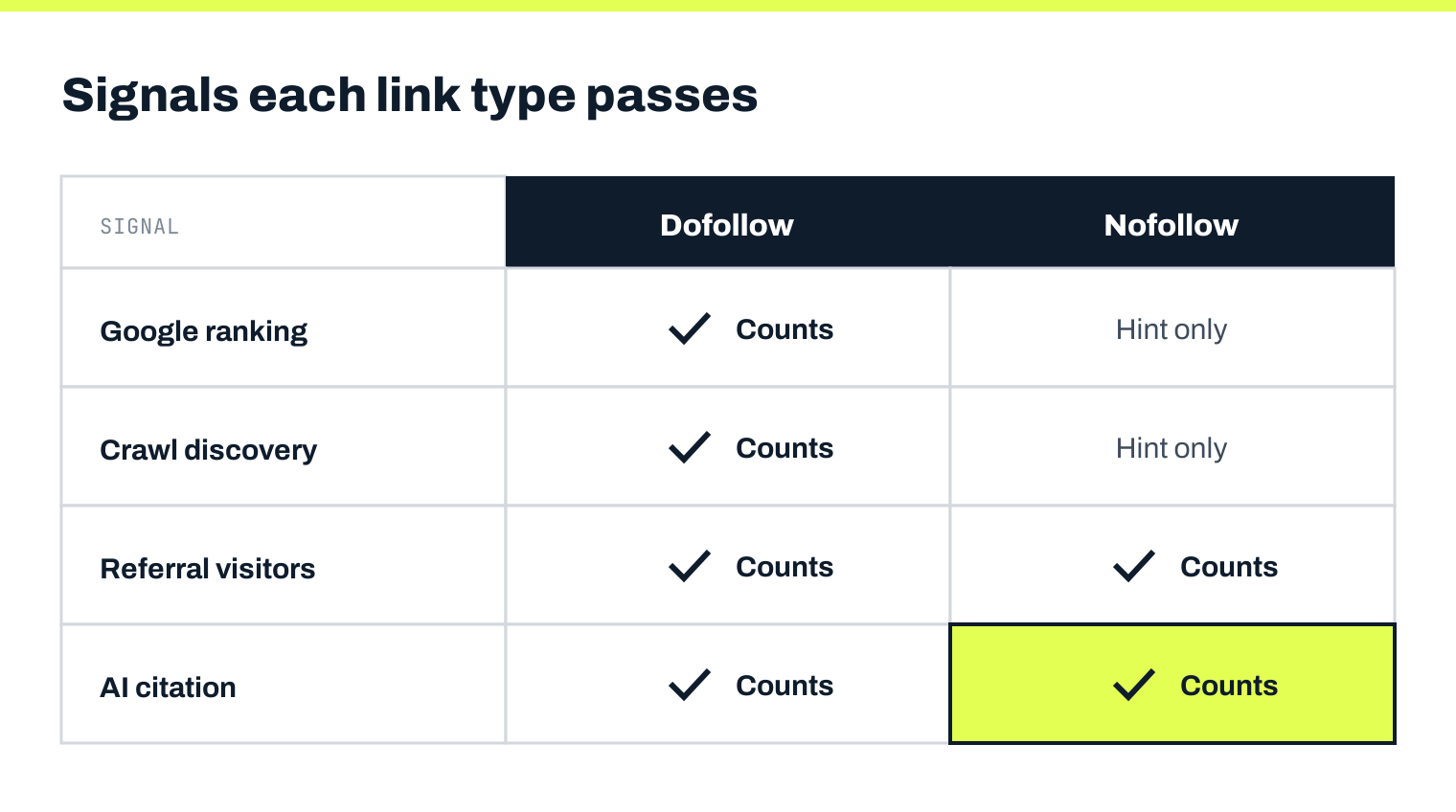
Dofollow backlinks count more, because they pass ranking signals by default, while nofollow backlinks count only as a hint in Google but can still help a page in AI search. A dofollow link is simply a standard link with no rel value, since “dofollow” is not a real HTML attribute, and a nofollow link carries rel=”nofollow”.
In Google Search, dofollow links carry the clear ranking weight. Nofollow links are read as a hint, so Google may still use one for discovery or ranking but gives it no guaranteed value. Links in Wikipedia articles and on most social platforms are nofollow by default, yet they still send referral visitors who click through to the page.
In AI search, the tag matters less. AI answers draw on page text, and a nofollow value does not stop that text from being retrieved or quoted, so a nofollow mention in a trusted article still places a brand among the earned sources answer engines prefer. A natural backlink profile mixes both types, since one made only of dofollow links can look built rather than earned.
FAQs
How long do backlinks take to show an impact?
Google has to recrawl the linking page before a new backlink counts, so the effect usually appears after several weeks to a few months.
Do internal links count as backlinks?
No. Links between pages on the same site are internal links; they spread authority and help crawling, while backlinks always come from another domain.
Do social media links count as backlinks?
Technically yes, but most platforms add nofollow or ugc tags, so these links mainly drive traffic and discovery rather than ranking signals.
How can backlinks to a site be checked for free?
The Links report in Google Search Console lists top linking sites, top linked pages and top linking text for any verified site.