Content that AI engines cite is more likely to answer a question in the first sentence, support its claims with reliable sources, and offer insights that go beyond what a search snippet can provide. Whether it’s Google AI Overviews, ChatGPT Search, or Perplexity, AI engines look for content they can understand, verify, and confidently reference. The rest of this guide breaks down exactly how to create content that AI engines cite, step by step.
Search behavior has shifted. A growing share of queries now gets answered directly inside an AI response instead of sending the searcher to a list of blue links. That means visibility isn’t just about ranking on page one anymore—it’s about becoming the source an AI model chooses to quote or summarize.
The encouraging part is that you don’t need to game the algorithm. Content that AI engines cite is built on the same fundamentals that have always mattered: clear writing, accurate information, and genuine expertise. The difference today is that those fundamentals need to be applied with greater clarity and consistency than ever before.
Key Takeaways
- AI engines cite content that is easy to extract, easy to trust, and worth citing.
- Direct answers in the first sentence get pulled into AI summaries more often than buried ones.
- Entities and context matter more than keyword density.
- FAQs only help if the answers are specific, not restated headlines.
- Trust comes from named sources and current data, not confident phrasing.
- An analyst voice explaining why, not just what, is what separates cited content from ignored content.
- Unedited AI drafts have detectable patterns that readers (and increasingly, ranking systems) discount.
Make AI-Assisted Drafts Sound Human
Drafting with AI isn’t the issue publishing an unedited draft is. Unedited AI text tends to share a few detectable habits:
- Repetitive transitional phrases (“It’s important to note,” “In today’s landscape,” “Moreover”)
- Uniform sentence length and rhythm across paragraphs
- Hedged, generic claims with no specific numbers or examples
- Section headers that promise a list or example that never actually follows through
Before publishing, check for:
- Vague phrases replaced with plain, specific language
- Long or repetitive sentences broken up
- At least one concrete example or observation added per section
- The piece read aloud once, listening for anything that sounds like a template
What Makes Content AI Engines Cite?
AI engines don’t choose content at random. They look for information that is clear, accurate, and easy to understand before using it in their responses. If your content answers a question well and supports its claims, it has a better chance of being cited.
In simple terms, citable content is content that AI can quickly identify, understand, and trust. It isn’t about adding more keywords or writing longer articles. It’s about presenting the right information in the right way.
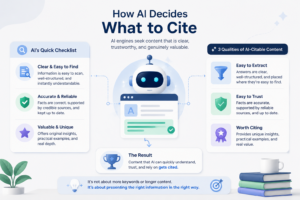
Most AI-citable content shares three key qualities:
- Easy to extract – Answers are clear, well-structured, and placed where they’re easy to find.
- Easy to trust – Facts are accurate, supported by reliable sources, and kept up to date.
- Worth citing – The content offers useful insights, practical examples, and real value instead of repeating what everyone else says.
The next sections break down each of these principles in detail, starting with how to structure your content so AI engines can easily extract the information they need.
How to Build Content That AI Can Extract Easily
Before AI can cite your content, it first needs to understand it. Content that AI engines cite is usually well-organized, easy to scan, and answers the main question without making readers search for the key information.
Start with a Direct Answer
Answer the main question in the first sentence or two. This helps readers find the information they’re looking for quickly and makes it easier for AI engines to identify the most important part of your content.
Use Descriptive Headings
Your headings should clearly explain what each section is about. Instead of vague titles, use headings that tell readers and AI exactly what information they’ll find next.
Keep Paragraphs Short and Focused
Stick to one idea per paragraph. Short paragraphs are easier to scan, improve readability, and help AI understand your content without getting lost in unnecessary details.
Example:
Instead of one long paragraph explaining three ideas, split it into three short paragraphs with one clear point each.
Group Related Information Together
Keep similar ideas in the same section instead of spreading them across the article. When related information stays together, it creates a clearer flow for both readers and AI engines.
Example:
Place all your tips for headings in one section instead of mentioning them throughout the article.
Use Lists and Tables Where They Add Clarity
Not everything needs to be explained in long paragraphs. Bullet lists, numbered steps, and tables make information easier to scan, compare, and extract—especially when presenting tips, features, or comparisons.
Example:
Instead of writing five tips in one paragraph, present them as a simple bullet list so readers can scan them in seconds.
Why it matters
AI engines don’t read content the way people do. They look for patterns, headings, and clear answers to understand what a page is about. The easier your content is to extract, the better its chances of becoming content that AI engines cite. At the same time, a well-structured article also makes the reading experience better for your audience.
Write Around Entities, Not Just Keywords
Keywords help AI discover your content, but entities help it understand your content. An entity can be a person, brand, place, product, concept, or anything with a clear identity.Keywords help AI discover content, but entities help AI determine exactly who or what your content is discussing. Modern NLP systems identify named entities and connect them to structured knowledge, making the content easier to interpret accurately.
Instead of only using keywords:
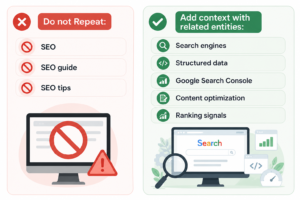
This helps AI understand how different ideas connect, making your content richer and more useful. Don’t write for keywords alone. Write so every important topic is clearly explained with the right context and relationships.
Use FAQs That Answer Real Questions
FAQs work well for AI citation because a clear question followed by a direct answer mirror both how people phrase searches and how AI engines structure responses. But a weak FAQ, one that just restates the article’s thesis adds little.The U.S. government’s plain language guidance recommends organizing content around users’ real questions and answering those questions directly. This approach helps readers find information faster and improves comprehension.
Weak FAQ example:
Q: What makes content AI-citable?
A: Content is more likely to be cited when it answers questions clearly and is backed by reliable information.
This just repeats the page title. It doesn’t answer anything a reader couldn’t already guess.
Stronger FAQ example:
Q: Do I need schema markup for AI engines to cite my content?
A: Schema markup isn’t required for citation, but FAQ Page and Article schema make it easier for crawlers to identify direct answers and authorship both of which correlate with higher citation rates in Google’s AI Overviews specifically.
The second version answers a question a real searcher would type, and it gives information the reader didn’t already have.
Earn Trust Through Facts, Not Just Opinions
Anyone can make a claim, but trusted content explains why that claim is true. AI engines and readers are more likely to trust information that is accurate, supported by reliable sources, and presented with evidence instead of assumptions.
| Instead of… | Try this… |
|---|---|
| Making bold claims without proof | Back them up with reliable sources or data. |
| Using outdated statistics | Check that your facts are current before publishing. |
| Quoting information without context | Explain where the information comes from and why it matters. |
| Relying only on opinions | Include evidence, examples, or expert insights to support your point. |
Develop an Analyst Voice, Not Just an AI Voice
Good content doesn’t stop at explaining what something is, it also explains why it matters. That’s what separates an analyst voice from generic AI-generated writing.
Generic vs. Analyst Writing
Generic:
AI citations are becoming important for SEO.
Analyst:
AI citations matter because users are increasingly getting answers directly from AI engines. If your content isn’t clear enough to be cited, it may lose visibility even if it ranks well in traditional search results.
How to write like an analyst
- Explain the why, not just the what.
- Connect ideas instead of listing facts.
- Use examples to support your point.
- Share observations backed by evidence.
- Help readers understand the bigger picture.
An analyst voice makes your content more useful because it teaches readers something beyond the basics.
Make AI-Assisted Content Sound Human
Using AI to draft content isn’t the problem. Publishing it without editing is.
Most AI-generated drafts contain repetitive phrases, predictable sentence patterns, and generic explanations. A quick human review can make the content feel more natural and enjoyable to read.
Signs your content sounds AI-written
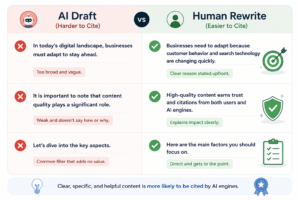
What to change before publishing
- Replace vague or overused phrases with plain language.
- Break up long, repetitive sentences.
- Add examples or observations where they improve understanding.
- Read the content out loud to check if it sounds natural.
Bring It All Together with a Simple Content Workflow
Writing content that AI engines cite isn’t about following one rule—it’s about combining several good writing practices into a consistent process.
A simple workflow to follow
Research the topic
↓
Answer the main question first
↓
Add relevant entities and context
↓
Include helpful FAQs
↓
Verify every important fact
↓
Add your own analysis
↓
Edit for a natural, human voice
↓
Publish with confidence
Common Mistakes That Cost AI Citations
| Mistake | Better approach |
|---|---|
| Opening with a long introduction | Answer the main question in sentence one. |
| Focusing only on keywords | Name the relevant entities and explain their relationships. |
| Making claims with no source | Attribute every factual claim to a named, dated source. |
| Writing generic explanations | Add original insight or a specific example. |
| Publishing AI drafts unedited | Edit for rhythm, specificity, and a human read-aloud check. |
Final Thoughts
Creating content that AI engines cite isn’t about following the latest SEO trick. It’s about publishing content that is clear, accurate, and genuinely useful. The same qualities that help AI understand your content also make it more valuable for the people reading it.
If you’re building a long-term content strategy, focus on the fundamentals—structure your content well, explain topics with context, verify your facts, share original insights, and always edit for a natural voice. These practices don’t just increase your chances of creating content that AI engines cite; they also help you build lasting trust with your audience.
To put these principles into practice, explore the detailed guides linked throughout this page. Each one takes a deeper look at a specific technique and shows you how to create content that AI engines cite consistently.
