
How to Write FAQs That Earn AI Citations

FAQs that earn AI citations are question-and-answer sections that address specific user queries with direct, accurate, and self-contained answers. To make FAQs more useful for AI citations, choose questions people actually search for, answer each one clearly, and include enough context for the response to make sense on its own.
Many articles include FAQ sections, but few create FAQs that earn AI citations. The problem isn’t the number of questions; it’s that they often repeat the article, cover vague topics, or fail to match what people actually want to know.
A well-written FAQ section makes information easier to find and understand. This article explains how to create FAQs that earn AI citations by selecting relevant questions, writing concise answers, and avoiding common mistakes that reduce their usefulness.
Key Takeaways
- Focus on real questions instead of guessing what readers might ask.
- Keep each FAQ limited to one clear intent.
- Answer the question in the first sentence.
- Write answers in one to three sentences.
- Use clear, factual language without unnecessary filler.
- Add FAQs that provide new information instead of repeating the article.
- Include only accurate, verifiable information.
- Link to a separate article when a topic needs a detailed explanation.
Why Some FAQs Never Get Cited
Many FAQ sections fail because they repeat information, use broad wording, or answer questions that readers are not actually asking. Instead of solving a specific problem, they add content without adding value. These issues also affect the broader process of getting cited by AI, where relevance, extractability, and credible supporting information influence which sources answer engines select.
Research in information retrieval and question answering shows that systems identify and retrieve information more effectively when it is organized around focused questions with clear, self-contained answers.
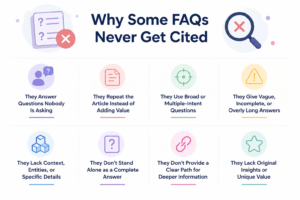
They Answer Questions Nobody Is Asking
Some FAQs are written from the writer’s perspective instead of the reader’s, using formal or technical phrasing that people rarely type into a search bar. A question that sounds precise to a writer can be one nobody actually asks. The fix is matching the question to how people actually search, which is essential for creating FAQs That Earn AI Citations and is covered in the next section in detail.
Less useful
What are advanced content optimization methodologies?
Better
How do I optimize content for AI search?
The second question reflects natural language and a single, clear intent, making it easier to understand and retrieve. Studies have found that matching natural-language queries improves information retrieval performance.
They Repeat the Article Instead of Adding Value
An FAQ should answer a question that the main content has not already covered. Repeating the same information makes the section less useful.
Bad FAQ vs Better FAQ
Bad FAQ
- Q: Why is content important for AI search?
- A: Content is important because AI search uses content to answer questions.
Better FAQ
- Q: Should every article include an FAQ section?
- A: No. Add an FAQ only when it answers a genuine follow-up question that isn’t already explained in the article.
Each FAQ should contribute something new rather than restating existing content.
Find the Questions Real People Ask
Strong FAQs begin with real questions, not guesses. The goal is to understand what people are actually trying to learn and phrase each question the way they naturally ask it. Research in information retrieval has shown that matching user language improves the chances of retrieving relevant information because the wording aligns more closely with search intent rather than author terminology. This is an important part of creating FAQs That Earn AI Citations, as relevant questions make answers more useful to both readers and AI systems.
Listen to the Language People Actually Use
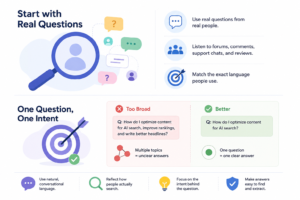
People rarely search using formal or technical phrases. They usually ask complete questions in everyday language.
Instead of
Content optimization techniques
Use
How do I optimize content for AI search?
The second example reflects conversational wording and makes the intent immediately clear. Studies on query formulation show that using natural language helps information retrieval systems better match questions with relevant answers.
One Question = One Clear Intent
Each FAQ should answer only one question. Combining multiple topics into a single FAQ makes the answer less focused and harder to understand.
Too broad
- Q: How do I optimize content for AI search, improve rankings, and write better headlines?
This question mixes three different topics.
Better
- Q: How do I optimize content for AI search?
- A: Start by answering the main question clearly, use descriptive headings, and organize information so each section covers one topic.
A 2026 ACL study, MAB-DQA: Addressing Query Aspect Importance in Document Question Answering with Multi-Armed Bandits, examined how document question-answering systems handle queries with multiple information aspects. Its framework separated queries into aspect-specific subqueries and achieved an average improvement of 5%–18% over the compared state-of-the-art method across four benchmarks. Although the study focuses on document question answering, it illustrates why separating distinct information needs can help retrieval systems identify relevant evidence more effectively.
Write Answers That AI Can Lift
A strong FAQ answers the question immediately and includes only the information needed to make the answer complete. Research on question answering shows that clear, self-contained answers are easier to identify and extract than responses that delay the main point. This is a key principle behind writing FAQs That Earn AI Citations, as direct answers make relevant information easier for AI systems to reference.
Answer in the First Sentence
Start with the answer instead of building up to it.
Poor Answer
- Content can be improved in several ways depending on the article.
Improved Answer
- Start by answering the main question clearly, then add supporting details.
Keep Answers Between One and Three Sentences
Most FAQ answers are effective in one to three sentences. If more explanation is needed, link to a dedicated article instead.
Add Context Without Overexplaining
Include only the context needed to make the answer clear.
Poor Answer
- Yes, FAQ sections have many benefits and can improve websites in different ways.
Improved Answer
- Yes, An FAQ section is useful when it answers follow-up questions that are not already covered in the article.
Good FAQs (FAQs That Earn AI Citations) vs Weak FAQs
Not every FAQ is equally useful. A strong FAQ answers a specific question in clear language and provides information that stands on its own. A weak FAQ is often too broad, repeats the article, or uses vague wording that leaves the reader with more questions.
Research in question answering has found that focused questions paired with concise, relevant answers improve retrieval accuracy because the relationship between the question and answer is more explicit. This makes the information easier to identify and reuse in retrieval systems, which is essential for creating FAQs That Earn AI Citations.
| Weak FAQ | Better FAQ |
|---|---|
| Repeats the article title | Answers a specific question. |
| Vague wording | Conversational language. |
| Long explanation | Direct answer + brief context. |
| Generic advice | Practical information. |
Example
Weak FAQ
- Q: Why is AI search important?
- A: AI search is becoming popular and is changing how people find information online.
Better FAQ
- Q: Why should I add an FAQ section to my article?
- A: Add an FAQ section when readers are likely to have follow-up questions that the main content does not answer.
Write in Canonical Language
The wording of an FAQ answer affects how easily it can be understood. Clear, direct language reduces ambiguity for readers and helps information retrieval systems interpret the meaning more consistently. This is especially important when writing FAQs That Earn AI Citations, as precise wording makes answers easier to understand and interpret. Research in linguistics and natural language processing has shown that ambiguous expressions require additional interpretation, while precise statements are easier to process and classify.
Instead of making uncertain statements by default, use language that is accurate, direct, and supported by evidence. The goal is not to sound more confident than the facts allow, but to avoid unnecessary hesitation when the information is already established. This clarity helps make FAQs That Earn AI Citations more reliable and useful for readers and AI systems.
| Instead of | Use |
|---|---|
| Probably | Is (when supported by evidence) |
| It depends | Can (when outcomes vary) |
| Usually | Helps (when evidence shows a general benefit) |
| Might not | Does not (when a verified fact supports it) |
Example 1
- Less clear
An FAQ will probably improve the reader’s experience.
- Better
A well-written FAQ helps readers find answers more quickly.
Example 2
- Less clear
This method usually works for most articles.
- Better
This method helps create consistent, easy-to-understand FAQ answers when each question has a single, clear intent.
Use definitive language only when the evidence supports it. If research is inconclusive or outcomes genuinely vary, acknowledge the uncertainty instead of overstating the claim.
Questions That Deserve Their Own FAQ
Not every question belongs in an FAQ section. The best FAQs That Earn AI Citations answer follow-up questions that add new information instead of repeating the main article. Research on question answering shows that focused questions with distinct intents improve answer retrieval because each response addresses a single information need rather than multiple topics.
Include FAQs that provide information readers are likely to look for after reading the main content, such as:
- Definitions – Explain an unfamiliar term or concept.
- What is a direct-answer lead?
- Comparisons – Help readers understand the difference between related topics.
- How is an FAQ different from a knowledge base?
- Requirements – Explain what is needed before applying a method.
- Do all articles need an FAQ section?
- Exceptions – Clarify when a recommendation may not apply.
- When should I avoid adding an FAQ?
- Common Misconceptions – Correct widely held misunderstandings.
- Does adding more FAQs improve content quality?
- Practical Steps – Answer “how-to” questions with clear actions.
- How do I write an FAQ answer in one to three sentences?
If a question introduces new information or answers a genuine follow-up, it belongs in the FAQ. If it simply repeats the article, leave it out.
When to Link Instead of Expanding
Not every question can be answered in two or three sentences. Some topics need examples, step-by-step instructions, or a detailed explanation. In these cases, keep the FAQ concise and direct readers to a dedicated article instead of turning the answer into a long paragraph. This approach helps create FAQs That Earn AI Citations by keeping answers focused while providing access to more detailed information when needed.
Example
Question
How should I structure content so AI can understand it?
FAQ Answer
Use a clear heading hierarchy, answer the main question early, and organize each section around a single topic. For a complete walkthrough, read our guide on Content Structure for AI Extraction.
This approach keeps the FAQ easy to scan while giving readers a clear path to more detailed information. It also prevents the FAQ section from becoming repetitive or overwhelming.
As a general rule, if answering a question requires a complete tutorial, summarize the key point in the FAQ and link to the full article. This keeps each answer focused while helping readers find the depth they need
Strengthen FAQs with Clear Entities and Verified Facts
Clear and accurate FAQs are easier to understand and more reliable. Before publishing, make sure each answer follows these principles:
- Mention the actual product, person, organization, standard, or concept instead of using vague words like it, they, or this.
- Be specific so readers immediately know what the answer refers to.
- Include only information that you can verify from reliable sources.
- Remove unsupported claims, estimates, or assumptions.
- Keep facts up to date if the topic changes over time.
Example
- Less clear: It helps improve content quality.
- Better: A direct-answer lead helps improve content structure for AI extraction by making the main answer easier to identify. For a deeper explanation, read Entity & Attribute-Rich Content.
Before You Publish: Review Every FAQ
A quick review before publishing can help you catch unclear wording, repeated information, or unsupported claims. Go through each FAQ and ask the following questions.
Does This Answer a Real Question?
Make sure the question reflects something your audience is actually likely to ask, not something added just to fill the FAQ section.
Can Someone Understand the Answer Immediately?
The answer should be clear from the first sentence without requiring readers to search through the rest of the article.
Is the Answer Under Three Sentences?
Keep answers brief and focused. If a topic needs a longer explanation, summarize it and link to a dedicated article.
Does It Avoid Unnecessary Jargon?
Use simple, natural language that readers can understand without technical explanations.
Is Every Claim Verifiable?
Include only information that you can support with reliable sources. Remove assumptions or unsupported statements.
Would This Answer Make Sense on Its Own?
Each FAQ should still be useful if it appears outside the article or is shown independently in search results or AI-generated responses.
FAQs
What makes an FAQ more likely to earn AI citations?
An FAQ is more likely to be cited when it answers a real question directly, uses clear language, and provides a complete answer in one to three sentences.
How many FAQs should an article include?
There is no fixed number. Include only the questions that add new value and address genuine follow-up queries.
Can one FAQ answer multiple questions?
No, Each FAQ should focus on one question and one clear intent to keep the answer specific and easy to understand.
Should I repeat information from the article in the FAQ?
No, Each FAQ should provide new information, clarify a point, or answer a follow-up question instead of repeating the main content.
Is conversational language better for FAQs?
Yes, Writing questions the way people naturally ask them makes the FAQ easier to understand and more relevant to user intent.
Can I link to another article from an FAQ?
Yes, If a topic requires a detailed explanation, provide a brief answer and direct readers to a dedicated article for more information.