Getting cited by AI means your content is selected as a trusted source for AI-generated answers. As platforms like ChatGPT, Google AI Overviews, Perplexity, and Microsoft Copilot become more common, earning AI citations can improve your visibility, credibility, and organic traffic.
This guide covers how AI answer engines choose sources, the factors that influence citation decisions, and practical strategies to help your content become more discoverable, trustworthy, and citable.
What Does It Mean to Get Cited by AI?
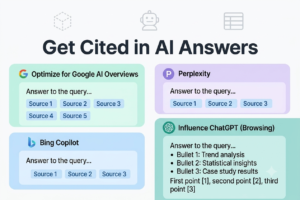
Getting cited by AI means an AI answer engine uses your content as supporting evidence when generating a response. Instead of simply linking to a webpage, AI may reference or attribute the information it relied on, helping users verify where the answer came from.
AI Citations vs. AI Recommendations
AI citations and AI recommendations serve different purposes. A citation attributes information to a source used to generate an answer, while a recommendation suggests a product, service, or resource based on the user’s query. A page can be recommended without being cited, and cited without being recommended.
Why AI Citations Matter
AI citations increase your content’s visibility in AI-generated answers and strengthen credibility by associating your brand with trusted information. They can also drive qualified traffic, build authority, and expand your reach beyond traditional search results.
Adobe’s 2025 AI survey, based on 1 trillion visits to U.S. retail websites, found that traffic from generative AI sources increased by 1,200% between July 2024 and February 2025, showing how quickly AI-driven referrals are growing.
Rise of Answer Engine Optimization (AEO)
Answer Engine Optimization (AEO) is the practice of creating content that AI answer engines can easily retrieve, understand, and cite. Unlike traditional SEO, which focuses on rankings, AEO emphasizes clear answers, structured content, factual accuracy, and strong trust signals to improve visibility in AI-generated responses.
A Semrush study of more than 10 million keywords found that Google AI Overviews appear most frequently for informational searches, reinforcing the need to optimize content for direct answers rather than rankings alone.
How AI Answer Engines Find and Cite Information
AI answer engines retrieve, evaluate, and synthesize information before generating a response. Understanding this retrieval-first process helps explain how AI selects the sources it cites.
How AI Answer Engines Work
AI answer engines retrieve relevant information, assess its quality, and generate a response based on the strongest supporting evidence.
Retrieval Comes Before Generation
Before producing an answer, AI systems first retrieve relevant information to improve accuracy and ground their responses in reliable sources.
Retrieval-Augmented Generation (RAG) Explained
Retrieval-Augmented Generation (RAG) combines information retrieval with language generation, allowing AI to answer questions using relevant external content rather than training data alone.
Query Fan-Out Explained
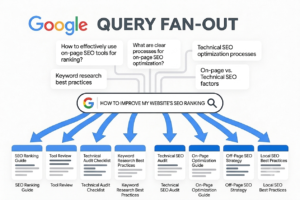
Query fan-out is the process where an AI answer engine expands a single user query into multiple related searches before generating a response. Instead of relying on one search, the system retrieves information from several relevant angles to build a more complete and accurate answer.
How AI Chooses Which Sources to Cite
AI prioritizes sources that are relevant, well-structured, trustworthy, and supported by reliable evidence, making them more likely to be cited in generated responses.
Why Ranking #1 Doesn’t Guarantee AI Citations
Ranking first in traditional search results does not automatically mean your content will be cited by AI answer engines. While search rankings measure how pages perform in search results, AI citations depend on whether the content provides the most relevant, trustworthy, and extractable information for a specific query.
An Ahrefs analysis of 300,000 keywords found that pages appearing in Google’s AI Overviews were not always the highest-ranking organic results, indicating that AI systems prioritize relevance and supporting evidence over ranking position alone.
Rankings and Citations Are Different
Search engines rank web pages based on hundreds of signals to determine their position in search results. AI answer engines, however, retrieve and evaluate information before generating a response. As a result, a lower-ranked page may be cited if it answers the query more clearly and provides stronger supporting evidence.
Why Smaller Sites Can Be Cited
Smaller websites can earn AI citations by publishing accurate, well-structured, and original content. A page that directly answers a niche question or presents unique insights may be selected over a higher-authority website with broader but less relevant content.
Why AI Prioritizes Evidence Over Position
AI answer engines prioritize the quality of evidence rather than a page’s search ranking. Content that is relevant, clearly written, supported by credible sources, and easy to extract is more likely to be cited than content that ranks highly but lacks direct, verifiable answers.
Six Factors That Drive AI Citations
AI answer engines evaluate multiple signals before selecting content as a citation. While every platform uses its own retrieval and ranking methods, they consistently prioritize content that is relevant, trustworthy, and easy to understand. The following factors have the greatest influence on whether your content is cited.
Relevance – Does Your Content Match the Actual Query?
Relevance is the foundation of AI source selection. Content that directly answers the user’s question is more likely to be retrieved and cited than content that only discusses the topic broadly.
Search Intent – Does Your Content Answer What Users Actually Want?
Matching search intent means understanding the purpose behind a query. If users are looking for an explanation but your page focuses on promotion or unrelated information, AI is less likely to select it. Align your content with the user’s actual information needs.
Extractability – Can AI Lift a Clean Answer From Your Page?
AI favors content that is easy to extract. Use descriptive headings, concise paragraphs, bullet points, tables, and direct definitions so important information can be identified quickly.
Entity Clarity- Does AI Know Who You Are?
Clearly identify your brand, products, people, and topics throughout your content. Consistent entity information helps AI understand relationships and attribute information accurately.
Corroboration – Does Anyone Else Confirm Your Claims?
Information supported by multiple credible sources is generally considered more reliable. Citing reputable references and earning mentions from trusted websites can strengthen your content’s credibility.
Freshness – How Recently Was This Verified?
Regularly updated content is more likely to be trusted, especially for topics that evolve quickly. Review statistics, examples, and factual information to ensure they remain accurate.
Authority – Why Should AI Trust This Source?
Authority is built through expertise, accurate information, transparent sourcing, and a consistent publishing history. Demonstrating experience and supporting claims with reliable evidence increases the likelihood of AI selecting your content as a citation.
What Type of Content Get Cited Most?
Not all content has the same likelihood of being cited by AI answer engines. AI systems generally favor content that provides clear answers, original insights, and well-structured information that is easy to retrieve and verify. The following content formats are cited most frequently.
Definitions and Direct Answers
Content that clearly defines a concept or answers a question upfront is easier for AI to retrieve and use in generated responses.
Original Research, Data, and Statistics
Unique research, proprietary data, surveys, and verified statistics provide evidence that AI systems can reference when generating factual answers.
Orbit Media’s 2024 Annual Blogger Survey, based on responses from more than 1,000 bloggers, found that bloggers who publish original research are significantly more likely to report “strong results” than those who don’t.
Comparison Tables and Structured Lists
Tables, bullet lists, and other structured formats make key information easier to scan, compare, and extract accurately.
Expert Commentary and First-Hand Experience
Insights based on subject matter expertise, practical experience, or original analysis add unique value that AI systems are more likely to cite than generic content.
How to Build Authority Beyond Your Own Site
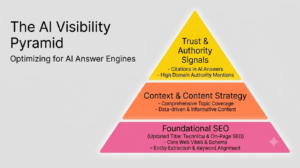
AI answer engines assess more than the content on your website. They also consider how your brand is recognized, referenced, and validated across the web. Building authority beyond your own site increases trust and improves your chances of being cited.
Why Being Mentioned Beats Being Ranked
Mentions on reputable websites help establish credibility, even if your page isn’t the highest-ranking search result. Independent references reinforce your brand as a trusted source.
How to Get Into the Roundups, Reviews, and Threads AI Retrieves
Earning mentions in expert roundups, product reviews, industry discussions, and community threads increases your visibility in the sources AI frequently retrieves.
Digital PR and Expert Contributions
Publishing original research, sharing expert insights, and contributing to reputable publications help build authority beyond your own website.
Keeping Your Brand Entity Consistent Across the Web
Consistent brand names, business details, and entity information across websites, directories, and social profiles make it easier for AI to recognize and trust your brand.
Topical Authority and Content Clusters
Creating interconnected content around a specific topic demonstrates expertise and helps AI understand your authority within that subject area.
Technical Foundations for AI Citations
Creating high-quality content is only part of the process. It also needs to be accessible, crawlable, and easy for AI systems to interpret. These technical foundations improve content discovery and help AI answer engines retrieve and cite your pages more effectively.
Are You Blocking AI Crawlers Without Realizing It?
The first step is to ensure AI crawlers can access your content. Incorrect robots.txt rules, restrictive meta robots tags, or server configurations can unintentionally prevent AI systems from crawling your important pages.
Does Your Content Render Without JavaScript?
Content should be available even if JavaScript doesn’t load completely. Important text, headings, and key information that depend entirely on client-side rendering may be harder for some AI retrieval systems to access.
Structured Data and Schema That Helps Retrieval
Structured data helps search engines and AI systems better understand the meaning of your content. Using appropriate schema markup for articles, FAQs, organizations, and products provides additional context that supports retrieval and interpretation.
Internal Linking and Crawl Paths
A clear internal linking structure makes it easier for crawlers to discover related pages and understand topical relationships. Connecting relevant content also strengthens your site’s overall topical authority.
Metadata and Page Experience Basics
Clear title tags, descriptive meta descriptions, logical heading structure, and a fast, mobile-friendly experience make content easier to discover and navigate. While these elements don’t guarantee AI citations, they create a stronger technical foundation for both users and AI retrieval systems.
A Backlinko and ClickFlow analysis of approximately 5 million Google search results found that pages with a meta description earned about 6% more clicks than pages without one.
How Do You Measure AI Citations?
Measuring AI citations means tracking how often your content is referenced, recommended, and discovered across AI answer engines. Because AI visibility extends beyond search rankings, monitoring the right metrics helps you understand your content’s reach, authority, and overall performance.
SparkToro and Datos analyzed billions of Google searches and found that nearly 60% of searches ended without a click, highlighting why visibility alone is no longer enough and why measuring citations separately from traffic is becoming increasingly important.
You’ll Get Cited and Get No Traffic
AI citations don’t always generate clicks because users may get their answer directly within the AI response. Even without traffic, citations increase brand visibility, reinforce credibility, and establish your content as a trusted source.
Tracking AI Citations
Tracking AI citations helps you identify where and how often your content is referenced in AI-generated answers. Monitoring citations over time reveals which topics and pages are earning the most visibility.
Tracking AI Recommendations
Tracking AI recommendations shows how often your brand, products, or services are suggested in AI responses. Unlike citations, recommendations measure brand exposure even when your content isn’t directly referenced.
Measuring AI Referral Traffic
Measuring AI referral traffic helps you understand how many visitors arrive from AI platforms and which content attracts them. This provides insight into how AI visibility translates into website engagement.
Share of AI Voice
Share of AI Voice measures how frequently your brand appears in AI-generated answers compared with competitors. It helps evaluate your visibility within your industry and identify opportunities to strengthen your presence.
The Metrics Worth Monitoring
The most valuable AI visibility metrics include citation frequency, recommendation frequency, AI referral traffic, Share of AI Voice, and branded mentions. Tracking these together provides a more complete view of your performance across AI answer engines.
The AI Citation Checklist
- AI crawlers aren’t blocked
- Content renders without JavaScript
- Every H3 answers its question in the first two sentences
- Headings mirror real queries
- Claims carry evidence data, sources, or first-hand experience
- Entity is consistent across site, schema, and third-party mentions
- You appear in the roundups and threads your buyers ask about
- Content is verified, not just re-dated
- Citations tracked across all four major engines
Frequently Asked Questions
1. Can AI cite content without linking to it?
Yes. Some AI answer engines reference a source without providing a clickable link.2. Do AI citations change over time?
Yes. Citations can change as content is updated and new sources become available.3. Does publishing more content increase AI citations?
Not necessarily. Original, accurate, and authoritative content is more important than volume.4. Can AI cite user-generated content?
Yes. If it is relevant, trustworthy, and helps answer the query, AI may cite it.5. Can the same page be cited for different queries?
Yes. A single high-quality page can be cited across multiple related queries if it provides useful information.

kashish
Passionate about SEO, AI search, and content marketing, sharing practical insights on search trends, AI visibility, and digital growth.