

Shoppers increasingly start product research by asking an AI assistant instead of typing into a search bar. That shift is agentic commerce: AI agents that find, compare, and buy products on a shopper’s behalf. For online retailers, it changes where product discovery happens and decides whether products make the shortlist before a shopper ever reaches their website.
What Is Agentic Commerce?
Agentic commerce is a shopping model in which AI agents research, compare, and purchase products for a consumer within limits the consumer sets. The consumer states a goal, such as a budget, size, or delivery date, and the agent carries out the shopping steps needed to meet it.
Agentic commerce differs from AI-powered recommendations. A recommendation engine suggests products, and the shopper does the clicking. An agent takes actions: it filters catalogs, checks stock, builds a cart, and completes or hands off checkout after the shopper approves.
How Does Agentic Commerce Work?
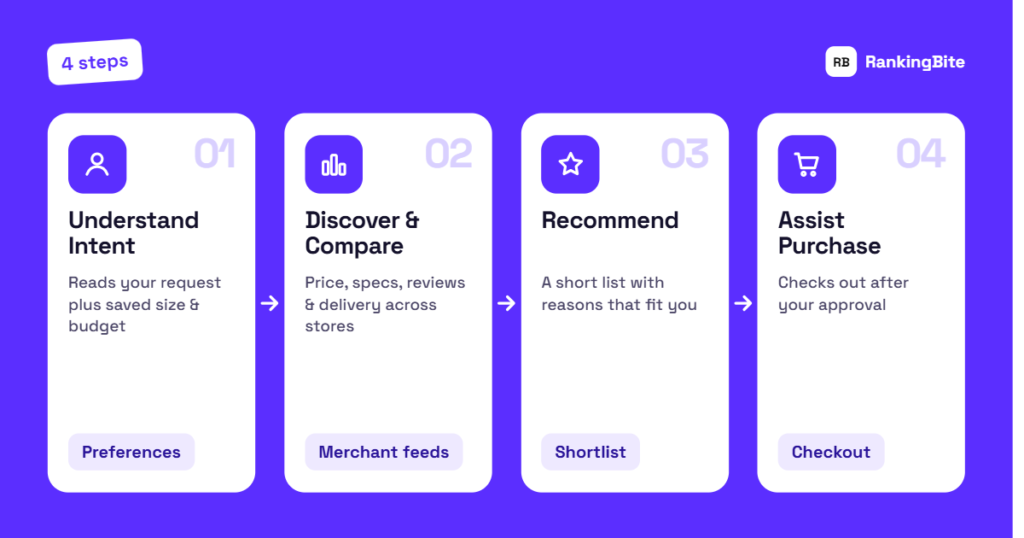
- Understanding intent: The agent reads the request and stored preferences, such as size or budget.
- Discovering and comparing: It pulls listings from merchant feeds and the web, then compares price, specs, reviews, and delivery.
- Recommending: It returns a short list with reasons tied to the shopper’s needs.
- Assisting with purchase: After authorization, it opens checkout or completes the order where supported.
Example: A shopper asks for “waterproof trail shoes under $120, size 10, delivered by Friday.” The agent shortlists three pairs, explains grip and weight differences, and opens checkout with size 10 selected.
What Is Agentic Shopping, and How Is It Changing Online Buying?
Agentic shopping is the consumer side of agentic commerce: a shopper hands product research, comparison, and sometimes checkout to an AI shopping agent. Instead of moving between search results, review sites, and retailer tabs, the shopper describes a need once and gets a short list of options with reasons.
This changes how people buy. Shoppers now reach a retailer’s site with the decision nearly made, so fewer visits are spent browsing and more end in a purchase. Adobe Analytics found that AI-referred visits to US retail sites now convert better than other traffic.
Agentic Shopping vs. Traditional Online Shopping
| Factor | Traditional Online Shopping | Agentic Shopping |
|---|---|---|
| Product discovery | Manual search and browsing | Conversational AI |
| Product comparison | Customer-led | AI-assisted |
| Personalization | Filters and recommendations | Contextual recommendations |
| Checkout | Customer completes purchase | Agent-assisted where supported |
Real-World Applications of AI Shopping Agents
- Personalized recommendations: Shortlists matched to budget, size, and use case.
- Price and delivery comparisons: The same product compared across sellers on price, stock, and shipping time.
- Automated repeat purchases: Grocery and household staples reordered where the merchant supports it.
How Does ChatGPT Shopping Work for Consumers and Retailers?
ChatGPT shopping is a conversational product search that shows product cards, comparisons, and merchant links drawn from merchant feeds and the web.
How ChatGPT Finds and Recommends Products
A shopper asks for something like “a quiet dishwasher under $800,” and ChatGPT returns visual product cards with side-by-side comparisons. When several merchants sell the same item, it weighs price, availability, quality, and whether the merchant is the primary seller.
Can Customers Buy Products Directly Through ChatGPT?
Rarely. OpenAI launched in-chat Instant Checkout in 2025 but scaled it back in March 2026. Walmart, an early partner, found in-chat purchases converted three times lower than click-throughs to its website. Most purchases now finish on the merchant’s site or in a merchant’s own app inside ChatGPT.
What Does ChatGPT Shopping Mean for Ecommerce Brands?
ChatGPT has become a discovery channel that sits before search. Brands that appear in its answers reach shoppers earlier, while brands with incomplete product data are left out of the comparison entirely.
What Is the Agentic Commerce Protocol (ACP)?
The Agentic Commerce Protocol is an open standard, co-developed by OpenAI and Stripe, that lets AI agents and merchant systems exchange product, order, and payment data in a shared format. Every store runs a different catalog, cart, and payment stack, so agents need one common language to read them all.
ACP works through three parts:
- Product Feed: Merchants publish titles, prices, stock, and promotions for ChatGPT to search and compare.
- Agentic Checkout: The agent sends an approved order to the merchant’s existing checkout system.
- Delegated Payment: ChatGPT passes a secure, single-use payment token to the merchant’s payment processor instead of card details.
Merchants stay the seller of record and keep fulfillment, returns, and customer support. Most connect through their commerce or payment platform, such as Shopify, Stripe, or PayPal, rather than building the integration themselves. Since ChatGPT shifted its focus to discovery, the product feed matters most: a complete, accurate feed decides whether a product appears in results at all.
Which AI Shopping Platforms Can Ecommerce Brands Sell Through?
Ecommerce brands can reach shoppers through five major AI shopping platforms: ChatGPT, Google AI Mode and Gemini, Microsoft Copilot, Perplexity, and Amazon Rufus. Each uses a different data source and checkout model.
| Platform | How products get listed | In-chat checkout | Shopify merchants |
|---|---|---|---|
| ChatGPT | Product feed or commerce platform | Limited; mostly merchant sites or apps | Listed by default |
| Google AI Mode and Gemini | Google Merchant Center | Selected US merchants | Supported |
| Microsoft Copilot | Microsoft Merchant Center and partners | Copilot Checkout in the US | Auto-enrolled |
| Perplexity | Web crawling and merchant programs | Yes, via PayPal | Supported |
| Amazon Rufus | Amazon catalog only | Inside Amazon | Must sell on Amazon |
Outside Amazon, merchants remain the merchant of record. Shopify merchants get the widest reach with the least work, because one catalog connects to ChatGPT, Copilot, Gemini, and Perplexity.
How Is Agentic Commerce Transforming the Ecommerce Industry?
Agentic commerce is moving product discovery from search result pages into AI conversations. Retailers now compete for a place in an agent’s shortlist, not only for a top position on Google.
AI-powered discovery. Agents narrow thousands of listings to three or four options. A product left out of that shortlist gets no consideration, however strong its product page is.
Personalized shopping. A request like “vegan leather work bag for a 15-inch laptop, under $150” carries four filters that a search bar handles poorly. Agents combine them in one request and refine results through follow-up questions.
Faster purchasing. Agents do the comparison work, and checkout integrations remove steps. Shoppers arrive on product pages ready to buy rather than ready to browse.
New opportunities for retailers. Smaller brands compete on product data quality rather than ad budgets, because agents rank listings on fit, price, availability, and reviews.
What Are the Benefits and Challenges of Agentic Commerce for Businesses?
The benefits are higher-intent shoppers and shorter buying journeys. The cost is accurate product data, secure payments, and new integrations that many stores do not have yet.
Benefits of Agentic Commerce for Ecommerce Businesses
- Wider discovery: Products reach shoppers inside ChatGPT, Gemini, and Copilot, not only on search engines and marketplaces.
- Relevant recommendations: Better matches reduce mismatched orders and returns.
- Less friction: Shoppers land on the exact product variant they asked about.
- Higher conversions and repeat purchases: AI-referred visitors arrive ready to buy, and agents handle reorders where supported.
- Support efficiency: Agents answer sizing and delivery questions before shoppers contact support.
Challenges of Implementing Agentic Commerce
- Inaccurate product data: Feed prices or stock that differ from the product page signal an unreliable seller.
- Trust and payment security: Shoppers need confidence before letting an agent handle payment.
- Integration cost: Feeds, schema markup, and agent-friendly checkout need developer time.
- Limited transparency: Platforms do not publish full ranking criteria.
- Inconsistent experiences: Each platform displays products and promotions differently.
How Do You Get Products Listed in AI Shopping Agents?
- Submit a complete product feed. Include titles, descriptions, images, prices, availability, and product URLs. Google and Copilot read from their own Merchant Centers.
- Use your platform’s connector. Shopify merchants can turn on agentic storefronts to reach several AI platforms from one dashboard.
- Match pages to the feed. Keep price, stock, and titles identical, and add Schema.org Product and Offer markup.
- Let verified agents in. Review bot-management rules and remove CAPTCHAs from the checkout path.
- Join checkout programs that fit, such as Copilot Checkout or Google’s checkout in AI Mode.
What Does Agentic Commerce Cost Merchants?
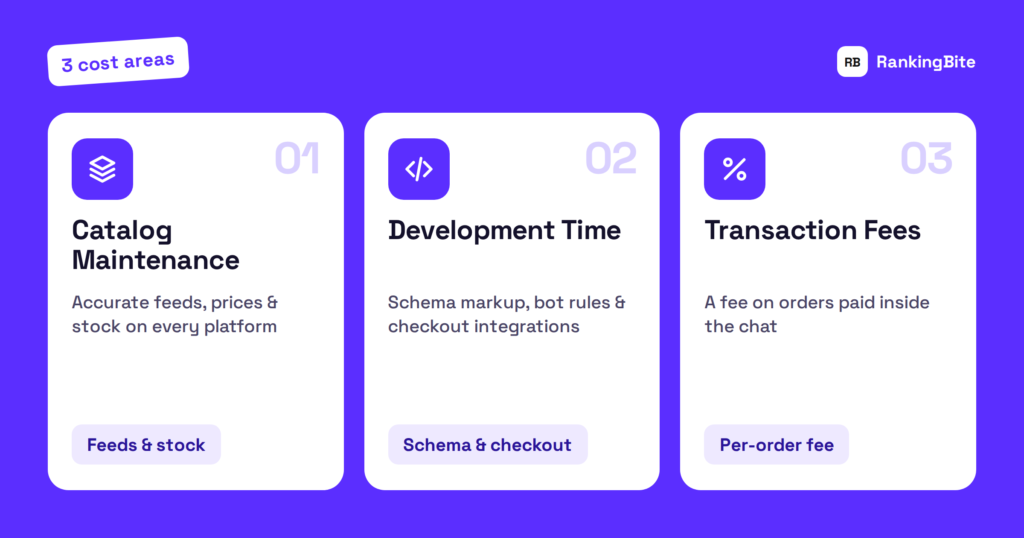
Agentic commerce costs depend on a store’s platform and how far it goes beyond product listings. Most spending falls into three areas:
- Catalog maintenance: Keeping feeds, prices, stock, and product descriptions accurate and updated across every platform.
- Development time: Adding schema markup, adjusting bot rules, and building checkout integrations such as Google’s checkout in AI Mode or a ChatGPT app.
- Transaction fees: Platforms that process payments inside the chat charge a fee on completed orders.
Merchants on Shopify or similar platforms avoid most development work, so their main ongoing cost is product data quality. For most stores, getting listed costs far less than building in-chat checkout, which makes listings the sensible first step.
How Do You Measure Agentic Commerce Results?
- AI referral traffic: Segment visits from ChatGPT, Gemini, Copilot, and Perplexity in analytics.
- Conversion rate: Compare AI-referred sessions with organic and paid search traffic.
- AI visibility: Each month, ask each assistant for your main product category the way a customer would, and note whether your products appear.
- Product descriptions: Check how assistants describe your products, and fix the product data behind any errors.
Agentic commerce and ecommerce SEO share one foundation: structured, accurate, crawlable product content.
RankingBite helps ecommerce businesses build it, combining ecommerce SEO with AI search visibility so products rank in Google and get recommended in ChatGPT, Gemini, Copilot, and Perplexity. Contact RankingBite to see how visible your catalog is to AI shopping agents.
Conclusion
Agentic commerce has moved product discovery into AI conversations, and the shoppers it sends arrive ready to buy. AI platforms now shape the shortlist, while most sales still close on merchant websites. Retailers with accurate feeds, readable product pages, and agent-friendly checkout will win visibility in both AI platforms and search.
Frequently Asked Questions About Agentic Commerce
What is an example of agentic commerce?
A shopper asks ChatGPT for a carry-on suitcase under $200 that fits airline size limits. The agent compares options on weight, warranty, and delivery time, recommends two, and opens the chosen product’s checkout page on the retailer’s site.
Is agentic commerce the same as generative AI shopping?
No. Generative AI shopping describes AI tools that answer product questions and recommend items. Agentic commerce adds actions on the shopper’s behalf, such as filtering catalogs, building carts, and completing checkout after the shopper approves.
What is the difference between ACP and UCP?
ACP is the Agentic Commerce Protocol from OpenAI and Stripe, used for ChatGPT shopping. UCP is the Universal Commerce Protocol from Google and Shopify, used for checkout in Google AI Mode and Gemini. Both connect AI agents to merchant catalogs and checkout.
Can customers buy directly inside ChatGPT?
Only in limited cases. ChatGPT now focuses on product discovery and comparison, then sends shoppers to the merchant’s website or the merchant’s own app inside ChatGPT to complete the purchase.
How do I get my products listed in ChatGPT shopping?
Submit a product feed to OpenAI, or connect through a commerce platform such as Shopify, which lists eligible merchants by default. Accurate prices, stock, images, and descriptions decide whether listed products actually appear in results.
Does agentic commerce replace traditional ecommerce SEO?
No. AI shopping agents rely on the same product pages, structured data, reviews, and crawlable content that ecommerce SEO improves. Strong SEO raises the chance that agents read, trust, and recommend a product.
Can small ecommerce businesses benefit from agentic shopping?
Yes. Small stores compete on product data quality instead of ad budgets. Platforms like Shopify connect catalogs to major AI assistants without custom development, so accurate product data puts small brands beside large retailers in AI shortlists.