AI search has changed how people research and buy products. Instead of clicking through multiple websites, users now ask tools like ChatGPT, Perplexity, and Google’s AI Overviews for recommendations. In many cases, they get the answers they need without ever leaving the chat. That shift creates a new problem for brands: coverage gaps. Every prompt where a competitor gets named and you don’t is a customer who never learns you exist.
Many marketing teams measure AI visibility by tracking brand mentions. While that shows where you’re already being recognized, it doesn’t reveal where you’re missing out. The biggest opportunities often lie in high-intent prompts such as product comparisons, “best tool for…” searches, pricing questions, and alternative recommendations. These are the moments when buyers are actively evaluating their options and getting ready to make a decision.
This guide explains what an AI search coverage gap is, why it matters, and how to identify it using a practical, repeatable process. You’ll also learn how to separate meaningful gaps from low-value ones, allowing you to focus your efforts where they can have the greatest business impact.
What Is a Coverage Gap in AI Search?
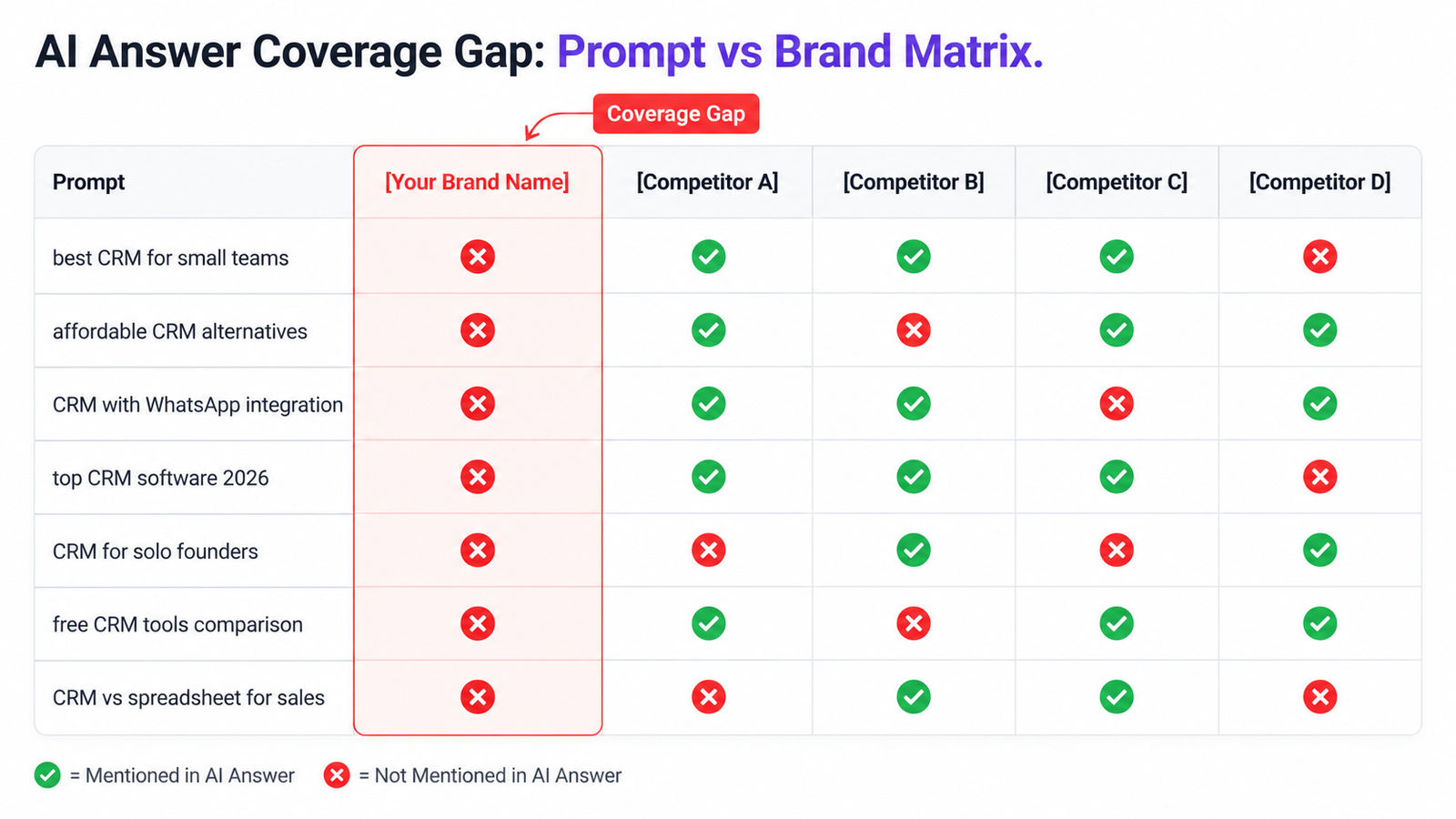
A coverage gap happens when your brand should reasonably appear in an AI-generated answer but doesn’t, while one or more competitors do. Unlike traditional SEO, this isn’t about ranking lower in search results. It’s about being completely absent from the AI’s recommendation.
It’s also important to understand the difference between visibility and coverage.
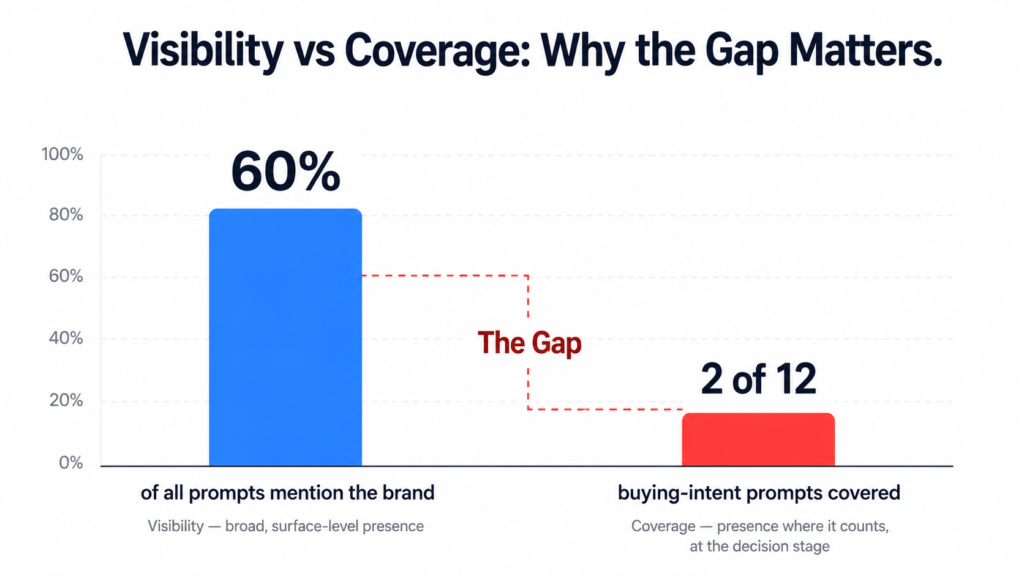
Visibility measures how often your brand is mentioned across different AI prompts. Coverage focuses on whether your brand appears in the specific prompts that influence buying decisions. A company may have strong overall visibility but still miss the high-intent prompts that matter most, such as comparison searches, pricing questions, or “best tool” recommendations. In other words, visibility is about quantity, while coverage is about relevance.
How Do You Detect a Coverage Gap?
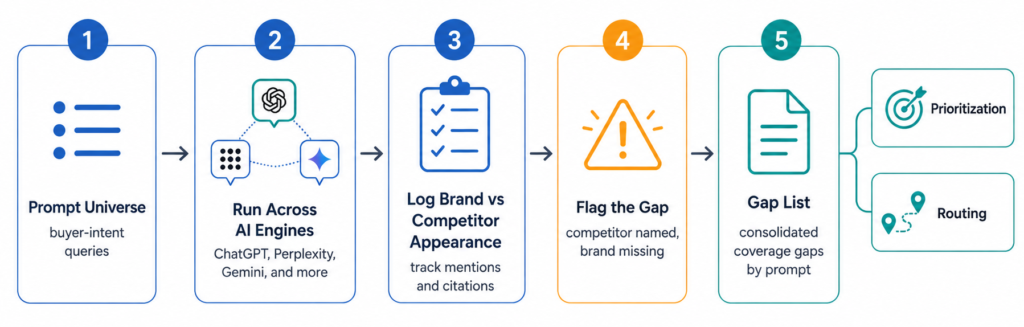
Gaps don’t surface on their own. You detect them by running a defined set of buyer-intent prompts across the AI engines your customers use and logging two things for every prompt: whether your brand appears and which competitors appear. Any prompt where competitors are named and you are not is a logged gap. That’s the whole mechanism.
This is why a coverage audit depends on a prompt universe, the deliberately assembled list of queries your buyers actually ask on the way to a purchase. If you haven’t built one yet, build it first. An audit run against a random handful of prompts produces a random handful of gaps, and you’ll have no way to tell whether the picture is representative. The prompt universe is the input to this process; the gap list is the output.
Nothing else in this guide works without that log. Prioritization ranks the rows in it. Routing assigns a fix to each row.
Worked Example
Imagine you sell a project management platform for mid-sized businesses. A simple AI search audit could produce results like these:
| Prompt |
ChatGPT |
Perplexity |
Google AI Overview |
Coverage |
| What is project management software? |
Mentioned |
Mentioned |
Mentioned |
3/3 – Good coverage, but low buying intent |
| Asana vs Monday.com |
Not Mentioned |
Not Mentioned |
Not Mentioned |
0/3 – High-priority coverage gap |
| Best project management tool for a 10-person startup |
Mentioned (3rd) |
Not Mentioned |
Mentioned (5th) |
2/3 – Present, but underperforming |
| Competitor alternatives |
Not Mentioned |
Not Mentioned |
Not Mentioned |
0/3 – High-value coverage gap |
| Best PM tool for construction companies |
Not Mentioned |
Not Mentioned |
Not Mentioned |
0/3 – Review whether this fits your target audience first |
The first row may look encouraging because your brand appears everywhere. However, it represents an informational query with low purchase intent. The real opportunities are the comparison and alternatives prompts, where buyers are actively evaluating solutions. If your brand doesn’t appear there, you’re likely missing potential customers at a critical stage of the buying journey.
Missing vs. Underperforming
Not every coverage issue is the same. Understanding the difference helps you choose the right solution.
A missing result means your brand doesn’t appear in the AI response at all. This often happens because there isn’t enough relevant content for AI systems to reference. You may not have comparison pages, competitor-focused content, or enough third-party mentions. In this case, the priority is to create the missing content.
An underperforming result means your brand is included but appears lower in the response or receives very little attention. Usually, the content already exists, but it lacks the depth, credibility, or context needed to earn stronger recommendations. Improving existing pages, adding detailed product information, strengthening comparison content, and earning more third-party validation can often increase your visibility.
Treating these two situations as the same can waste time and resources. If you’re already appearing in AI responses, your focus should be on improving that content rather than creating entirely new pages.
Why Commercial Prompt Gaps Cost More Than Traffic Gaps
Which Gaps Actually Cost You Customers?
Missing an informational query dents awareness. Missing a commercial prompt costs buyers who are ready to purchase. When someone asks “best CRM for small businesses,” “HubSpot alternatives,” or “Asana vs. Monday.com,” they are comparing options before deciding. If your brand isn’t in the answer, you never enter the consideration set.
Why Doesn’t This Loss Show Up in Analytics?
Users often get a complete answer inside the chat and act on the shortlist the AI gives them. No click means no referral traffic, no session, no conversion. Google Analytics and Search Console only measure visits that reach your site, so from a reporting perspective the lost opportunity doesn’t exist.
Why Commercial Coverage Needs Its Own Audit
That blind spot is the problem. Traditional metrics can look healthy while AI search quietly leaves you out of the conversations that drive revenue. A separate coverage audit tells you whether you show up when buyers are actively comparing solutions.
The 5-Step Framework for Finding AI Search Coverage Gaps
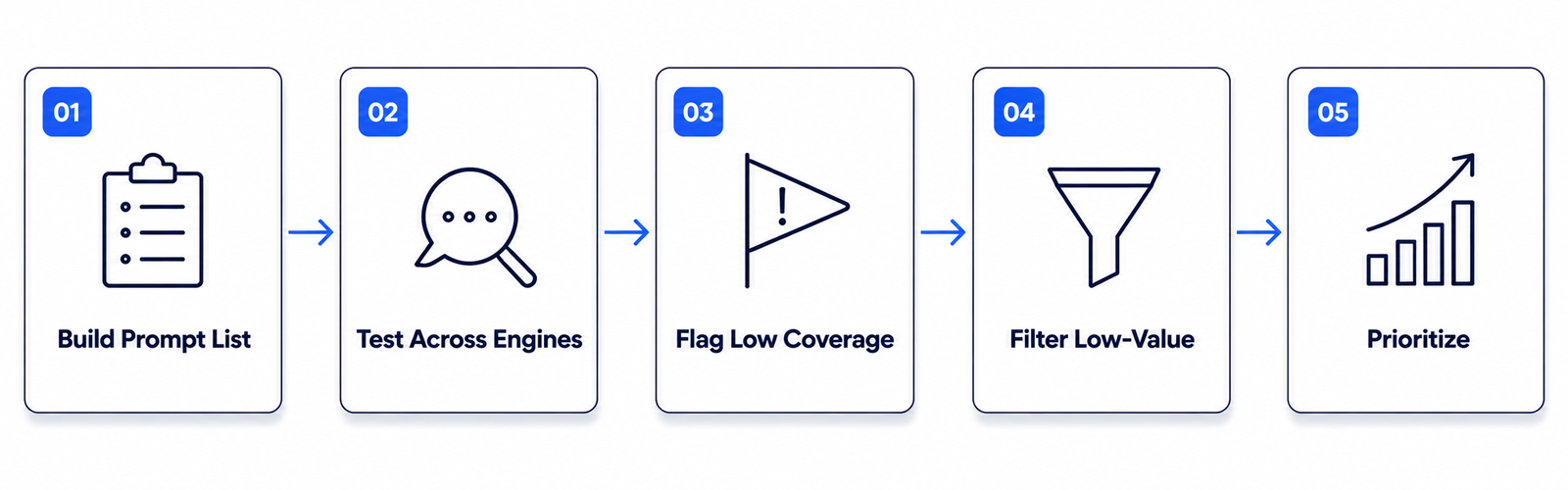
Finding coverage gaps isn’t about checking a few prompts at random. You need a consistent process that helps you identify where your brand is missing, measure the impact, and decide which opportunities deserve your attention first.
Step 1: Build Your Commercial Prompt List
Start by creating a list of prompts that potential customers are likely to use during the buying journey. Focus on questions that indicate commercial intent rather than general informational searches.
A good starting point is to gather prompts from multiple sources, including:
- Questions your sales team hears during demos or sales calls
- Competitor comparison searches, such as “[Competitor] vs [Your Brand]” and “[Competitor] alternatives”
- “Best [category] for [use case]” searches
- Industry-specific or persona-based queries for your target audience
For most businesses, a list of 30 to 80 commercial prompts is enough for the first audit. The goal isn’t to create the biggest list possible. It’s to cover the searches that influence real buying decisions.
Step 2: Check Coverage Across AI Search Engines
Next, test every prompt across the AI platforms your audience actually uses. For many businesses, this includes ChatGPT, Perplexity, and Google AI Overviews, but your list should reflect your own customers’ behavior.
For each prompt, record:
- Whether your brand appears
- The overall sentiment, if mentioned
- Approximately where your brand appears in the response
- Which competitors are recommended
A simple spreadsheet works well for this process. Although several monitoring tools are emerging, there isn’t a single platform that accurately tracks AI visibility across every engine. For now, a manual or semi-manual audit often provides the most reliable results.
To keep your data consistent, run each prompt in a fresh conversation instead of relying on previous chat history. AI responses change over time, and cached conversations can influence the results.
Step 3: Identify Low-Coverage Prompts
Once you’ve collected the data, look for prompts where your brand appears inconsistently.
If you’re tracking three AI platforms, any prompt where your brand appears in only one or none of them deserves closer attention. These gaps often reveal the areas where competitors have stronger visibility.
Don’t treat this threshold as a strict rule. If one AI platform matters more to your audience than the others, you may want to adjust your evaluation accordingly.
Step 4: Separate Real Opportunities from Low-Value Gaps
Not every missing mention requires action.
Review each flagged prompt and ask whether it aligns with your ideal customer profile and business goals. Some prompts may target audiences you don’t serve or products you don’t offer. Others may have little commercial value despite showing low coverage.
Filtering these out helps you concentrate on opportunities that have a realistic impact on revenue.
Step 5: Prioritize the Gaps That Matter Most
After removing low-value prompts, rank the remaining opportunities based on three key factors:
- Commercial value: How close is the searcher to making a purchase?
- Competitive difficulty: Can you realistically compete with the brands already being recommended?
- Ease of improvement: Do you already have content, customer reviews, or case studies that can strengthen your visibility?
A simple value-versus-effort framework makes prioritization much easier.
| Prompt |
Commercial Value |
Effort |
Priority |
| Asana vs Monday.com |
High |
Medium |
Do First |
| Competitor alternatives |
High |
Low |
Do First |
| Best project management tool for a 10-person startup |
Medium |
Low |
Do Next |
| Best PM tool for construction companies |
Low (if outside your ICP) |
High |
Skip |
Which Commercial Prompts Should You Prioritize?
Not every commercial prompt has the same business value. Some influence purchase decisions directly, while others simply help buyers explore their options. If you want to improve AI search visibility efficiently, focus on the prompts that are most likely to generate qualified leads and conversions.
Brand Comparison Prompts
Searches such as “Brand A vs Brand B” usually come from buyers who have already narrowed down their options. At this stage, they’re comparing features, pricing, or overall value before making a final decision.
If your brand is missing from these AI-generated responses, you’re losing visibility at one of the most critical moments in the buying journey.
Competitor Alternative Prompts
Queries like “Alternatives to [Competitor]” often signal strong purchase intent. The user is actively looking for a replacement, which makes them highly receptive to new recommendations.
Appearing in these responses can introduce your brand to buyers who are already motivated to switch solutions.
Pricing and Buying Decision Prompts
Prompts that include pricing, affordability, licensing, or purchasing recommendations typically come at the final stage of the buying process.
If AI search doesn’t mention your brand here, you may lose potential customers just before they make a purchase.
Category and “Best Tool” Searches
Queries such as “Best CRM for startups” or “Best project management software” reach a broader audience than comparison searches. While users may still be researching, these prompts often shape the shortlist they’ll evaluate later.
Consistent visibility in these searches helps ensure your brand stays in the conversation throughout the decision-making process.
Industry or Persona-Specific Prompts
Some searches focus on a particular industry, business size, or job role, such as “Best accounting software for law firms” or “Best CRM for real estate agents.”
Although these prompts usually attract lower search volume, they often deliver highly qualified prospects because the recommendations are tailored to a specific audience. If these segments match your ideal customer profile, they deserve special attention.
Not Every Missing Prompt Needs to Be Fixed
A missing mention doesn’t automatically mean you have a problem to solve. Some gaps are worth addressing, while others have little impact on your business goals.
You can usually deprioritize or ignore a prompt if:
- It targets an audience outside your ideal customer profile.
- It reflects informational intent rather than buying intent.
- Competing for the prompt would require significant effort with limited potential return.
- The prompt isn’t part of your customers’ typical buying journey.
For example, if your software is built specifically for small businesses, missing a prompt like “Best enterprise ERP software” isn’t necessarily a weakness. Trying to compete for that search could attract the wrong audience and divert resources from opportunities that are more likely to generate revenue.
Instead of aiming for complete coverage across every AI prompt, focus on the searches that align with your products, target customers, and business objectives. A smaller number of high-value wins will usually deliver better results than broad visibility across low-intent topics.
Common Reasons Your Brand Doesn’t Appear in AI Search
There’s no single reason why a brand is missing from AI-generated responses. In most cases, it comes down to gaps in your content, credibility, or the information available about your business online. While the exact ranking systems used by AI platforms aren’t publicly documented, the following factors are commonly associated with stronger AI visibility.
Weak Topic Coverage
If your website doesn’t cover a topic in enough depth, AI systems have very little information to reference. Thin or incomplete content makes it difficult for your brand to be recommended for relevant commercial queries.
Missing Comparison Content
Comparison searches are becoming increasingly important in AI search. If you don’t have pages comparing your product with competitors, AI engines have fewer signals connecting your brand to those buying-stage conversations.
Limited Third-Party Mentions
Reviews, industry publications, customer testimonials, and independent websites all help reinforce your brand’s credibility. When competitors are discussed across multiple trusted sources and your brand isn’t, AI systems are more likely to recommend them instead.
Inconsistent Entity Signals
AI models rely on consistent information to understand what your company does and where it fits within a category. Different brand names, unclear positioning, or missing structured data can make it harder for AI to confidently associate your business with relevant searches.
Thin Product Information
Detailed product pages, feature descriptions, pricing information, and documentation provide AI systems with valuable context. If these resources are missing or incomplete, your competitors may have a stronger foundation for AI-generated recommendations.
A simple way to identify the cause of a coverage gap is to compare your content with the competitors that already appear in AI responses. Look at the pages they’re ranking with, the reviews they’ve earned, and the information they provide. In many cases, you’ll discover that one or two missing assets are creating the gap.
Case Study: Using a Coverage Gap Audit to Improve AI Visibility
The following example is illustrative and is intended to demonstrate how the framework works in practice.
A mid-sized HR software company decided to audit its AI search visibility across 45 commercial prompts using ChatGPT, Perplexity, and Google AI Overviews.
At first glance, the results looked encouraging. The company appeared in around 60% of all tracked prompts, suggesting it had strong overall visibility.
However, a closer look revealed a different story.
Out of 12 comparison and competitor-alternative prompts, the brand appeared in only two. These were the prompts most closely tied to purchase decisions, yet competitors dominated almost every response.
The audit uncovered two major issues. First, the company had never created dedicated comparison pages for its main competitors. Second, it had significantly fewer third-party reviews than the leading brands in its category.
Instead of trying to improve every missing prompt, the marketing team focused on the highest-value opportunities. They published comparison pages targeting their most common competitors and encouraged satisfied customers to leave reviews on trusted software review platforms.
Three months later, they repeated the audit.
Coverage across the 12 comparison and alternative prompts increased from 2 out of 12 to 7 out of 12. Interestingly, the company’s overall visibility changed very little. The biggest improvement came from appearing in the prompts that mattered most to potential buyers.
The lesson is simple. A broad visibility score doesn’t always reflect business impact. Measuring coverage across high-intent commercial prompts provides a much clearer picture of where your brand is winning and where it’s being overlooked.
Frequently Asked Questions
-
How many times should I run the same prompt?
Two or three times in fresh sessions. Log a gap when your brand is consistently absent, not absent once.
-
Should I include my brand name in the prompt?
No. Branded prompts force a mention. Coverage is measured on unbranded, category-level prompts only.
-
Does ranking first in Google guarantee a mention in AI answers?
No. A page can rank well and still be skipped if its answer is hard to extract.
-
How long does it take for a fix to show up in AI answers?
Weeks, not days. Re-audit 60 to 90 days after the work ships.
-
What if AI mentions my brand but gets the details wrong?
That is an accuracy problem, not a coverage gap. Fix the stale sources, not your content volume.
-
What if no brand appears at all for a prompt?
Then it is not a gap. Your absence only matters where a competitor is present.
-
Who should own the coverage audit?
Whoever owns organic performance, with sales input on the prompt list. One owner, not shared.