How to Get Your Brand Into the Listicles and Roundups AI Actually Cites
AI assistants answer recommendation queries by pulling from third-party listicles and roundups, not brand pages. A citation press analysis of over 60,000 citations across…
AI assistants answer recommendation queries by pulling from third-party listicles and roundups, not brand pages. A citation press analysis of over 60,000 citations across 10,000 commercial prompts found that brand homepages accounted for only 4-7% of citations from ChatGPT and Claude. Most citations went to ranked, editorial “best of” listicles and expert roundups from independent publishers instead.
Because of this, earning placement in one of these listicles or roundups often beats publishing your own “Best X” page.
Listicle and roundup citation optimization is the practice of identifying and earning placement on the third-party “best of” listicles and expert roundups that AI assistants already trust and cite for recommendation queries.
Key takeaways:
- Brand homepages get as little as 4–7% of AI citations; most go to third-party listicles and roundups instead
- Score opportunities by citation frequency, cross-platform visibility, and editorial authority, not Domain Rating
- Lead outreach with genuine value, not a backlink ask
- Citations shift over time; this is a quarterly process, not a one-time project
Why Listicles and Roundups Are What AI Cites
Recommendation queries require comparing multiple options. Listicles and roundups pre-structure that comparison, which makes them easy for AI to lift and cite directly.
That’s why the same listicles and roundups get cited repeatedly across similar prompts and why this format dominates commercial and buying-intent queries more than articles or product pages.
The Types of Listicles and Roundups AI Commonly Cites
Three formats show up again and again.
Editorial “Best X” Listicles dominate buying-intent prompts like Best CRM Software or Best SEO Tools.
Comparison and Alternative Listicles get cited for head-to-head queries, like HubSpot vs. Salesforce or Ahrefs Alternatives.
Expert Roundups carry named-expert recommendations, which add credibility signals AI weighs heavily.
Across all three, editorial framing matters as much as format. Third-party listicles and roundups consistently outperform self-promotional “best of” lists a brand publishes about itself.
Step 1: Discover the Listicles and Roundups AI Already Uses
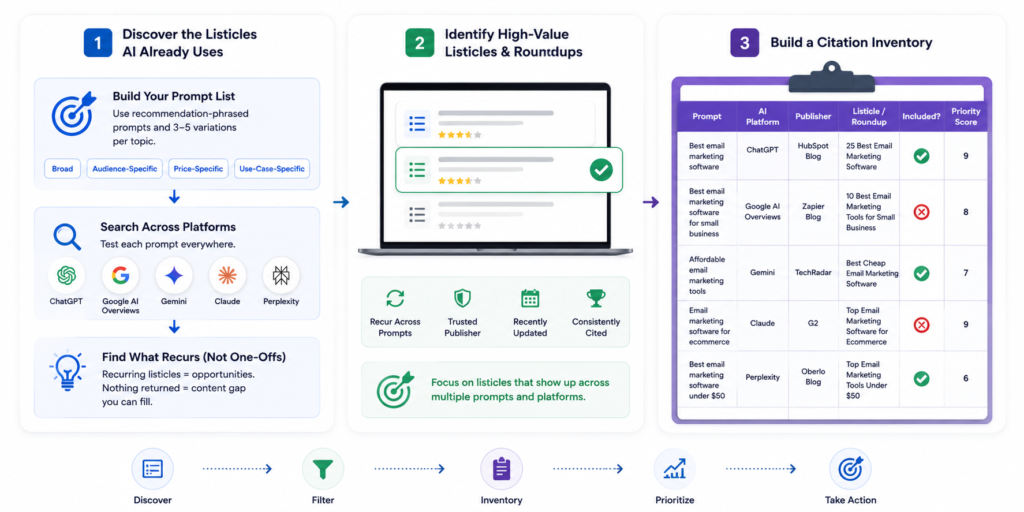
- Build your prompt list. Use recommendation-phrased prompts “Best email marketing software,” not just “email marketing software.” Run 3–5 variations per topic: broad, audience-specific, price-specific, and use-case-specific.
- Search across platforms. Test each prompt in ChatGPT, Google AI Overviews or AI Mode, Gemini, Claude, and Perplexity. Tools like Peec AI, Profound, or Otterly.AI can automate this tracking for you. Winning on one platform says little about a listicle or roundup standing on another, so check each one rather than assuming coverage carries over. Look for listicles and roundups that recur across prompts, not one-offs. If a prompt returns nothing at all, treat that as a content gap you can fill directly with your own page.
- Build a citation inventory. Track the publisher, the article, the brands included, the publication date, and your own inclusion status for each result. A simple spreadsheet works: columns for prompt, AI platform, publisher, listicle or roundup name, whether you’re included, and a priority score.
Step 2: Prioritize the Highest-Impact Listicles and Roundups
Not every listicle or roundup is worth the same effort. Score each one on a 1–5 scale across five weighted factors:
| Factor | Weight | What to Check |
|---|---|---|
| Citation Frequency | 30% | Appears consistently across your prompt set. |
| Cross-Platform Visibility | 25% | Referenced on one platform versus three or more platforms. |
| Editorial Authority | 20% | Published by reputable sources with real authors and an independent editorial process. |
| Freshness | 15% | Content has been updated within the last 6–12 months. |
| Commercial Relevance | 10% | Closely matches the target product, service, or category. |
Worked example (illustrative): A “Best CRM Software” listicle cited on 4 of 5 prompts, appearing on 3 platforms, from an established review site, updated 3 months ago, with a direct category match, comes out to a weighted score of roughly 4.75. That’s a clear priority.
Freshness carries real weight in this framework. Content that hasn’t been updated in a while is generally a weaker bet for staying visible in AI answers, since AI systems tend to favor pages that reflect current information over stale ones.
Landing coverage across multiple third-party sources rather than relying only on your own site tends to produce a real lift in AI citation rates within weeks of placement. Exact numbers vary by brand and industry, so use your own placement data here if you have it.
As a rule of thumb: pursue anything scoring 3.5 or higher. Deprioritize anything below 2.5, unless it’s your only viable entry point in an otherwise thin category.
Step 3: Earn Placement in AI-Cited Listicles and Roundups
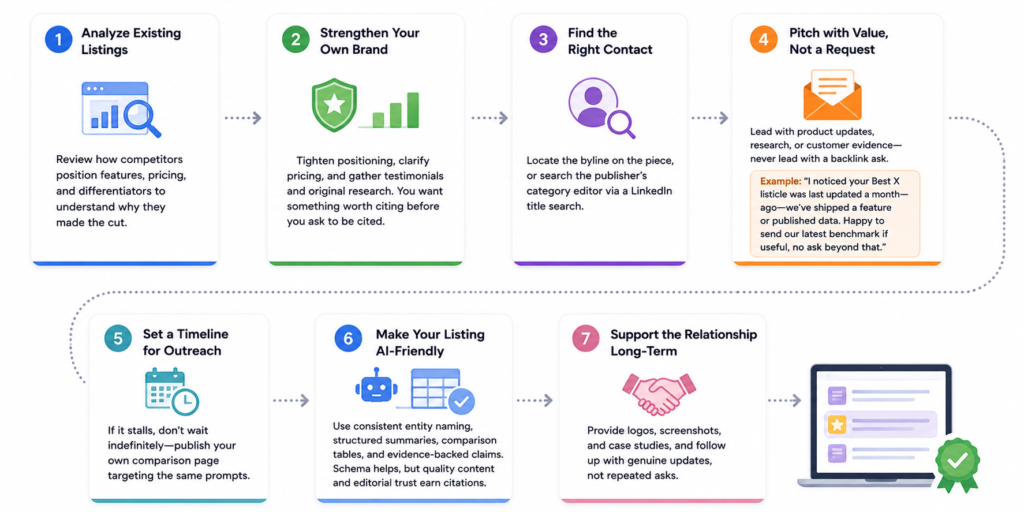
- Analyze existing listings. Review how competitors are positioning their features, pricing, and differentiators to understand why they made the cut in the first place.
- Strengthen your own brand before reaching out. Tighten your positioning, clarify pricing, and gather testimonials and original research. You want something worth citing before you ask to be cited.
- Find the right contact. Locate the byline on the piece, or search the publisher’s category editor via a LinkedIn title search.
- Pitch with value, not a request. Lead with product updates, new research, or customer evidence; never lead with a backlink ask. Example pitch: “I noticed your Best X listicle or roundup was last updated a month since then we’ve shipped a feature or published data. Happy to send our latest benchmark if useful, no ask beyond that.”
- Set a timeline for outreach. If it stalls, don’t wait indefinitely in parallel; publish your own comparison page targeting the same prompts.
- Make your listing AI-friendly once you’re in. Use consistent entity naming, a structured feature summary, comparison tables, and evidence-backed claims. Schema markup helps machines parse the page, but it’s content quality and editorial credibility that actually earn the citation.
- Support the relationship long-term. Provide logos, screenshots, and case studies, and follow up with genuine updates, not repeated asks.
Step 4: Measure Whether the Placement Worked
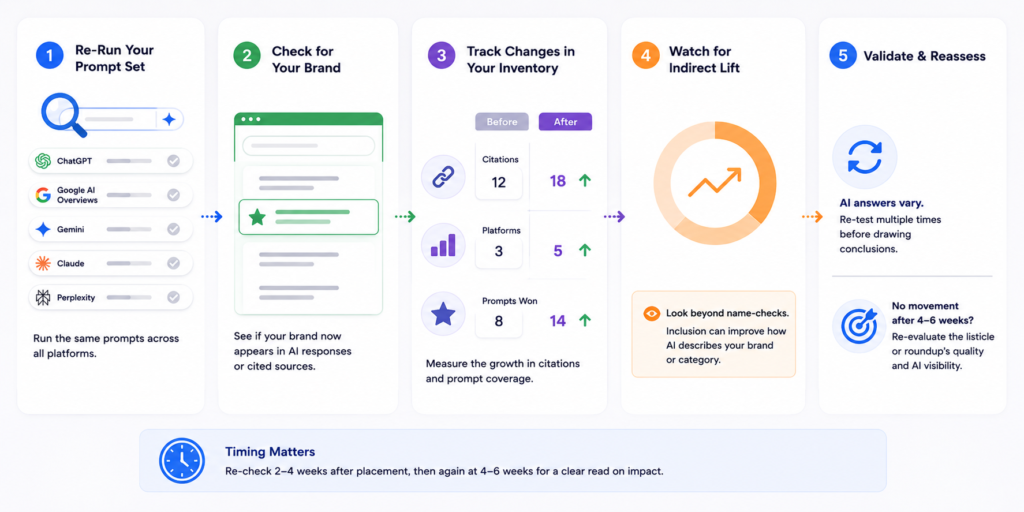
Re-run your prompt set 2–4 weeks after placement to check whether your brand now appears, and track the change in your citation inventory. Watch for indirect lift too, even without a direct name-check; being featured in a listicle or roundup can shift how AI describes your category.
AI answers can vary from run to run, so re-test a few times before concluding a placement didn’t work. If there’s no movement after 4–6 weeks, check whether the listicle or roundup itself was actually high-scoring to begin with.
Own Page vs. Earning Listicle or Roundup Placement
Earn placement when a high-scoring listicle or roundup already exists and is realistically winnable. Publish your own page instead when your prompts consistently return nothing, or when existing listicles and roundups score below 2.5 with no realistic path in.
A hybrid approach often works best: run both in parallel, pursuing outreach on winnable placements while building owned pages for the gaps.
Common Mistakes to Avoid
- Chasing every listicle or roundup equally instead of scoring them. Not every opportunity deserves the same effort without a scoring system; you end up spending outreach time on low-impact listings while high-value ones sit untouched.
- Prioritizing Domain Rating over actual AI citation influence. A high-DR site isn’t necessarily one AI systems cite often. These are different signals, and optimizing for the wrong one wastes effort on pages that won’t move your visibility.
- Generic, backlink-first outreach. Pitches that ask for a link without offering anything in return read as self-serving to editors, and tend to get ignored or deprioritized.
- Weak or inconsistent product positioning. If your brand is described differently across your own site, your listings, and your outreach emails, it’s harder for both editors and AI systems to recognize you as a coherent, citable entity.
- Missing supporting evidence. Claims without data, testimonials, or original research give editors little reason to trust or feature you over a competitor who shows up with proof.
- Ignoring listicles and roundups once you’re already included. Inclusion isn’t permanent. Listicles and roundups get updated regularly, and if you go quiet, you can just as easily get replaced or bumped out in the next revision.
Build a Repeatable Strategy
Getting cited once isn’t the finish line; staying cited requires ongoing attention. Monitor for new “Best X” listicles and roundups monthly, since new entrants appear in your category regularly.
Re-run your prompt sets quarterly to track citation drift, then use those results to refresh and re-score your citation inventory. Scores you calculated months ago may no longer reflect reality.
Finally, maintain relationships with editors even after you’ve secured a placement. Staying in touch keeps you top of mind the next time they refresh the list.
FAQ
How do I know which listicles and roundups AI is actually citing?
Run your target prompts across ChatGPT, Gemini, Claude, and Perplexity, and log which publishers show up repeatedly.
Does Domain Rating matter for listicle and roundup citations?
Less than in traditional SEO, editorial authority and citation frequency across AI platforms matter more than backlink-based metrics.
How long does it take to get added to a listicle or roundup after outreach?
Often several weeks, if you hear back at all. Build owned content in parallel rather than waiting.
What if nothing exists for my niche query?
Treat it as a content gap; publish your own comparison or “Best X” page targeting that exact prompt.
Conclusion
AI visibility increasingly runs through the listicles and roundups AI already trusts. Discover where you’re missing, prioritize by real influence rather than domain metrics, and earn placement by helping editors, not just asking them.
Then measure whether it worked, and repeat the cycle. Citations compound over time for brands that keep at it.
