Cybersecurity brands appear in AI search when ChatGPT, Perplexity, Gemini and Google AI Overviews can reach their pages, extract clear answers from them and confirm their claims through trusted outside sources. These AI tools write one answer from a few sources instead of listing ten links, so a brand is either named in that answer or missing from the buyer’s shortlist.
AI search for cybersecurity is the practice this complete guide covers from start to finish. It starts with how GEO, AEO and SEO fit together and why security content faces a stricter trust bar. It then covers the questions security buyers ask AI tools, crawler access, the content formats and third-party signals that earn citations, and how to measure citation share.
Key takeaways
- AI tools write one answer from a few sources. They do not show a ranked list of links the way Google does.
- Cybersecurity fits Google’s “Your Money or Your Life” standard, so AI tools look for outside proof before naming a vendor.
- Security engineers, procurement leads and CISOs ask AI tools different questions, and each group needs its own content.
- Blocked search crawlers stop citations before content quality matters.
- Google does not use llms.txt, and no special schema is required for Google’s AI features.
- Gated content is invisible to AI crawlers.
- Citation share across a fixed set of buyer prompts is the metric to track.
What is AI search for cybersecurity?
AI search for cybersecurity is the practice of making a security vendor visible inside AI-generated answers, not only on a Google results page. When a buyer asks an AI tool which vendors to consider, the brand appears in the answer and in the sources behind it.
The main platforms are ChatGPT, Perplexity, Gemini and Google AI Overviews. AI search affects every security category, from EDR (endpoint detection and response) and IAM (identity and access management) to SIEM (security information and event management), cloud security and MSSPs (managed security service providers).
How AI search differs from Google search
Google search returns a list of ranked pages, and the buyer chooses which ones to open. AI search returns one written answer built from two to seven sources on average, according to GrackerAI’s State of AI Search Visibility in Cybersecurity 2026 report. The same report found that 73% of the 100 security vendors it tested received zero ChatGPT citations when buyers asked for recommendations in their own category.
Fewer slots means tighter competition. A vendor ranked on page one of Google still misses the AI answer when its content is not one of the few sources the model selects.
GEO vs AEO vs SEO: which one does a security brand need?
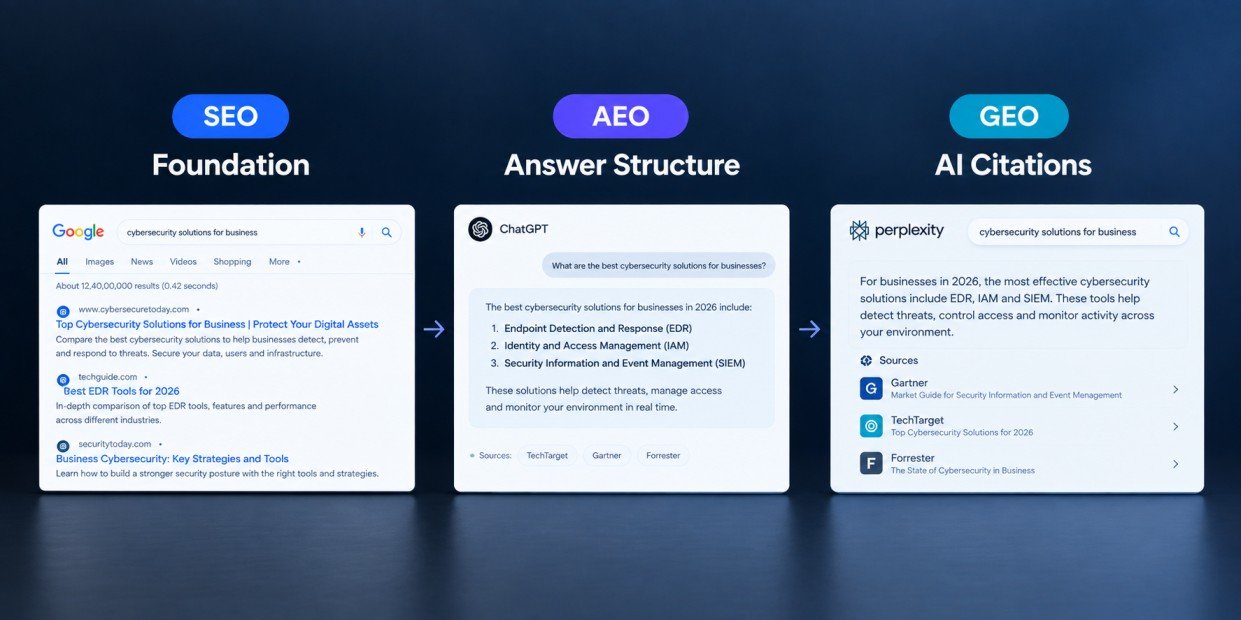
A security brand needs all three, because each one solves a different part of the same problem. SEO gets pages indexed and ranked, AEO makes individual answers easy to extract, and GEO is the result: the brand named inside AI-generated answers.
| Discipline | Full Name | Goal | What Gets Measured |
|---|---|---|---|
| SEO | Search Engine Optimization | Rank pages in Google search results | Rankings, organic traffic |
| AEO | Answer Engine Optimization | Structure content so AI models extract clear answers | Extractable answers, featured snippets |
| GEO | Generative Engine Optimization | Get the brand named in AI-generated answers | Citation share across AI platforms |
GEO – is the outcome, and it depends on both the brand’s own pages and outside sources such as review sites.
SEO – builds the foundation. Google AI Overviews and AI Mode only use pages that are indexed and eligible for regular search snippets, according to Google.
AEO – works at the passage level, so each section answers one question clearly.
Why does cybersecurity need its own approach to AI search?
Cybersecurity content faces a higher trust bar and a more precise vocabulary than most B2B categories. Generic AI search advice written for project management or HR software misses both.
A higher trust bar
Google’s Search Quality Rater Guidelines define “Your Money or Your Life” (YMYL) topics as those that can significantly affect people’s health, financial stability or safety. A security product that fails leads to a breach, which puts cybersecurity purchases squarely in that territory.
AI answers in this category lean on outside sources. GrackerAI’s benchmark found that Gartner Magic Quadrant mentions, G2 reviews and Forrester Wave inclusions earned the highest citation rates among third-party sources, while most vendor-owned content was not cited at all.
A precise vocabulary
Security buyers search with exact identifiers from public standards:
- CVE IDs from the CVE Program, the public catalog of known vulnerabilities. CVE-2021-44228, for example, is the Log4Shell flaw.
- Technique IDs from MITRE ATT&CK, a public framework of attacker behavior. TA0008, for example, is the lateral movement tactic.
- Control IDs from NIST SP 800-53, the US government catalog of security controls. AC-2, for example, covers account management.
Pages that map a product to these identifiers give an AI model a precise match for a buyer’s question. Pages that say “advanced threat protection” give it nothing specific to match.
Which questions do security buyers ask AI tools?
Security buyers ask AI tools three kinds of questions based on their role: technical questions from engineers, eligibility questions from procurement, and strategic questions from CISOs. A brand needs content that answers all three, because one deal passes through every role.
Security engineers
Engineers deploy and run the product, so their prompts carry specific technical constraints:
- “Which CNAPP tools detect container drift at runtime?”
- “Which SIEM tools support Sigma rules for custom detections?”
- “Which identity threat detection tools cover Entra ID and Okta together?”
Product documentation, configuration guides and direct capability comparisons win this group. Marketing pages without implementation detail lose it.
Procurement and compliance leads
Procurement teams check whether a vendor can be bought, audited and approved. Their prompts are eligibility checks:
- “Which PAM vendors hold ISO 27001 and publish a data processing agreement?”
- “Which email security vendors offer EU data residency?”
- “Which XDR vendors have a current SOC 2 Type II report and a public trust center?”
PAM stands for privileged access management. SOC 2 Type II is an independent audit of how a company protects customer data over a period of time. Trust-center pages that list certifications, audit dates and scope as plain text win this group.
CISOs and decision-makers
CISOs weigh business risk, cost and fit over individual features:
- “Is an MDR service cheaper than building an in-house SOC for a 1,000-person company?”
- “Which XDR platforms reduce tool sprawl for a lean security team?”
- “Should a mid-market bank move to SASE or keep separate firewall and VPN tools?”
MDR is managed detection and response, XDR is extended detection and response, and SASE (secure access service edge) combines networking and security in one cloud service. Analyst coverage, peer reviews and content that ties a security decision to cost or risk win this group.
Where do AI tools find the sources they cite?
AI tools find sources in two ways: a live web search at the moment of the question, and the training data the model learned from earlier. Live search rewards well-structured, reachable pages. Training data rewards a brand that other sites mention often and consistently.
Retrieval is the live part. Perplexity searches on almost every query. ChatGPT searches the web when a question needs current information or when the user turns search on. The tool pulls candidate passages from indexed pages, matches them against the question and writes the answer from the passages that fit best.
Passages, not pages, are the unit of selection. A long page with one clean, self-contained answer to the buyer’s question outperforms several pages that never state the answer directly.
Training data is the background knowledge. A model answering without a live search draws on what it learned during training. Brands that appear across Wikipedia, review sites, analyst reports and community discussions carry more weight here. GrackerAI’s benchmark found that 48% of ChatGPT’s cybersecurity citations came from Wikipedia and about 11% from Reddit.
Can AI crawlers actually reach your content?
AI crawlers reach a security brand’s content only when robots.txt, firewall rules and page formats allow it. Security companies block unfamiliar bots as a standard control, and those rules often stop AI search crawlers without the marketing team knowing.
Training crawlers vs search crawlers
AI companies run separate crawlers for separate jobs. Blocking a training crawler keeps content out of future models. Blocking a search crawler removes the brand from live AI answers.
| Company | Crawler | Job |
|---|---|---|
| OpenAI | GPTBot |
Collects content for model training |
| OpenAI | OAI-SearchBot |
Indexes pages for ChatGPT search |
| OpenAI | ChatGPT-User |
Fetches a page when a user’s request needs it |
| Anthropic | ClaudeBot |
Collects content for model training |
| Anthropic | Claude-SearchBot |
Indexes pages for Claude’s search results |
| Anthropic | Claude-User |
Fetches a page when a user’s request needs it |
| Perplexity | PerplexityBot |
Indexes pages for Perplexity answers |
| Perplexity | Perplexity-User |
Fetches a page in response to a user’s query |
Google works differently. Google-Extended is a robots.txt token, not a separate crawler. It tells Google whether content collected by its regular crawlers can be used to train Gemini models. Blocking Google-Extended does not remove a page from Google Search or AI Overviews.
A security brand can block training crawlers and still allow search crawlers. That setup keeps content out of model training while keeping the brand eligible for live AI answers. OpenAI, Anthropic and Perplexity each publish their crawler names in official documentation.
Where security teams accidentally block AI crawlers
AI crawler blocks happen in two places:
- robots.txt, the file that tells bots which pages they are allowed to crawl. A blanket “disallow” rule written before AI search existed blocks search crawlers along with everything else.
- WAF and CDN bot rules, where WAF is a web application firewall and CDN is a content delivery network such as Cloudflare or Akamai. These tools challenge or block unfamiliar bots at the network edge, and the block never appears in robots.txt.
Server and CDN logs show whether AI crawlers get through. Search the logs for each crawler’s user agent and confirm the requests receive 200 responses, not 403 errors or challenge pages.
Does llms.txt help?
llms.txt is a text file placed at the root of a website that points AI systems toward its most important pages. Google does not use it. Google’s guide to optimizing for generative AI features states that site owners “don’t need to create new machine readable files, AI text files, markup, or Markdown” to appear in Google Search, because “Google Search itself doesn’t use them.”
Adding the file causes no harm, but crawler access, content structure and outside mentions carry far more weight.
Which schema matters in 2026?
Schema markup is structured code that describes a page’s content to search engines. Its role changed in 2026. Google stopped showing FAQ rich results on May 7, 2026, and announced it would drop the related Search Console report in June 2026.
Google also states that “there’s no special schema.org markup you need to add” to appear in AI Overviews or AI Mode. Schema now works as a clarity signal, not a ranking lever.
Three schema types still matter for security brands:
- Organization schema, which confirms the company’s name, logo, website and social profiles. This comes first.
- Article schema, which marks up blog posts, guides and research reports.
- FAQPage schema, which still describes question-and-answer content, even without the rich result.
Schema must match what a reader sees on the page. Google’s documentation asks site owners to make sure structured data matches the visible text.
Content AI can actually read
Some content stays invisible to crawlers even when access is open:
- PDFs, which crawlers skip or read poorly.
- Text inside images, such as certification badges or pricing tables saved as graphics.
- JavaScript-heavy pages that load key text only after scripts run in the browser.
Rebuilding these as plain HTML text makes the same information available to AI crawlers.
Which content formats earn AI citations for security brands?
Four content formats earn AI citations most consistently for security brands: named-competitor comparisons, category roundups, technical explainers and text-based trust centers.Each format gives an AI tool a structured, quotable answer to a specific buyer question.
Comparison pages that name competitors
Comparison pages answer prompts such as “CrowdStrike vs SentinelOne for a small SOC.” An AI tool looks for a page that places both named vendors side by side with clear differences. Vendors that avoid naming competitors leave that answer to review sites and competitors’ own pages.
Honest category roundups
Category roundups answer “best EDR tools” style prompts. A vendor’s own roundup works when it lists clear selection criteria, real pros and cons for every product and a fair place for competitors. A roundup that ranks the vendor first with no criteria reads as promotion.
Technical explainers with precise terms
Technical explainers answer engineer prompts. A page on ransomware detection that references specific MITRE ATT&CK techniques, such as T1486 (data encrypted for impact), outperforms a generic “what is ransomware” article. Precise identifiers show a model that the content matches the question exactly.
Trust-center and compliance pages as text
Trust centers answer procurement prompts. Most security vendors already hold the information, including SOC 2 reports, ISO 27001 certificates, FedRAMP status and audit dates. The problem is packaging: certificates saved as images or PDFs stay invisible to AI crawlers.
A text-based trust center lists each certification by name, the issuing body, the audit period and the scope.
Is gated content hurting your AI visibility?
Gated content earns no AI citations, because AI crawlers cannot fill in a lead form. A whitepaper behind a form adds nothing to how ChatGPT or Perplexity describes a vendor’s category, no matter how strong the research inside it is.
The middle path keeps both benefits:
- Publish the core findings as ungated HTML, with the main numbers, charts and conclusions on the page.
- Keep a gate on an interactive asset, such as a risk assessment, ROI calculator or benchmark tool, where lead capture adds real value to the buyer.
Why do third-party signals decide who gets cited?
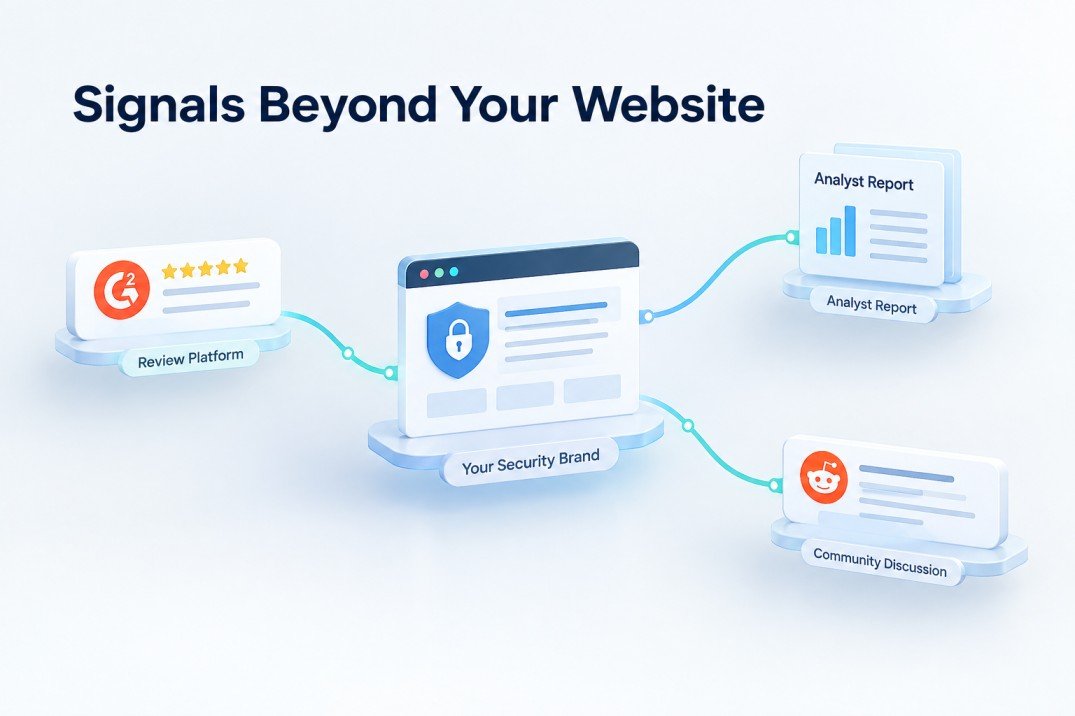
AI tools trust what other sources say about a security vendor more than what the vendor says about itself. A claim that appears only on the vendor’s website is weak evidence in a YMYL category, so outside confirmation decides which vendors get named.
Review platforms
Review platforms such as G2 and Gartner Peer Insights give AI tools structured, independent opinions from real users. Complete profiles with the correct product category, integrations and recent reviews make those listings more useful as sources.
Analyst and independent evaluations
Analyst reports such as the Gartner Magic Quadrant and the Forrester Wave carry heavy weight in security buying. GrackerAI’s benchmark found these sources earned the highest citation rates among third-party content types.
MITRE ATT&CK Evaluations add a neutral public record of how a product performed against named attacker techniques. MITRE does not rank vendors or name winners, so a vendor summary of its results works best when it links to the public data and avoids “winner” claims.
Community discussions
Community discussions on Reddit, such as r/cybersecurity and r/netsec, and on practitioner forums appear often in AI answers. Genuine participation by named employees, answering real questions, builds that presence. Promotional posts get removed or ignored.
Which metric shows real AI search progress?
Citation share is the metric that shows real progress: the percentage of relevant buyer prompts in which a brand is cited. It measures how often the brand appears across a fixed set of questions, not whether it appeared once.
Citation share vs presence
Presence records whether a brand appeared at least once. A brand cited in 1 answer out of 50 has presence but almost no citation share.
Building a prompt benchmark
A prompt benchmark is a fixed list of buyer questions, run on a regular schedule. A useful benchmark follows four rules:
- Use real buyer language from sales calls, support tickets and RFPs, not keyword tools.
- Cover all three personas: engineers, procurement and CISOs.
- Cover every buying stage, from problem awareness to validation.
- Keep the list fixed, so month-to-month results stay comparable.
Tracking progress
AI visibility tools such as Otterly and Profound run prompt sets across AI platforms and record which brands appear. Good progress is a steady monthly rise in citation share across more than one platform, not a one-week jump.
Which fixes should a security brand make first?
Security brands get the fastest results by fixing access and structure before creating new content. This checklist follows that order:
- Confirm search crawlers such as OAI-SearchBot, Claude-SearchBot and PerplexityBot are not blocked in robots.txt or firewall rules.
- Add Organization schema before investing further in Article or FAQPage schema.
- Rebuild trust-center and compliance pages as plain text, not PDFs or images.
- Ungate the core findings of top-performing whitepapers.
- Publish at least one honest comparison page against a named competitor.
- Claim and update G2 and Gartner Peer Insights profiles.
- Build a prompt benchmark and run it every month.
New content earns nothing while crawlers are blocked or key pages are unreadable, so the first four steps come before any new writing. Teams without in-house bandwidth for this work often bring in an AI visibility agency such as RankingBite to run the audit and set up the prompt benchmark.
Frequently asked questions
1-What is AI search for cybersecurity?
It is the work of getting a security brand named when buyers ask AI tools such as ChatGPT or Perplexity for vendor recommendations.
2-Is GEO replacing SEO?
No. GEO builds on SEO, because AI tools rely on pages that are already crawlable and indexed.
3-Does llms.txt improve AI citations?
No meaningful evidence shows it does, and Google states that Google Search does not use it.
4-Should security brands block AI crawlers?
Block training crawlers if needed, but keep search crawlers such as OAI-SearchBot and PerplexityBot allowed.
5-Which AI platform should a security brand test first?
Perplexity, because it searches live on almost every query and shows content changes fastest.

Farhan khan
Farhan is an SEO writer covering content strategy, search visibility, and brand discovery across search engines and AI platforms.