

The best AI search engine in 2026 depends on the task. ChatGPT Search works best for conversational search, Perplexity AI for source-backed research, and Google AI Mode for AI-powered results inside Google Search.
Each AI search engine handles sources, follow-up questions, and pricing differently, so the right pick depends on how you search. This guide ranks 7 platforms on answer quality, citations, web freshness, and cost, so you can match the right tool to research, work, or everyday questions.
What Is an AI-Powered Search Engine?
An AI-powered search engine is a search tool that uses large language models to read web sources and return a direct, written answer instead of only a list of links. Users ask full questions in natural language and receive summarized answers with cited sources.
AI-powered search works in three steps:
- Query understanding: Natural language processing (NLP) interprets the intent behind a conversational question.
- Web retrieval: The engine searches a live web index and pulls the most relevant pages.
- Answer generation: A large language model (LLM) such as GPT or Claude summarizes those pages into one answer and links the sources it used.
Adoption is rising fast. A Q2 2026 survey of 1,008 U.S. consumers by Fractl and Search Engine Land found that 70% of consumers use AI tools for search more than they did a year earlier.
Which AI Platforms Are Considered Answer Engines in 2026?
Answer engines are platforms that respond to a query with a generated answer rather than a ranked page of links. In 2026, they fall into three categories based on how AI sits inside the product.
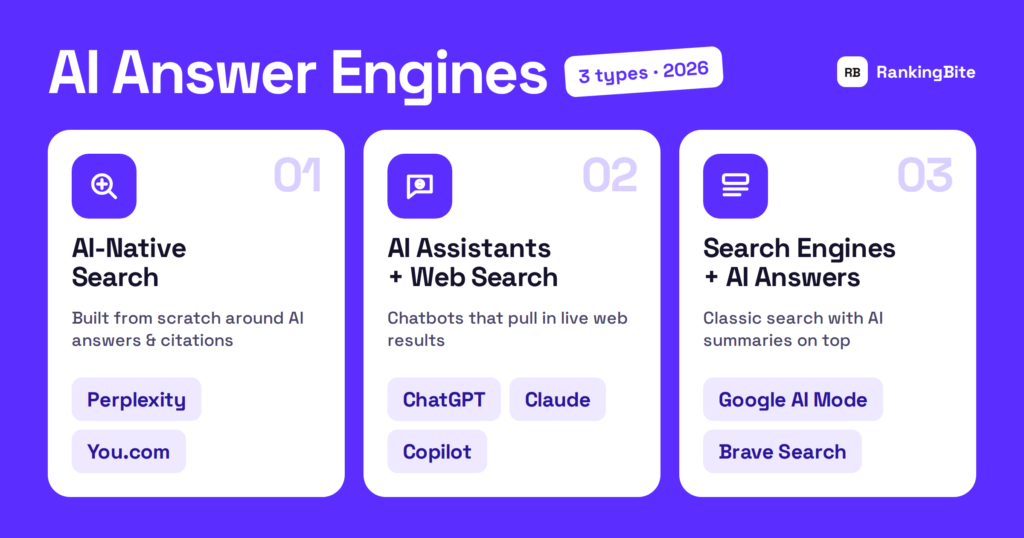
- AI-native search platforms: Tools built from the ground up around AI answers and citations. Examples include Perplexity AI and You.com.
- AI assistants with web search: Chatbots that pull live web results into a conversation when a question needs current information. Examples include ChatGPT Search, Claude, and Microsoft Copilot.
- Traditional search engines with AI-generated answers: Established search engines that add AI summaries above or beside classic results. Examples include Google AI Overviews and AI Mode, and Brave Search with its AI answers.
All three categories cite web sources, so each one affects how brands are discovered online.
How Were the Best AI Search Engines Evaluated?
The best AI search engines were evaluated on six criteria: answer quality, source reliability, web freshness, conversational capabilities, ease of use, and pricing. Each platform was compared on how it handles everyday, research, and product queries.
- Answer quality: Accuracy, depth, and clarity of the generated response.
- Source reliability: Whether answers cite credible, clickable sources.
- Web freshness: How well the engine handles news and recent information.
- Conversational capabilities: Support for follow-up questions without losing context.
- Ease of use: Interface design, speed, and app availability.
- Pricing: The value of the free tier and the cost of paid plans.
7 Best AI Search Engines in 2026: Rankings and Comparison
The 7 best AI search engines in 2026 are ChatGPT Search, Perplexity AI, Google AI Mode, Microsoft Copilot, Claude, Brave Search, and You.com. All seven offer a free tier.
Each platform is ranked by its overall score across the six evaluation criteria. ChatGPT Search ranks first because it combines live web answers, follow-up questions, and writing tools in one app. You.com ranks seventh because its focus has shifted toward enterprise and API products. The table below summarizes each platform before the detailed reviews.
| Rank | Platform | Best For | Standout Feature | Free Plan | Main Paid Plan |
|---|---|---|---|---|---|
| 1 | ChatGPT Search | Conversational search | Live web answers inside ChatGPT chats | Yes | Plus, $20/month |
| 2 | Perplexity AI | Source-backed research | Inline citations on every answer | Yes | Pro, $20/month |
| 3 | Google AI Mode | AI-powered Google search | Query fan-out across Google’s index | Yes | None (free in Google Search) |
| 4 | Microsoft Copilot | Productivity and web search | Copilot inside Word, Excel, and Outlook | Yes | Microsoft 365 Premium, $19.99/month |
| 5 | Claude | In-depth research and analysis | Cited web search with long-document analysis | Yes | Pro, $20/month |
| 6 | Brave Search | Privacy-focused AI search | Independent web index | Yes | Search Premium, $3/month |
| 7 | You.com | Customizable AI research | Multiple AI models and custom agents | Yes | Varies; check you.com |
1. ChatGPT Search – Best for Conversational Search
Best for: Users who want search answers inside a natural, ongoing conversation.
Overview: ChatGPT Search is OpenAI’s built-in web search inside ChatGPT. It pulls live results into chats and links sources, so users can research and refine answers in one thread.
Key features:
- Real-time web results with linked sources
- Follow-up questions that keep full conversation context
- Deep research mode for multi-step reports
Pros:
- Strong at explaining and summarizing complex topics
- One app covers search, writing, and analysis
Cons:
- Citations are less prominent than Perplexity’s
- The Free and Go plans run lighter models with usage caps
Pricing: Free; Go $8/month; Plus $20/month; Pro from $100/month
Who should use it? Students, writers, and professionals who research through back-and-forth questions.
Final verdict: ChatGPT Search is the most versatile choice for conversational, everyday search.
2. Perplexity AI – Best for Source-Backed Research
Best for: Researchers who need every claim tied to a source.
Overview: Perplexity AI is an AI-native answer engine. It searches the web in real time and returns concise answers with numbered inline citations that link to the original pages.
Key features:
- Inline citations on every answer
- Pro Search and Deep Research for multi-source reports
- A model picker on paid plans and the free Comet browser
Pros:
- Transparent sourcing makes fact-checking fast
- Clean, ad-light interface built for research
Cons:
- The free plan caps Pro searches
- Max costs $200/month, which suits only heavy users
Pricing: Free; Pro $20/month; Max $200/month.
Who should use it? Analysts, journalists, marketers, and students who verify sources.
Final verdict: Perplexity is the best AI search engine for cited, research-grade answers.
3. Google AI Mode – Best for AI-Powered Google Search
Best for: Users who want AI answers backed by Google’s search index.
Overview: Google AI Mode is a conversational search tab inside Google Search, powered by Gemini. It reached more than 1 billion monthly users by Google I/O 2026.
Key features:
- Query fan-out runs many sub-searches for one question
- Search Live for voice and camera queries
- Shopping comparisons and agentic tasks such as reservations
Pros:
- Direct access to Google’s index, Maps, and Shopping data
- No extra app or sign-up required
Cons:
- Answers favor Google’s own products and surfaces
- Fewer controls over sources than Perplexity
Pricing: Free inside Google Search.
Who should use it? Everyday searchers who already use Google for local, shopping, and travel queries.
Final verdict: Google AI Mode is the easiest upgrade for anyone who wants AI answers without leaving Google.
4. Microsoft Copilot – Best for Productivity and Web Search
Best for: Microsoft 365 users who want AI search connected to their work apps.
Overview: Microsoft Copilot is Microsoft’s AI assistant, formerly Bing Chat. It grounds answers in Bing web results and runs inside Windows, Edge, and Microsoft 365 apps.
Key features:
- Bing-powered web answers with cited sources
- Copilot inside Word, Excel, PowerPoint, and Outlook
- Voice and vision features on paid plans
Pros:
- Connects web research with documents and email
- Built into Windows and Edge at no cost
Cons:
- Office app features require a Microsoft 365 subscription
- Consumer plans cannot access company work data
Pricing: Free; Microsoft 365 Premium $19.99/month, which replaced Copilot Pro.
Who should use it? Professionals and teams who work daily in Microsoft 365.
Final verdict: Microsoft Copilot is the strongest pick for combining web search with productivity tasks.
5. Claude – Best for In-Depth Research and Analysis
Best for: Users who need careful analysis of complex questions and long documents.
Overview: Claude is Anthropic’s AI assistant. It searches the web on every plan, cites its sources, and analyzes long documents, files, and data in one conversation.
Key features:
- Web search with cited sources, including on the free plan
- Research mode that runs multiple searches and compiles a report on paid plans
- Connectors for apps such as Google Workspace and Slack
Pros:
- Strong at analyzing long documents and nuanced questions
- Clear, well-structured written answers
Cons:
- Research mode requires a paid plan
- No built-in image generation
Pricing: Free; Pro $20/month; Max from $100/month.
Who should use it? Analysts, writers, and professionals who research complex topics or review long documents.
Final verdict: Claude is the best AI search tool for in-depth research and analysis.
6. Brave Search – Best for Privacy-Focused AI Search
Best for: Users who want AI answers without tracking.
Overview: Brave Search is a private search engine built on its own independent web index. It adds AI answers to results and offers Ask Brave for conversational AI chat.
Run the test and write the result, or delete both Test result lines
Key features:
- Independent index, not reliant on Google or Bing
- AI answers with sources directly in results
- Ask Brave chat for multi-turn questions
Pros:
- No user profiling or tracking
- Serves more than 50 million queries per day
Cons:
- Smaller index than Google for niche or local queries
- Fewer integrations with productivity apps
Pricing: Free; Search Premium $3/month for ad-free results.
Who should use it? Privacy-conscious users and anyone avoiding Big Tech search.
Final verdict: Brave Search is the best private AI search engine in 2026.
7. You.com – Best for Customizable AI Research
Best for: Users who want to choose AI models and build custom research agents.
Overview: You.com is an AI search and agent platform. It lets users switch between models such as GPT, Claude, and Gemini and create custom agents for repeat research tasks.
Test result: [Add what You.com returned for your test queries, plus a screenshot.]
Key features:
- Multi-model access from one interface
- Custom AI agents for specific workflows
- Research mode for long, cited reports
Pros:
- High control over models and output style
- Strong enterprise and API options
Cons:
- Focus has shifted toward enterprise and API products
- Smaller user base than ChatGPT or Perplexity
Pricing: Free plan available; paid plans changed several times since 2025, so check you.com for current rates.
Who should use it? Power users and teams building tailored AI research workflows.
Final verdict: You.com is the best fit for customizable, multi-model AI research.
Which AI Search Engine Should You Choose for Your Needs?
The right AI search engine depends on your main task: everyday questions, cited research, work productivity, or privacy. Match the platform to the job you use to search for most.
Best AI Search Engines by Use Case
- Everyday searches: Google AI Mode or ChatGPT Search
- Source-backed research: Perplexity AI or You.com
- Productivity: Microsoft Copilot or Claude
- Privacy: Brave Search
Which AI Search Engines Matter Most for Businesses?
Businesses should monitor ChatGPT Search, Google AI Mode, Perplexity, Claude, and Microsoft Copilot for AI-generated brand mentions. These platforms now shape product and service discovery before a buyer visits any website.
Visibility varies across platforms because each engine uses a different index, retrieval method, and source preference. A brand cited by Perplexity is not automatically cited by Google AI Mode.
Tracking that gap matters. Only 24% of marketers track LLM visibility, while 27% of brands have already been misrepresented in AI answers. Measure three metrics on each platform:
- AI citations: How often your pages appear as sources
- Brand mentions: How often AI answers name your brand
- Share of voice: Your mentions compared with competitors
Want to know how your brand appears in ChatGPT, Perplexity, and Google AI Mode? Talk to RankingBite to measure and grow your AI search visibility.
Frequently Asked Questions
Which is the best AI search engine in 2026?
ChatGPT Search is the best all-round AI search engine in 2026 for conversational search. Perplexity AI leads for cited research, and Google AI Mode leads for everyday Google queries.
Is Perplexity better than ChatGPT Search?
Perplexity is better for source-backed research because every answer carries inline citations. ChatGPT Search is better for conversational follow-ups, writing, and analysis in one place.
Which AI search engine is the most accurate?
Perplexity AI is the easiest to verify because it cites sources inline. No AI search engine is error-free, so check important answers against the original sources.
What is the best free AI search engine?
Google AI Mode is the best free AI search engine because all its features are free inside Google Search. Brave Search is the best free option for privacy.
Can businesses optimize for AI search engines?
Yes. Businesses optimize for AI search by publishing clear, factual, well-structured content, earning third-party mentions, and tracking AI citations and share of voice on each platform.