AI search engines answer questions before a brand ever gets the chance to make its case. ChatGPT, Perplexity, and Google’s AI Overviews now sit between a buyer and a purchase decision, and they decide which brands get mentioned based on prompts, not keywords, especially for the buyer-intent queries that used to drive conversions straight from a search results page. A business that only tracks its old keyword rankings has no idea how it’s actually performing on the buyer-intent queries that matter most in this new layer of search. That performance has a name, and it’s AI visibility.
Most SEO teams still measure success through rankings and click-through rates. That approach misses the actual moment of influence, which happens inside an AI-generated answer, not on a results page. A prompt universe is the tool that closes this gap: it’s the foundational input every AI visibility measurement depends on, and it’s also what feeds coverage-gap analysis once it’s built.
We ran this exact process for a B2B SaaS client earlier this year. Their keyword rankings looked healthy, but a 40-prompt audit showed they weren’t mentioned in a single AI-generated comparison query against their two closest competitors, meaning their AI visibility was effectively zero on the exact queries closest to a sale. That gap is invisible in a rank tracker and only shows up once the prompts are actually built and tested.
This guide covers what AI visibility actually means, what buyer-intent queries are, how to assemble prompts across the funnel, and why commercial prompts deserve priority over informational ones when the goal is AI visibility, not just traffic.
What are Buyer-Intent Queries?
Buyer-intent queries are prompts a person types when they’re close to making a purchase decision, not when they’re simply learning about a topic. A prompt like “best CRM for a 10-person sales team” carries far more commercial weight than “what is CRM software,” and it’s also far more likely to shape whether a brand gets an actual purchase consideration versus just general awareness.
These queries show up at three stages of the funnel: comparison shopping, vendor shortlisting, and final validation before checkout. Someone asking an AI assistant “[Brand A] vs [Brand B] for small business” has already narrowed their options and wants a decision-ready answer, and a brand’s AI visibility on that exact prompt often decides whether it makes the shortlist at all.
What is AI Visibility, and Why Does It Start With Prompts?
AI visibility is how often and how favorably a brand gets mentioned inside AI-generated answers across tools like ChatGPT, Perplexity, Google AI Overviews, and Copilot when someone asks a relevant question. It’s the AI-era equivalent of a search ranking, except there’s no results page to check. The only way to measure it is to ask the same questions a buyer would ask and record what comes back.
That’s why AI visibility can’t be measured without a prompt universe first. A rank tracker works because Google’s results page is a fixed, checkable format. An AI-generated answer isn’t fixed; it changes based on the exact wording of the prompt, the platform, and the sources available at that moment. Without a defined, repeatable set of prompts to test, there’s no consistent way to know whether AI visibility is improving, flat, or slipping.
AI visibility gets measured across four metrics, and each one maps directly back to the prompt universe:
- Mention rate: The percentage of tracked prompts where the brand appears at all.
- Sentiment: Whether the brand is described favorably, neutrally, or negatively when it does appear.
- Share of voice: How often the brand appears relative to named competitors across the same prompt set.
- Citation rate: How often the brand’s own content gets linked or referenced as a source inside the answer.
Every one of these numbers is only as good as the prompt list behind it. That’s the practical reason a prompt universe comes first; everything else in AI visibility tracking is downstream of it.
What is a Prompt Universe, and How Is It Different From a Keyword List?
A prompt universe is the complete, organized set of every question a buyer might ask an AI assistant about a brand, its competitors, and its category. It’s the master list a team tests against AI platforms to generate mention rate, sentiment, share of voice, and citation data.
A keyword list tracks search volume and ranking position for isolated terms. A prompt universe tracks full natural-language questions, grouped by intent and buying stage, because that’s how people actually talk to AI assistants. Keywords are fragments; prompts are complete decisions in progress, and AI visibility, unlike a keyword ranking, only exists as a number once this defined set of prompts has been tested against it.
This is the part most teams get backwards, and the data backs it up plainly.
Comparison-style queries, the classic “X vs Y” format, now trigger an AI Overview on roughly 95% of searches, according to Seer Interactive’s ongoing 2026 tracking of AI Overview trigger rates across query types. [^1] If a brand’s content strategy leans on comparison pages for organic traffic, that traffic is already routed through an AI-generated answer before a human ever sees the page, which means AI visibility on comparison prompts matters more than ranking position on those same pages.
The upside for brands that do get cited is real. The same research found that being cited inside an AI overview delivered several times the organic click-through rate of not being cited throughout 2025, even as overall click-through rates on AI overview queries kept compressing. [^1] In other words, AI visibility inside the answer now outperforms visibility on the page below it.
This is exactly why buyer-intent queries, comparisons, categories, and persona prompts specifically deserve tracking priority over broad informational ones. Informational prompts build awareness at scale. Commercial prompts sit at the exact query type where AI visibility now determines whether a brand gets considered at all.
What Types of Buyer-Intent Queries Belong in a Prompt Universe?
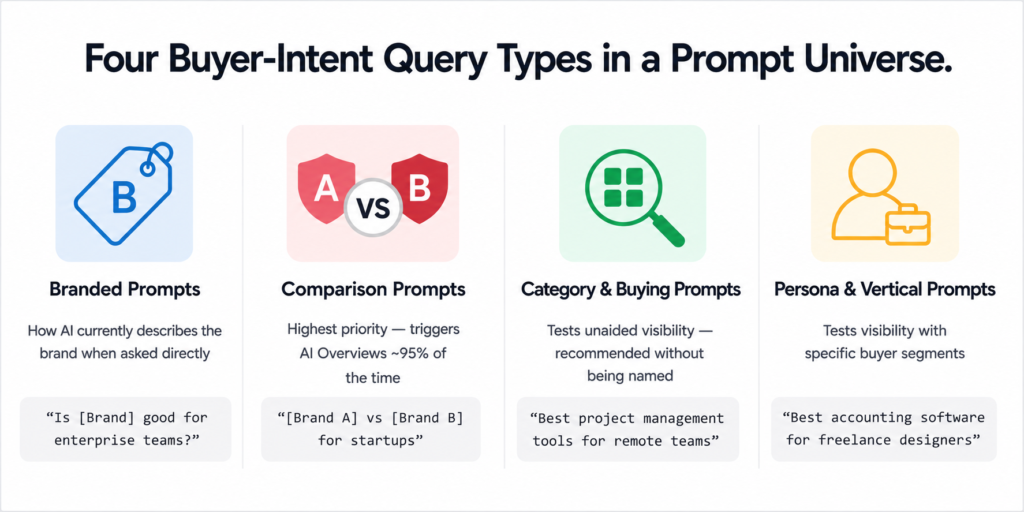
A complete prompt universe covers four query types: branded, comparison, category and buying, and persona and vertical. Each one tests AI visibility at a different moment in the buyer’s research process, and each is built by expanding a seed keyword into constraint-rich questions.
One seed produces a portfolio, not a single prompt. Take the seed keyword CRM software. As a keyword, it is one term with one ranking position. As a prompt seed, it expands across all four query types by layering constraints: company size, budget, industry, integration, role, and competitor set. The examples below trace that single seed through every type.
Branded Prompts
Branded prompts directly name a company, product, or service. They reveal how AI assistants currently describe and position a business when asked point-blank, which is the clearest baseline read on existing AI visibility. From the CRM seed:
- “Is [Brand] a good CRM for a 12-person sales team?”
- “[Brand] CRM pricing for a startup under 20 seats”
- “[Brand] CRM complaints from small business users”
Comparison Prompts
Comparison prompts pit one brand against competitors. Given how dominant AI overviews are on this exact query pattern, this is the highest-priority category for AI visibility tracking in the entire prompt universe. From the same seed:
- “[Brand] vs [Competitor A] for a B2B startup”
- “[Brand] vs [Competitor B] on ease of setup for non-technical teams”
- “Which is cheaper for 10 users, [Brand] or [Competitor A]?”
Category & Buying Prompts
Category and buying prompts focus on the product category itself without naming any brand. They reveal whether a brand earns unaided AI visibility, meaning it gets recommended without being asked about by name. From the same seed:
- “Best CRM for a 10-person sales team”
- “Cheapest CRM with a free trial for small business”
- “CRM that integrates with QuickBooks and Slack”
Persona & Vertical Prompts
Persona and vertical prompts narrow the query by role or industry. They surface whether a brand’s AI visibility holds up with specific buyer segments or only shows up in generic, broad-audience answers. From the same seed:
- “Best CRM for a solo real estate agent”
- “CRM for a marketing director managing an outbound team”
- “Simplest CRM for a freelance consultant who hates admin”
One seed keyword, twelve prompts, four query types. Each constraint added, whether it’s the seat count, the integration, or the role, is a prompt an AI assistant answers differently and a place where AI visibility can be present or absent independently. This is the mechanical difference between a keyword list and a prompt universe: the keyword is the input, and the constraint-rich prompt set is the unit that actually gets tracked.
How Do You Assemble Prompts Across the Funnel?
Building a prompt universe follows a repeatable seven-step process, moving from foundational research to ongoing AI visibility tracking.
Step 1: Define Your Core Products, Services, and Audience
List every product line, service offering, and target audience segment a business serves. This inventory becomes the raw material every prompt in the universe gets built from, so skipping it leads to AI visibility blind spots later. Pull this straight from an existing keyword research framework; if one already exists, the audience and product segmentation usually overlap, and reusing it saves a full research cycle.
Step 2: Create Branded Prompt Sets
Write 15 to 20 prompts that directly reference the brand across pricing, features, reviews, suitability for different company sizes, and use-case fit. Include both favorable framings (“is [Brand] worth it”) and skeptical ones (“[Brand] complaints” or “[Brand] alternatives”), since AI assistants pull from both types of source content when forming an answer, and both shape sentiment, not just mention rate.
Step 3: Build Comparison Prompt Sets
Identify the three to five competitors that come up most often in sales conversations and build comparison prompts against each one, covering different angles: pricing, features, ease of use, and “which is better for [use case].” Given the near 95% AI overview trigger rate on this query type, this is the set worth building out first for AI visibility purposes, not last.
Step 4: Expand into Category & Buying Prompts
Pull category-level questions from AI assistants’ own autocomplete suggestions, PAA boxes, and competitor content to find how buyers phrase generic requests. Include both broad category prompts (“best [category] tools”) and narrower buying-stage ones (“[category] tools with a free trial” or “cheapest [category] tool for small teams”). These prompts test unaided AI visibility, which carries more weight than a branded mention.
Step 5: Add Persona and Industry-Specific Prompts
Map each buyer persona to the specific language they use, since a marketing director and a solo founder ask very different questions about the same product. Build at least 3 to 5 prompts per persona, covering their specific pain points and vocabulary rather than reusing the same category prompts with a role name inserted. AI visibility often varies sharply between personas even when the overall mention rate looks fine.
Step 6: Organize the Prompt Universe Into a Tracking Sheet
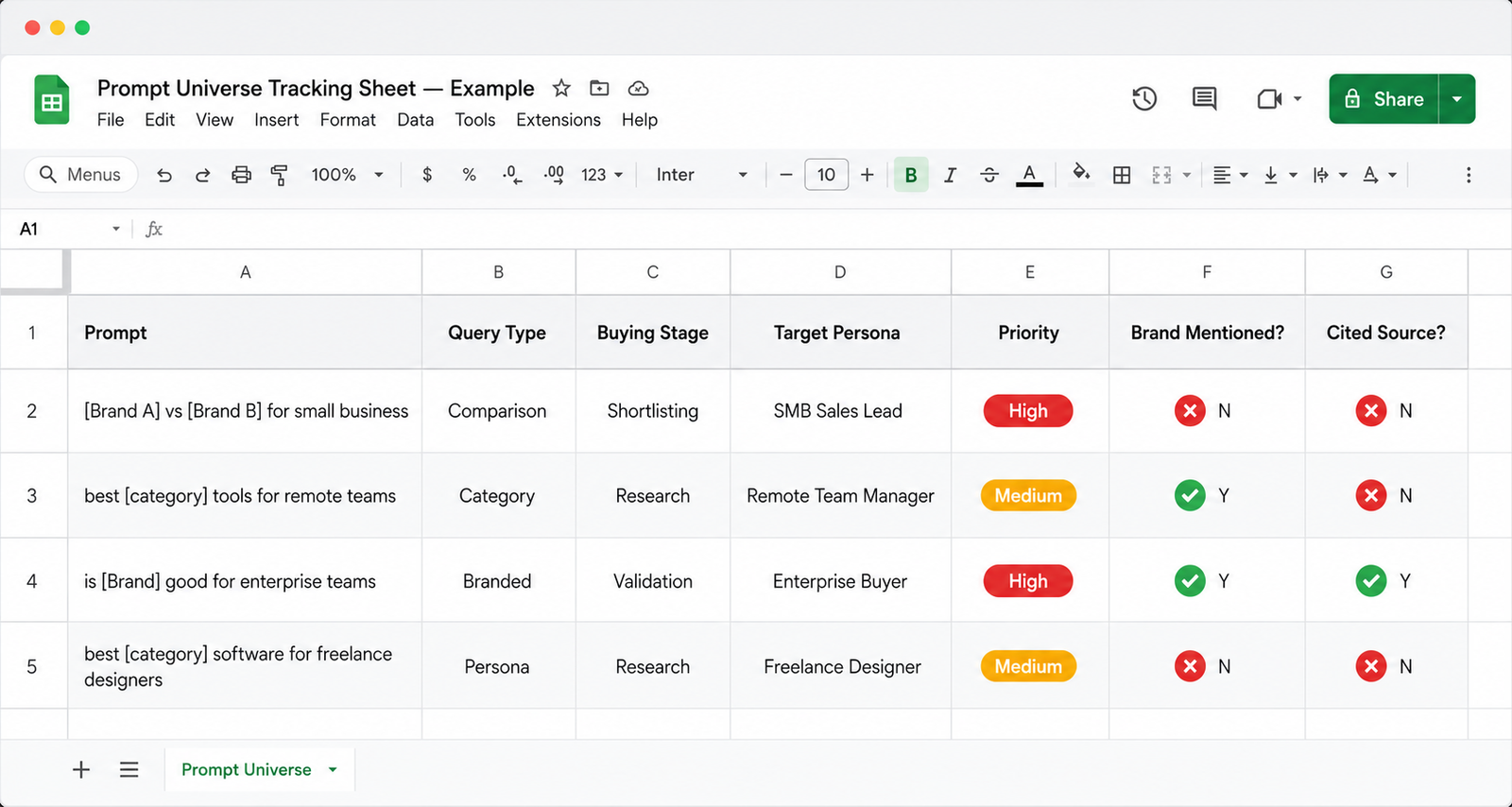
Every prompt needs to sit in a structured sheet, not a loose list. The minimum column set:
A ready-to-use version of this template is attached as a separate spreadsheet file so it can be duplicated directly instead of rebuilt from scratch. The last two columns are what turn this sheet into an AI visibility tracking system instead of a static list — they get filled in every time the prompt universe is tested against an AI platform.
Step 7: Validate and Continuously Expand
Test the prompt set across major AI platforms, note which prompts return zero brand mentions, and add new prompts as products, competitors, and market language shift. This validation step is also the direct handoff into coverage-gap analysis, covered next.
How Does a Prompt Universe Feed Coverage-Gap Analysis?
The prompt universe isn’t the end goal; it’s the input. Once it’s built and tested, it becomes the tool that exposes exactly where AI visibility is missing. At a high level, that process looks like this:
- Identify missing AI visibility: Run each prompt through major AI assistants and flag every query where the brand doesn’t appear at all.
- Find buyer-intent content gaps: Match zero-mention prompts against existing content to see which comparison pages, reviews, or category guides simply don’t exist yet.
- Prioritize new content opportunities: Rank the gaps by buying-stage proximity a missed comparison prompt deserves attention before a missed top-of-funnel prompt, given how much more AI Overview traffic now runs through comparison queries.
What Mistakes Should You Avoid When Building a Prompt Universe?
- Tracking only informational prompts: Measuring AI visibility through “what is” queries alone hides the real gaps sitting in comparison and category prompts, which are exactly the query types carrying the highest AI overview presence.
- Ignoring commercial intent: Skipping pricing, review, and “best for” prompts means missing the moments where citation delivers several times the click-through of a non-cited mention.
- Forgetting persona-specific queries: A prompt universe built around one generic buyer misses how AI visibility can differ sharply by role or industry.
- Not updating the prompt universe: A static list goes stale within a few months as new competitors, products, and phrasing patterns emerge, and AI visibility data collected against an outdated prompt set stops being reliable.
How Often Should a Prompt Universe Be Maintained?
Refresh the prompt list every 4 to 6 weeks to account for new competitors, product launches, and shifts in buyer phrasing. Track mention rate, sentiment, and citation status across the same prompts over time rather than checking once and moving on. AI visibility is a moving number, not a one-time audit result. When expanding, prioritize new comparison and category prompts over informational ones, since those are still where the tracking data shows the most AI overview activity and the most citation upside.
FAQs
-
Do AI answers change if I run the same prompt twice?
Yes. Run each prompt two or three times in fresh sessions before recording a result, otherwise you are logging variance as a finding.
-
Does prompt wording matter, or is the meaning enough?
Wording matters. Two phrasings of the same question can return different brands, which is why prompts get locked once written, not reworded each cycle.
-
Should I test every AI platform or just one?
Test the ones your buyers actually use. Coverage differs sharply by platform, so a single-platform read tells you about that platform, not about AI visibility.
-
Can I automate prompt universe tracking?
Partly. Monitoring tools are improving, but none cover every engine reliably, so most teams still run a manual or semi-manual audit.
-
Should prompts match real search volume?
No. Prompts are questions buyers ask an assistant, not terms with a volume figure. Sales calls are a better source than a keyword tool.
-
Who should build and own the prompt universe?
Whoever owns organic performance, with sales input on the comparison and objection prompts. One owner, not shared.