Best X” and Comparison Content: The Format to Invest In for Commercial Intent
Ranked “Best X” pages are the highest-return content format in 2026, because they win the queries AI cannot finish. Head-to-head comparisons support them; the…
Ranked “Best X” pages are the highest-return content format in 2026, because they win the queries AI cannot finish. Head-to-head comparisons support them; the numbered list is what gets lifted.
Commercial discovery changed shape. A buyer who once opened six tabs now asks one question, “best CRM for a 20-person sales team,” and reads a synthesized recommendation with sources attached. The tab-opening stopped. The decision did not.
That decision needs things a summary does not hold: tested tradeoffs, real pricing, honest exclusions, and a stated position on who each product suits. Definitions get absorbed. Judgments get cited.
This article covers why the format performs, how AI systems select comparison content, how to build pages that earn citations, the structure that works, the mistakes that block recommendations, and how comparison pages fit into a cluster that bridges SEO and AEO.
Why Comparison and “Best X” Content Performs Better in AI Era
The format did not get better. The competition got worse. A summary can finish a definition, so definitions stopped paying. A summary cannot finish a decision, so decisions are where the click stayed, and the ranked list is the shape that decision arrives in.
Commercial Intent Drives Better Business Outcomes
Commercial queries sit one step from a purchase. Someone searching “best project management software for agencies” has a budget, a problem, and a shortlist forming.
Informational queries sit five steps back. Someone searching “what is project management software” may never buy anything.
Same topic. Entirely different economics. Content budgets that chase search volume fund the second group and wonder why the pipeline is empty.
Why AI Frequently Recommends Comparison Content
AI systems answer buying prompts by retrieving and summarizing sources. A buying prompt needs structured evaluation: criteria, tradeoffs, use cases, verdicts. Comparison pages already contain exactly that.
A definition page offers a model nothing it cannot generate itself. A tested comparison offers judgments the model has no way to produce alone. That asymmetry is why the format gets pulled into answers.
The data shows format tracking intent. Wix Studio’s AI Search Lab analyzed 75,000 AI answers and over 1 million citations in March 2026: articles won informational queries at 45.5%, listicles won commercial queries at 40.9%, and product pages won transactional and navigational queries. Format follows intent, and commercial intent belongs to the ranked list.
Google’s May 2026 guide on generative AI features names unique, expert-led content as the primary driver of visibility in AI search. A comparison built on real testing is that description in page form.
Why Comparison Content Converts Better Than Informational Content
Comparison readers arrive with a decision pending. They want the shortlist narrowed and the reasoning shown. When your page does both, the next click is a pricing page or a demo form.
The absorbed traffic, the definition readers, was never converting anyway. Losing it costs sessions. It does not cost revenue.
Real Example: Informational vs Commercial Queries
Four queries from a CRM portfolio, same topic, four different jobs:
| Query | Intent | AI Behavior | Business Value |
|---|---|---|---|
| “What is CRM” | Informational | AI Overview answers the question completely. | Near Zero |
| “Best CRM software” | Commercial | AI Overview summarizes options, but users still compare before choosing. | High |
| “HubSpot vs Salesforce” | Commercial Comparison | Requires feature-level comparison, making detailed content more valuable. | Highest |
| “HubSpot pricing” | Transactional | AI Overview appears less often because users need current pricing details. | Highest |
The biggest search volume in the set. It is also the only one that stopped paying. Most content plans still lead with it.
How AI Selects Comparison Content for Recommendations
Selection is not about which page ranks best. It is about which page contains something the model cannot write itself. Every signal below is a version of that same test, and the pages that fail it fail for the same reason: they are made of information the model already has.
Signals That Increase AI Citations
Six characteristics separate a cited comparison from an ignored one:
- Evidence-backed claims. “Faster onboarding” is an adjective. “Onboarding took three days versus two weeks” is a claim a model can lift and attribute.
- Original insights. Something the model cannot assemble from existing pages. Your testing, your methodology, your findings.
- Comparison tables. Structured data extracts cleanly. A table row survives summarization intact; a paragraph rarely does.
- Fresh information. Retrieval favors current pages, and pricing and feature sets change constantly. An outdated comparison is a wrong comparison.
- E-E-A-T. Named authors with verifiable credentials, a real organization behind the page, and reputation signals that resolve.
- First-hand product experience. Screenshots from inside the product, workflow-level detail, and limitations only a user would know.
The last one carries the most weight and is the easiest to fake badly. A model can tell the difference between a feature list rewritten from a vendor site and an account of what broke during setup.
Example: Thin Affiliate Page vs Expert Comparison
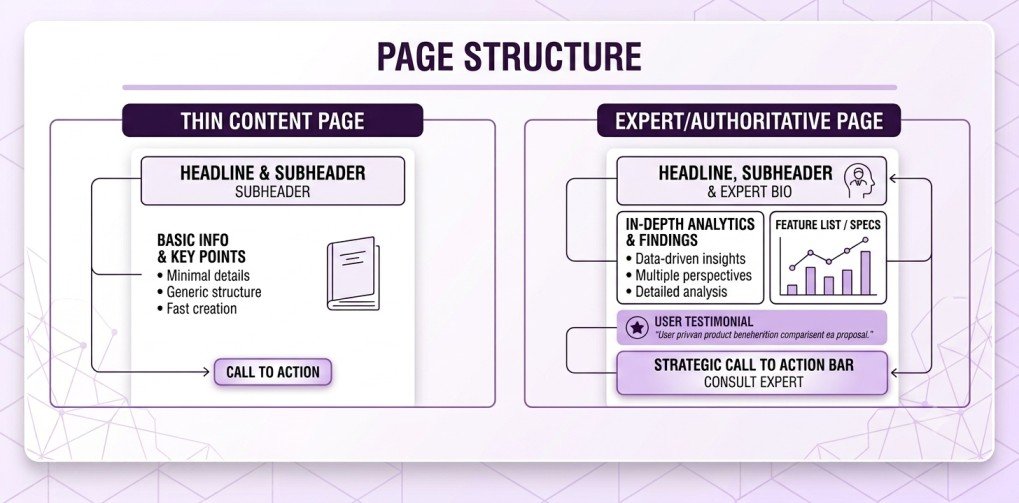
Two pages target “best email marketing tools.”
The first lists eight products with feature bullets pulled from vendor sites, five-star ratings for every option, and affiliate links. Nothing was tested. Nothing is excluded. Every product is “great for growing businesses.”
The second tests four products against a stated set of criteria, publishes the methodology, names which product lost and why, includes deliverability results from actual sends, and recommends against one option for a specific use case.
The first page contains no information a model lacks. The second contains findings that exist nowhere else. Retrieval treats them accordingly and so do readers.
How to Build Comparison Pages That Earn Trust and Citations
Trust and citations come from the same place, which is convenient. Both are earned by showing the work: what you tested, how you decided, and what you found that nobody else has. The three practices below are that in order, and none of them is a writing exercise. They are things you do before you write.
Define a Clear Evaluation Framework
State your criteria before your verdicts. Five to seven criteria, chosen for the reader’s decision, not the products’ strengths.
Then publish the weighting. If ease of setup matters more than feature depth for your audience, say so and say why. A framework the reader can disagree with is a framework they can trust.
Compare Products Objectively
Objectivity is not neutrality. Neutrality gives every product four stars and helps nobody.
Objectivity means the same tests, the same criteria, and the same scrutiny applied to each option, then a clear verdict. Name what each product does badly, including the one you recommend. A comparison with no losers is an advertisement.If your own product is in the comparison, that scrutiny applies to it hardest. Name where it loses, and do not hand yourself the top spot.
Support Recommendations with Evidence
Every verdict needs its receipt on the page:
- Pricing with tiers, dates, and what changes between them
- Test conditions and methodology
- Screenshots or output from actual use
- Named limitations and the use cases each product fails
- The date the comparison was last verified
Evidence is also what makes a page citable. A claim with a number attached gets quoted. An adjective gets ignored.
A Real-World Example
Say you are comparing two help desk tools for a support team of ten.
The weak version: a table of features, both marked “yes” across the board, and a conclusion that both are excellent choices depending on your needs.
The strong version: you run both for two weeks with real tickets. You publish the setup time for each, the number of steps to build one automation, what the migration broke, which one your team preferred and why, and the exact price at ten seats after the discount tier applies. You conclude that one fits teams with a technical admin and the other does not.
Same products. The second version answers the question. It also gives a model something to cite, and a buyer something to act on.
The Ideal Structure for “Best X” and Comparison Pages
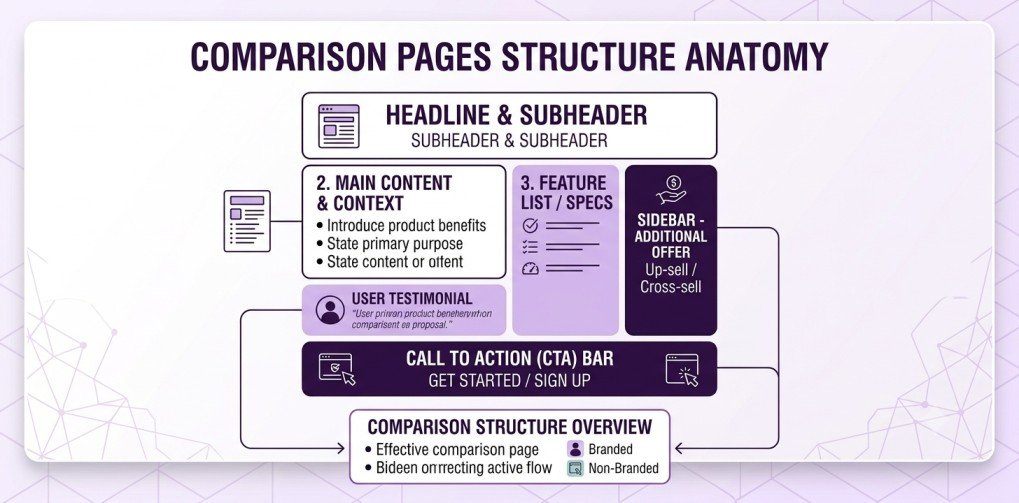
Essential Page Elements
- Quick answer. The verdict in the first 100 words, followed by a numbered list of your picks. Rank them, do not just list them. Numbered Top-N structure is what gets extracted; an unordered set of options is not. Name the winner, name who it suits, name the exception. Readers who need only this should get it without scrolling.
- Comparison table. Products as rows, criteria as columns. Real values, not checkmarks. This is the block most likely to be extracted.
- Evaluation methodology. What you tested, how, over what period, and what you excluded. Placed high, because it is what makes everything below it credible.
- Product summaries. One block each. Strengths, weaknesses, pricing, and the buyer it fits. Same structure for every product so they stay comparable.
- Best for different use cases. “Best for small teams,” “best for enterprise,” “best on a budget.” This section maps directly to how buying prompts get phrased.
- Final recommendation. A stated position, with the conditions under which it changes.
The use-case section deserves attention. Buying prompts almost never ask “which is best.” They ask “which is best for a 12-person agency running client retainers.” A page organized around use cases answers the prompt as written.
Common Mistakes That Prevent AI Recommendations
Four mistakes, and they are not all the same kind. Three of them make a page ignorable. One of them, the newest, makes a page a target. That distinction matters, because ignorable costs you a citation and targeted costs you the site.
Thin Affiliate Content
Feature lists rewritten from vendor pages, universal praise, and affiliate links. The page contains no original information, so retrieval has no reason to prefer it over the vendor site it copied.
Self-Ranking Your Own Product
Publishing your own “best X” list and placing yourself at #1 is now actively targeted. Amsive’s analysis, led by Lily Ray, documented sites running self-serving ranked listicles at scale losing 30 to 50% of organic visibility in early 2026, and Google confirmed to The Verge that it is targeting the pattern.
The line is simple. Building honest comparison content that names real competitors and gives each a genuine downside is safe, including when you are one of the options. Ranking yourself first in your own roundup is not. Earning placement inside a credible third party’s “best X” list compounds; manufacturing your own does not.
Missing Evaluation Criteria
A ranking with no stated basis is an opinion in a table. Readers cannot check it, and neither can anything else. Criteria first, verdicts second. The order is the credibility.
Unsupported Rankings
“We recommend X” with nothing behind it. Every position in your ranking needs a reason tied to a criterion and evidence tied to the reason. A ranking that would not survive a reader asking “how do you know?” will not earn a citation either.
Outdated Comparisons
Pricing changes. Features ship. Products get acquired. A comparison with 2024 pricing is not stale content; it is wrong content, and being wrong on a buying page costs more than being absent.
Set a verification schedule and publish the date you last checked.
Integrating Comparison Content Into Your SEO and AEO Strategy
One page does not earn citations on its own. It earns them because of what points at it, what it points at, and where else your name appears. This section is the part most teams skip, because it is not writing, and it is why their best comparison page still loses to a worse one on a stronger site
Connect Informational and Commercial Content
Informational content stopped being a traffic engine. It became a routing layer. Your “what is CRM” page will keep losing clicks to the overview. What it can still do is hand the readers it does get to “best CRM software,” and hand those readers to “HubSpot pricing.” Each page serves the next question.
Earn Placement in Other People’s Lists
Your own comparison is half the play. The other half is appearing inside credible third-party roundups, which carry citation weight you cannot manufacture on your own domain. Three things earn it: publishing original data or testing that a roundup author wants to cite, direct outreach to publications already ranking for your buying prompts, and genuinely fitting the category you are pitching. A pitch to a list you do not belong on fails on merit before anyone reads it.
Strengthen Your Content Cluster
Comparison pages sit in the middle of the cluster and carry the most weight. They receive links from informational pages above and send links to product and pricing pages below.
They also carry the topical authority. Depth on one commercial topic, comparisons, alternatives, use cases, pricing, signals coverage that single pages cannot.
Guide Users Toward Transactional Pages
Every comparison page needs an exit that converts. Link to pricing from the pricing row. Link to the demo from the verdict. Link to the migration guide from the section about switching.
Place the link where the question arises, not in a block at the bottom.
Measure Performance Beyond Rankings
Four numbers for a comparison page:
- Conversions and assisted conversions, not sessions
- Citation rate on your buying prompts across AI Overviews, AI Mode, ChatGPT, and Perplexity
- Branded search growth, which citations produce without clicks
- Click-through to transactional pages from the comparison
Seer Interactive found cited brands earn 35% more clicks than uncited ones on the same query. Citation is not a vanity metric on this format; it is distribution.
Internal Linking Strategy for Comparison Pages
Four rules:
- Descriptive anchors. “HubSpot vs Salesforce comparison,” not “read more.” The anchor tells both readers and retrieval systems what sits on the other side.
- Informational pages link up to commercial pages. Every definition page routes to the comparison that serves the next question.
- Comparison pages link down to transactional pages. Pricing, demo, signup, migration.
- Comparison pages link across to each other. “Best X” links to “X vs Y” links to “X alternatives.” That lateral web is the cluster.
Example: CRM Content Cluster
INFORMATIONAL(routes traffic)
 What is CRM·CRM implementation guide· CRM metrics explained
↓ links down to
COMMERCIAL (earns citations, carries the cluster)
 Best CRM software· HubSpot vs Salesforce· HubSpot alternatives
 Best CRM for small business· Best CRM for agencies
↓ links down to
TRANSACTIONAL (converts)
 HubSpot pricing· Salesforce pricing· CRM migration service· Demo
Informational pages absorb the AI losses and route what survives. Commercial pages earn the citations and carry the buying prompts. Transactional pages close. Budget follows that order in reverse: most investment at the bottom two layers, least at the top.
Frequently Asked Questions
What is comparison content in SEO?
Comparison content evaluates two or more products against stated criteria and reaches a verdict. It covers “X vs Y” pages, “best X” roundups, and “X alternatives” pages. It targets commercial intent, users choosing between options rather than learning what the category is.
Why does AI frequently recommend comparison and “Best X” pages?
Buying prompts need structured evaluation, and comparison pages already contain it: criteria, tradeoffs, use cases, verdicts. A tested comparison also carries judgments a model cannot generate on its own, which is exactly what makes a source worth citing.
Are “Best X” articles still effective in the AI era?
Yes, when they contain real testing. Thin roundups rewritten from vendor sites are not effective, because they offer nothing a model lacks. Tested comparisons with methodology and honest exclusions perform better now than before, because the alternative is worse than ever.
How can I make comparison pages more likely to earn AI citations?
Publish original testing, put the verdict in the first 100 words, use a comparison table with real values instead of checkmarks, name limitations and losers, add first-hand screenshots, attach a named author with credentials, and keep pricing current with a visible verification date.
Should I create comparison pages or product pages first?
Product and pricing pages first, because comparison pages need somewhere to send buyers. Then comparisons, then informational content last. That order is the reverse of how most content plans get built.
How often should comparison and “Best X” content be updated?
Quarterly at minimum, and immediately when pricing or major features change. Outdated pricing on a buying page is wrong information, not stale information. Publish the last-verified date so readers and retrieval systems can both see it.
Conclusion
Comparison and “Best X” content is the strongest investment for commercial intent because it sits where the click survived and the decision still happens.
The format wins on both sides of the split. Traditional search rewards it because buyers search this way and convert here. AI search rewards it because a tested comparison contains judgments no model can generate: criteria, tradeoffs, honest exclusions, real pricing, first-hand experience.
The requirements are the same in both cases. State your framework before your verdict. Test what you claim. Name the losers, including inside your own recommendation. Structure the page so the answer arrives first and the evidence sits under it. Keep it current, and publish the date you last checked.
Do that and one page serves two systems. That is the entire bridge between SEO and AEO, and it is built from the same materials it always was.

Farhan khan
Farhan is an SEO writer covering content strategy, search visibility, and brand discovery across search engines and AI platforms.