
Many articles contain useful information, but they still don’t get cited. The reason isn’t always the quality of the content, it’s often the way the information is presented. Research on information extraction has found that clearly structured documents improve how accurately AI systems identify and extract relevant information. If the main answer is buried under long introductions or unnecessary background, AI engines may not recognize it as the best source to reference.
A small change in structure can make a big difference. When the answer appears early and the supporting details follow naturally, your content becomes much easier to extract and understand.
AI Can’t Extract What It Can’t Find
AI engines scan a page to locate clear answers. If readers have to scroll through several paragraphs before reaching the point, AI has to do the same. The harder the answer is to find, the less likely it is to be extracted.
Example: Question: What is a direct-answer lead?
Hard to extract:
Before we understand direct-answer leads, it’s important to know how content writing has evolved over the years…
Easy to extract:
A direct-answer lead is a writing approach where you answer the reader’s main question in the opening sentence and explain it afterward.
The second version gives the answer immediately, making it easier for both readers and AI to understand.
The Hidden Cost of Delayed Answers
Many writers save the answer for later because they want to build context first. While this may work in storytelling, it often works against informational content.
When the answer is delayed, readers spend more time searching for it, and AI engines may choose another page that provides the information more quickly.
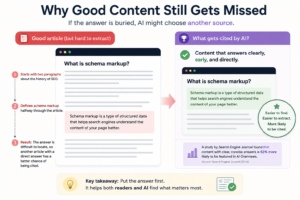
Example: A user searches: “What is schema markup?”
Less effective approach:
Two paragraphs explain the history of SEO before mentioning schema markup.
Better approach:
Schema markup is structured data that helps search engines understand the content of a webpage. After that, explain how it works, why it’s useful, and where it should be used.
A good article isn’t always an extractable article. If the answer comes too late, it can easily be overlooked.
The Direct-Answer Lead Framework
A direct-answer lead follows a simple principle: answer first, explain second. Instead of making readers work to find the information they need, you present the key takeaway immediately and use the rest of the section to add context, examples, or supporting details.
Research on online reading consistently shows that people scan content before they read it in detail. The well-known Nielsen Norman Group’s eye-tracking research has consistently shown that web users scan pages for relevant information rather than reading every word, reinforcing the value of presenting key information early.
The 30-Second Rule
Ask yourself one question before publishing:
Can someone understand the main answer within 30 seconds of landing on this section?
If the answer is yes, your content is already easier to read and easier for AI engines to extract. If readers have to scroll through several paragraphs before finding the key point, consider moving the answer closer to the top.
Example
Question: Why is internal linking important?
Hard to scan
Websites contain many pages, and connecting them properly has always been an important part of website management…
Easy to scan
Internal linking helps search engines and readers discover related pages while improving the overall flow of information.
The second version tells readers exactly what they came to learn before expanding on the topic.
The Direct-Answer Formula
A simple structure can make almost any informational section easier to understand.
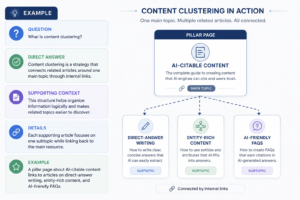
This order matches the way people naturally look for information. They want the answer first, followed by the explanation that helps them understand it better.
When the Formula Doesn’t Work
Not every piece of content should begin with the answer. Some formats are designed to create curiosity or tell a story before revealing the main point.
For example, a personal experience, case study, or narrative article often benefits from building context first because the journey is part of the message.
Example
Works well with a direct-answer lead
- Definitions
- Tutorials
- FAQs
- How-to articles
- Product explanations
Better with storytelling first
- Personal experiences
- Case studies
- Opinion pieces
- Brand stories
The key is knowing your content’s purpose. If the goal is to help someone find a clear answer quickly, lead with the answer. If the goal is to tell a story or persuade, building context first can be the better choice.
| Goal | Original | Improved |
|---|---|---|
| Remove the Long Introduction | Many businesses today are trying different content strategies to improve their online visibility. One important strategy that has gained attention in recent years is content clustering. Let’s first understand why this approach has become popular. | Content clustering is a strategy that connects related articles around one main topic through internal links. |
| Replace Generic Statements with Clear Answers | It is important to understand that page speed plays a significant role in user experience. | A fast-loading page improves user experience by reducing waiting time and keeping visitors engaged. |
| Move the Answer Before the Explanation | Before learning about structured data, it’s helpful to know how search engines collect and organize information from websites. | Structured data is code that helps search engines understand the meaning of your content. It provides additional context about products, reviews, recipes, and events. |
Formatting Choices That Improve AI Extraction
A clear answer is only part of the equation. The way you format your content also affects how easily readers and AI engines can understand it. Small formatting choices can make important information easier to find without changing what you write.
Keep One Idea in Each Paragraph
Each paragraph should focus on a single point. When multiple ideas are mixed together, the content becomes harder to scan and understand.
Example
Instead of explaining definitions, benefits, and examples in one paragraph, give each its own section.
Use Clear and Descriptive Headings
Your headings should tell readers exactly what the next section covers. Specific headings improve navigation and make it easier to locate information quickly.
Break Information into Lists or Tables
Not every idea needs a long paragraph. Lists and tables help organize information, making it easier to compare key points at a glance.
Example
Instead of writing five formatting tips in one paragraph, present them as a bullet list.
Support Ideas with Examples
A short example often explains an idea better than a long explanation. Real examples also make content easier to understand and remember.
Do a Quick Scan Before Publishing
Before you publish, scroll through your article. If you can understand the main points just by reading the headings and the first sentence of each section, your content is likely well structured for both readers and AI engines.
Apply the Direct-Answer Lead Beyond Introductions
A direct-answer lead isn’t just for the beginning of your article. Using the same approach throughout the page makes your content easier to scan, understand, and extract.
Use it in:
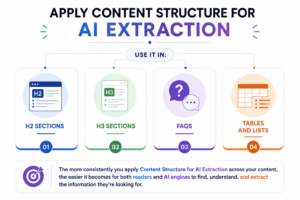
- H2 sections – Start each section by answering the main question before adding details.
- H3 sections – Open with the key point instead of a long explanation.
- FAQs – Give a direct answer in the first sentence, then provide supporting information.
- Tables and lists – Keep labels clear so readers can understand the information at a glance.
The more consistently you apply Content Structure for AI Extraction across your content, the easier it becomes for both readers and AI engines to find, understand, and extract the information they’re looking for.
Pair Structure with Context
A clear answer tells AI where the answer is. Context tells AI what the answer actually means. Without enough context, even a well-written answer can be misunderstood, interpreted incorrectly, or overlooked because it doesn’t clearly explain who or what it’s referring to.
This is why content structure for AI extraction is about more than placing the answer first. Your content should also include enough detail for AI engines to understand the topic without making assumptions. When a direct answer is supported by clear context, it becomes easier to extract, interpret, and reference accurately.
Instead of using vague words like it, they, or this, mention the actual topic, person, product, or concept you’re discussing. Naming the subject removes confusion, improves readability, and gives both readers and AI a clearer understanding of your content.
Example
Less clear
It helps improve visibility by organizing information better.
More clear
Content clustering improves visibility by organizing related articles around a central topic.
Adding specific names and details makes your writing easier to understand and gives AI more confidence in interpreting your content correctly.
Related reading: Entity & Attribute-Rich Content: The Format AI Lifts into Answers explains how using clear entities and descriptive attributes makes your content even easier for AI engines to understand and cite.
FAQs
1. Does placing the answer first improve the chances of AI citing my content?
Yes, Answering the main question at the beginning makes it easier for AI engines to identify and extract the most relevant information.
2. Should every section start with a direct answer?
Yes, Starting each important section with the key takeaway improves readability and helps readers find information faster.
3. Can long introductions reduce content extractability?
Yes, Long introductions can delay the main answer, making it harder for both readers and AI engines to locate the information.
4. Should I remove explanations if I use a direct-answer lead?
No, Give the answer first, then add context, examples, and supporting details to help readers understand the topic.
5. Does a direct-answer lead replace good content?
No, It improves how information is presented, but accurate facts, clear writing, and useful insights are still essential.
6. Can lists and tables make content easier to extract?
Yes, They organize information clearly, making it easier for both readers and AI engines to scan important points.
7. Should I use the direct-answer lead in FAQ sections?
Yes, FAQs perform best when the first sentence directly answers the question before providing additional details.
