
How Cybersecurity Brands Get Cited by ChatGPT and Perplexity

Cybersecurity brands get cited by ChatGPT and Perplexity when both systems can reach their pages, match them to a buyer’s exact question and confirm their claims through outside sources. Perplexity searches the web on almost every question, while ChatGPT searches only when a question needs current information or the user turns search on.
ChatGPT and Perplexity cite security vendors whose pages use exact vulnerability and technique IDs, answer one buyer question per passage, earn proof from analysts, reviews and security communities, and stay open to AI search crawlers.
Security companies often block those crawlers with their own bot rules, so a brand can lose citations before content quality even matters.
How ChatGPT finds and cites security vendors
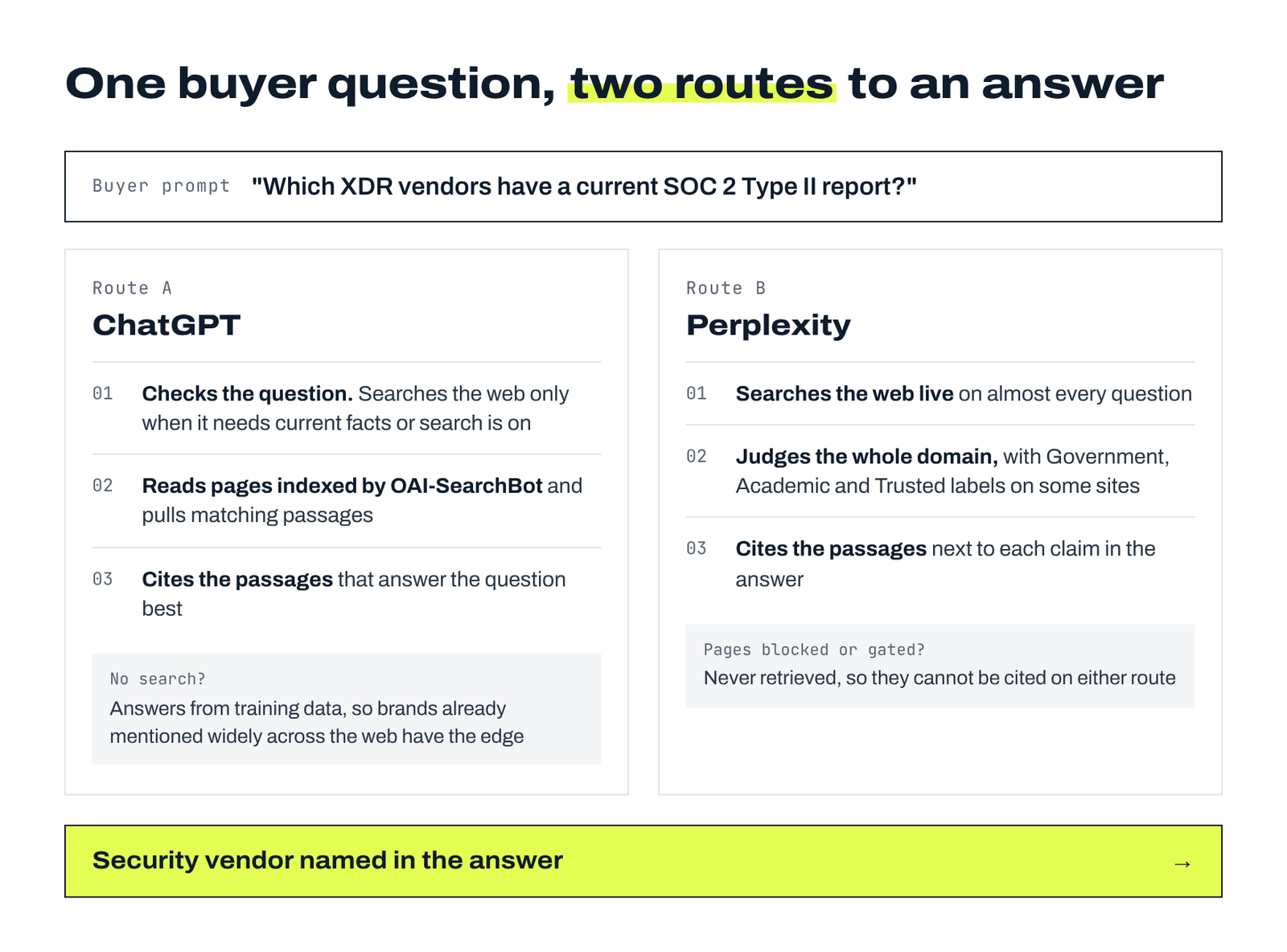
ChatGPT cites a security vendor when it runs a web search and finds a passage that answers the buyer’s exact question. Without a search, it answers from training data and names the vendors it already knows.
When ChatGPT searches the web and when it answers from memory
ChatGPT searches the web when a question needs current facts or when the user turns search on. Security questions often qualify, because the answers change: a new CVE (Common Vulnerabilities and Exposures) entry, a renewed certification or a product release. A prompt such as “Which XDR vendors have a current SOC 2 Type II report?” depends on audit dates, so it usually needs a search. XDR is extended detection and response, and SOC 2 Type II is an independent audit of how a company protects customer data over time.
Without a search, ChatGPT draws on what it learned during training. Vendors mentioned widely across review sites, analyst reports, Wikipedia and security forums have the edge in that mode.
For a security brand, both modes count: fresh, specific pages win search answers, and wide outside mentions win memory answers.
OAI-SearchBot decides whether a vendor is eligible at all
OAI-SearchBot is the crawler that makes a page eligible for ChatGPT search. Sites that opt out of OAI-SearchBot are not shown in ChatGPT search answers, although they can still appear as navigational links. GPTBot is a separate crawler that collects training data, so a brand can block GPTBot and still allow OAI-SearchBot.
Security teams block unfamiliar bots as a standard control, and three checkpoints decide whether a search crawler gets through:
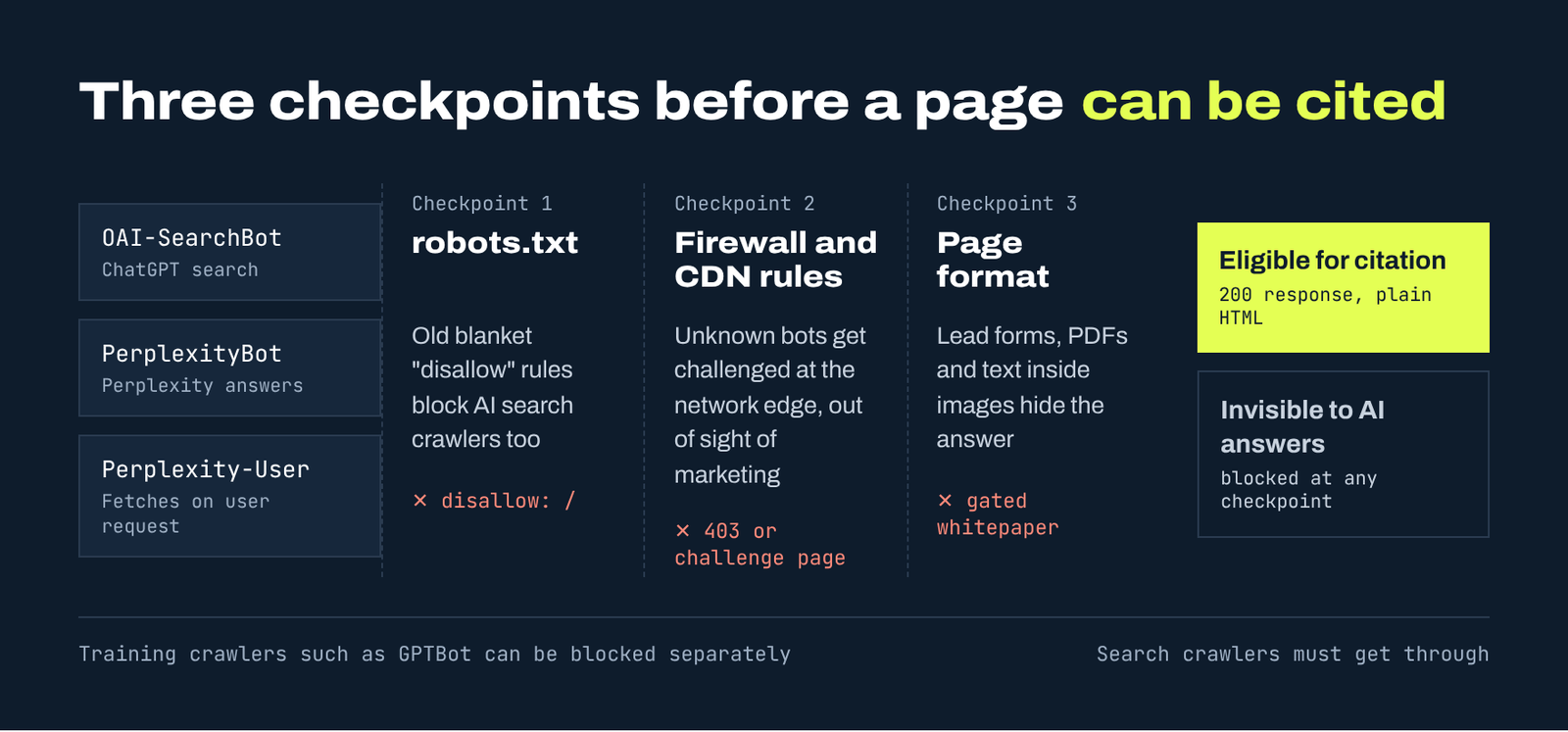
For a security brand, a technical SEO audit comes before any content work. It confirms whether OAI-SearchBot receives a 200 response in the server or CDN (content delivery network) logs, rather than a 403 error or a challenge page.
How Perplexity finds and cites security vendors
Perplexity searches the web on almost every question and places a source beside each claim, so every buyer prompt is a fresh chance for a security page to be cited.
Live search on almost every security question
Live search favors pages that state current, specific facts. Release notes, vulnerability advisories, integration pages and trust-center pages with audit dates give Perplexity a precise passage to quote. Perplexity recommends allowing PerplexityBot for a site to appear in its results, and a separate agent, Perplexity-User, fetches a page when a user’s request needs it.
For a security brand, an outdated product page can lose to a competitor’s dated, detailed one, even when the older page ranks higher on Google.
Domain labels: why the whole site gets judged
Perplexity rates whole websites, not single pages. It marks some domains with a Government, Academic or Trusted label, and each label covers every page on that domain. The Trusted label goes to sites that appear often enough to be rated and publish within their own area of expertise. A domain without a label has not been rated yet, which is not a negative judgment.
For a security brand, a site that publishes consistently within security shows a clearer area of expertise than one spread across unrelated topics.
One security page, two different results
The same security page can be cited on Perplexity and missed on ChatGPT, because the two platforms reach their sources by different routes:
Example: one trust-center page
A vendor publishes a trust-center page listing its SOC 2 Type II audit period as plain text. Perplexity can retrieve it on the next procurement question, while ChatGPT cites it only when it searches and names better-known vendors when it answers from memory. (An illustrative example.)
Tracking each platform separately shows which gap a brand has. A miss on Perplexity usually points to access or weak passages, while a miss on ChatGPT memory answers points to too few outside mentions.
What makes a security passage quotable on both platforms?
A security passage gets quoted when it answers one buyer question with exact identifiers and makes a claim that outside sources can confirm. Both platforms pull passages, not whole pages, so one clean answer outweighs a long page that never states it.
Vulnerability and technique IDs instead of marketing terms
Exact identifiers give ChatGPT and Perplexity a precise match for a buyer’s question. Security buyers ask with IDs from three public standards: CVE entries for known vulnerabilities, MITRE ATT&CK technique IDs for attacker behavior and NIST (National Institute of Standards and Technology) SP 800-53 control IDs for security controls. A page that names them matches the question; a page that says “advanced threat protection” matches nothing:

The AI search for cybersecurity complete guide lists more identifier examples for each standard.
Claims that analysts, reviews and forums can confirm
Outside confirmation decides whether a security claim gets repeated. Buyers stake their company’s data on these answers, so AI tools look for proof beyond the vendor’s own site. Four sources carry that proof:
- Review platforms such as G2 and Gartner Peer Insights
- Analyst reports such as the Gartner Magic Quadrant and the Forrester Wave
- MITRE ATT&CK Evaluations, a neutral public record of how products perform against named techniques
- Practitioner communities such as r/cybersecurity and r/netsec
Engineers, procurement leads and CISOs (chief information security officers) each ask different questions, so each claim needs confirmation where that role looks.
How to track citation share on ChatGPT and Perplexity
Citation share is the percentage of buyer prompts in which a brand is cited, tracked on ChatGPT and Perplexity separately. A brand cited in 1 answer out of 50 has presence, but almost no citation share.
A useful prompt set for LLM citation tracking follows three rules:
- Real buyer language from sales calls, support tickets and RFPs (requests for proposal), not keyword tools
- Prompts for every buyer role: engineers, procurement leads and CISOs
- The same list every month, so results stay comparable
FAQs
Why does a security vendor appear on Perplexity but not on ChatGPT?
ChatGPT doesn’t search on every question. When it answers from memory, it names vendors already mentioned widely across the web.
Does blocking GPTBot remove a brand from ChatGPT search?
No. GPTBot collects training data, while OAI-SearchBot controls whether pages appear in ChatGPT search answers.
Can a gated whitepaper get cited by ChatGPT or Perplexity?
No. AI crawlers can’t fill in a lead form, so the core findings need to sit on an open HTML page.
Which platform should a security brand track first, ChatGPT or Perplexity?
Both. Perplexity reflects page fixes on almost every question, while ChatGPT memory answers reflect how widely a brand is mentioned across the web.