Entity and Attribute Rich Content: The Format AI Lifts into Answers
Many articles contain useful information but still don’t appear in AI-generated answers. The difference often isn’t the quality of the writing it’s how the…
Many articles contain useful information but still don’t appear in AI-generated answers. The difference often isn’t the quality of the writing it’s how the information is presented. AI systems identify and reuse clear facts more easily than long, descriptive paragraphs, so content that lacks structure around important information is less likely to be selected.
Entity and attribute rich content presents important people, products, services, companies, places, or concepts as clearly defined entities with specific attributes. Instead of relying on broad descriptions, it organizes information into explicit facts that are easier for both readers and AI systems to understand, connect, and reuse.
This article explains what entities, attributes, and relationships are, why they influence AI-generated answers, and how to write content that turns descriptive text into extractable facts. You’ll also learn practical writing techniques and examples that make your content more reusable.
Why AI Lifts Some Information Instead of Others
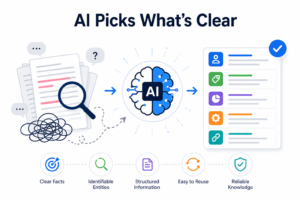
AI doesn’t choose content because it’s longer. It favors information that is explicit, tied to identifiable entities, and easy to reuse as reliable facts. When key details are stated clearly instead of being buried in long explanations, AI can extract them more accurately.
Research in document-level information extraction shows that identifying entities and their relationships is fundamental to extracting knowledge from text.
AI Looks for Identifiable Facts
Research in document-level information extraction shows that identifying entities and their relationships is fundamental to extracting knowledge from text.
Instead of writing:
Our platform helps teams stay organized and work more efficiently.
Write:
ProjectFlow is a cloud-based project management platform with Kanban boards, Gantt charts, real-time collaboration, and Slack and Google Drive integrations.
This version gives AI clear, reusable facts:
- Entity: ProjectFlow
- Category: Project management platform
- Deployment: Cloud-based
- Features: Kanban boards, Gantt charts
- Integrations: Slack, Google Drive
Why Generic Writing Gets Overlooked
Generic introductions often delay the main topic, making it harder for AI to identify key information.
Instead of: Businesses face many challenges, and the right software can improve productivity.
Write: Notion is a collaborative workspace that combines note-taking, databases, project tracking, and team collaboration.
The second version introduces the entity immediately and attaches clear attributes AI can reuse.
What Makes Information Reusable
Information is easier for AI to extract when it answers clear questions about an entity, such as:
- What is it?
- What does it do?
- Who is it for?
- What are its key features?
- How is it different?
Understanding Entities, Attributes, and Relationships
Before you can create entity and attribute rich content, you need to understand the three building blocks that help AI recognize and connect information: entities, attributes, and relationships. Together, they turn descriptive writing into structured knowledge that is easier to identify, interpret, and reuse.
Studies in knowledge representation consistently find that information becomes more useful when entities are clearly defined, their attributes are explicitly stated, and their relationships are represented consistently.
What Is an Entity?
An entity is any specific and identifiable person, product, company, service, location, organization, event, or concept that your content discusses.
For example:
- Apple
- ChatGPT
- Google Analytics
- Mount Everest
- Content marketing
Each of these represents a distinct subject that AI can recognize and associate with other information.
What Is an Attribute?
An attribute is a fact or characteristic that describes an entity. Attributes answer questions such as what it is, who created it, when it was launched, what it does, or what features it has.
For example:
| Entity | Attributes |
|---|---|
| ChatGPT | AI chatbot, developed by OpenAI, launched in 2022. |
| Google Analytics | Web analytics platform, owned by Google. |
| Mount Everest | Highest mountain on Earth, located in the Himalayas. |
How Entities Connect Through Relationships
Entities rarely exist on their own. They gain meaning through their relationships with other entities.
For example:
- OpenAI → developed → ChatGPT
- Google → owns → Google Analytics
- Mount Everest → located in → Himalayas
These connections help AI understand context instead of treating every fact as an isolated piece of information.
Examples Across Different Content Types
Entity and attribute rich content can be applied to almost any type of page:
- Product page: Product name, category, features, specifications, price.
- Service page: Service name, provider, target audience, deliverables.
- Company page: Company name, industry, headquarters, founder.
- Educational article: Topic, definition, key concepts, related terms.
Instead of describing these subjects in broad language, present them with clear names, factual attributes, and explicit relationships.
Write Every Topic as a Complete Information Object
Writing entity and attribute rich content starts by treating every topic as a complete information object instead of a general discussion. Every important entity should be introduced with enough factual details that readers and AI systems can understand it without searching for missing context.
Identify the Primary Entity
Every section should focus on one main entity. State its name clearly and explain what it is in the opening sentence before adding supporting details.
Instead of:
This tool helps businesses automate repetitive tasks.
Write:
Zapier is a workflow automation platform that connects applications and automates repetitive tasks without coding.
The second example immediately identifies the entity and establishes its purpose.
Add the Essential Attributes
Once the primary entity is introduced, include the facts that define it. Focus on attributes that help explain the entity rather than promotional claims.
For example, a software product may include:
- Category
- Developer or company
- Primary purpose
- Key features
- Supported platforms
- Target audience
These attributes give the entity a complete identity instead of leaving readers to infer important details.
Connect Related Entities
Mention related entities wherever they add context.
For example:
Zapier integrates with Google Sheets, Slack, and Salesforce to automate workflows across multiple applications.
This creates clear relationships between entities, helping AI understand how they are connected.
Keep Terminology Consistent
Use the same name for the same entity throughout the page. Avoid switching between different labels or relying on vague pronouns.
Less clear:
The platform offers workflow automation. This software also connects apps. It helps businesses save time.
More clear:
Zapier offers workflow automation by connecting applications and automating repetitive tasks.
Consistent terminology reduces ambiguity and makes the information easier to recognize, extract, and reuse.
Transform Narrative Writing into Extractable Facts
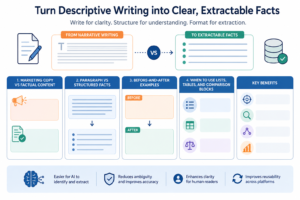
Narrative writing helps tell a story, but AI systems retrieve information more effectively when important facts are stated directly. Instead of embedding key details within long explanations, present them as explicit, self-contained statements. This approach makes entity and attribute rich content easier to identify, interpret, and reuse.
Research on information extraction has shown that systems achieve better results when relevant facts are expressed clearly rather than being scattered across complex narrative text. Explicitly stated information reduces ambiguity and improves the accuracy of extracting entities and their associated attributes.
Marketing Copy vs Factual Content
Marketing-focused writing leans on emotion, persuasion, or broad claims. Factual content leans on verifiable information — what an entity is, what it does, and what specifically sets it apart. When the goal is AI retrieval, factual statements simply carry more weight than promotional language, because there’s nothing for the model to verify or extract from a claim like “the best solution on the market.”
Before:
Trello is the ultimate way to organize your team and get more done, loved by millions worldwide.
After:
Trello is a visual project management tool that uses boards, lists, and cards to organize tasks. It’s owned by Atlassian and used by teams for kanban-style workflows.
The difference isn’t tone alone. The “after” version names the entity, states its category, attaches an owner, and describes a specific mechanism (boards, lists, cards). None of that can be extracted from “the ultimate way to organize your team.
Paragraph vs Structured Facts
Long paragraphs can hold valuable information, but stacking several ideas into one block makes each fact harder to isolate. Breaking information into concise, well-organized statements lets every attribute stand on its own while staying tied to the main entity.
Before:
Notion has become popular with teams because it combines a lot of different tools in one place, including note-taking and databases, and it’s flexible enough to be used for project tracking too, which makes it appealing for startups and small teams that don’t want to juggle multiple apps.
After:
Notion is a collaborative workspace platform.
– Category: Note-taking, databases, and project tracking
– Best suited for: Startups and small teams
– Key advantage: Replaces multiple single-purpose apps with one tool
Same information, but now an AI system (or a skimming reader) can pull “category” or “best suited for” as a discrete fact instead of parsing it out of a 50-word sentence.
When to Use Lists, Tables, and Comparison Blocks
Different formats help organize different types of information. Lists highlight individual attributes, tables present structured comparisons, and comparison blocks make similarities and differences easy to identify. Choosing the right format helps readers scan the content while making factual information more accessible for information extraction systems.
The Attributes That Make Content More Reusable
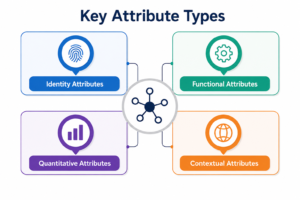
Not every attribute carries the same value. Some simply describe an entity, while others help readers and AI systems understand exactly what it is, what it does, and how it differs from similar entities. The goal of entity and attribute rich content is to include the attributes that provide clear, factual context instead of unnecessary details.
Research on knowledge representation has found that entities become more useful when they are described through meaningful attributes that define their identity, characteristics, and relationships. These attributes allow information systems to distinguish one entity from another and retrieve more precise information.
Identity Attributes
Identity attributes answer the basic question: What is this entity?
These include facts such as its name, category, creator, location, industry, or type. They establish the entity’s identity and make it recognizable across different sources.
Functional Attributes
Functional attributes explain what the entity does or what it is used for.
Examples include capabilities, services, supported features, use cases, or primary functions. These attributes help explain the purpose of the entity rather than simply naming it.
Quantitative Attributes
Quantitative attributes describe an entity using measurable facts.
These may include dimensions, capacity, duration, release year, price, performance metrics, or any other numerical information that can be verified. Because they are objective, they are often easier to extract and compare.
Contextual Attributes
Contextual attributes provide additional information that helps place an entity within a broader context.
These can include the intended audience, industry, operating environment, compatibility, related technologies, or associated organizations. Contextual attributes help connect entities to other relevant concepts, making the information more complete and easier to interpret.
Common Entity Optimization Mistakes
Even high-quality content can be difficult for AI to interpret if entities and their attributes are unclear. Entity and attribute rich content works best when every important fact is explicit, consistent, and connected to the correct entity.
| Common Mistake | Less Effective | Better |
|---|---|---|
| Hiding the Primary Entity | Businesses need better ways to manage customers. | HubSpot CRM is a customer relationship management platform for managing contacts and sales. |
| Using Inconsistent Names | The software improves teamwork. This platform also manages projects. | Asana improves teamwork and manages projects. |
| Missing Important Attributes | Canva is a useful tool. | Canva is a cloud-based graphic design platform with templates and collaboration features. |
| Mixing Multiple Entities Without Context | Slack, Zoom, and Trello help teams work better. | Slack supports messaging, Zoom enables video meetings, and Trello manages tasks. |
| Using Vague Language Instead of Facts | It has many great features. | It includes real-time collaboration, version history, and automated backups. |
Frequently Asked Questions
Is an entity the same as a keyword?
No, A keyword is a search term, while an entity is a specific person, place, product, organization, or concept.
Should every page have one primary entity?
Yes, A clear primary entity helps keep the content focused and reduces ambiguity.
Can one entity have multiple attributes?
Yes, An entity can have attributes such as its category, features, creator, purpose, and location.
Are attributes only numerical facts?
No, Attributes can include names, categories, features, functions, locations, dates, and other descriptive facts.
Do I need tables for entity and attribute rich content?
No Tables help organize facts, but clear paragraphs and lists can also work effectively.
Can entity and attribute rich content improve readability?
Yes, Presenting information as clear, factual statements makes content easier for readers to scan and understand.
Conclusion
Writing entity and attribute rich content is about making information easier to understand, not just easier to read. When every important entity is clearly named, supported with accurate attributes, and connected through meaningful relationships, your content becomes more useful for both readers and AI systems.
Instead of relying on broad descriptions or promotional language, focus on presenting complete, factual information that can stand on its own. Over time, this approach creates content that is easier to interpret, compare, and reuse across AI-powered search experiences while also improving clarity for human readers.
