
GEO vs AEO vs AI-SEO: Which Agency Type Do You Need?

GEO (Generative Engine Optimization), AEO (Answer Engine Optimization), and AI-SEO (Artificial Intelligence SEO) are three approaches to improving a brand’s visibility across AI-powered search and traditional search platforms. A GEO agency focuses on getting content cited in AI-generated responses, an AEO agency works to make content appear in direct answers and featured snippets, while an AI-SEO agency combines AI-driven SEO strategies with optimization for AI search platforms. The right choice depends on where your audience searches, how they discover brands, and which visibility goals your business wants to achieve.
As platforms like ChatGPT, Google AI Overviews, Perplexity, and Gemini change how people discover brands, businesses need to understand the differences between these services. Many leading agencies offer all three, but if you need one specific service, evaluate the agency’s expertise, experience, and approach in that area.
Understanding these differences will help you choose an agency that aligns with your business goals, target audience, and long-term search strategy.
GEO vs AEO vs AI-SEO: What’s the Difference?
GEO, AEO, and AI-SEO are often used together, but they focus on different parts of the search experience. The main difference is where your brand needs visibility and how people discover information.
GEO (Generative Engine Optimization) focuses on how a brand appears in responses generated by platforms such as ChatGPT, Perplexity, and Gemini. This includes brand mentions, citations, and how a business or product is represented in AI-generated answers.
A GEO agency helps businesses improve their visibility across AI platforms through citation tracking, brand mention analysis, content optimization, and entity building.
AEO (Answer Engine Optimization) focuses on providing clear answers to specific user questions. It involves structuring content so search engines and answer-focused platforms can easily understand and present relevant information.
An AEO agency works on question-based content, FAQ optimization, structured data, and featured snippet opportunities to help businesses appear in direct answers.
AI-SEO is a broader approach that combines traditional SEO with strategies for AI-powered search. It includes technical SEO, content optimization, search intent, entity signals, and AI visibility monitoring.
An AI-SEO agency combines traditional search optimization with AI search strategies to improve visibility across Google and platforms like ChatGPT and Perplexity.
Although these approaches overlap, their primary focus differs. Here’s a quick comparison:
| Approach | Agency’s Main Focus | Typical Goal |
|---|---|---|
| GEO | AI citations and brand mentions | Appear in AI-generated responses |
| AEO | Answer-focused content and structured data | Appear in direct answers and featured snippets |
| AI-SEO | Traditional SEO and AI search optimization | Build visibility across search platforms |
Understanding these differences helps you choose an agency based on your business goals and where you want your brand to appear.
When Do You Need a GEO Agency?
A GEO agency makes sense when your main concern is how your brand appears in generative AI responses. Traditional rankings may show where your website appears in search results, but they do not necessarily tell you whether AI platforms mention or cite your brand when users ask relevant questions.
A GEO-focused agency typically looks at the prompts people use to research products, services, and brands. It may also examine which sources AI platforms rely on and where your brand is missing from those responses.
You may need a GEO agency if:
- Your competitors appear in AI responses while your brand does not.
- Your brand is rarely mentioned or cited by AI platforms.
- AI tools provide incomplete or inaccurate information about your company.
- You want to track visibility across platforms such as ChatGPT, Perplexity, or Gemini.
- You want to understand which buyer-intent prompts lead to your brand being mentioned.
- Your existing SEO strategy is not addressing visibility in generative AI search.
When Do You Need an AEO Agency?
Not every search starts with a product name or a short keyword. Someone might search “How does payroll software work?”, “What should I look for in payroll software?”, or “Is payroll software worth it for a small business?” They are looking for an answer before they are ready to choose a brand.
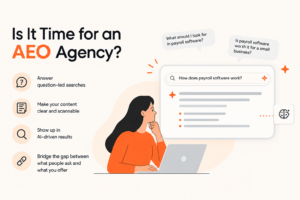
That is where AEO becomes relevant. The focus is on the questions your audience asks and whether your content gives a clear answer that search systems can easily understand. This can involve improving existing pages, creating question-led content, and making important information easier to find.
An AEO agency could be useful if your business:
- Relies heavily on informational or question-based searches.
- Has content that is useful but does not answer key questions clearly.
- Wants to improve visibility in answer-focused search experiences.
- Has gaps between the questions customers ask and the content available on the site.
- Needs help restructuring content around specific search questions.
- Wants to make its existing content more useful for conversational searches.
When Do You Need an AI-SEO Agency?
An AI-SEO agency may be a good fit when:
- You want to improve visibility across both traditional and AI-powered search.
- Your current SEO strategy needs to account for changing search behavior.
- You need technical SEO and content work as part of the same strategy.
- Your website performs well in traditional search but has limited visibility in AI search.
- You want to bring SEO, content, and AI-search efforts under one broader strategy.
- You need ongoing measurement across different search environments.
AI-SEO takes a wider view of search rather than focusing on one specific format. The work can include technical SEO, content optimization, search intent, entity signals, and efforts to improve how your brand is understood across newer search experiences.
Traditional rankings also do not tell the whole story anymore. An Ahrefs study of 300,000 keywords found that the presence of an AI Overview was associated with a 58% lower average click-through rate for the top-ranking page in December 2025.
This approach can also be useful when your business is already investing in SEO but wants to adapt that work for the way search is changing. Instead of starting a completely separate strategy, an agency can identify where existing SEO work can support visibility in AI-powered search.
The important thing is to look beyond the term AI-SEO when comparing agencies. Different agencies may use the label for different services, so check what they actually include, which platforms they work with, and how they measure progress.
Can One Agency Handle GEO, AEO, and AI-SEO?
Yes. An agency can offer GEO, AEO, and AI-SEO as part of the same service, especially when the goal is to build visibility across different search experiences.
The three areas can overlap. Content created for AEO may also support visibility in AI-generated answers, while technical SEO and entity work can contribute to how search systems understand a brand.
What matters is not whether an agency uses all three terms, but what it actually does under each service. Before hiring, look at the platforms covered, the type of optimization included, the prompts or queries being tracked, and how results are reported.
How to Choose the Right AI Search Agency
Choosing an AI search agency is not just about finding one that uses terms like GEO, AEO, or AI-SEO. The same label can cover very different services, so it is worth looking at what the agency will actually do, measure, and report.
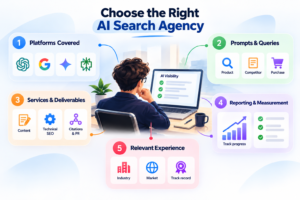
Platform coverage matters because AI search experiences do not behave exactly like traditional search. Pew Research Center found that users who encountered an AI summary clicked a traditional search result in 8% of visits, compared with 15% when no AI summary appeared.
Platforms Covered
Start by checking which AI and search platforms the agency works with. This should match the platforms your audience uses and the markets you care about. Ask whether they monitor platforms such as ChatGPT, Google AI Overviews, Perplexity, Gemini, or others relevant to your business.
Prompts and Queries Tracked
Ask how the agency chooses the prompts and queries it monitors. A useful strategy should go beyond a few generic searches and include queries that reflect how potential customers research your products, services, competitors, and industry.
The prompts should also reflect different stages of the buying journey, giving you a clearer picture of where your brand appears during research and comparison.
Services and Deliverables
Get a clear picture of what is included in the work. Depending on the agency, this could cover content updates, technical SEO, entity optimization, citation opportunities, brand mentions, digital PR, or other visibility work.
Make sure the proposal explains what the agency will actually deliver rather than relying on broad terms.
Reporting and Measurement
Find out how progress will be measured and how often you will receive updates. Reports should show the areas being monitored and meaningful changes over time, rather than simply listing activities completed by the agency.
Relevant Experience
Industry experience can also matter, particularly if your business operates in a specialised or competitive market. Look at the type of companies the agency has worked with and whether that experience is relevant to your goals.
GEO vs AEO vs AI-SEO: Which One Do You Need?
There is no single approach that fits every business. The right choice depends on how your audience searches, where you want your brand to appear, and what parts of your current search strategy need attention.
- GEO: Consider this when your priority is increasing brand mentions, citations, and visibility in generative AI responses.
- AEO: Consider this when your priority is providing direct answers to question-based searches and improving visibility in answer-focused search experiences.
- AI-SEO: Consider this when you want a broader strategy that combines traditional SEO with work focused on AI-powered search.
These approaches can also work together. A business may use AEO to improve how its content answers common questions while using GEO to monitor how the brand appears in AI-generated responses. At the same time, technical SEO and content improvements can support both efforts.
The agency’s name should therefore not be the deciding factor on its own. Look at the actual scope of work, platforms covered, prompts being tracked, deliverables, and reporting process. This gives you a clearer idea of whether the agency’s approach matches what your business needs.
For a deeper understanding of how GEO, AEO, and traditional SEO differ and work together, read our detailed guide on AEO vs GEO vs SEO: What’s Actually Different
Frequently Asked Questions
Is GEO the same as AEO?
No, GEO focuses more on visibility, mentions, and citations in generative AI responses, while AEO focuses on providing clear answers to specific questions.
Is AI-SEO broader than GEO?
Yes, AI-SEO generally covers a wider search strategy that can combine traditional SEO with optimization for AI-powered search experiences.
Can one agency provide all three?
Yes, Some agencies offer GEO, AEO, and AI-SEO together, although the exact services and scope can vary between agencies.
How do I evaluate an AI search agency?
Look at its platforms, tracked prompts, services, deliverables, reporting process, and relevant experience before choosing an agency.