Ultimate Guide to ChatGPT & Perplexity Citations Tracking
AI citations show which websites and pages are being used to support AI-generated answers. For agencies like RankingBite, tracking these citations helps understand which…
AI citations show which websites and pages are being used to support AI-generated answers. For agencies like RankingBite, tracking these citations helps understand which content gets referenced, which sources competitors earn, and where new citation opportunities exist.
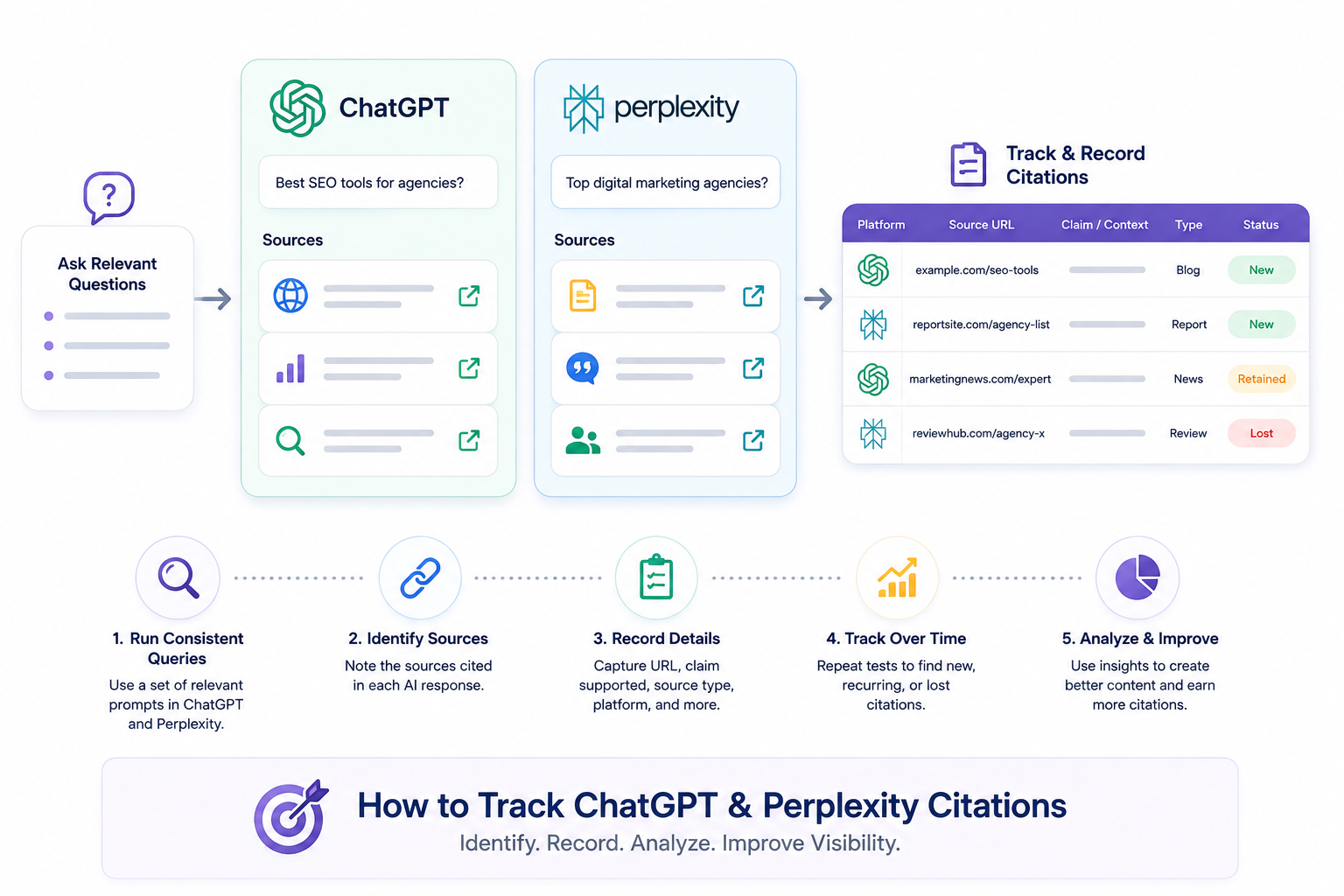
This guide explains how to identify, record, classify, and analyze citations from ChatGPT and Perplexity so you can turn citation data into practical SEO and AEO improvements.
What Is an AI Citation?
An AI citation is a link or source reference that an AI platform provides to support information included in its response. For agencies, tracking these references helps identify which pages are being used as supporting sources.
Citation vs Brand Mention
A brand mention simply names a company or brand.
A citation connects the AI response to a specific source.
Example: ChatGPT mentions “Agency A” but links to a third-party article about it. That is a brand mention, while the linked article is the citation.
What Information Does a Citation Reveal?
A citation can reveal:
- Cited URL: The specific page referenced.
- Source domain: Where the information comes from.
- Citation context: What claim or information the source supports.
- AI platform: Where the citation appeared.
- Prompt: The query that generated the response.
Why Citation Tracking Needs Its Own Dataset
Citation data contains details that ordinary brand-visibility tracking may miss. A dedicated dataset lets you compare cited pages, source domains, prompts, platforms, and competitors over time, making citation patterns easier to identify.
What Should You Track for Every Citation?
Focus on the details that make each citation useful for analysis, rather than simply counting citations.
- Citation position: Where the source appears among the cited references.
- Claim supported: The specific statement or fact associated with the source.
- Source type: Research, news, directory, review, community, or other source.
- Citation frequency: How often the same page is referenced across tests.
- Prompt category: The broader topic or intent behind the query.
- Citation status: New, retained, or lost compared with earlier checks.
- Source ownership: Whether the cited page belongs to your brand, a competitor, or an independent publisher.
Example: If one research page is cited repeatedly for industry statistics, its citation frequency and supported claims can reveal that it has strong reference value for that topic.
How to Track ChatGPT Citations
Tracking How to get cited in ChatGPT helps you understand which pages and sources are being referenced in AI-generated answers and where your brand can improve its AI visibility.
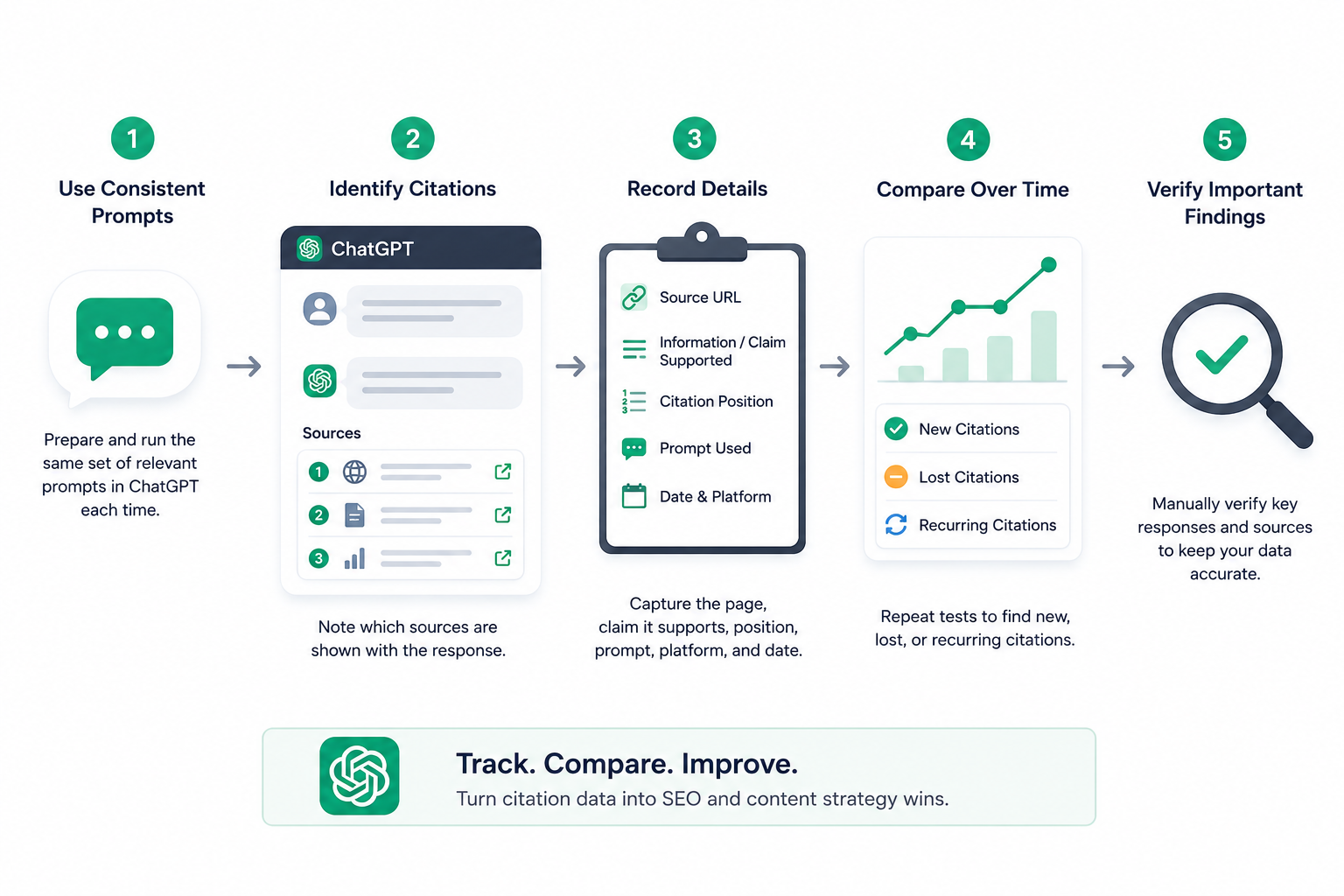
Use a fixed set of relevant prompts and run them through ChatGPT Search during each tracking cycle. Record brand mentions, cited URLs, cited pages, competitors, and the date.
For small-scale tracking, ChatGPT + Google Sheets is enough. For larger campaigns, tools such as Peec AI, Otterly AI, Profound, Semrush, and Ahrefs Brand Radar can help automate AI visibility and citation monitoring.
Example: If ChatGPT cites your agency’s case study for an SEO-related prompt, record the exact page and claim it supports. Repeat the same prompt regularly to identify new, lost, and recurring citations. Always manually verify important citations before adding them to your dataset.
How to Track Perplexity Citations
Tracking How to get citied in Perplexity helps identify which pages are being referenced in its answers, how often your brand appears, and where new citation opportunities exist.
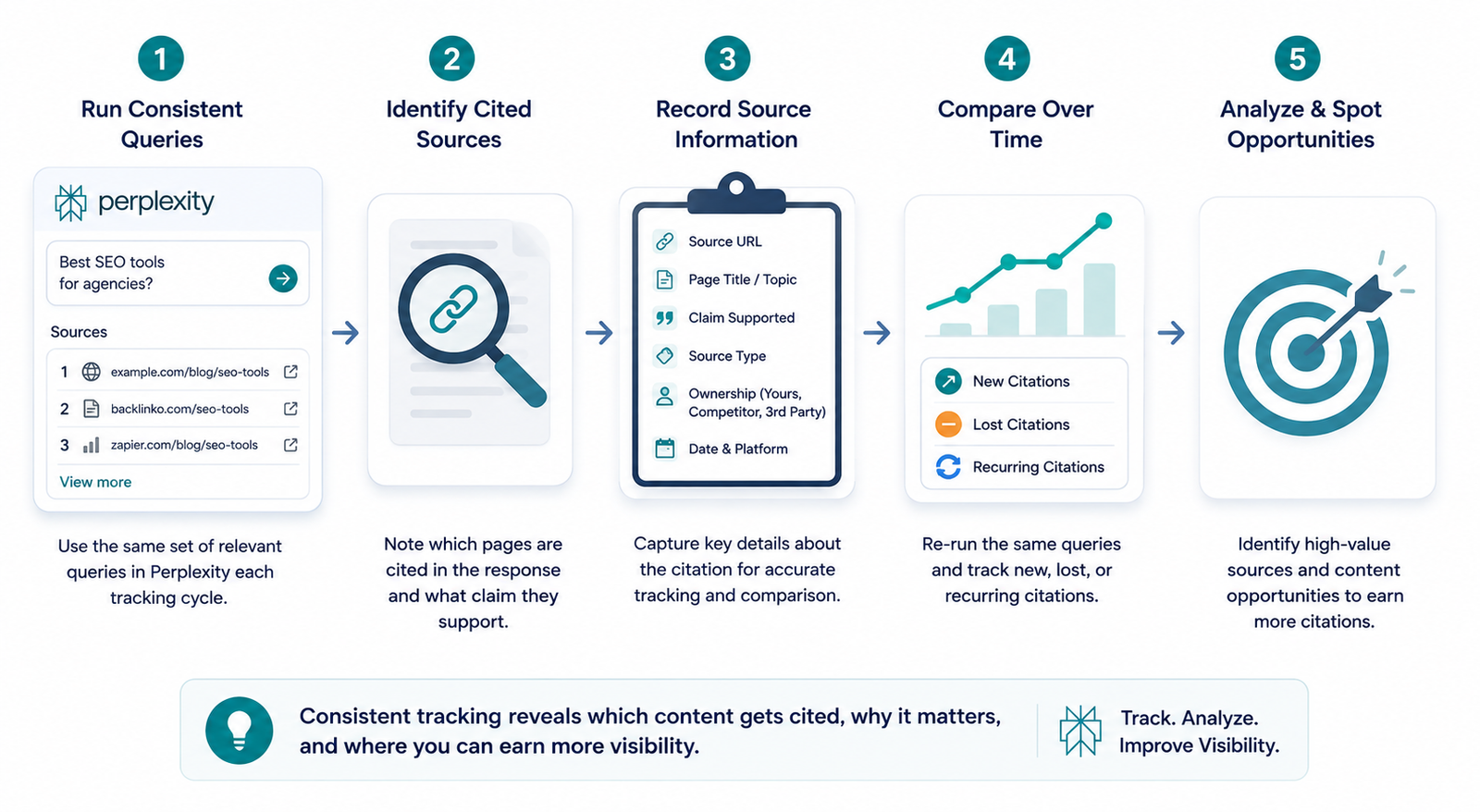
Start by running a consistent set of relevant queries in Perplexity and review the sources displayed with each answer. Focus on identifying which pages are selected to support specific claims.
Record the source pattern rather than only counting citations. Note whether the cited page belongs to your website, a competitor, or an independent publisher, and identify the type of information it supports.
Repeat the same queries during each tracking cycle and compare the results for changes. This can reveal newly cited sources, recurring sources, and citations that disappear from Perplexity responses.
Example: If Perplexity repeatedly cites an industry report from your website when answering questions about SEO trends, you can identify that report as a recurring source and monitor its citation frequency over time.
How to Classify Your Citations
Classifying citations helps you understand where your visibility comes from and what types of content AI systems reference. Use consistent categories so citation patterns can be compared over time.
First-Party Citations
These are citations from your own website or owned digital properties. They may include original research, case studies, service pages, reports, or data resources.
Example: Perplexity cites your agency’s original SEO benchmark report.
Third-Party Citations
These come from independent websites that reference your brand, expertise, research, or services. They can include industry publications, review platforms, directories, and relevant communities.
Example: ChatGPT cites a marketing publication that features your agency as an expert source.
Citation Type by Content
Classify the cited page based on what it provides, such as original research, statistics, expert commentary, case studies, guides, reviews, or service information. This helps identify which content formats are most frequently referenced.
Example: If research reports receive more citations than service pages, you can identify original data as a stronger citation asset.
How to Analyze AI Citation Quality
AI Citation quality is not determined by citation volume alone. Evaluate whether each source is relevant, credible, specific, and useful for the information it supports.
- Relevance: Does the cited page directly address the topic?
- Source credibility: Is the publisher trustworthy and knowledgeable?
- Information quality: Does the page provide useful evidence, data, or expertise?
- Content freshness: Is the information current for the topic?
- Citation context: Does the source actually support the claim being made?
- Source specificity: Is AI citing the most relevant page rather than a generic homepage?
Example: A current industry research report directly supporting a statistic is generally a stronger citation than a generic page that only briefly mentions the topic.
How to Find Citation Gaps
AI Citation gaps show where competitors or other sources are being referenced while your brand is absent. Identifying these gaps can reveal opportunities to improve your content and external visibility.
Competitor Citation Gaps
Compare the sources cited for similar prompts and identify domains or pages that repeatedly support competitors but not your brand.
Content Citation Gaps
Look for topics where your website has relevant information but receives little or no citation activity. This can highlight content that may need stronger evidence, clearer information, or greater depth.
Source-Type Gaps
Identify source categories that frequently appear in AI responses but are missing from your citation profile, such as research publications, industry media, reviews, or specialist directories.
How to Track Citation Changes Over Time
Track AI citations at regular intervals using the same prompts, platforms, and evaluation rules. Record when citations appear, disappear, or change between tracking periods.
Compare changes at the page, domain, topic, and competitor level to identify meaningful patterns.
Example: If a research page was cited 12 times in January but only 7 times in February, investigate whether competing sources gained visibility, the page changed, or AI responses shifted.
Manual vs Automated Citation Tracking
The right approach depends on the number of prompts, platforms, and clients you need to monitor.
| Factor | Manual Tracking | Automated Tracking |
|---|---|---|
| Best for | Small-scale analysis | Large-scale monitoring |
| Data collection | Manually recorded | Automatically collected |
| Setup | Simple | Requires tool configuration |
| Scalability | Limited | High |
| Cost | Low or none | Usually paid |
| Validation | Direct review | May require manual verification |
Manual tracking works well when testing a small, focused prompt set and reviewing individual citations. Automated tracking is more suitable for agencies monitoring many prompts, competitors, or clients on a recurring basis.
Example: An agency tracking 30 prompts monthly can manage the process manually, while an agency monitoring hundreds of prompts across multiple clients may benefit from automation.
How to Build a Citation Tracking Dashboard
A citation dashboard should turn raw citation records into clear trends and actionable insights. Keep it focused on the metrics and comparisons that matter.
- Citation Overview: Total citations and change from the previous period.
- Platform Breakdown: Compare citation activity across ChatGPT and Perplexity.
- Top Cited Pages: Identify which URLs receive the most citations.
- Top Source Domains: See which websites are frequently referenced.
- Competitor Comparison: Compare your citation presence with competitors.
- Topic Breakdown: Identify subjects generating the most citations.
- Citation Trends: Track gains and losses over time.
Example: A monthly dashboard might show that research pages generate the most citations, while competitor sources dominate product-comparison topics. This immediately highlights where further investigation is needed.
How to Turn Citation Data Into SEO Actions
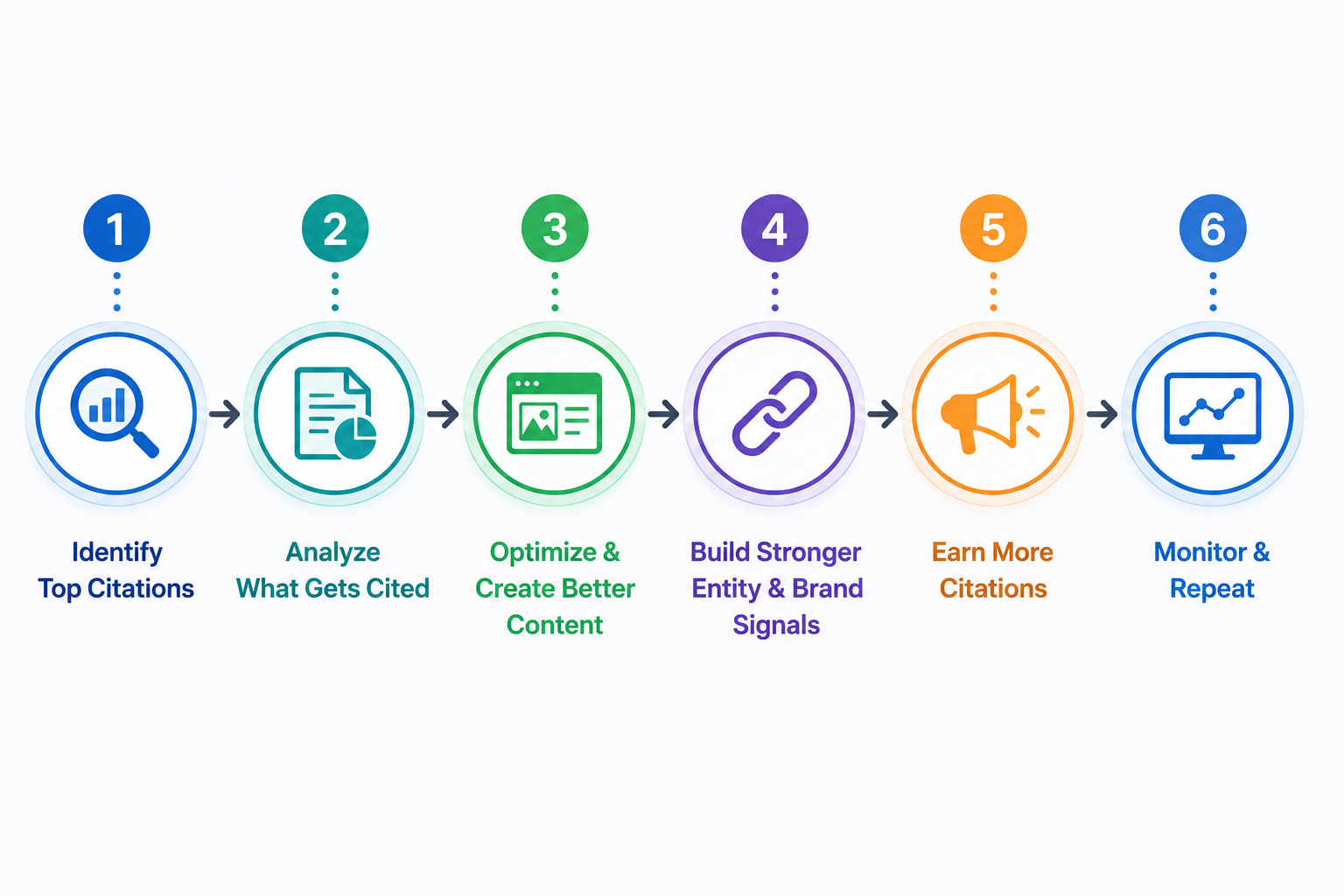
Citation data becomes valuable when it helps you identify specific content and authority opportunities rather than simply reporting citation counts.
Improve Pages That Are Almost Being Cited
Review pages that appear relevant to AI responses but are rarely selected as sources. Improve their clarity, evidence, structure, or topical coverage where needed.
Create Content for Repeatedly Cited Topics
Identify topics that consistently generate citations and assess whether your site has a strong resource covering them. Create a focused page when a genuine information gap exists.
Investigate Competitor Citation Sources
Analyze the external pages and publications frequently cited alongside competitors. This can reveal source types or industry coverage worth pursuing.
Build More Original, Reference-Worthy Content
Prioritize assets that provide information others can reference, such as original research, surveys, datasets, benchmarks, and expert analysis.
Strengthen Pages That Already Earn Citations
Study pages that already receive citations and improve their supporting evidence, freshness, internal connections, and usefulness without unnecessarily changing their core purpose.
Frequently Asked Questions
Can a citation disappear from an AI response?
Yes. AI responses and source selection can change, so a previously cited page may not appear in later responses.
Should every AI citation be considered valuable?
No. A citation is more useful when the source is relevant, credible, and directly supports the information in the response.
Can one page receive multiple citations?
Yes. The same page can be cited across different prompts, topics, or AI responses.
Do citations from different AI platforms have the same value?
Not necessarily. Each platform has different retrieval and response systems, so citation patterns should be analyzed separately.
Can citation tracking identify content opportunities?
Yes. Repeated citation patterns can reveal topics, source types, and content formats that may offer opportunities for further content development.
Conclusion
Tracking ChatGPT and Perplexity citations helps you understand which sources AI systems use and where your content fits within those answers. By consistently recording citations, evaluating their quality, identifying gaps, and monitoring changes, you can turn citation data into practical SEO insights.
The goal is not to maximize citation numbers alone. Focus on earning relevant, credible, and meaningful citations that demonstrate the value of your content and strengthen your visibility across AI search.Ultimate Guide to ChatGPT & Perplexity Citation Tracking

Shanya
Hi, I'm Shanya, an SEO and content writer at RankingBite. I specialize in creating SEO-focused content around search, AI, cybersecurity, and digital marketing. I enjoy turning complex topics into clear, useful content that helps brands build visibility, connect with their audience, and grow their digital presence.