Fintech buyers are no longer relying on Google alone to research financial products and services. Increasingly, they ask ChatGPT, Google AI Overviews, or other AI tools for recommendations, comparisons, and answers before they ever visit a company’s website. By the time they reach a search results page, AI may have already shaped which brands they consider.
That creates a problem for fintech companies that have invested heavily in traditional SEO. A brand can rank well on Google and still be missing from the AI-generated answers that potential customers see first. Strong search rankings do not automatically translate into mentions, citations, or recommendations in AI.
The reason is simple: ranking and recommendation are not the same system. Traditional SEO focuses heavily on helping pages perform in search results, while AI visibility depends on how clearly a brand is understood, described, supported, and surfaced across different information sources.
For fintech companies, both need to work together. Building visibility in AI should not mean abandoning SEO or creating a completely separate marketing programme. It means connecting search performance with the signals that influence how AI systems understand and recommend a financial brand.
Why AI Visibility Breaks Down Differently Than Traditional SEO
A fintech company can rank on the first page of Google and still have little presence in an AI-generated answer. That is because traditional search and AI search do not evaluate content in exactly the same way. Google rankings are influenced by factors such as relevance, authority, links, and technical performance, while AI systems also look at how clearly a brand is understood and how consistently it is discussed across different sources.
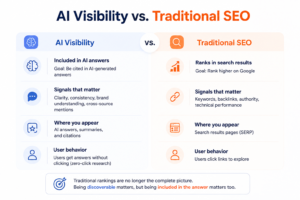
This creates a low overlap between Google’s top results and the sources AI chooses to cite. A smaller fintech brand with focused, well-supported content can sometimes appear in an AI answer even when larger competitors dominate conventional search results.
Pew Research Center found that users who encountered an AI summary clicked a traditional search result in only 8% of visits, compared with 15% when no AI summary appeared. Only 1% of visits resulted in a click on a link within the AI summary itself.
There is also a change in where the buyer journey happens. With zero-click research, users can ask an AI tool to compare payment platforms, recommend a business banking provider, or explain a lending product without opening several search results. The shortlist may already be formed before the buyer visits a website.
For fintech companies, this means traditional rankings are no longer the complete picture. Being discoverable matters but being included in the answer matters too.
How AI Platforms Decide What to Cite
AI platforms do not all pull information or present citations in the same way. A fintech company that appears in ChatGPT may not necessarily receive the same visibility in Google AI Overviews or Perplexity. Each platform has its own way of finding, selecting, and presenting information.
Understanding these differences helps fintech teams avoid treating AI visibility like another version of traditional search rankings. The goal is to understand what each platform tends to reward and where a brand’s information needs to be stronger.
ChatGPT
ChatGPT can use information from the web when answering questions that require current or specific information. For fintech brands, this makes clear and trustworthy online information important. Product details, company information, expert content, and credible third-party references can all help provide the context an AI system needs to understand a brand.
Google AI Overviews
Google AI Overviews sits within the traditional Google search experience, but the answer it generates can go beyond simply repeating the highest-ranking page. It brings together information from multiple sources to provide a direct response to the query.
This means fintech companies need content that is both relevant to the search and strong enough to support the claims being presented.
Perplexity
Perplexity is particularly focused on answering questions with supporting sources alongside the response. For fintech companies, this puts added importance on having information that is easy to verify and supported by credible sources. Content that clearly addresses a specific question and provides useful evidence has a better chance of becoming part of that research journey.
| Platform | Citation logic | What it rewards |
| ChatGPT | Uses relevant information and sources to build an answer | Clear brand information, useful content, credible references |
| Google AI Overviews | Combines information from sources relevant to the search | Relevance, helpful content, authority, strong search foundations |
| Perplexity | Places sourced information directly alongside its answers | Specific answers, verifiable information, credible sources |
Five Layers Fintech Brands Need for AI Visibility
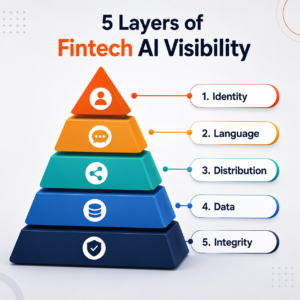
Publishing more content is not always the answer when a fintech brand is missing from AI results. The problem can run deeper, with AI struggling to understand the company, finding conflicting descriptions across different sources, or lacking enough reliable information beyond the brand’s own website. For fintech companies, these gaps matter because trust and accuracy play a major role in financial decisions. A useful way to look at AI visibility is through five layers: Identity, Language, Distribution, Data, and Integrity, with each layer addressing a different part of how a fintech brand is understood, represented, and evaluated online.
Layer 1: Identity
Can a Model Disambiguate You?
First, AI needs to know exactly who the company is. That includes what it offers, who it serves, which markets it operates in, and what makes it different from other companies.
If a brand uses different descriptions across its website, profiles, directories, and media coverage, it becomes harder to build a clear picture of the company.
Keeping important company and product information consistent gives AI a much clearer reference point.
Layer 2: Language
Do Others Describe You the Way You Describe Yourself?
A company controls how it describes itself, but it cannot control how others talk about it. Industry publications, review sites, partners, analysts, and other relevant sources all contribute to how a fintech brand is understood. When these sources consistently associate the brand with the same products, categories, and strengths, they help reinforce a clear identity. When outside descriptions differ widely from the company’s own messaging, the brand can become harder for AI systems to interpret accurately.
Layer 3: Distribution
Are You in the Corpora Models Actually Learn From?
Your website is only one source of information about your company. AI systems encounter brands through many other websites and publications, so fintech companies need a presence beyond their own domain.
Relevant financial publications, industry websites, directories, reviews, expert commentary, and other trusted sources can help expand that presence. The aim is not to collect random mentions. It is to build a presence in places that are genuinely relevant to the market and topics the brand wants to be associated with.
Layer 4: Data
Is Your Content Machine-Extractable?
Even useful information can be overlooked when it is difficult to find or interpret. Important details should be presented in a straightforward way, with clear headings, descriptions, and supporting information.
For fintech companies, this could include product features, pricing, eligibility requirements, security details, supported markets, and other information customers regularly look for. Making these details easy to locate and understand helps both users and the systems processing the content.
Data quality and governance are already major concerns for financial firms using AI. In the Bank of England and FCA survey, 46% of firms using or planning to use AI said they had only a “partial understanding” of the AI technologies they used, compared with 34% reporting a complete understanding.
Layer 5: Integrity
Will a Model Actually Recommend You?
Getting mentioned is one thing. Being recommended is another.
When someone asks an AI tool to suggest a fintech provider, the brand needs more than visibility. Its information needs to be credible, consistent, and supported by trustworthy sources. Accurate product details, transparent claims, expert coverage, and reliable third-party references all help build that level of confidence.
The five layers work together. A brand with strong content but weak identity signals can still be difficult to understand. A well-known fintech with plenty of mentions can still struggle if its information is inconsistent.
Looking at all five layers gives companies a clearer idea of why they are visible or why they are being left out.
How to Measure and Monitor Fintech AI Visibility
AI visibility needs to be measured consistently because results can change as AI platforms update how they search, interpret, and present information. A fintech company should start with a fixed set of buyer-intent prompts and run them regularly across the relevant AI platforms. This makes it easier to see whether the brand is gaining or losing visibility instead of relying on occasional searches.
The most useful signals include citation share, sentiment, competitor overlap, and how often the brand appears for important prompts. Looking at these changes over time can reveal where competitors are gaining ground and where the brand needs stronger coverage.
This also makes ongoing monitoring more useful than a one-time audit. AI visibility can shift within weeks after model or platform changes, so fintech teams need a regular view of what is being said about their brand.
A 90-Day Roadmap for Closing the Gap
Improving AI visibility works better when the work is done in the right order. Instead of publishing content first and checking results later, fintech companies can follow a simple Audit → Diagnose/Architect → Execute process. The audit shows where the brand currently stands, the diagnosis identifies what is holding it back, and execution focuses on the changes most likely to improve visibility.
| Stage | What to do | Main goal |
|---|---|---|
| Audit | Test buyer-intent prompts across AI platforms, review citations, brand mentions, competitors, and existing content. | Establish a clear baseline |
| Diagnose / Architect | Identify gaps across Identity, Language, Distribution, Data, and Integrity, then prioritize the highest-impact fixes. | Build the right strategy |
| Execute | Improve content, strengthen third-party visibility, fix information gaps, and monitor AI responses. | Increase visibility and measure progress |
The 90-day period should not be treated as three separate monthly tasks. The sequence matters more than the calendar. Start by understanding the current situation, identify the reasons behind the gaps, then focus execution on the areas with the most potential to improve AI visibility.
Conclusion
AI visibility is becoming an important part of the fintech buyer journey. Ranking well on Google still matters, but it is no longer enough if potential customers are using AI platforms to research, compare, and shortlist financial products.
The strongest approach is to work on rankings and AI recommendations together, rather than treating them as two separate marketing efforts. Fintech companies that build a clear identity, consistent language, strong distribution, accessible data, and credible information can improve their chances of being found and represented accurately across AI platforms.
For fintech teams that want to understand where they stand before investing in fixes, RankingBite offers a visibility audit covering all five layers and six answer engines.
FAQ
What is AI visibility for fintech companies?
AI visibility is the ability of a fintech brand to appear accurately in AI-generated answers. It includes brand mentions, citations, recommendations, and how the company is described across AI platforms.
How is ranking in ChatGPT different from ranking in Google?
Yes, they are different. Google ranks web pages in search results, while ChatGPT generates answers using information from relevant sources. A strong Google ranking does not guarantee visibility in ChatGPT.
How long before you see results?
No, there is no fixed timeline. Results depend on the brand’s existing visibility, content, authority, competition, and the changes made to improve its AI presence.
Can any agency guarantee a ChatGPT recommendation?
No, ChatGPT responses are probabilistic, so no credible agency can guarantee a recommendation. A specialist can improve the signals that make a brand more likely to be recommended and track the changes over time.
