ChatGPT and Perplexity cite a cybersecurity brand when its content uses exact technical terms, is confirmed by outside sources, answers buyer questions in quotable passages, and isn’t blocked by the company’s own bot rules.
Cybersecurity is a high-stakes category, so AI models are stricter here than in most B2B spaces. They want proof from review sites, analysts and security communities, not just a vendor’s own claims. They also have to answer three very different buyers: the security engineer, the procurement lead and the CISO.
Many security brands also lose citations for technical reasons. Their own bot rules block AI crawlers, or their best content sits behind a lead form that AI can’t read.
Key takeaways
- 73% of cybersecurity vendors in a 2026 benchmark received zero ChatGPT citations in their own category.
- Cybersecurity is a Your-Money-or-Your-Life category, so AI models require stronger corroboration before citing a brand.
- Security buyers use three distinct prompt patterns, tied to their role: engineer, procurement, or CISO.
- Gated content stays invisible to AI retrieval. One study recorded 14 citations for gated pages against 1,847 for the same content ungated.
- Many security companies block the AI crawlers that would otherwise cite them, through standard security bot policies.
Why do AI models treat cybersecurity content differently?
AI models are more careful with cybersecurity than with most B2B topics, because a bad recommendation can lead to a breach. That shows up in three ways.
1-They want outside proof
AI models trust analyst reports, review sites and practitioner discussions more than your product page. If your claims only live on your own site, they rarely get repeated.
2-They answer more than one buyer
A security deal involves several roles, and each one asks different questions. Most vendor sites only answer one of them.
3-They match exact terms
Buyers ask about a specific CVE, MITRE ATT&CK technique or NIST control, not “advanced threat protection.” Pages that name these get matched. Broad marketing phrases don’t.
How do ChatGPT and Perplexity actually decide what to cite?
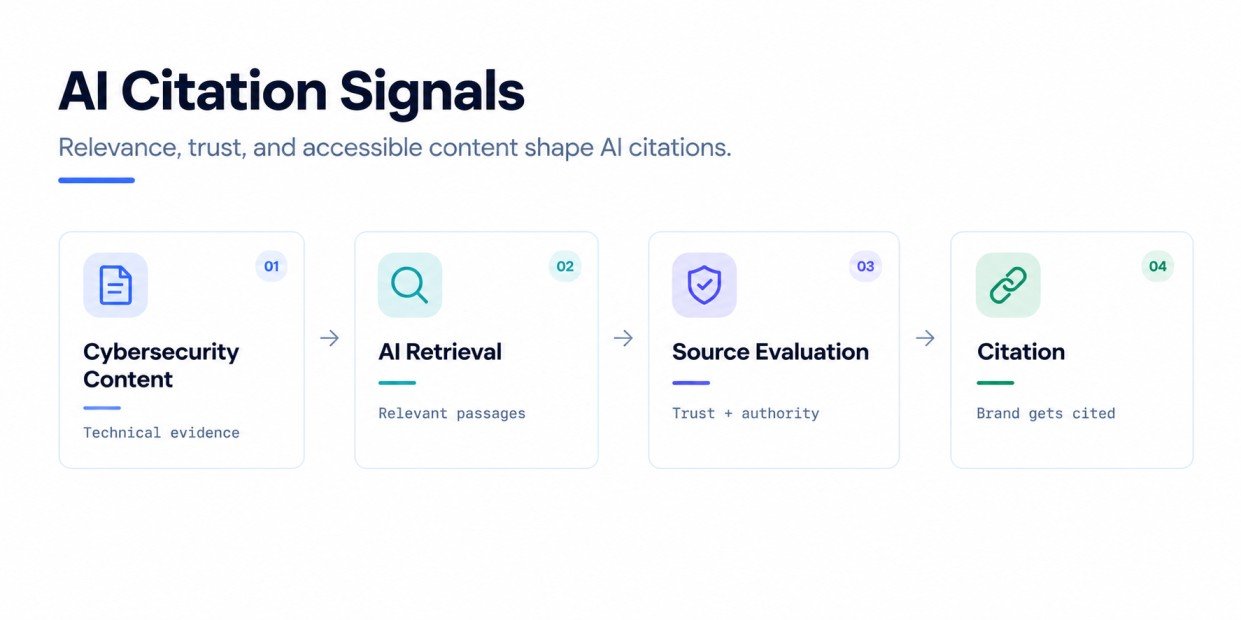
ChatGPT and Perplexity do not rank pages the way Google does. Perplexity retrieves live content on nearly every query, using retrieval-augmented generation (RAG). ChatGPT uses RAG only when browsing or web search is active; otherwise it answers from its training data.
RAG pulls candidate passages from indexed content. It matches those passages against the buyer’s question.
The model then writes its answer from whichever passages score highest on relevance. Passages, not pages, are the actual unit of competition in retrieval mode.
Publishing volume does not improve citation odds on its own. A single page with one clean, quotable answer can outperform a dozen pages that never state the answer directly.
A page ranking first on Google can still get skipped in an AI answer. A model with no clean, extractable passage simply moves to the next source.
What are the three buyer personas security content has to answer?
Security buyers split into three distinct roles, and each role types a different kind of question into ChatGPT or Perplexity.
The security engineer
asks technical questions with specific constraints: which EDR tool supports a named container environment, or how one vendor’s detection logic compares against another’s. Precise documentation and direct technical comparisons win this persona. Marketing language about a “platform” with no implementation detail loses it.
The procurement and compliance lead
checks whether a vendor can be purchased and audited. Their prompts sound like “which vendors are SOC 2 Type II and FedRAMP Moderate,” not “which vendor is best.” Trust-center pages with named certifications and audit dates, published as real text rather than locked inside a PDF, win this persona.
The CISO or decision-maker
evaluates strategic fit and board-level risk over individual features. Prompts here sound like “platform consolidation versus best-of-breed for a mid-market company.” Analyst coverage, peer review data, and content tying a security decision to a business outcome win this persona.
Which content formats earn cybersecurity AI citations?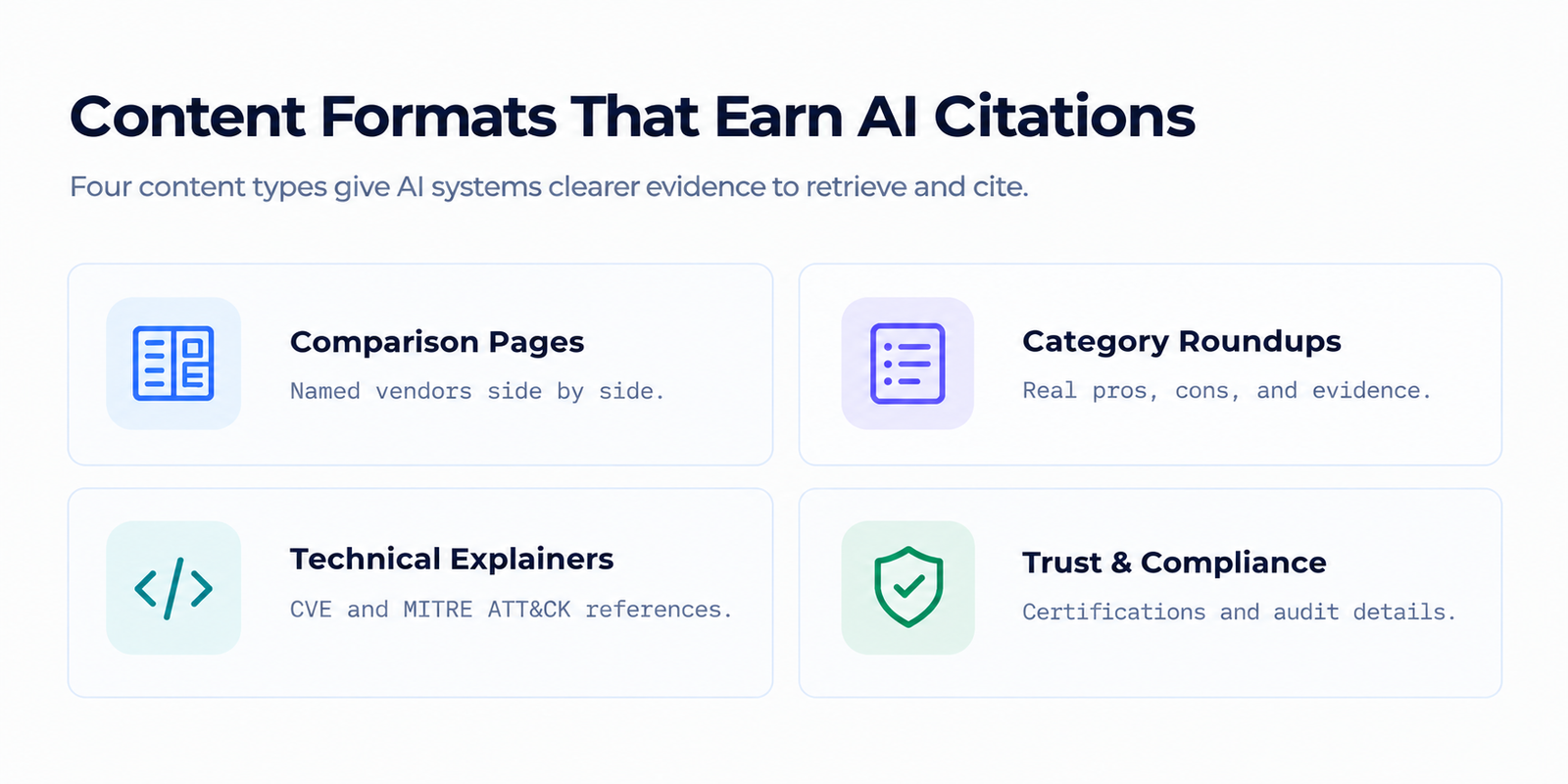
Four content formats consistently earn citations in security categories, because each gives an AI system a structured, quotable answer to a specific buyer question.
Comparison pages that name real competitors directly win citations because a buyer’s AI tool retrieves structured content that places two named vendors side by side.
Category roundups work through a similar mechanism. A vendor’s own honest “best of” list, with real pros and cons, reads as a trusted source rather than a promotional one.
Technical explainers using precise vocabulary, actual CVE references, actual MITRE technique IDs, outperform generic “what is X” articles because that vocabulary signals verified domain expertise.
Trust and compliance pages built as structured text remain the most overlooked opportunity. Most vendors already hold this information. It stays invisible to AI retrieval because it sits inside a PDF or an image instead of extractable text.
Where does crawler access quietly block citations?
Crawler access failures explain a share of citations that content quality alone cannot fix. Security teams commonly block bots at the network edge as a standard security control.
Security bot policies often block the AI crawlers that would otherwise retrieve and cite a brand’s own content. CChecking whether crawlers such as OAI-SearchBot (ChatGPT) and PerplexityBot (Perplexity) pass through that policy rules out a technical cause before a content rewrite starts.
What does gating content actually cost?
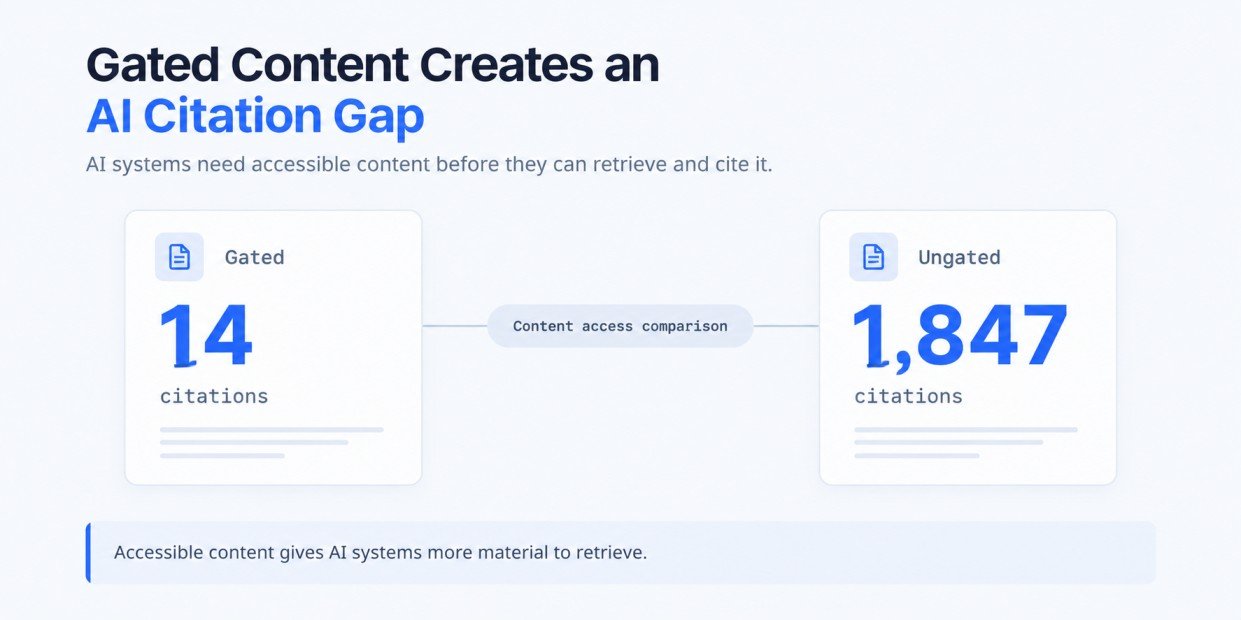
Gated whitepapers stay invisible to AI retrieval, regardless of how valuable the content is internally.
One 90-day study tracked 240 pages. Two gated whitepaper landing pages earned 14 citations combined. The same content published without a gate earned 1,847 citations.
Content behind a form contributes nothing to how an AI system describes a brand’s category.
How do ChatGPT and Perplexity differ for security content?
ChatGPT and Perplexity weigh sources differently, and that difference changes which content format performs best on each one.
Platform
Tends to favor
Weaker fit
ChatGPT
Established authority sites, comprehensive documentation
Vague, generic content
Perplexity
Fresh, evidence-rich, detailed comparison content
Thin or undated pages
How do you measure your citation share?
Citation share, not citation presence, is the metric worth tracking. Citation share is the percentage of relevant buyer prompts where a brand actually gets cited.
A benchmark of 25 to 35 prompts per buyer persona, drawn from real buyer language rather than keyword tools, forms a workable testing set.
Running that benchmark across ChatGPT and Perplexity on a fixed schedule produces a trend, not a single snapshot.
A rising citation share shows the changes are working. A very low share means a brand is close to invisible in AI search.
Frequently asked questions
Why do security vendors with strong SEO get zero AI citations?
Usually one of two causes: blocked crawlers, or content with no passage an AI system can extract.
Does gated content hurt AI visibility?
Yes. Gated content is not retrievable, so it earns zero citations.
Which AI platform matters most for security buyers?
Both matter. Perplexity is best for quick testing, and ChatGPT favors established authority sites.
What metric should security brands track?
Citation share: the percentage of relevant buyer prompts where a brand gets cited.
Do ChatGPT and Perplexity cite the same sources?
No. ChatGPT favors authority sites and Perplexity favors fresh, detailed comparisons.
What is a common content mistake security brands make?
Gating content behind a form. An AI system cannot cite what it cannot retrieve.

Farhan khan
Farhan is an SEO writer covering content strategy, search visibility, and brand discovery across search engines and AI platforms.