People are increasingly using AI tools to find financial products and fintech companies. They may ask which payment platform is best for a small business, which fintech app offers a specific feature, or what alternatives are available. Instead of showing a list of links, AI tools often provide a direct answer and recommend a few brands.
This creates a new visibility challenge for fintech companies. A brand may rank well in traditional search but still be left out of AI-generated answers. Generative Engine Optimization (GEO) helps address this gap by making a brand easier for AI systems to understand and consider when generating responses.
For fintech brands, GEO involves more than optimizing keywords. Clear product information, relevant content, credible third-party mentions, citations, and consistent information across the web can all influence how a brand appears in AI search.
So, how does GEO actually help fintech brands get noticed in AI search results?
GEO in Fintech: From Search Rankings to AI Recommendations
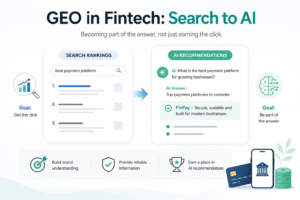
Traditional SEO is largely focused on helping a website appear higher in search results. GEO takes a different approach: it focuses on how a brand appears when an AI tool generates an answer.
For fintech companies, this can mean moving beyond ranking for searches such as “best payment platform” and working toward being one of the brands an AI system considers when answering that question. The focus shifts from simply getting a click to becoming part of the answer itself.
This makes brand understanding important. AI systems need enough reliable information to identify what a fintech company offers, who it serves, and how it compares with other options. GEO helps strengthen those signals so the brand has a better chance of being included when relevant questions are asked.
How AI Finds Fintech Brands
AI-generated answers are built from information gathered across different sources, not just from a single webpage. When deciding which fintech brands to include, an AI system may consider how relevant a company is to the query, how clearly its products are described, and how consistently the brand is represented online.
For example, a fintech platform that is clearly associated with small-business payments across its website, industry publications, reviews, and other relevant sources has stronger context around its offering. These signals can help AI systems connect the brand with related searches and include it when the context fits.
GEO Signals That Influence AI Visibility
GEO strengthens the information around a fintech brand so AI systems can better understand what the company offers, who it serves, and where it fits within relevant searches. Several signals contribute to this understanding.
Clear Brand Information
A fintech brand should clearly communicate what it offers, who its target customers are, and which problems its products solve. Product pages, company descriptions, and other key pages should use straightforward and consistent language.
For example, a payment company should clearly state whether it serves small businesses, enterprises, marketplaces, or another specific audience.
Relevant Content
Content should address the topics and questions potential customers are actually interested in. This includes educational topics, product-related questions, comparisons, and use-case content.
For example, a fintech company offering expense management software could create content around “how businesses can automate expense reporting” rather than publishing only general articles about fintech.
Third-Party Mentions
Information outside a company’s own website can also contribute to how its brand is understood. Industry publications, reviews, expert discussions, business directories, and relevant communities can provide independent context around the company.
Relevant and credible mentions can help reinforce the brand’s connection with its products, services, and area of expertise.
Reliable Citations
Fintech content often includes claims about products, financial processes, regulations, market data, or industry trends. Supporting these claims with reliable sources makes the information more useful and trustworthy.
Well-supported content also gives AI systems stronger material to reference when generating answers.
Consistent Information
Brand details should remain accurate across the website and external sources. Differences in product descriptions, company information, pricing, or positioning can make it harder to build a clear understanding of the brand.
Keeping important information consistent helps create a stronger and more reliable picture of the fintech company across the web.
Together, these signals give AI systems clearer context about a fintech brand and its relevance to specific searches.
Where GEO Builds Brand Visibility
A fintech brand’s AI visibility is not built on its website alone. AI systems can encounter information about a company across many parts of the web, and each source can add context around the brand.
First-party sources
Include the company website, product pages, documentation, research, and educational content. These sources explain what the brand offers directly.
Third-party sources
Add an outside perspective. Industry publications, reviews, expert discussions, business directories, and relevant communities can help establish how the brand is viewed beyond its own marketing.
For example, if a fintech company describes its payment solution on its website and the same positioning is supported by relevant industry coverage and independent reviews, AI systems have multiple sources connecting the brand with that category.
GEO brings these sources together rather than treating website optimization as the entire visibility strategy.
From Visibility to Recommendation
A fintech brand may already have useful content and a strong online presence, yet still struggle to appear when users ask AI for recommendations. The difference often comes down to how clearly the available information connects the brand with the searches that matter.
Take a fintech platform built for small-business payments. If its website explains the product, industry sources discuss its use cases, and relevant pages answer questions about payment solutions, AI systems have more context linking the brand to that category.
Over time, improving these signals can help the brand move from simply having an online presence to being recognized as a relevant option in AI-generated answers.
The goal of GEO is not to force a brand into every response. It is to build enough relevant and credible information for AI systems to consider the brand when it genuinely fits the user’s needs.
How Fintech Brands Can Measure AI Search Visibility
GEO performance cannot be measured through traditional search rankings alone. Fintech brands also need to understand how often they appear in AI-generated answers and whether those answers represent the brand accurately.
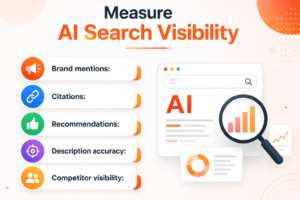
Useful indicators include:
- Brand mentions: How often the brand appears for relevant prompts.
- Citations: How frequently AI answers reference sources associated with the brand.
- Recommendations: How often the brand is suggested when users ask for fintech solutions.
- Description accuracy: Whether AI tools correctly describe the company, products, and positioning.
- Competitor visibility: How the brand compares with competitors across the same searches.
For example, a fintech company can test the same set of prompts each month and compare its mentions, citations, recommendations, and description accuracy over time. This provides a clearer picture of whether its GEO efforts are improving AI visibility.
Common GEO Mistakes Fintech Brands Should Avoid
| GEO Mistake | Why It Can Hurt AI Visibility | What Fintech Brands Should Do Instead |
|---|---|---|
| Focusing only on Google rankings | Strong organic rankings do not automatically translate into visibility in AI-generated answers. | Optimize for both traditional search and the signals AI systems use to understand and cite brands. |
| Publishing generic content | Broad, repetitive content gives AI systems little distinctive or useful information to associate with the brand. | Create specific, helpful content that clearly addresses relevant fintech questions and topics. |
| Ignoring external sources | Relying only on the company website limits the independent information available about the brand. | Build a consistent presence across credible industry publications, reviews, communities, and other relevant sources. |
| Leaving information inconsistent | Different product descriptions, company details, or positioning across websites can make the brand harder to understand accurately. | Keep important brand, product, and company information consistent across key online sources. |
| Making unsupported claims | Unverified financial or product-related claims can weaken the credibility of information associated with the brand. | Support important claims with reliable data, documentation, and trustworthy sources. |
Avoiding these mistakes gives AI systems clearer, more consistent, and more reliable information to work with when answering relevant fintech queries.
How GEO Works Alongside SEO and AEO
GEO is not a replacement for SEO or AEO. Each approach supports a different way users discover information, and fintech brands can benefit from having all three working together.
SEO for Traditional Search
SEO focuses on improving a website’s visibility in traditional search results through relevant content, technical optimization, and authority.
For example, a fintech company could use SEO to target “business payment solutions.”
AEO for Direct Answers
AEO focuses on answering specific questions clearly so that search engines and answer-focused platforms can use that information directly. A fintech brand could target a question such as “How do business payment platforms work?”
GEO for AI Search
GEO focuses on improving a brand’s chances of appearing in AI-generated responses, summaries, and recommendations.
For example, a fintech company could optimize for a query like “Which payment platforms are best for small businesses?”
Why Fintech Brands Need All Three
These approaches can support each other. SEO helps make content discoverable, AEO makes key information easier to understand and use, while GEO helps connect that information with AI-driven searches.
Together, they give fintech brands a broader presence across the different ways customers now search for financial solutions.
What Strong AI Visibility Looks Like
Strong AI visibility is more than simply seeing a fintech brand’s name appear in an answer. The quality and context of that appearance matter just as much.
A brand with stronger AI visibility may be mentioned when users search for relevant solutions, included in product recommendations, supported by citations, and described accurately. It should also appear for a range of relevant prompts rather than only one branded search.
For example, a fintech company offering expense management software could appear when users ask for the best expense management tools for growing businesses, be mentioned in comparisons with competitors, and have its key features described correctly.
This type of visibility shows that AI systems are not only recognizing the brand but also connecting it with the topics, products, and use cases that matter to its target audience.
Frequently Asked Questions
Can a fintech brand appear in AI search without ranking #1 on Google?
Yes, AI platforms use information from multiple sources, so strong relevance, credible mentions, and clear brand information can help a fintech brand appear even without the top Google ranking.
Does GEO guarantee that a fintech brand will be recommended by AI?
No, GEO improves a brand’s visibility signals but cannot guarantee mentions or recommendations. Results depend on the query, AI platform, available information, and competition.
How long does it take for GEO efforts to influence AI visibility?
There is no fixed timeline. Results depend on the brand’s existing visibility, content, authority, and third-party presence. GEO usually requires ongoing monitoring and optimization.
Can GEO help a new fintech brand compete with established companies?
Yes, A new fintech can build visibility through focused content, clear positioning, credible mentions, and authority around its specific niche.
