Quick answer
The right AI SEO agency should do more than promise visibility in ChatGPT or other AI search platforms. Look for an agency that can explain how it measures AI visibility, which platforms and prompts it tracks, how it improves your content and technical SEO, and how it reports results. Relevant case studies, clear methodology, transparent reporting, and a strategy based on your business goals are also important when comparing agencies.
What Does an AI SEO Agency Actually Do?
An AI SEO agency helps businesses improve how their brand, content, and website appear across AI-powered search experiences. This can include platforms such as ChatGPT, Google AI Overviews, Perplexity, Gemini, and other answer engines that generate responses instead of simply showing a list of blue links.
The work can involve improving existing content, strengthening technical SEO, building credible sources around a brand, and tracking whether AI platforms mention or cite the business for relevant searches. The exact approach varies by agency, so it is important to understand what an agency actually means when it offers “AI SEO.”
The need to track more than traditional rankings is supported by 2026 research from Ahrefs. Its analysis of 863,000 keyword SERPs and 4 million AI Overview URLs found that only 37.9% of cited URLs also appeared within the first 10 blocks of the corresponding search results.
An AI SEO agency may typically work on:
- AI visibility: Tracking where and how often a brand appears in relevant AI-generated answers.
- Content optimization: Improving content so important information is clear, useful, well-supported, and easier for answer engines to interpret.
- Technical SEO: Addressing crawlability, indexability, site structure, internal linking, and other technical foundations.
- Brand authority: Strengthening the sources, mentions, expertise, and information that help establish a brand as a credible source.
AI SEO vs. Traditional SEO
Traditional SEO is largely focused on helping web pages rank in search results. It looks at factors such as technical accessibility, keywords, content relevance, internal links, backlinks, and user experience. Recent research also shows why GEO and AEO cannot be treated simply as extensions of traditional ranking. A June 2026 study analyzing more than 100,000 AI-search responses found that visibility differed substantially across brands and AI platforms, while corporate websites accounted for about 78% of cited sources.
AI search adds another layer. Instead of only asking which page ranks for a query, businesses also need to consider whether their information is understood, mentioned, or cited when an AI system generates an answer.
That does not make traditional SEO irrelevant. A technically weak website or poorly structured content can still create problems. AI SEO should generally build on solid SEO fundamentals rather than replace them.
Where GEO and AEO Fit In
GEO, or Generative Engine Optimization, focuses on improving a brand’s visibility in AI-generated answers. AEO, or Answer Engine Optimization, focuses more on structuring information so answer engines can understand and use it when responding to specific questions.
There is some overlap between the two, and agencies may use these terms differently. What matters when evaluating an agency is whether it can clearly explain what it will optimize, where it will measure visibility, and how the work connects to your business goals.
This is why choosing an AI SEO agency should involve more than checking whether it offers GEO or AEO. The real difference is in the strategy, measurement, content work, technical execution, and evidence the agency can provide.
8 Things to Check Before Choosing an AI SEO Agency
Choosing an AI SEO agency is not just about finding one that offers GEO, AEO, or AI visibility services. Agencies can use the same terms while following very different approaches. Look at how they define AI SEO, measure results, improve your site, and report their work before signing a contract.
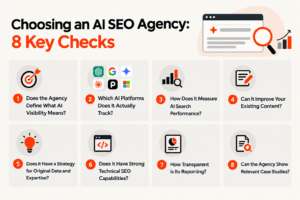
1. Does the Agency Define What AI Visibility Means?
AI visibility can refer to mentions, citations, prompt-level visibility, or share of AI-generated answers. Ask the agency which metrics it uses and what each one actually means.
It should be able to explain:
- What counts as a mention or citation
- Which prompts it tracks
- How often results are tested
- How progress is measured
Be cautious with claims about “ranking in ChatGPT.” AI platforms do not work exactly like traditional search engines, so the agency should explain its metrics clearly.
2. Which AI Platforms Does It Actually Track?
One platform does not give you the full picture. ChatGPT, Google AI Overviews and AI Mode, Perplexity, Gemini, Claude, and Microsoft Copilot can produce different results for the same query.
Check whether the agency tracks the platforms relevant to your audience and market. It should also explain how it tests visibility across those platforms rather than simply listing them as part of its service.
3. How Does It Measure AI Search Performance?
The measurement process matters as much as the result. A useful system should have a defined set of prompts, regular testing, and a baseline for comparison.
Look for coverage of:
- Customer and buyer-intent queries
- Location and language
- Mentions versus citations
- Competitor visibility
- Before-and-after results
A percentage increase means little without knowing how it was calculated.
4. Can It Improve Your Existing Content?
AI SEO does not always require publishing more pages. An agency should also know how to find opportunities within the content you already have.
Ask for a before-and-after example. It can show you much more about the agency’s process than a list of deliverables.
This could involve:
- Content audits and updates
- Direct-answer structures
- Entity and attribute optimization
- Relevant FAQs
- Stronger evidence and sources
- Changes based on actual AI-search behaviour
5. Does It Have a Strategy for Original Data and Expertise?
Generic content is easy to produce. What is harder to replicate is information that comes directly from your business and demonstrates genuine expertise.
Look for an agency that can work with:
- First-party data
- Original research
- Expert insights
- Industry-specific statistics
- Case studies
Also ask how AI is used in the content process. AI can support research and drafting, but the agency should have a way to add real business knowledge, evidence, and expertise.
6. Does It Have Strong Technical SEO Capabilities?
AI SEO still depends on a healthy website. Problems with crawling, indexing, structure, or performance can affect the foundation on which your content strategy is built.
Check whether the agency covers:
- Crawlability and indexability
- Structured data where relevant
- Internal linking
- Site architecture
- Page performance
Technical SEO should be part of the wider strategy, not something the agency ignores once AI visibility becomes the focus.
7. How Transparent Is Its Reporting?
A report should tell you more than whether a number went up or down. You should be able to understand what changed and what work was carried out.
Ask whether reports cover:
- AI citations and brand mentions
- Prompt visibility
- Platform-level changes
- Organic visibility
- Content and technical updates
- Business outcomes
Also check where the data comes from. First-party platform data and third-party AI visibility estimates are different, and the agency should explain the methodology behind its numbers.
8. Can the Agency Show Relevant Case Studies?
A case study is more useful when it shows the work behind the result, not just the final percentage or screenshot.
One AI-search screenshot only shows a single result at a particular point in time. Look for case studies that provide enough context to understand what changed and how it was measured.
Check for:
- A similar industry or business model
- A clear starting point
- Specific work completed
- An explained measurement method
- Results over a defined period
Questions to Ask an AI SEO Agency Before Signing
Before signing, focus on questions that reveal the agency’s actual process, scope, and measurement approach:
- What exactly do you mean by AI SEO?
- Which AI platforms and prompts will you track?
- How will you measure AI visibility?
- What will you use as our starting baseline?
- What will you actually change in our content and website?
- What will be included in the monthly reports?
- Can you show relevant case studies?
- How will you adapt the strategy as AI search platforms change?
The aim is to get specific answers about the work, measurement, and expected outcomes rather than broad promises.
Red Flags to Watch for When Choosing an AI SEO Agency
Not every AI SEO promise tells you how the agency actually works. Watch for signs that the strategy is based more on marketing claims than on a clear process and measurable work.
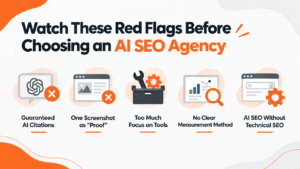
Guaranteed AI Citations
Be cautious with agencies that guarantee citations in ChatGPT, Google AI Overviews, or other AI platforms. Results can vary by prompt, platform, location, language, and available sources.
A credible agency should focus on measurable visibility improvements and explain what it can influence rather than promise a fixed citation outcome.
One Screenshot as “Proof”
A screenshot can show that a brand appeared for one prompt at one point in time. It does not demonstrate consistent visibility across different queries or platforms. Ask for broader evidence, such as tracked prompts, repeated measurements, and changes over a defined period.
Too Much Focus on Tools
AI SEO tools can help track prompts, mentions, competitors, and visibility. But using several tools does not automatically mean the agency has a strong strategy.
Ask how the agency turns tool data into content improvements, technical changes, and measurable actions.
No Clear Measurement Method
If an agency cannot explain its baseline, tracked prompts, platforms, or key metrics, it becomes difficult to evaluate its work. Before starting, make sure you understand what will be measured and how results will be compared over time.
This matters because AI visibility can differ substantially from traditional search visibility. A 2026 study across six AI search systems found that 41% of brands that performed strongly in Google search were underrepresented in ChatGPT and Perplexity.
AI SEO Without Technical SEO
AI visibility does not replace basic SEO. If a website has problems with crawling, indexing, site structure, or content accessibility, those issues still need attention. An agency that focuses entirely on AI search while ignoring technical foundations may leave important parts of your SEO strategy uncovered.
How to Compare AI SEO Agencies
When comparing AI SEO agencies, look beyond the services listed on their websites. Two agencies may both offer GEO, AEO, and AI visibility tracking but use very different methods.
Start with measurement and platform coverage. Check how each agency defines AI visibility, which platforms it monitors, which prompts it tracks, and how often it measures changes.
Then look at the actual SEO work. Does the agency improve existing content, handle technical SEO, develop original research, or support digital PR and link building where relevant?
Finally, compare reporting, case studies, industry experience, communication, and scope. You should be able to see what work will be done, how it will be measured, and what you will receive each month.
The aim is to compare the methodology and scope of each agency, not simply the number of services it offers.
What Should Be Included in an AI SEO Agency Proposal?
A clear AI SEO proposal should show exactly what the agency plans to do, how progress will be measured, and what you can expect from the engagement. Before signing, make sure the proposal covers the current baseline, target platforms, strategy, reporting, deliverables, and commercial terms.
It should also make the scope clear enough to understand what is included each month and how success will be evaluated.
| Proposal Element | What to Look For |
|---|---|
| Current Visibility Baseline | Your brand’s current visibility across relevant AI platforms, giving you a starting point for measuring progress. |
| Target Platforms and Prompts | The AI platforms, search queries, and buyer-intent prompts the agency will monitor. |
| Technical SEO and Content Strategy | The planned approach to technical SEO, existing and new content, content optimization, and any agreed digital PR or link building. |
| Reporting Methodology | How AI citations, mentions, prompt visibility, organic performance, and completed work will be measured and reported. |
| Deliverables, Timeline, and KPIs | Specific monthly deliverables, expected timelines, milestones, and KPIs used to evaluate progress. |
| Pricing and Contract Terms | Pricing, contract length, included services, scope limits, and any additional costs. |
Final Checklist Before You Sign
Before signing an agreement with an AI SEO agency, make sure you have clear answers to these points:
- Current visibility: Do you know where your brand currently appears in AI search?
- Platforms and prompts: Do you know which platforms and queries will be monitored?
- Planned work: Is it clear what the agency will change across your content, website, and SEO?
- Measurement: Do you understand which metrics will be used to track progress?
- Monthly deliverables: Does the contract clearly state what you will receive each month?
- Supporting evidence: Can the agency explain its methodology and provide relevant case studies?
If these details are clearly defined, you have a much stronger basis for evaluating the agency’s work throughout the engagement.
