

Brand visibility in AI answers can be measured by tracking how often your brand appears, how prominently it is mentioned, how frequently it is recommended, and which sources support those mentions across platforms like ChatGPT, Gemini, and Perplexity. Comparing these metrics with competitors helps you understand your brand’s presence in AI-generated answers and identify opportunities to improve it.
People are no longer using search engines only to find websites. They also ask AI tools for product recommendations, comparisons, solutions, and answers to everyday questions. As a result, a brand can influence buying decisions even when users never visit its website.
Measuring this visibility requires more than counting brand mentions. You also need to examine recommendation frequency, competitor presence, citations, and changes over time. This guide explains how to track these metrics and evaluate your brand’s performance across AI platforms.
What Counts as Brand Visibility in AI Answers?
Brand visibility in AI answers is not just about how often your company name appears. It also depends on whether AI platforms recommend your brand, cite your website, or include your business when comparing different options. These signals help you understand how visible your brand is across AI-generated responses and how users may discover your business through platforms like ChatGPT, Gemini, and Perplexity.
Here are four important signals to track when measuring brand visibility:
Brand Mentions
A brand mention occurs when an AI platform includes your company, product, or service name in its answer. For example, if someone asks ChatGPT to suggest SEO agencies and your company appears in the response, it counts as a brand mention. It shows that your brand is being recognized as relevant to that topic.
Brand Recommendations
A recommendation goes beyond a simple mention. It happens when an AI platform actively suggests your brand as a suitable option for a user’s needs. For example, if someone asks for an SEO agency for their SaaS business and ChatGPT recommends your company, it indicates that your brand is being considered as a relevant choice.
Website Citations
AI platforms may also use your website as a source when generating answers. They might link to one of your blog posts, service pages, or other website content. Tracking these citations helps you understand which pages contribute to your brand visibility and whether AI platforms rely on your content when answering relevant questions.
Competitor Comparisons
AI platforms often compare brands when users ask about alternatives, pricing, features, or solutions in a particular category. Your business may appear alongside competitors in these answers. Look at how your brand is described, which competitors are mentioned, and whether AI presents your business as a suitable alternative.
For a clearer picture of brand visibility, divide your tracking prompts into two groups:
-
Branded prompts: These include your company or product name in the question. They help you understand how AI platforms describe your brand when users already know about it.
-
Non-branded prompts: These do not mention your brand by name. They show whether AI platforms bring up your business on their own when users search for products or services in your category.
Tracking both helps you understand whether your brand is only appearing when users search for it by name or is also being discovered through general queries.
Calculate Your Brand Visibility
Once you know what counts as a brand appearance, the next step is to turn those appearances into a measurable number. A visibility rate gives you a simple way to see how frequently your brand appears across the AI answers you are tracking.
Start With the Visibility Rate
Take the number of relevant AI answers that mention your brand and divide it by the total number of answers you tested.
Brand Visibility Rate = Answers Mentioning Your Brand ÷ Total Answers Tested × 100
- For example, if you test 100 relevant prompts and your brand appears in 25 answers, your brand visibility rate is 25%.
Keep Your Measurement Set Consistent
The number only becomes useful when you measure it consistently. Use a fixed group of relevant prompts and test them across the AI platforms that matter to your audience.
Tools like Profound or Semrush AI Toolkit can run this same prompt set automatically on a schedule and calculate the visibility rate for you, which is worth considering once you’re testing more than a handful of prompts regularly.
Track the same basic numbers each time:
- Total answers tested
- Answers mentioning your brand
- Brand visibility rate
- Results by AI platform
You can also record whether the appearance was a simple mention, recommendation, or citation. This adds context to the score without changing the basic visibility calculation.
Use the Score as Your Baseline
Your first measurement gives you a starting point. Future checks can then show whether your brand is appearing in more or fewer relevant AI answers.
- For example: moving from 18% to 27% visibility shows that your brand is appearing across a larger share of the answers in your tracked set.
The goal is not to chase a single percentage. The useful insight comes from measuring the same way and watching the direction of your visibility over time.
Measure Your Share of Voice
Your visibility score tells you how often your brand appears. Share of voice adds another layer: how often your brand appears compared with competitors.
1. Count the Mentions
Use the same set of AI answers to record how many times your brand and each competitor are mentioned.
For example:
| Brand | Mentions |
|---|---|
| Your brand | 25 |
| Competitor A | 30 |
| Competitor B | 20 |
| Competitor C | 15 |
2. Apply the Formula
Once you have the total mentions, calculate your share of the AI conversation.
AI Share of Voice = Your Brand Mentions ÷ Total Brand Mentions × 100
If your brand has 25 mentions out of 90 total mentions, your AI share of voice is 27.8%.
Counting mentions by hand across several competitors gets tedious quickly- Semrush AI Toolkit calculates this figure automatically and compares it against up to nine competitors at once.
3. Compare the Results
Now look at where your brand stands against competitors. A higher share means your brand is being surfaced more frequently across the AI answers you are tracking.
You can also measure share of voice by topic, product, service, or prompt type. This shows whether competitors are gaining visibility in specific areas where your brand should be appearing. You can also compare AI brand mentions with competitors to understand which brands appear more frequently across relevant AI-generated answers.
Check the Context Behind Each Mention
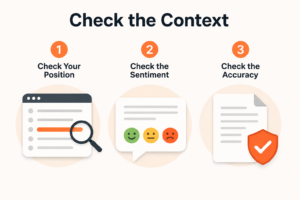
A brand appearing in an AI answer is only one part of the picture. The surrounding context tells you how the brand is actually being presented.
Check Your Position
Look at where your brand appears in the answer.
A brand listed as the first recommendation has stronger visibility than one mentioned briefly at the end. Record whether your brand is the top recommendation, one of the leading options, a secondary mention, or simply included in a comparison.
Ahrefs Brand Radar tracks this positioning automatically across your tracked prompts, so you’re not reviewing every response manually to note where your brand landed.
Check the Sentiment
Look at how the AI describes your brand.
A mention can be positive, neutral, mixed, or negative. This matters because a high number of mentions does not automatically mean strong brand visibility if those mentions are connected to complaints, limitations, or negative comparisons.
Check the Accuracy
Review whether the information is correct and current.
Check details such as your services, products, pricing, locations, features, or areas of expertise. An inaccurate mention may increase your visibility count while giving users the wrong impression of your brand.
Together, position, sentiment, and accuracy show what your visibility actually looks like inside AI answers, not just how often your name appears.
Track Visibility Over Time
A single measurement only shows where your brand stands at one point. Regular tracking helps you understand whether your presence in AI answers is growing, declining, or staying consistent.
Set a Regular Measurement Schedule
- Test the same prompts weekly or monthly.
- Use the same AI platforms for each check.
- Keep the measurement method consistent.
- Record results after every testing cycle.
SE Ranking is built for exactly this kind of ongoing check it keeps a running history so you can see the trend across cycles instead of manually logging each result yourself.
Compare Key Visibility Metrics
Brand visibility can differ considerably across AI platforms. SearchIntel’s 2026 benchmark found that the average recommended brand appeared on just 2.26 of the six platforms studied. This shows why checking your brand on only one AI platform may give you an incomplete picture. Regular platform-specific tracking helps identify where your brand is gaining visibility and where it is missing
- Brand visibility rate
- AI share of voice
- Brand mentions
- Website citations
- Recommendation frequency
- Sentiment and accuracy
Look for Meaningful Changes
- Identify increases or drops in brand visibility.
- Check when competitors gain or lose brand visibility.
- Review content updates made during the same period.
- Look for changes in citations and recommendations.
- Compare results with previous measurement periods.
Regular tracking helps turn individual AI answers into a clear visibility trend, making it easier to see whether your brand is gaining ground or losing presence.
What Your AI Visibility Numbers Tell You
Individual metrics are useful, but the real insight comes from looking at them together. To understand where competitors are gaining visibility while your brand remains absent, you can identify AI search coverage gaps.
Ask:
- Is your brand appearing for important prompts?
- Are competitors appearing more often?
- Is AI recommending or simply mentioning you?
- Are your pages being cited?
- Is your visibility improving over time?
Together, these answers show how visible your brand is, where it stands against competitors, and whether that visibility is moving in the right direction.
Frequently Asked Questions
Can AI answers change for the same prompt?
Yes, AI responses can vary, so repeated testing gives more reliable brand visibility data.
Do different AI platforms show the same brands?
No, ChatGPT, Gemini, Perplexity, and other platforms may surface different brands and sources.
Does location affect AI brand visibility?
Yes, Some AI answers can vary based on location, especially for local products and services.
Should branded prompts be included in tracking?
Yes, they can show how accurately AI platforms understand and represent your brand.
How often should AI answers be checked?
Yes, Regular checks, such as monthly tracking, can help identify meaningful changes.