AI search has changed what it means for a brand to be visible online. A company can rank well in Google and still be missing from the answers people get from ChatGPT, Google AI Overviews, Perplexity, or Gemini.
That makes brand mentions worth tracking. When an AI platform recommends your brand, compares it with competitors, or uses your content as a source, it gives you a different view of how your brand is being discovered and represented.
AI brand mention tracking helps you monitor those appearances over time. You can see where your brand is mentioned, which prompts trigger those mentions, which sources are being cited, and how your visibility compares with competitors.
The setup doesn’t have to be complicated. With the right prompts, platforms, tracking fields, and review process, you can build a system that turns AI search results into useful SEO insights.
Choose the AI Platforms to Monitor
You don’t need to track every AI platform from day one. Start with the ones your audience is most likely to use when researching products, comparing services, or looking for recommendations.
| Platform | What to watch |
|---|---|
| ChatGPT | Brand recommendations, comparisons, product mentions, cited sources |
| Google AI Overviews / AI Mode | Mentions, linked sources, visibility for search queries |
| Perplexity | Brand mentions, source citations, competitor visibility |
| Gemini | Recommendations, brand descriptions, cited websites |
The right mix depends on your market. For example, an SEO software company may prioritize prompts such as “best SEO tools for small businesses” across ChatGPT, Perplexity, and Google AI results.
Keep the platform list consistent once tracking begins. Checking the same platforms over time makes it easier to spot genuine changes instead of mixing platform differences with changes in brand visibility.
Build Your AI Prompt Set
Your tracking is only as useful as the prompts you test. Instead of choosing a handful of keywords and running them repeatedly, build a prompt set that reflects the questions a potential customer might actually ask an AI tool.
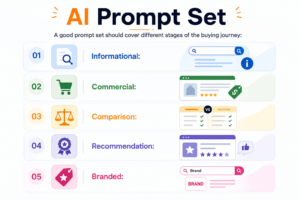
A good prompt set should cover different stages of the buying journey:
- Informational: Questions where users are looking for explanations or solutions.
Example: “How can a small business improve its local SEO?” - Commercial: Queries where users are researching available options.
Example: “What are the best local SEO tools for small businesses?” - Comparison: Queries that put your brand alongside competitors.
Example: “Semrush vs Ahrefs: which is better for keyword research?” - Recommendation: Questions that ask AI to suggest a product or service.
Example: “Which SEO platform should I use for a SaaS website?” - Branded: Queries that directly mention your company, product, or service.
Example: “What does [Brand Name] offer for enterprise SEO?”
You should also include non-branded prompts. These are particularly useful because they show whether AI platforms mention your brand when the user doesn’t already know it.
For example, a travel company shouldn’t only track:
“Is [Brand Name] good for booking international trips?”
It could also track:
“What are the best platforms for booking international trips?”
The second prompt gives you a clearer view of discovery and recommendation visibility.
Set Up Your Brand Mention Tracking
Once your platforms and prompts are ready, decide how you’ll record the results. The setup can be as simple as a spreadsheet or handled through a dedicated AI visibility tracking tool.
For each prompt, record the same core information every time:
| Field | What to record |
|---|---|
| Prompt | The exact query tested |
| AI platform | ChatGPT, Perplexity, Gemini, etc. |
| Brand mentioned | Yes / No |
| Citation | URL or source cited in the answer |
| Competitors | Other brands mentioned |
| Brand position | Where your brand appears in the response |
| Date checked | When the result was recorded |
- Example: If the prompt is “Best project management tools for remote teams?”, you might record that your brand was mentioned, two competitors appeared alongside it, and the AI cited a third-party review page.
Keep the exact prompt wording in your records. Small changes in phrasing can produce different answers, so changing the query each time makes your results harder to compare.
If you’re tracking dozens or hundreds of prompts, an automated monitoring platform can reduce the manual work. For a smaller prompt set, a structured spreadsheet is often enough to get started.
Establish Your AI Visibility Baseline
Before measuring growth or drops, capture where your brand stands right now. This gives you a fixed reference point for comparing future results.
Measure Your Initial Visibility
Run your complete prompt set across the AI platforms you’re monitoring. Record whether your brand appears in each response and how prominently it is presented.
For example, if your brand appears for 15 out of 50 prompts, your initial mention rate is 30%.
Record Your Citation Rate
Track how often your website or other brand-owned pages are used as sources.
A brand might be mentioned without its website being cited, so keep these two measurements separate.
Example:
50 prompts tested → 15 brand mentions → 8 brand citations.
Benchmark Against Competitors
Record which competitors appear alongside your brand. This helps you understand whether your visibility is limited to branded searches or extends to broader category and recommendation queries.
For instance, if competitors appear in 25 of 50 prompts while your brand appears in 15, that gives you a useful starting point for future comparisons.
Keep the initial results unchanged and use them as your baseline for every later tracking cycle.
Monitor AI Citations and Sources
A mention shows that your brand appeared, while a citation shows which source supported the answer. Track both separately.
Record Cited Sources
Save the specific URL cited in each relevant response, not just the domain. Look for sources that appear repeatedly across your prompts.
Compare With Competitors
| Brand | Common source | Type |
|---|---|---|
| Your brand | Product page | Brand-owned |
| Competitor A | Industry review | Third-party |
| Competitor B | Comparison page | Third-party |
This can reveal citation gaps, such as competitors being supported by more independent sources.
Keep Mentions and Citations Separate
An AI platform can mention your brand while citing another website. Recording both separately gives you a clearer picture of your actual visibility.
Analyze Changes in AI Brand Visibility
Compare each tracking cycle with your baseline instead of judging visibility from individual AI responses. A simple comparison makes changes easier to spot and investigate.
1. Compare Brand Mentions
Check whether your brand is appearing for more or fewer tracked prompts.
Example:
| Tracking cycle | Prompts tested | Brand mentions |
|---|---|---|
| Baseline | 50 | 18 |
| Month 2 | 50 | 23 |
| Month 3 | 50 | 27 |
The increase suggests broader visibility, but the next step is to identify which prompts and topics contributed to it.
2. Compare Competitor Visibility
Run the same comparison for your main competitors. A rise in your mentions matters differently if competitors are growing at a faster rate.
Look for:
- New competitors appearing in answers
- Competitors replacing your brand in recommendations
- Prompts where your brand consistently loses visibility
- Categories where your brand is gaining ground
3. Review Changes in Brand Descriptions
Read how the AI describes your brand across tracking cycles.
For example:
- Earlier: “A budget-friendly SEO tool for small businesses.”
- Later: “An SEO platform suited to agencies and growing businesses.”
A change like this can indicate that the information AI systems are drawing from has shifted.
4. Investigate Citation Changes
Finally, compare which pages and domains are being cited.
If your brand mentions increase but your website citations don’t, you may be gaining visibility through third-party sources rather than your own content. That distinction can help determine what to investigate next.
Turn AI Mention Data into SEO Actions
Use tracking results to identify where your brand is missing, where competitors are stronger, and which sources influence AI answers.
Improve Missing Content
If competitors appear for important prompts but your brand doesn’t, review the pages covering those topics.
- Example: Your brand isn’t appearing for “best CRM for small businesses.” Check whether your CRM content clearly addresses small-business needs.
Fill Content Gaps
Repeatedly missed prompts can reveal topics worth covering.
If users ask “best project management tool for remote teams” and you have no content addressing remote work, that’s a clear content opportunity.
Strengthen Third-Party Coverage
If competitors are frequently supported by reviews, publications, or comparison pages, look for relevant opportunities to earn credible third-party coverage.
Update Outdated Information
If AI systems repeatedly use outdated information about your brand, update your own pages and review the external sources contributing to those answers.
Common AI Brand Mention Tracking Mistakes
Even a simple tracking setup can produce misleading results if the process isn’t consistent. These are the mistakes worth avoiding:
- Tracking Too Few Prompts: A small prompt set can make your visibility look better or worse than it really is. Include different intents, topics, and both branded and non-branded queries.
- Monitoring Only One Platform: AI platforms can produce different answers for the same query. Track the platforms most relevant to your audience instead of relying on a single source.
- Treating One Response as a Trend: AI-generated answers can change between runs. Look for patterns across repeated checks rather than reacting to a single response.
- Ignoring Citations: A brand mention doesn’t necessarily mean its website was used as a source. Track brand mentions and citations separately.
- Focusing Only on Your Brand: Competitor visibility provides context. If your mentions increase while a competitor’s increase faster, your relative visibility may not have improved.
- Measuring Without Taking Action: Tracking numbers alone won’t improve visibility. Use the findings to identify content gaps, citation opportunities, and outdated information that need attention.
FAQs About AI Brand Mention Tracking
Does AI brand tracking show how users actually search?
No, It shows how selected prompts are answered, so it should be treated as a visibility sample rather than actual search-volume data.
Can AI brand mentions change without website changes?
Yes, AI responses can change because of updates to AI systems, sources, or other external information.
Should branded and non-branded prompts be tracked separately?
Yes, This helps distinguish existing brand awareness from broader category visibility.
Should AI tracking include local searches?
If location matters to your business, yes. Include location-based prompts to measure visibility in local recommendations.
Can AI tracking explain why competitors are recommended?
It can provide useful clues by showing the content and sources associated with competitor mentions, but it cannot confirm the exact reason.
