Key Takeaways
- AI Overviews and zero-click search have cut the return on purely informational content. The click that funded that investment is gone.
- Move budget toward commercial, transactional, and branded intent, where the user is closer to a decision and the overview cannot finish the job.
- Classify every page by query intent and business value before you invest, update, consolidate, or retire it.
- Prioritize comparison pages, pricing pages, buying guides, product tutorials, and case studies.
- Measure with qualified leads, assisted conversions, revenue influenced, and branded search growth. Not traffic.
- Treat informational content as a supporting asset that educates and routes, not as a traffic engine.
- Review the portfolio quarterly and reallocate as search behavior keeps moving.
The question is no longer how much content you publish. The question is which intent you buy.
Google answers most informational queries on the results page now. SparkToro, using Similarweb data, put zero-click at 68% of US searches in early 2026, and AI Overviews extended that behavior from quick facts to full explanations. The “what is X” article that used to carry your blog still ranks. It just gets read inside Google, by someone who never arrives.
Meanwhile the pricing page, the comparison page, and the branded query barely moved. Overviews rarely trigger there, because those queries need information a summary does not hold.
That gap is the whole strategy. This article gives you a framework for reading it: how to classify pages by intent, where to increase and cut, what to do with the informational library you already own, and which KPIs to put in front of leadership instead of a traffic chart.
Why is Traditional Content Investment No Longer Enough?
Publishing more informational articles produces diminishing returns now, and the mechanism is simple. You are buying impressions in a class where the click has been intercepted. The content still ranks. The traffic goes to the answer above it.
The common response is to publish more of exactly what stopped working. Volume was never the asset. The click was the asset, and on top-funnel queries it left.
Why Leadership Should Rethink Content Budgets
Content budgets were built on an assumption that no longer holds: that ranking produces traffic and traffic produces pipeline. The first half broke on informational intent.
A content program that reports sessions will keep funding the class that lost its clicks, because sessions is where that class still looks busy — impressions climb, the dashboard stays green, and nothing reaches sales.
Traffic Growth is No Longer a Reliable ROI Indicator
Traffic can rise while revenue falls, and it can fall while revenue holds. Both happened across 2026. A blog that adds a large volume of definition traffic and no demos has spent budget on an audience that was never buying.
The number that survived the shift is conversion rate per visit. When low-intent traffic moves to the summary layer, the visitors who remain arrived because the overview could not answer them.
Align Content Investment With Revenue
Every page should have a job that maps to money: create demand, capture demand, or support a page that does. Pages with no such job are inventory, not investment.
That single test, what is this page’s job, retires more content than any traffic threshold.
Which Query Intents Deserve Your Budget?
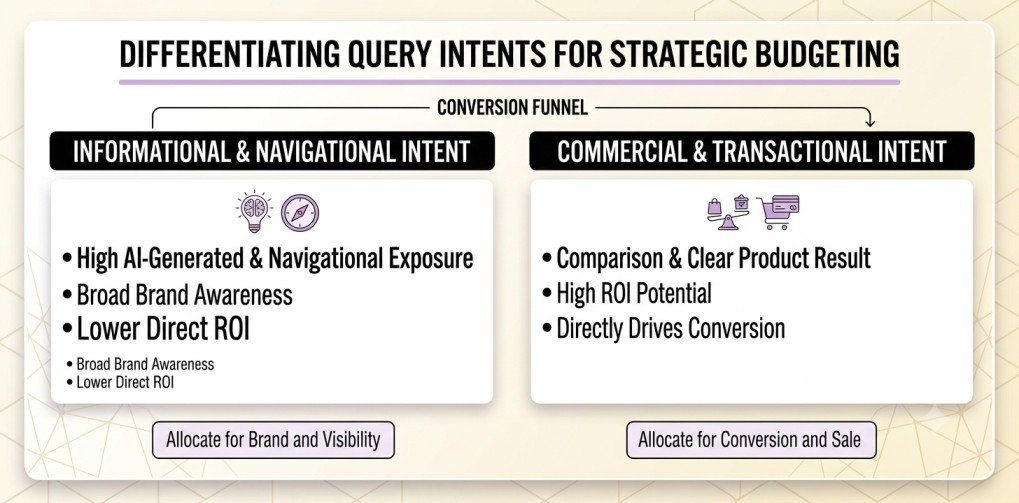
Four intents, four different economics:
| Intent | AI Exposure | User Distance from Purchase | Budget Priority |
|---|---|---|---|
| Informational | Highest | Furthest | Reduce and consolidate |
| Commercial | Moderate | Close | Increase |
| Transactional | Lowest | Closest | Increase |
| Branded | Lowest | Already decided | Defend and expand |
The pattern holds because of what each query needs. A definition is a settled fact, and a model can assemble it from anywhere. A buying decision needs pricing, tradeoffs, tested comparisons, and proof, the things that only exist because someone did the work.
A Real Keyword Portfolio
Take four queries from a single CRM portfolio. Same topic, four completely different investment cases:
| Query | Intent | What Happens in 2026 | Decision |
|---|---|---|---|
| “What is CRM” | Informational | Overview answers it. Impressions hold, clicks go, conversions stay near zero. | Consolidate into a pillar. Stop maintaining as a standalone traffic play. |
| “Best CRM software” | Commercial | Overview may summarize, but the user still wants a shortlist and reasoning. | Increase. Original testing, real criteria, honest exclusions. |
| “HubSpot vs Salesforce” | Commercial Comparison | Hard to synthesize. Needs feature-level detail and a point of view. | Increase most. Highest ROI page in the set. |
| “HubSpot pricing” | Transactional and Branded | Overview rarely triggers. User is deciding. | Increase. Keep exact, current, and complete. |
One topic. The first query is a cost centre. The last three are the business. Most content plans still spend the most on the first, because it has the biggest search volume, which is exactly the number that stopped meaning anything.
A Framework for Reallocating Your Content Budget
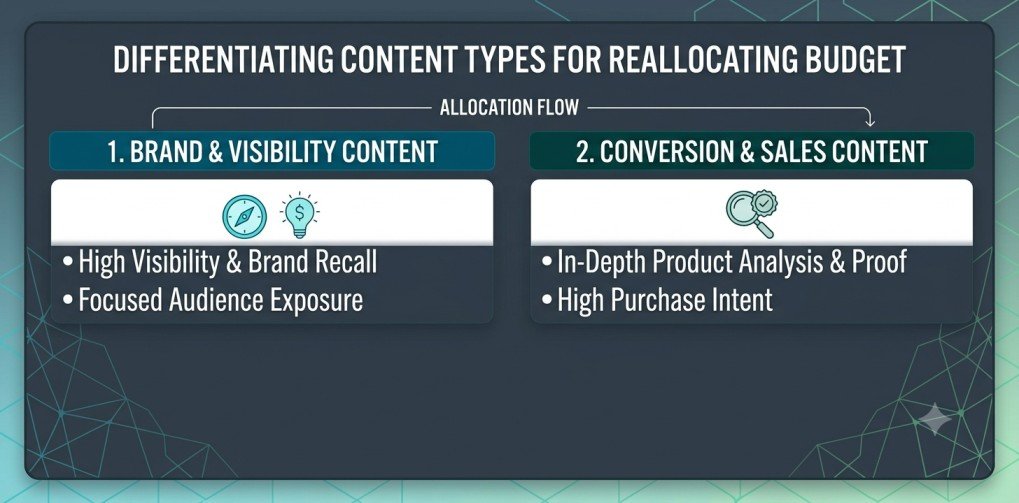
Four decisions. Every page gets one.
| Decision | Applies To | Action |
|---|---|---|
| Increase Investment | Commercial, transactional, and branded pages with conversions or clear conversion potential | Deepen with original data, testing, pricing detail, and proof. Refresh quarterly. |
| Maintain Investment | Informational pages that earn citations, assist conversions, or hold topical authority | Keep current and accurate. Do not expand. Route readers onward. |
| Consolidate | Overlapping informational articles competing for the same intent | Merge into one deep page. Redirect the rest. One page per task. |
| Reduce or Retire | Informational pages with no conversions, no assists, no citations, and no internal link value | Cut. Every retired page returns crawl budget and editorial time. |
The uncomfortable part is that “ranks well” appears in none of those criteria. A page ranking first for a query whose clicks are gone and whose readers never convert is not an asset. It is a maintenance bill.
One guardrail before you act on that. Check assisted conversions before you retire anything. An informational page that converts nobody but sits in the path of buyers is doing real work, and a last-click report will tell you to kill it. Last-click is the single fastest way to over-retire a library that was earning its keep.
How Do You Classify Your Existing Content Portfolio?
Five steps. Do it once properly and the quarterly version takes an afternoon.
1. Group pages by intent. Informational, commercial, transactional, branded. Use the query the page actually ranks for, not the one you wrote it for. Those diverge more often than teams expect.
2. Measure traffic, conversions, and assisted conversions. Assists matter most here, for the reason above. Pull them per page, not per segment.
3. Identify pages affected by AI Overviews. Compare impressions against clicks year over year in Search Console. Impressions up, clicks down, average position steady is absorption. Search Console will not tell you an overview appeared, so the pattern is your evidence.
4. Flag underperforming informational content. No conversions, no assists, no citations, no internal link role, flat or falling clicks. Four out of five means it is a candidate.
5. Assign a decision. Invest more, maintain, consolidate, retire. One per page. No page leaves the audit unlabelled.
A Worked Example
Say a B2B software blog has 340 published pages. Run the audit above, group the results, and the table might look like this:
| Segment | Pages | Share of Sessions | Share of Pipeline | Decision |
|---|---|---|---|---|
| Informational Definitions and “What Is” | 180 | 61% | 4% | Consolidate to ~30, retire the rest. |
| How-To and Tutorials | 90 | 24% | 21% | Maintain, add product routing. |
| Comparisons and Alternatives | 34 | 9% | 38% | Increase. |
| Pricing, Product, Case Studies | 36 | 6% | 37% | Increase. |
The numbers are illustrative. The shape is what to check for: most of the traffic sitting on almost none of the pipeline, and a small block of commercial pages carrying most of it. Build the table with your own numbers and next quarter’s content plan writes itself.
Where Should You Invest More Content Budget in 2026?
Eight formats, ranked by how hard they are to synthesize:
- Comparison pages: “X vs Y” needs feature-level accuracy and a stated position. Highest ROI format in most portfolios.
- Alternatives pages: captures users actively leaving a competitor. Commercial intent, low AI exposure.
- Buying guides: criteria, tradeoffs, and recommendations tied to real use cases.
- Pricing pages: exact numbers, tiers, and what changes between them. An overview cannot invent your pricing.
- Product-led tutorials: teach the task using your product. Educates and demonstrates in one page.
- Industry landing pages: vertical-specific proof, regulation, and language. Local and sector detail resists summarization.
- Customer case studies: outcomes with methodology and named context. The most citable asset you own, because nobody else has it.
- Brand authority content: original research, benchmarks, and points of view that earn mentions and grow branded search.
A Worked Example
Two pages, same topic, same team, same quarter.
The first is a long “what is marketing automation” guide. It takes two days to write, ranks well, and earns a healthy impression count. It produces no demo requests, because the people reading it are learning a definition and the overview above already gave them one.
The second is a “Marketo vs HubSpot for mid-market B2B” comparison. It takes twice as long, because it requires actually testing both products. It ranks lower and earns a fraction of the impressions. It produces demo requests, because the people reading it are choosing.
Fewer impressions, more effort, and the entire pipeline contribution. That trade is the strategy in one paragraph.
What Should You Do With Existing Informational Content?
Do not delete the library. Repurpose its job.
Informational content stopped being a traffic engine and became three other things:
- A citation asset. Deep, original informational content still earns AI citations, and citations deposit brand recall that shows up later as branded search. Seer Interactive found cited brands earn 35% more clicks than uncited ones on the same query.
- A routing layer. Every informational page should hand the reader to the commercial page that serves the next question. Descriptive internal links, placed where the question naturally arises.
- A topical authority signal. Coverage depth still feeds the ranking systems that decide retrieval. Consolidated, well-maintained informational content supports the commercial pages beside it.
So: consolidate the overlap, keep the best of it current, add original data where you can, and make every page point somewhere that converts. What you stop doing is commissioning new definition articles because a volume tool showed a big monthly number.
Which KPIs Matter More Than Traffic?
Six numbers for a leadership report:
- Qualified organic leads: leads matching your ICP, not form fills.
- Demo requests from organic: the clearest intent signal a content program produces.
- Assisted conversions: captures the informational page that shaped the decision without closing it.
- Revenue influenced: the number that decides next year’s budget.
- Branded search growth: the downstream receipt for AI visibility. Citations create demand that arrives as branded queries later.
- Sales pipeline contribution: content-sourced and content-influenced pipeline, reported separately.
Traffic can stay on the report. It belongs near the bottom, as a diagnostic, not at the top as the outcome.
A Step-by-Step Strategy for Rebalancing Content Investment
- Audit all existing pages. Every URL, with impressions, clicks, conversions, and assists attached.
- Classify each page by intent. Based on the queries it actually ranks for.
- Measure business impact. Conversions and assists per page, then per intent segment. This is where the sessions column and the pipeline column stop agreeing.
- Identify AI-vulnerable informational content. Impressions up, clicks down, position steady, conversions at zero.
- Consolidate overlapping articles. Merge competing pages into one deep page per task. Redirect the rest.
- Reallocate future budget quarterly. Set the split by intent, review against business impact each quarter, and move it again as behavior shifts.
Run the full audit annually. Run steps 3 and 6 every quarter.
Frequently Asked Questions
Should I delete my informational content?
No. Consolidate it, do not delete it. Informational pages still earn AI citations, route readers to commercial pages, and feed the topical authority that supports everything beside them.
How do I know if a page is losing clicks to AI Overviews or losing rankings?
Check average position first. Impressions up, clicks down, position steady is absorption, and the page is fine. Impressions and clicks falling together with position dropping is ranking loss, which is a different problem with a different fix. Search Console will not tell you an overview appeared, so the pattern is your evidence.
What percentage of my budget should go to commercial content?
No universal split exists, because it depends on what your portfolio already owns. Run the audit, compare share of sessions against share of pipeline per intent segment, and let the gap set the ratio.
Can I still rank for informational keywords in 2026?
Yes. Ranking was never the problem. Those pages still rank, still earn impressions, and still get read, just inside Google rather than on your site. The question is not whether you can rank, it is whether the ranking pays for the page.
How often should I run this audit?
Fully once a year, every URL. Then run the business-impact measurement and the reallocation decision quarterly, which takes an afternoon once the classification exists.
What if a page ranks first but produces no conversions?
Check assisted conversions before you touch it. A page that closes nobody but sits in the buyer’s path is doing real work that last-click reporting will hide. If it has no assists, no citations, and no routing role either, then first position is not saving it. That page is a maintenance bill.
Does this mean traffic no longer matters?
Traffic is still a useful diagnostic, just not the outcome. It tells you something changed. Conversions, assists, and revenue influenced tell you whether it mattered. Keep traffic on the report, near the bottom.
Conclusion
Success in the AI era is not about publishing the most content. It is about owning the intents where the click still exists and the decision still gets made.
The shift is uncomfortable because it retires work that ranks. A first-position page with high impressions and no pipeline feels like an asset right up until you check what it costs to maintain and what it returns. Meanwhile the comparison page nobody prioritized carries a third of the revenue.
Classify by intent and business value. Increase where users are close to deciding. Consolidate the informational library and give it a supporting job: citations, routing, authority. Report leads, assists, revenue influenced, and branded search growth.
Optimize the portfolio for outcomes. The traffic chart was always a proxy, and in 2026 it stopped being a good one.

Farhan khan
Farhan is an SEO writer covering content strategy, search visibility, and brand discovery across search engines and AI platforms.