AI search is changing how people discover and evaluate brands. Instead of clicking through a list of search results, users are increasingly getting direct answers that mention specific companies, products, and sources.
That makes brand visibility harder to judge through traditional rankings alone. Tracking where your brand appears in AI answers, how often it is mentioned, and which pages get cited gives you a clearer picture of how your brand is being discovered and represented.
This also helps you spot gaps, understand what drives visibility, and make better decisions about the content and sources supporting your brand.
What are Brand Mentions and Citations in AI Search?
A brand mention is any reference to your brand in an AI-generated answer. It can appear as a recommendation, comparison, explanation, or direct answer to a user’s question.
A citation is a source link included in the answer to support the information provided. The cited page could be your website, a publisher, review site, or another third-party source. Research on generative search engines shows that citations are not always reliable indicators of support. In an evaluation of four generative search engines, only 51.5% of generated sentences were fully supported by citations, while 74.5% of citations actually supported their associated statements.
Mentions vs. Citations
- Brand mention: Your brand is named in the answer.
- Brand citation: A URL is included to support the answer.
- Mention without citation: Your brand appears, but there is no link to your site.
- Citation without a direct mention: Your page may be cited as a source even when your brand name is not prominent in the answer.
Types of AI Brand Mentions
Brand mentions can appear in different contexts, such as:
- Recommendations: Your brand is suggested as an option.
- Comparisons: Your brand is compared with competitors.
- Category answers: Your brand appears among leading options.
- Explanations: Your brand is referenced to support a specific claim.
How Citations Appear in AI Answers
Citations can point to product pages, research, articles, guides, reviews, or other relevant sources. Looking at these URLs helps you understand which content earns visibility and supports your brand’s presence in AI answers.
Why Track Brand Mentions in AI Search?
Tracking brand mentions shows how often your brand appears in AI-generated answers and which platforms or prompts bring it up. It also helps you see whether your visibility is improving or staying consistent.
It can reveal topics where competitors are appearing instead of your brand and show which content or sources are connected to your mentions and citations. This gives you clearer direction on where to improve your AI visibility.
AI Brand Tracking vs. Traditional Brand Monitoring
The two approaches measure brand visibility differently:
- Search rankings vs. AI mentions: Traditional monitoring tracks where your pages rank, while AI tracking checks whether your brand appears in generated answers.
- Keywords vs. prompts: Traditional monitoring focuses on keywords such as “project management software,” while AI tracking uses conversational questions such as “What is the best project management software for a small team?”
- Rankings vs. citations: SEO monitoring measures your position in search results, while AI tracking looks at whether your brand or website is mentioned or cited in an answer.
- Different visibility gaps: A page can rank well in search but still be left out of an AI answer, where a competitor may be recommended or cited instead.
Challenges of Tracking AI Brand Mentions
Tracking AI brand mentions can be more complex than traditional brand monitoring because AI answers are not fixed. Several factors can affect whether, where, and how your brand appears.
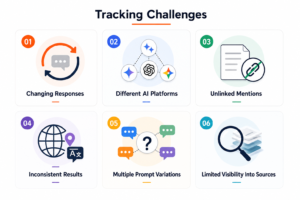
Changing Responses
The same prompt may generate different answers at different times, making it difficult to maintain a consistent record.
Different AI Platforms
ChatGPT, Gemini, Google AI Overviews, and other platforms may use different sources and mention different brands.
Unlinked Mentions
Your brand can appear in an answer without a clickable link, making these mentions harder to discover through website analytics.
Inconsistent Results
Location, language, prompt wording, and search context can influence which brands and sources appear.
Multiple Prompt Variations
Users can ask similar questions in many different ways, so tracking a single keyword or query is not enough.
Limited Visibility Into Sources
An AI answer may use information from several sources, making it difficult to determine which content influenced a specific mention.
How to Track Brand Mentions and Citations
A reliable tracking process starts with a defined set of platforms, prompts, and metrics. Instead of checking AI answers randomly, use the same framework regularly so changes in visibility are easier to identify.
Define Platforms and Prompts
Choose the AI platforms and relevant questions you want to monitor. Include product searches, category questions, comparisons, and recommendation-based prompts.
Start with a mix of prompts such as “best [category] for [use case],” “[Brand A] vs [Brand B] for [audience],” and “what is the top-rated [product type] in 2026.” Tools such as Semrush AI Toolkit and Profound can save these prompts and run them regularly across supported AI platforms, which is much easier than checking each question manually.
Record Mentions and Citations
For each response, note whether your brand was mentioned, whether your website was cited, and which URL appeared.
Doing this manually across dozens of prompts and platforms can quickly become difficult to manage. Tools such as Otterly.ai and SE Ranking can automate the monitoring process and keep a record of results, making it easier to spot changes without maintaining a large spreadsheet.
Monitor Competitors
Track the same prompts for competing brands to see where they appear, how often they are cited, and where your brand is missing.
Tools such as Ahrefs Brand Radar, Semrush, and SE Ranking also provide competitor comparison features, including visibility and share-of-voice data. This means you can compare brands within the same monitoring workflow rather than repeating the entire process separately for every competitor.
Unlinked Mentions
Your brand can appear in an answer without a clickable link, making these mentions harder to discover through website analytics. Citation tracking can help uncover these gaps by showing where your brand is being referenced and whether a brand-owned URL is attached to the mention.
Metrics for Measuring AI Brand Visibility
Measuring AI visibility requires more than counting how many times your brand name appears. The following metrics help you understand the frequency, quality, and competitive position of your visibility across AI answers.
| Metric | What It Measures |
|---|---|
| Mention rate | The percentage of tracked prompts where your brand is mentioned in the AI answer. |
| Visibility/share of voice | Your brand’s share of total brand mentions compared with competitors across the same set of prompts. |
| Citation rate | How often your website or other brand-owned content is cited as a source in AI answers. |
| Competitor visibility | How frequently competing brands appear across the prompts you are monitoring. |
| Visibility by platform | How your brand’s mentions and citations vary across different AI search platforms. |
| Prompt-level visibility | Which specific questions, topics, or search intents generate the most visibility for your brand. |
| Citation source distribution | The types of websites and content sources being cited when your brand appears in AI answers. |
How to Compare AI Brand Visibility With Competitors
Comparing your brand with competitors shows where you are gaining visibility and where other brands are being surfaced instead. Use the same prompts and platforms for each brand to make the comparison meaningful.
Compare Mentions
Check how often your brand appears compared with competitors across the same set of prompts.
Compare Citations
Look at how frequently each brand’s website or content is cited and which pages receive the most citations.
Identify Visibility Gaps
Find prompts, topics, and categories where competitors appear but your brand is missing or receives less visibility.
How to Audit AI Brand Mentions and Citations
An AI brand audit helps you understand how your brand is being represented across AI answers. Reviewing mentions, citations, and the sources behind them can reveal accuracy issues, content gaps, and opportunities to strengthen your visibility.
Auditing the sources behind an answer is important because having a citation does not necessarily mean that the cited source fully supports the claim. A 2025 study evaluating seven LLMs found that 50%–90% of responses were not fully supported by their cited sources, depending on the model and evaluation setting.
- Check accuracy: Verify that brand information is correct, current, and consistent.
- Review cited sources: Check whether cited URLs accurately represent your brand and expertise.
- Find missing or outdated information: Identify gaps, incorrect details, or sources that need updating.
- Identify improvement opportunities: Use recurring issues to determine what content or sources need improvement.
How to Improve Brand Visibility in AI Search
Improving AI visibility starts with making your brand and its information easier to understand, verify, and reference. Focus on building useful content and reliable sources rather than trying to influence individual AI answers.
- Create citable content: Publish clear, well-supported content that directly answers relevant questions.
- Strengthen brand/entity information: Keep important details about your brand, products, and services clear and consistent.
- Improve content accuracy and freshness: Update outdated information and review important pages regularly.
- Build authoritative third-party presence: Earn mentions and coverage from credible websites that AI platforms may use as sources.
Tools for AI Brand Monitoring
AI brand monitoring tools vary in how many AI platforms they cover, what they measure, and how deeply they analyze mentions and citations. Instead of choosing a tool based only on the number of features it offers, look at whether it fits the way you plan to monitor AI visibility, competitors, prompts, and cited sources.
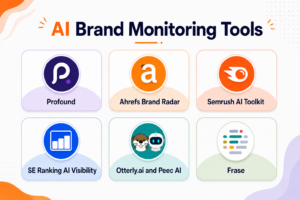
Profound
Profound is designed for enterprise-level AI visibility tracking. It monitors more than 10 AI engines, including ChatGPT, Perplexity, Gemini, Claude, Grok, and DeepSeek. It also uses simulated buyer personas to show how a brand appears at different stages of the purchase journey. For larger teams, its SOC 2 Type II compliance and detailed audit trails can be useful when AI visibility data needs to be monitored and documented at scale.
Ahrefs Brand Radar
This brings AI visibility tracking into the Ahrefs ecosystem. It analyzes a large volume of AI queries to identify where and how brands are mentioned, while its Citation Tracker helps identify the URLs that AI models use as sources. This makes it useful for teams that want to connect AI visibility and citation data with their existing SEO workflow.
Semrush AI Toolkit
This combines several AI visibility signals, including brand mentions, citations, sentiment, and share of voice. It also allows brands to compare their visibility against up to nine competitors. For SEO teams already using Semrush to monitor traditional search performance, this provides a way to bring AI search visibility into the same broader measurement process.
SE Ranking AI Visibility
It focuses on ongoing monitoring of brand mentions, placement, and competitors across platforms such as ChatGPT and Google AI Overviews. Its historical comparisons can help teams see how visibility changes over time instead of relying on one-off checks of AI answers.
Otterly.ai and Peec AI
They are lighter-weight options for teams that want to start monitoring AI visibility without adopting a more enterprise-focused platform. Their prompt-based approach makes them useful for tracking selected queries, brand mentions, and citations and receiving visibility insights over time.
Frase
It goes beyond simply monitoring AI visibility. When it identifies a lost citation or content opportunity, the platform can connect that insight with content research, drafting, and optimization. This can be useful for teams that want to move from identifying a citation gap to working on the content needed to address it within the same workflow.
The right tool depends on the depth of monitoring you need. Enterprise teams may benefit from platforms with broader AI-engine coverage, persona-based analysis, and detailed reporting, while smaller teams may prefer simpler prompt-based monitoring. The key is to choose a tool that helps you consistently track the same prompts, competitors, mentions, and citations so that changes in AI visibility can be measured over time.
FAQs
Can AI answers change over time?
Yes. AI responses can change as models, sources, and information are updated.
Should you track the same prompts every time?
Yes. Consistent prompts make it easier to compare visibility over time.
Do AI mentions drive website traffic?
They can, especially when an AI answer includes a clickable citation to your website.
Can a brand appear without its website being cited?
Yes. A brand can be mentioned even when no brand-owned URL is included.
Should you track mentions across different locations?
If your audience is location-specific, yes. AI results can vary by location and context.
