

LLM optimization (LLMO) is the process of improving how large language models discover, interpret, and represent your brand. It goes beyond publishing content by focusing on brand identity, information consistency, external mentions, and content accessibility. These elements help AI systems find reliable information about your business and use it when generating relevant answers.
This matters because AI tools like ChatGPT, Gemini, Perplexity, and Google AI Overviews now answer questions directly. It also works alongside SEO: SEO helps your pages rank, while LLM optimization helps AI models understand and recommend your brand accurately.
What Is LLM Optimization (LLMO)?
LLM optimization (LLMO) is the practice of improving how AI systems built on large language models discover, interpret, cite, and represent a brand and its content. It overlaps with SEO, generative engine optimization (GEO), and answer engine optimization (AEO). LLMO extends SEO rather than replacing it.
SEO asks whether a page ranks. LLMO asks three further questions:
- Retrieval: Can AI systems access and retrieve the page?
- Understanding: Can AI systems understand the business behind the page?
- Representation: Do AI systems describe the brand accurately?
How Do AI Systems Find Information About Your Brand?
AI systems collect brand information from four sources: training data, live search and retrieval, third-party coverage, and structured brand data. Each source calls for a different action.
1. Training Data
What it is: Information an AI model learns before its release.
What to know: Publishing new content does not directly update a model that is already trained.
2. Live Search and Retrieval
What it is: Web pages an AI system accesses while it generates an answer.
What to do: Make sure your pages are crawlable, indexed, and high quality. These factors improve your chances of being discovered. OpenAI’s crawler documentation treats its search crawler and its training crawler as separate crawlers, so check your settings for each one.
3. Third-Party Coverage
What it is: Brand information from reviews, comparison articles, directories, news publications, and online communities.
What to do: Build credible brand mentions on the external platforms that matter in your industry.
4. Structured Brand Data
What it is: Information that helps AI understand your business, products, services, and industry category.
What to do: Keep your brand details accurate and consistent across your website and external sources. Google’s guidance on AI features in Search states that its AI features need no special markup or files.
How Do AI Platforms Differ?
Allowing one crawler does not unlock every AI product, so check each platform separately.
| Platform | Access to check | Where answers draw from | How citations typically appear |
|---|---|---|---|
| ChatGPT search | OAI-SearchBot (GPTBot relates to training and is separate) | OpenAI’s crawler and search partners | Inline links and a sources list |
| Google AI Overviews and AI Mode | Googlebot crawling and indexing, as for regular Search | Google Search index | Supporting links beside the answer |
| Gemini app | Google-Extended, a robots.txt token (not a crawler) for Gemini training and grounding; it does not affect Search | Google Search, when grounding is used | Linked sources |
| Perplexity | PerplexityBot for search; Perplexity-User for user-triggered fetches | Live web search and its own index | Numbered citations |
| Microsoft Copilot | Bingbot and Bing indexing | Bing Search | Linked sources |
Crawler policies change, so confirm each platform’s documentation before editing robots.txt or firewall settings.
Why Is Your Brand Missing From AI Answers?
Before producing more content, find the likely failure point. Most problems fit one of five patterns, each tied to one of RankingBite’s Five Layers.
| Observed problem | Likely cause | Layer to address |
|---|---|---|
| Important pages cannot be reached or indexed | Crawler blocks, rendering issues, noindex tags, canonical conflicts, or firewall rules | Data |
| AI describes the business vaguely or incorrectly | Vague category language or conflicting descriptions | Identity and Language |
| AI names competitors but not you | Weak external coverage or missing comparisons | Distribution |
| AI repeats outdated prices, services, or locations | Old pages or inconsistent listings | Integrity |
| AI cites a page that does not support the claim | Thin content or a mismatch between the query and the page | Language and Integrity |
How to Optimize for LLMs Using RankingBite’s Five Layers
RankingBite’s Five Layers of AI Search Visibility separate brand clarity, external credibility, technical access, and factual accuracy.
Where Should You Start?
The layers work together, but fixes are worth tackling in this order:
- Data: make sure crawlers can reach the pages you want considered.
- Integrity: remove conflicting or outdated facts.
- Identity: make your category, audience, and offering unmistakable.
- Language: write clear, direct answers that AI systems can extract and quote.
- Distribution: build credible third-party evidence, which takes the longest.
Identity: Make Clear Who You Are
State clearly what you sell, who it is for, and what problem it solves, and use the same description on your homepage, About page, profiles, and directories.
“AI-powered growth intelligence for modern teams” may be memorable, but it hides the category. Compare: “Acme is a marketing attribution platform for B2B SaaS teams. It connects ad, CRM, and product data to show which campaigns influence pipeline and revenue.”
Organization and Product schema help search engines identify your business, but they are not a direct LLMO ranking lever; use them only where they accurately describe the page.
Language: Write for Retrieval
AI systems often extract single passages, so put a direct answer at the top of each section, use headings that match buyer questions, and state your audience and use cases plainly.
Before: “Acme Shield is an advanced digital intelligence solution that empowers modern enterprises to stay ahead of evolving risks.”
After: “Acme Shield is a threat intelligence platform for security teams at mid-size companies. It helps analysts investigate phishing, ransomware, and leaked employee credentials by monitoring breach dumps and criminal forums.”
Distribution: Build Credible Visibility Beyond Your Website
Independent sources show what others can verify about you. Focus on the publications, reviews, comparison pages, and directories that already appear in your category. Integration guides, benchmarks, and strong case studies give them a reason to mention you; generic guest posts rarely do.
Data: Make Important Content Accessible
Check that:
- Important pages return a successful response and are not accidentally set to noindex.
- robots.txt, CDN rules, firewalls, and login walls do not block the crawlers you intend to allow.
- Key content is in accessible HTML, not only in JavaScript, PDFs, or images.
- Canonical tags point to the preferred page, redirects are short, and internal links connect related product, comparison, and documentation pages.
Integrity: Keep Your Information Accurate
When your site, old pages, directories, and reviews disagree, AI may repeat the error. Audit the facts that affect buying decisions, such as pricing, capabilities, integrations, regions served, and contact details. Correct errors at the source and clearly label historical pages.
How to Test Whether Your LLM Optimization Changes Work
One AI answer is not a trend, so run a repeatable test before and after each change.
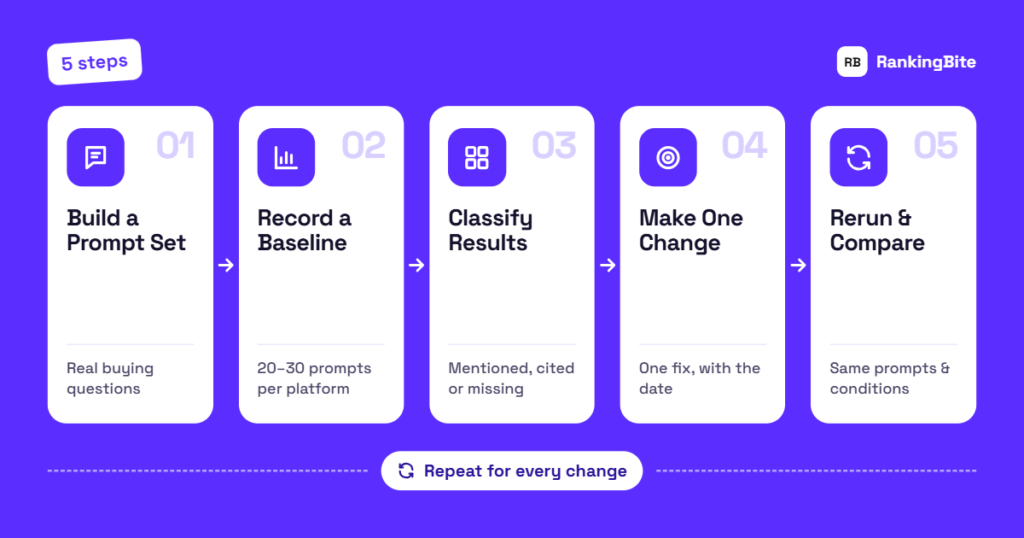
Run a repeatable test before and after each change, because one AI answer is not a trend. The test has five steps: build a prompt set, record a baseline, classify each result, make one targeted change, then rerun and compare.
Step 1: Build a Prompt Set
Use real buying questions, not only branded ones. Cover four prompt types. Example prompts for a project management platform:
- Category discovery: Which project management tools support remote software teams?
- Feature comparison: Compare tools that support time tracking, workload planning, and API access.
- Brand evaluation: What are the strengths and limitations of [Brand] for remote teams?
- Objection handling: Is [Brand] suitable for a 50-person company with strict security requirements?
Step 2: Record a Baseline
Keep test conditions identical so later results are comparable.
- Use fixed, word-for-word prompts.
- Run each prompt several times in separate sessions, from the same location.
- Log the date, platform, prompt, full response, named brands, cited URLs, and factual errors.
Run at least 20 to 30 prompts per platform before treating a pattern as real.
Step 3: Classify Each Result
Sort each AI answer by how it treats your brand, then trace it to the layer that needs work. Your brand can be:
- Mentioned
- Cited
- Recommended
- Missing while competitors appear
- Described inaccurately
Missing from category answers points to a Distribution problem. Wrong descriptions point to an Identity or Integrity problem.
Step 4: Make One Targeted Change
Fix one issue at a time so you can measure its impact.
- Content: Fill information gaps and answer relevant questions.
- Crawlability: Remove crawler restrictions and improve page accessibility.
- Brand accuracy: Correct outdated pricing, product details, and company information.
- Third-party presence: Build credible brand mentions across relevant platforms.
Record each change and the date you made it.
Step 5: Rerun and Compare
After AI platforms have had time to discover the change, rerun the same prompts under identical conditions. Then compare these four metrics against your baseline:
- Brand mention rate: How often AI answers mention your brand.
- Citation rate: How often AI answers cite your pages.
- Recommendation frequency: How often AI answers recommend your brand.
- Answer accuracy: Whether the brand information is correct.
How to Measure LLM Optimization Performance
| Metric | What it measures |
|---|---|
| Brand mention rate | Share of responses that name the brand |
| Citation rate | Share of responses that link to your domain |
| Citation relevance | Whether the cited page supports the specific claim |
| Answer accuracy | Whether capabilities, pricing, and positioning are correct |
| Query coverage | Which buyer questions include the brand |
| Competitor visibility | Which alternatives appear in the same answers |
| AI referral traffic | Visits arriving from AI platforms |
| Assisted conversions | Leads or revenue influenced by AI-originated sessions |
Keep each platform’s results separate. A brand can be cited without being recommended, or recommended without being cited.
What LLM Optimization Cannot Guarantee
LLMO improves the conditions for accurate visibility, but it cannot guarantee a specific recommendation, a citation in every answer, quick changes to training data, or identical answers across platforms. Treat it as an ongoing cycle, not a one-time fix.
Conclusion
RankingBite’s Five Layers give the work a structure: make your data accessible, protect the integrity of your facts, clarify your identity, sharpen your language, and extend your distribution. Repeatable prompt testing shows whether it is working.
AI answers will keep changing as platforms update their models, crawlers, and sources. Brands that stay accurate, accessible, and consistently described are the ones AI systems can rely on. Start with one layer, measure the result, and build from there.
Frequently Asked Questions
How can I optimize for ChatGPT?
Allow OAI-SearchBot to access the public pages you want considered, keep them clear, describe your business consistently, and test relevant prompts over time.
How long does LLM optimization take to work?
It depends on the issue. Removing a crawler block can work faster than building third-party coverage. Measure changes over weeks, not days, with a consistent prompt set.
Can LLMO make ChatGPT recommend my brand?
No. It can improve the clarity, accessibility, and accuracy of the information AI uses, but no one can guarantee a specific recommendation.