Learning how to optimize for AI Overviews and answer engines starts with one shift: AI systems cite passages, not pages. Make your site crawlable by AI systems, answer each question in the first 40 to 60 words under every heading, write self-contained passages, add original data, and build brand signals beyond your own website.
Search now has two layers. The first is the familiar list of blue links. The second is the AI-generated answer that sits above those links or replaces them: Google AI Overviews, ChatGPT search, Perplexity, and Microsoft Copilot. According to Conductor’s 2026 AEO/GEO Benchmarks Report, 25% of Google searches now generate an AI Overview, based on an analysis of 21.9 million queries.
This guide covers the complete AI Overview optimization process, including the crawler access, platform differences, and measurement steps that most guides skip.
Key Takeaways
- AI Overviews and answer engines select individual passages, so structure matters more than page length.
- Blocking the wrong crawler in robots.txt can remove your site from an entire AI platform.
- Every H2 should open with a direct 40- to 60-word answer.
- Original data and first-hand examples give AI systems a reason to cite you over competitors.
- Google Search Console does not separate AI Overview data, so visibility tracking needs prompt testing.
What Are AI Overviews and Answer Engines?
AI Overviews are Google’s AI-generated summaries that appear at the top of search results and cite multiple web sources. Answer engines are AI platforms such as ChatGPT, Perplexity, and Copilot that respond to questions with one synthesized answer instead of a ranked list of links.
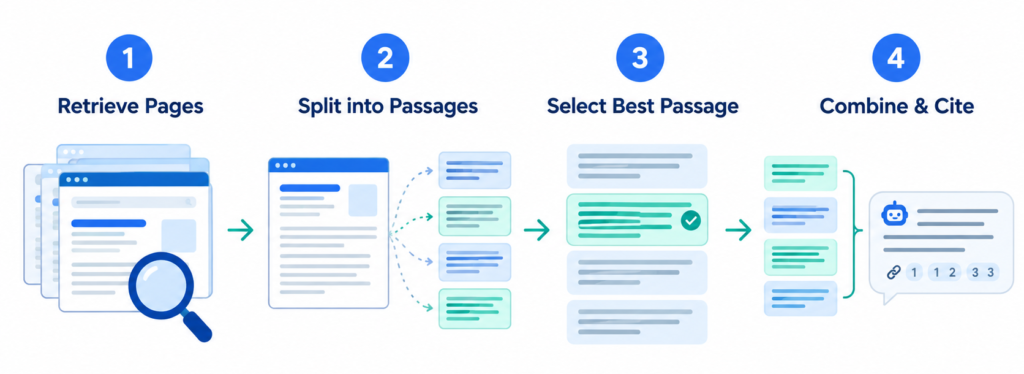
Both systems follow the same basic process:
- They retrieve pages relevant to the query from a search index.
- They split those pages into smaller passages.
- They select the passages that answer the question most clearly.
- They combine the selected passages into one response and cite the sources.
Optimizing for this process is called Answer Engine Optimization (AEO). The same practice is also called Generative Engine Optimization (GEO) or LLM optimization. All three terms share one goal: getting your content selected, cited, and represented accurately inside AI-generated answers.
How Is Answer Engine Optimization Different From SEO?
Traditional SEO earns a position in a ranked list. Answer engine optimization earns a citation inside a generated response. Both rely on search indexes, but AEO shifts the unit of competition from the whole page to the individual passage that answers a specific question.
| Factor | Traditional SEO | Answer Engine Optimization |
|---|---|---|
| Goal | Rank on page one | Get cited in the AI answer |
| Unit that competes | Whole page | Individual passage |
| Success metric | Rankings and clicks | Citations and brand mentions |
| Content style | Keyword-targeted | Answer-first and entity-rich |
| Authority signals | Backlinks | Backlinks, mentions, reviews, original data |
Rankings still matter, but they no longer decide visibility on their own. Conductor’s research shows that 57% of AI Overview citations come from outside the organic top 10. A clearly structured page ranking in position 15 can earn a citation over a vague page ranking in position 3.
How Do AI Platforms Choose Their Sources?
Each AI platform retrieves sources through a different crawler and search index. A page can appear in Google AI Overviews and stay invisible in Copilot if it is missing from Bing’s index. Knowing which system reads your site is the foundation of multi-platform AI visibility.
| Platform | Crawler or Index | What It Tends to Favor |
|---|---|---|
| Google AI Overviews | Googlebot and Google’s search index | Indexed, snippet-eligible pages with direct answers and strong E-E-A-T |
| ChatGPT Search | OAI-SearchBot plus third-party search providers | Conversational explanations and widely referenced brands |
| Perplexity | PerplexityBot and its own index | Fresh content, specific facts, and well-cited sources |
| Microsoft Copilot | Bing’s search index | Pages indexed in Bing with detailed, structured answers |
How to Optimize for AI Overviews and Answer Engines: 11 Steps
Optimizing for AI Overviews and answer engines follows a fixed order: technical access first, content structure second, and authority third. Skipping technical access makes every other step useless, because AI systems cannot cite pages they cannot crawl or index.
1. Make Your Pages Accessible to AI Crawlers
Check these settings before changing any content:
- Confirm your robots.txt file does not block Googlebot, Bingbot, OAI-SearchBot, or PerplexityBot.
- Separate training crawlers from search crawlers. Blocking GPTBot stops OpenAI from using your content for model training, but ChatGPT search uses OAI-SearchBot.
- Understand Google Extended correctly. It controls whether Google uses your content for Gemini training. It does not control AI Overviews, which use regular Googlebot crawling.
- Remove nosnippet tags from pages you want cited, since Google requires snippet eligibility for AI Overview inclusion.
- Submit your XML sitemap to Bing Webmaster Tools, because Copilot depends on Bing’s index.
- Render important content in HTML rather than relying only on JavaScript.
2. Match the Search Intent Behind Each Query
AI systems generate a different answer format for each type of intent. Match your page structure to the format the engine is likely to produce:
- Informational queries such as “what is AEO?” need a definition in the opening lines.
- How-to queries need numbered steps in logical order.
- Comparison queries such as “AEO vs SEO” need a side-by-side table.
- Commercial queries such as “best AEO tools” need criteria, options, and a clear verdict.
3. Lead Every Section With a Direct Answer
Place a 40- to 60-word answer directly under each H2. This passage must fully answer the heading’s question without relying on the rest of the section. AI systems extract opening passages far more often than content buried deeper in a section.
Write H2s as the questions your audience types into search. For example, change “Schema Markup” to “Does Schema Markup Help With AI Overviews?”
4. Write Self-Contained Passages
AI engines retrieve passages, not full articles, so every paragraph must make sense on its own:
- Name the subject directly instead of using “it” or “this” to refer to an earlier paragraph.
- Keep one idea per paragraph and limit paragraphs to three or four sentences.
- Remove phrases such as “as mentioned above,” which break when a passage is extracted.
5. Format Content for Easy Extraction
Structured formats are easier for AI systems to parse and quote. Use each format for the content it suits:
- Numbered lists for processes and ranked items
- Bullet lists for features, criteria, and non-sequential points
- Tables for comparisons, specifications, and pricing
- Bold lead-ins to highlight the key term in each list item
6. Define Entities Clearly
AI systems understand content through entities: brands, people, products, and concepts, along with the relationships between them. Strengthen entity signals with four practices:
- Define every key term the first time it appears.
- Use one consistent version of your brand name.
- State relationships between concepts explicitly, such as “AEO is a branch of search optimization focused on AI citations.”
- Link related pages on your site so the topic cluster is clear to crawlers.
7. Add Information Gain
AI systems have no reason to cite a page that repeats what every competitor already says. Information gain means adding something the existing top results do not offer:
- Original data from surveys, audits, or internal analysis
- First-hand results from testing a tactic on real pages
- Specific examples, screenshots, and worked cases
- A clear point of view on where common advice falls short
8. Implement Schema Markup
Schema markup tells AI systems what your content is and how its parts connect. These schema types support AI visibility most directly:
- Article with author name and publish date
- FAQPage for question-and-answer sections
- How-to for step-by-step guides
- Organization to connect your brand entity to your website
- Product and Review for commercial pages
Validate all markup using Google’s Rich Results Test before publishing.
9. Strengthen E-E-A-T Signals
AI engines favor trustworthy sources to reduce inaccurate answers. Every page should include:
- A named author with a bio that shows relevant experience
- A credible source for every statistic
- Original images instead of stock photos wherever possible
- A visible publish date and last-updated date
10. Keep Content Fresh
Outdated statistics and old advice reduce citation chances across every AI platform. Review high-value pages every three to six months, replace old data with current figures, and update the modified date only when the content changes meaningfully.
11. Build Authority Beyond Your Website
AI answers reflect how the wider web describes your brand, not only what your own site says. Build that external presence through:
- Mentions and links from respected industry publications
- Profiles on review platforms relevant to your industry
- Genuine participation in communities such as Reddit and Quora
- Consistent brand information across directories and social profiles
What Does an AI-Ready Rewrite Look Like?
An AI-ready passage states the answer immediately, includes specific actions, and makes sense without surrounding context. The difference between content AI ignores and content AI cites is usually structure, not expertise.
Before:
There are many different approaches that businesses can take when they are thinking about how to improve their visibility in the new AI-driven search experiences that are becoming more common across platforms.
After:
To improve visibility in AI search, answer the query in the first 40 to 60 words, write self-contained passages, and add original data. These three changes make content easier for AI systems to extract and cite.
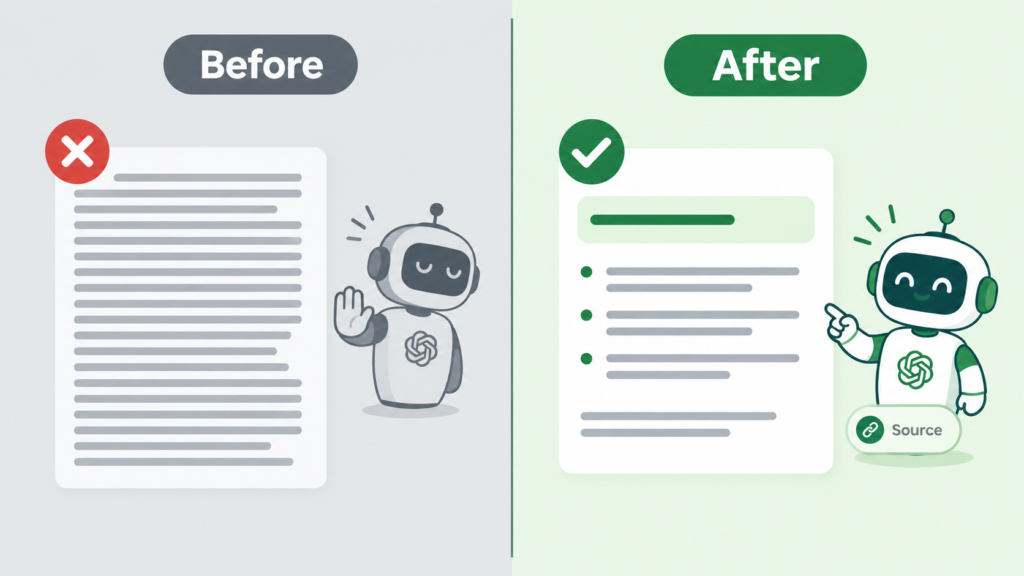
The rewritten version gives a complete answer in two sentences and works as a standalone passage.
How Do You Measure AI Visibility?
Google Search Console includes AI Overview impressions and clicks inside standard Web performance data but does not report them separately. Measuring AI visibility requires combining Search Console trends, referral traffic data, and direct prompt testing across each platform.
Follow this five-step measurement process:
- Build a prompt list. Write 20 to 50 questions your audience asks, using their real phrasing.
- Test prompts monthly. Run each prompt in Google, ChatGPT, Perplexity, and Copilot, then record whether your brand is cited, mentioned, or absent.
- Watch Search Console patterns. Rising impressions paired with falling clicks on informational queries often signal AI Overview absorption.
- Track AI referral traffic. In GA4, filter sessions from chatgpt.com, perplexity.ai, and copilot.microsoft.com.
- Scale with a tracking tool. Use a dedicated AI visibility platform once your prompt list grows beyond manual testing.
Which Mistakes Keep Content Out of AI Answers?
Most pages fail to earn AI citations because of technical blocks and weak structure, not a lack of topic knowledge. These are the most common mistakes:
- Blocking AI search crawlers in robots.txt without realizing it
- Burying the main answer below a long introduction
- Writing paragraphs that depend on earlier context
- Repeating the same advice every competitor already covers
- Publishing statistics without citing sources
- Ignoring Bing, which removes visibility in Copilot
- Skipping schema markup
AI Overview Optimization Checklist
Use this checklist before publishing any page you want cited in AI Overviews and answer engines.
| Area | What to Check |
|---|---|
| Crawl access | Googlebot, Bingbot, OAI-SearchBot, and PerplexityBot allowed |
| Indexing | Page indexed in Google and Bing, no nosnippet tag |
| Direct answers | 40 to 60 word answer under every H2 |
| Headings | Question-based H2s that match real searches |
| Passages | Every paragraph readable on its own |
| Formatting | Lists and tables used where content suits them |
| Entities | Key terms defined and brand name consistent |
| Information gain | At least one original data point or example |
| Schema | Article, FAQPage, and HowTo markup validated |
| E-E-A-T | Author bio, sourced statistics, visible dates |
| Freshness | Reviewed within the last six months |
| Measurement | The prompt list is tested monthly across four platforms |
Conclusion
Knowing how to optimize for AI Overviews and answer engines is now a core part of search visibility, not an add-on to SEO. Start with crawler access and indexing, then restructure content into answer-first, self-contained passages, and finish by building authority with original data and external mentions. Brands that follow this process give AI systems a clear reason to cite them across Google, ChatGPT, Perplexity, and Copilot.
Frequently Asked Questions
Can I stop my site from appearing in Google AI Overviews?
Yes. Adding a nosnippet directive removes a page from AI Overviews, but it also removes the text snippet from standard search results. Blocking Google Extended does not remove pages from AI Overviews, because it only controls Gemini model training.
Does ranking first on Google guarantee an AI Overview citation?
No. A top ranking improves the chances of being cited, but AI Overviews select passages based on how directly they answer the query. Well-structured pages ranking lower often earn citations over vague pages ranking higher.
Does an llms.txt file improve AI visibility?
Google has stated that it does not use llms.txt for AI Overviews or rankings. Adding the file causes no harm, but crawler access, content structure, and brand authority have a much larger impact on AI citations.
How long does it take to appear in AI answers after optimizing?
The timeline depends on how often each platform recrawls your pages. Frequently crawled sites see changes faster, while Google AI Overviews generally reflect updates only after Google recrawls and reindexes the page.
Can a small website compete with large brands in AI search?
Yes. AI systems select passages based on clarity and relevance, so a small website with a precise, original answer can be cited alongside large publishers. Niche expertise and original data are the strongest advantages for smaller sites.

Faijan waris
Hi, I'm Faijan, a passionate SEO and content strategist at RankingBite. I specialize in creating high-quality, SEO-optimized content that not only ranks on search engines but also resonates with readers. From compelling blog posts to engaging web copy, I craft every piece of content with purpose and precision. My goal is simple: to help brands tell their story, connect with their audience, and grow their digital presence through the power of words.