Owned citations vs. Earned citations is about understanding how AI answer engines evaluate trust. Owned citations help AI interpret your content and its relationships, while earned citations demonstrate that independent sources recognize your expertise. A strong AI citation strategy requires both.
This article explores how they work, where they come from, and why both are important for increasing your chances of being cited by AI answer engines.
According to Adobe, traffic from generative AI sources grew 3,500% between July 2024 and May 2025, showing why earning visibility across AI ecosystems has become increasingly important.
What Is an Owned Citation?
An owned citation is a reference to a source that appears within content you own and control. It is used to support a claim by linking to or citing another piece of content from your own website, such as a research report, case study, documentation, or related article.
Unlike earned citations, owned citations are created by your organization. They help AI answer engines understand how your content is connected, identify the original source of information, and retrieve supporting evidence from across your website.

Examples of Owned Citations
- Linking to your own research report
- Referencing another blog post on your website
- Citing an internal case study
- Linking to product documentation or help center articles
- Referencing proprietary data or original surveys
Why Owned Citations Matter for AI Search
Owned citations help AI systems:
- Connect related content across your website.
- Verify claims using your original source.
- Better understand your topical expertise.
- Retrieve supporting information more efficiently.
While owned citations strengthen your website’s knowledge structure, they don’t provide independent validation. AI answer engines still rely on trusted third-party sources to confirm credibility before citing information.
What Are Earned Citations?
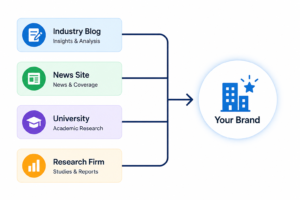
An earned citation is a reference to your brand, content, research, or data made by an independent third party. Because these citations come from external sources rather than your own website, they act as stronger trust signals for AI answer engines.
Earned citations indicate that other publishers, researchers, journalists, or industry experts consider your content reliable enough to reference. This external validation increases the confidence AI systems have when selecting sources for generated answers.
A 2025 study analyzing 167,551 AI citations across 128 brands found that 85.7% of AI citations came from third-party websites, while only 14.3% came from brand-owned websites, highlighting the importance of earning recognition beyond your own properties.
What Counts as Earned Citations?
Earned citations include references from:
- News publications
- Industry blogs
- Research organizations
- Academic journals
- Government websites
- Professional associations
- Review platforms
- Independent experts
Owned vs. Earned Citations: What’s the Difference?
Owned and earned citations work together to improve AI visibility, but they contribute in different ways. Owned citations help AI understand and connect your content, while earned citations provide external validation that strengthens trust and authority.
Quick Comparison
| Aspect | Owned Citation | Earned Citation |
|---|---|---|
| Definition | References within content you own. | References from independent third-party sources. |
| Control | Your organization. | External publishers or websites. |
| Purpose | Supports and connects your own content. | Validates your credibility. |
| Trust Signal | Self-verification. | Third-party verification. |
| Role in AI Search | Helps AI understand and retrieve your content. | Helps AI trust and cite your content. |
| Example | Linking to your own research or case study. | A news site or industry blog citing your research. |
| How to Build | Publish original content and use internal citations. | Earn citations through research, digital PR, and
expert contributions. |
How AI Uses Owned and Earned Citations Together
AI answer engines evaluate both owned citations and earned citations to understand, verify, and rank information. Owned citations provide context by connecting related information within your own content, while earned citations provide external validation that strengthens trust and authority.
Owned Citations Give AI Information
Owned citations help AI systems understand the relationship between your content pieces and identify your primary sources. By linking to your own research, case studies, documentation, or supporting pages, you create a clearer information structure for AI to retrieve.
However, owned citations mainly show what information your brand provides—they do not independently prove its credibility.
Earned Citations Confirm AI Can Trust It
Earned citations act as third-party validation. When trusted websites, publications, or experts reference your content, they signal that your information is recognized beyond your own platforms.
Earned citations strengthen three key signals:
- Trust: Independent sources show that your information is recognized and supported externally.
- Corroboration: Multiple reliable sources referencing similar information increase confidence in its accuracy.
- Authority: Consistent recognition from credible sources strengthens your brand’s expertise.

kashish
Passionate about SEO, AI search, and content marketing, sharing practical insights on search trends, AI visibility, and digital growth.