
AI can help produce a first draft in minutes, but many AI-written articles still feel easy to recognize. The writing may be grammatically correct, yet it often follows predictable patterns, repeats familiar phrases, and lacks the natural variation found in human writing.
Removing AI footprints means editing those machine-like patterns so the content reads naturally and reflects human judgment. Small changes in wording, structure, and sentence flow can make a significant difference.
This guide explains the common signs of AI-generated writing, practical ways to fix them, and a simple checklist to help with removing AI footprints and creating content that feels authentic and human.
Why AI-Written Content Often Feels Artificial
Most AI-generated content is grammatically correct and easy to understand, yet it can still feel unnatural. The reason is that AI predicts the most likely sequence of words based on patterns learned from large collections of text. As a result, many drafts follow similar sentence structures, repeat familiar expressions, and rely on safe, predictable wording. Removing AI footprints means identifying these recurring patterns and replacing them with writing that feels more natural and intentional.
Research in computational linguistics has shown that human and machine-generated text often differ in their linguistic patterns. Machine-generated writing tends to be more repetitive and formulaic, while human writing shows greater variation in vocabulary, sentence structure, and expression. These differences make AI-generated text recognizable, even without using an AI detector.
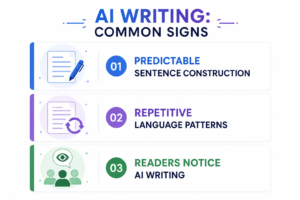
Predictable Sentence Construction
AI frequently builds sentences using the same structure, making paragraphs sound repetitive.
- AI-style
The platform improves productivity by helping teams collaborate more effectively.
- More natural
Teams use the platform to organize projects, share updates, and keep work moving without switching between multiple tools.
Repetitive Language Patterns
AI often repeats similar transitions, sentence openings, and phrasing throughout a draft. Even when the wording changes slightly, the overall rhythm stays the same, making the content feel less engaging.
- Less natural:
This feature helps teams stay organized. This feature also saves time. This feature improves accuracy. - More natural:
This feature keeps tasks organized in one place. Teams spend less time switching tools, and fewer details slip through the cracks.
The first version repeats “this feature” as a crutch. The second drops the subject once it’s established and lets each sentence do different work instead of restating the same one.
Why Readers Notice AI Writing Even Without AI Detectors
Most readers don’t need software to sense when writing feels artificial. Repeated sentence patterns, predictable phrasing, and generic language create a style that lacks the variety people naturally expect. Breaking these patterns is one of the simplest and most effective steps in removing AI footprints.
The Most Common AI Writing Tells
Many AI drafts share the same writing habits. Individually, these patterns may seem harmless, but when several appear together, the content starts to feel repetitive and mechanical. Removing AI footprints begins with recognizing these common tells and replacing them with more natural alternatives.
| AI Writing Tell | Why It Stands Out | Better Approach |
|---|---|---|
| Overused transition words | Frequent use of words like however, moreover, furthermore, and therefore creates an unnatural flow. | Use transitions only when they improve clarity or remove them entirely. |
| “It’s not X, it’s Y” pattern | This sentence structure appears repeatedly in AI-generated writing and becomes predictable. | State the point directly instead of using a contrast formula. |
| Excessive em dashes (—) | Overusing em dashes interrupts the reading flow and creates a recognizable AI style. | Split the idea into two sentences or use commas where appropriate. |
| Triple-list writing | AI often groups ideas into sets of three, making paragraphs feel formulaic. | Vary sentence structures and list lengths naturally. |
| Generic filler phrases | Phrases like it’s important to note, in today’s world, or when it comes to add words without adding value. | Remove the filler and begin with the main idea. |
| Repeated sentence openings | Starting several sentences the same way makes the writing sound repetitive. | Alternate sentence openings to create a more natural rhythm. |
| Overused intensifiers | Words like very, highly, extremely, and truly weaken the writing instead of strengthening it. | Replace them with more precise words or remove them entirely. |
Generic language often sounds polished but says very little. It relies on broad claims instead of concrete information, making the content less useful for readers and harder to interpret accurately. Removing AI footprints involves replacing vague wording with precise details that explain exactly what something is, does, or achieves.
Research in psycholinguistics and discourse comprehension has found that readers understand and remember information more effectively when it contains concrete rather than abstract language. Specific details reduce ambiguity, improve comprehension, and make written communication feel more credible and natural.
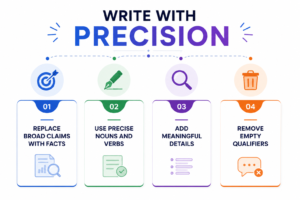
Replace Broad Claims with Facts
Instead of describing something as powerful, innovative, or effective, explain what makes it so using verifiable information.
Use Precise Nouns and Verbs
Strong nouns and verbs communicate ideas more clearly than vague adjectives and adverbs. They make sentences shorter while increasing clarity.
Add Meaningful Details
Include information that helps readers understand the topic without adding unnecessary words. Relevant facts, features, actions, or measurable details create stronger and more informative writing.
Remove Empty Qualifiers
Words such as very, really, quite, somewhat, and extremely rarely add value. Replacing them with more precise language makes the writing sound more confident and natural.
Edit Sentences for a Natural Rhythm
Natural writing doesn’t follow the same pattern from one sentence to the next. Some ideas are best expressed in a short sentence, while others need more explanation. AI-generated drafts often repeat similar sentence lengths and structures, creating a steady rhythm that feels mechanical. Removing AI footprints means introducing variation without making the writing difficult to read.
Mix Short and Long Sentences
Using sentences of different lengths creates a more natural flow.
- Less natural
The software is easy to use. It has many features. It helps teams collaborate. It improves productivity.
- More natural
The software is easy to use, even for first-time users. It combines collaboration tools, task management, and reporting in one place, helping teams stay organized without adding unnecessary complexity.
Change Repetitive Sentence Openings
Starting several sentences the same way makes a paragraph predictable.
- Less natural
The platform offers reporting tools. The platform includes automation features. The platform supports team collaboration.
- More natural
The platform offers reporting tools. Built-in automation reduces repetitive tasks, while collaboration features help teams work more efficiently.
Remove Unnecessary Repetition
Repeating the same words or ideas weakens the writing.
- Less natural
The application is fast. The application is reliable. The application is simple to use.
- More natural
The application combines speed, reliability, and an intuitive interface.
Read the Content Aloud
Reading your draft aloud helps identify awkward wording, repetitive patterns, and sentences that sound unnatural. If a sentence feels uncomfortable to say, it usually needs editing before publishing.
Build a Human Vocabulary
The words you choose influence how natural your writing feels. AI-generated drafts often rely on the same phrases and formal expressions, making different articles sound alike. Removing AI footprints involves replacing predictable wording with language that is clear, direct, and appropriate for your audience.
- Replace overused phrases
- Leverage → Use
- Utilize → Use
- Facilitate → Help
- Avoid empty intensifiers
- Very useful → Useful
- Highly effective → Effective
- Choose precise words
- Good results → Higher conversions
- Many features → Task automation, reporting, and collaboration
- Write the way people naturally speak
- Less natural: It is important to note that this tool offers several benefits.
- More natural: This tool offers several useful features.
Before-and-After Editing Examples
A full rewrite isn’t usually necessary. Most of the work is finding the handful of patterns that make a draft feel automated, then swapping them for choices that sound specific and considered.
The examples below show how small changes can make AI-assisted drafts feel more like human-written content.
Product Description
- Before:
Experience the ultimate solution for all your skincare needs. Our innovative product is designed to provide exceptional results and deliver a seamless experience for users looking for healthier and glowing skin.
- After:
This lightweight moisturizer helps keep skin hydrated without leaving a sticky finish. Its formula absorbs quickly and works well for daily use, especially when your skin feels dry after cleansing.
What changed:
- Removed exaggerated phrases like “ultimate solution” and “exceptional results.”
- Added clear product details.
- Focused on what the user actually experiences.
LinkedIn Post
- Before:
Success is not just about working harder; it’s about working smarter. In today’s fast-paced world, professionals need to adapt, innovate, and embrace new opportunities to achieve growth.
- After:
A few months ago, I started learning digital marketing alongside my regular studies. The biggest lesson has been that progress comes from practicing small skills consistently, not from trying to master everything at once.
What changed:
- Removed common motivational patterns.
- Added personal experience.
- Replaced generic advice with a specific situation.
Quick Checklist to Remove AI Footprints
Before publishing AI-assisted content, review it using this checklist to make sure it sounds natural, useful, and written for real readers.
- Replace generic phrases with specific details
Avoid vague statements like “improves efficiency” or “provides great results.” Add examples, numbers, situations, or clear explanations. - Remove repeated sentence patterns
AI writing often follows similar structures. Mix short and long sentences to create a more natural flow. - Cut unnecessary filler transitions
Words like “furthermore,” “moreover,” and “in today’s digital world” can make content feel predictable. Use them only when they add meaning. - Avoid overused AI phrases
Replace common expressions like “not just X, but Y” or “plays a crucial role” with direct explanations. - Break triple-listing habits
Instead of forcing three points into every sentence, include only the details that support the idea. - Add human perspective
Include examples, observations, opinions, or experiences where appropriate. - Check sentence tone
Make sure the writing sounds like a person explaining something, not a machine summarizing information. - Review facts and claims
Remove exaggerated statements and make sure every claim is accurate and supported.
A final read-through from the perspective of a real reader can reveal sentences that feel too polished, predictable, or disconnected. The goal is not to hide AI assistance but to create content that feels clear, useful, and genuinely written.
Frequently Asked Questions
- Can AI-generated content be made to sound human?
Yes, Editing the structure, adding specific details, removing repetitive patterns, and including human perspectives can make AI-assisted content feel more natural.
- Does removing AI footprints mean rewriting everything?
No, Small edits like improving wording, adding examples, and changing sentence patterns can often make a major difference.
- Are AI writing patterns easy to identify?
Yes, Common signs include generic wording, repeated sentence structures, excessive transitions, and predictable phrases.
- Should I avoid using AI for content creation?
No, AI can help with research and drafting, but human editing is needed to add accuracy, experience, and originality.
- Can AI detectors identify all AI-written content?
No, AI detection tools are not always accurate and can produce incorrect results. Quality, usefulness, and authenticity matter more than trying to pass a detector.
Conclusion
AI drafts give writers a useful starting point. The work of editing them adds what a first pass usually lacks: real context, a specific point of view, the small judgment calls a person makes without thinking about it.
That means swapping a generic phrase for a specific one, breaking up a run of same-sounding sentences, and pulling examples from something that actually happened instead of inventing one to fill space.
None of that requires hiding that AI helped write the draft. It requires putting in the parts AI can’t supply on its own.
