Most content teams already have a library of published pages that contain useful information, research, and expertise. The challenge is that many of these pages were created for traditional search and readers, not for systems that need to quickly understand, extract, and present information.
To repurpose existing content for AI, teams do not always need to create new articles from scratch. Small changes such as improving structure, adding missing context, strengthening sources, and making information easier to identify can increase the value of existing pages.
This guide explains how to review and update existing content for AI search. It focuses on practical improvements that help pages become clearer, more complete, and easier to understand while keeping the original information and purpose intact.
Audit Existing Content for AI Search Opportunities
Before making changes, start by identifying which existing pages have the strongest potential for improvement. Not every article needs a complete update. The goal is to find content that already provides value but has gaps that limit how effectively it can be understood and used.
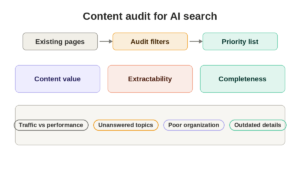
Look for pages that:
- Already receive traffic, engagement, or backlinks but are not performing as expected.
- Cover important topics but lack clear answers or structured information.
- Contain valuable insights that are difficult to find because of weak organization.
- Have outdated references, missing details, or incomplete topic coverage.
A useful audit focuses on three areas:
Content value: Does the page provide accurate and useful information that is worth improving?
Extractability: Can important information be easily identified, or is it hidden inside long explanations?
Completeness: Does the page answer the main questions users have about the topic?
For example, an existing article explaining a process may already have detailed steps, but the key definition, important entities, or supporting facts may be difficult to locate. Instead of creating a new page, restructuring and improving the existing one can make the information more accessible.
A focused audit helps teams spend time on pages where small updates can create meaningful improvements rather than rewriting content that already works.
Restructure Pages Around Direct Answers
Many existing pages contain valuable information but place the most important answer too far into the content. When information is buried under long introductions or broad explanations, it becomes harder for both readers and AI systems to identify the main point quickly.
Start by reviewing the opening section of the page. The first few lines should clearly explain the main topic, definition, or solution before moving into supporting details.
For example:
- Before:
“Businesses today face many challenges when managing their online presence. Different strategies and approaches can help improve performance over time…” - After:
“Content optimization improves how information is structured, updated, and presented so users can find clear answers faster.”
The second version provides the core answer immediately and then allows the rest of the page to expand on the details.
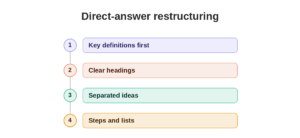
When restructuring existing content:
- Move key definitions and conclusions closer to the beginning.
- Use headings that clearly describe the information covered in each section.
- Separate different ideas instead of combining multiple topics into long paragraphs.
- Turn complex explanations into steps, lists, or clearly organized sections where useful.
The goal is not to shorten the content or remove depth. It is to make important information easier to locate while keeping the expertise and detail that make the page valuable. A well-structured page helps readers understand the topic faster and gives AI systems clearer information to work with.
Add Entity and Attribute Details to Existing Pages
Existing pages often mention important topics without clearly explaining their details. Adding entity and attribute information helps make the content more specific and easier to understand.
Improve existing content by:
- Defining key entities: Clearly explain important tools, concepts, companies, people, or processes.
- Adding attributes: Include details such as features, functions, categories, use cases, or limitations.
- Replacing vague statements: Change broad claims into specific, meaningful information.
- Connecting related information: Show relationships between entities to create better topic understanding.
Example:
- Before:
“This tool helps businesses improve marketing.” - After:
“This email marketing tool helps small businesses automate campaigns, track customer engagement, and manage subscriber lists.”
Adding these details makes existing content more complete without unnecessary expansion.
Build FAQ Sections from Existing Content Gaps
Existing content often answers user questions indirectly, but those answers may be difficult to find. Adding relevant FAQs helps organize information around the specific questions people search for.
Find Questions Hidden Inside Existing Content
Review the page and identify topics where readers may need more explanation. Sections that explain a process, feature, or concept can often be converted into direct questions.
Create Clear, Self-Contained Answers
Each FAQ should answer one specific question without requiring users to read multiple sections for context. Keep responses concise while including the necessary details.
Fill Missing Information Gaps
Add FAQs for important questions the page does not currently address. Focus on real user concerns rather than adding questions only for keywords.
A well-built FAQ section strengthens existing content by making important answers easier to discover and understand.
Refresh Evidence and Source Quality
Existing content can become less reliable when facts, examples, and references become outdated. Refreshing evidence helps maintain accuracy and improves the overall strength of the page.
- Update outdated information: Replace old statistics, examples, and references with current and relevant information.
- Review existing sources: Check whether cited sources are still accurate, accessible, and trustworthy.
- Add stronger references: Support important claims with original research, official documents, studies, or credible publications.
- Improve source context: Explain how the source supports the information instead of adding references without explanation.
- Remove unsupported claims: Review statements that lack evidence and either support them or rewrite them.
Refreshing evidence keeps existing content accurate while making it more dependable for readers and information systems.
Improve Content Clarity Without Expanding Length
Improving an existing page does not always mean adding more information. In many cases, better clarity comes from organizing what is already available and removing elements that make the content harder to understand.
Remove Information Overload
Review the page for:
- Repeated explanations covering the same idea.
- Long sections that can be simplified.
- Details that do not support the main topic.
Make Key Information Easier to Find
Improve visibility by:
- Placing important points in the right sections.
- Using descriptive headings.
- Separating different ideas instead of combining them.
Replace General Statements With Clear Details
Weak statements can reduce understanding. Update them by adding specific explanations, examples, or supporting details where needed.
The goal is to make existing content more focused and useful without increasing its length unnecessarily.
Before and After Repurposing Examples
Practical changes are often easier to understand when the difference between the original content and the improved version is clear. Repurposing focuses on improving structure, clarity, and information quality without creating a completely new page.
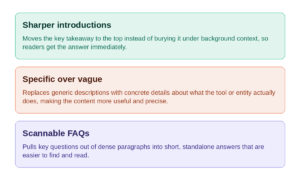
Example 1: Improving the Introduction
- Before:
The page starts with a broad background explanation and delays the main answer. - After:
The introduction immediately explains the topic, provides the key takeaway, and then expands with supporting details.
Example 2: Specific Over Vague
- Before:
“This tool helps companies manage their marketing activities.” - After:
“This marketing tool helps companies automate email campaigns, monitor customer interactions, and organize audience data.”
The updated version provides clearer information about the entity and its purpose.
Example 3: Creating Direct FAQ Answers
- Before:
Important questions are answered within long paragraphs. - After:
Common questions are separated into FAQs with short, direct answers that are easier to find.
These small improvements can increase the usefulness of existing pages without requiring a full rewrite.
Content Transformation Process
To repurpose content for AI, teams can improve what is already available instead of creating a new page from the beginning. The process focuses on making existing information clearer, more structured, and more useful while keeping the original value of the content.
Review Existing Content
Start by analyzing the current page to identify valuable information, missing details, and areas that need improvement.
Improve Information Structure
Reorganize the content so important points are easier to find. Strengthen sections, add missing context, and create a clearer flow.
Enhance Content Completeness
Add necessary details, updated references, and supporting information to make the page more accurate and valuable.
Refine for Better Understanding
Remove unnecessary complexity and ensure the content communicates ideas clearly without increasing length.
A structured transformation process helps teams repurpose content for AI while getting more value from existing pages and maintaining the original expertise and purpose of the content.
FAQs
- Can multiple content pieces be combined into one page?
Yes, related content can be merged when separate pages cover overlapping information.
- Is repurposing useful for outdated evergreen content?
Yes, evergreen content can gain more value when its information is refreshed and reorganized.
- Can repurposed content support other marketing channels?
Yes, updated content can be adapted for newsletters, social posts, and other formats.
- Does repurposing remove the need for new content?
No, it works alongside new content creation by maximizing existing resources.
- Is content repurposing limited to written articles?
No, videos, reports, guides, and other formats can also be transformed into useful content.
