Self-contained content chunks are structured so that each important passage retains its meaning even when it is retrieved separately from the rest of the page. They explicitly identify the subject, communicate the main claim, and preserve the context needed to interpret that claim without relying on surrounding paragraphs.
This matters because content is not always consumed in the sequence in which it was written. A retrieval system may surface a paragraph, sentence, or subsection without the heading or explanation that originally introduced it. If that passage depends on earlier text for its subject, definitions, timeframe, or references, its meaning can become incomplete or ambiguous.
The solution is not to repeat the entire article inside every section. Instead, each important chunk should carry the minimum context required to stand on its own. This makes the information easier to understand when extracted, quoted, summarized, or presented independently from the original page.
What Is a Content Chunk?
A content chunk is a logically complete unit of information that communicates a specific idea without requiring the reader to reconstruct its meaning from nearby text. It can be a paragraph, subsection, definition, explanation, or other bounded piece of content.
Content Chunk vs. Context-Dependent Passage
A self-contained chunk identifies what it is discussing and communicates its main point directly. A context-dependent passage assumes the reader has already seen something else.
For example, “This increased adoption by 18%” depends on earlier text to identify what “this” refers to. “The new passwordless authentication feature increased adoption by 18%” carries the subject and claim within the passage itself.
What Makes a Chunk Self-Contained?
A self-contained chunk generally includes four elements:
- Subject: What entity, concept, or process is being discussed.
- Context: The information needed to interpret the statement.
- Claim: The specific fact, explanation, or conclusion being communicated.
- Relevant reference: A source, condition, timeframe, or other detail when it materially affects interpretation.
The goal is not to make every passage exhaustive. It is to ensure that removing the surrounding page does not remove information essential to understanding the passage.
Once a chunk is defined, the next question is why otherwise clear content can lose meaning when retrieved independently.
Why Content Loses Context During Retrieval
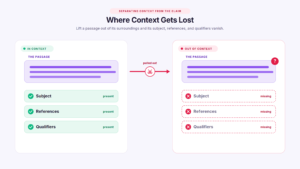
Content can lose meaning when a retrieved passage is separated from the text that originally explained it. The problem is usually not that the sentence itself is incorrect, but that essential information exists elsewhere on the page.
When Context or References Are Missing
A retrieved passage can be grammatically complete yet unclear when it depends on information from earlier text. Phrases such as “this approach,” “it,” “they,” or “the platform” may refer to something that is no longer present, leaving the reader unsure what they mean. Self-contained chunks should therefore name the subject, action, and relevant context directly instead of relying on surrounding paragraphs.
When Claims Lose Their Subject
A factual claim can also become unclear when its subject, timeframe, location, or scope exists outside the retrieved passage. “Reported a 32% increase in attacks” leaves open who reported it, what experienced the increase, and during which period.
Preserving these details keeps a claim interpretable even when the passage is separated from its original location.
How to Make Each Content Chunk Self-Contained
Making a chunk self-contained means placing the information necessary for interpretation inside the chunk itself. The aim is not maximum detail, but sufficient context without unnecessary repetition.
State the Subject Explicitly
Name the entity, concept, product, process, or organization being discussed. Replace vague openings with direct statements when the subject could otherwise depend on an earlier paragraph.
Instead of “It reduced processing time,” write “The automated data-validation process reduced processing time.”
Add Only the Context Needed for Meaning
Include the background required to understand the claim, but leave out information that does not affect its interpretation. A chunk should answer the immediate “what is this about?” question without becoming a duplicate of the surrounding article.
Define Terms Before Using Them
If understanding the statement requires a specialized term, abbreviation, or concept, provide its meaning within the relevant chunk. This prevents readers from having to retrieve an earlier definition before interpreting the passage.
For example, instead of introducing “RAG” without explanation, identify it as retrieval-augmented generation when the term first becomes necessary to the point being made.
Make References Explicit
Replace references that depend on surrounding text with the entity or concept they describe. “This method improves accuracy” is weaker when the method is defined elsewhere; “Retrieval-augmented generation improves answer accuracy by supplying relevant external information” makes the relationship explicit.
The practical standard is simple: if removing the surrounding paragraphs makes a necessary reference unclear, that reference belongs inside the chunk.
The Essential Context Inside a Content Chunk
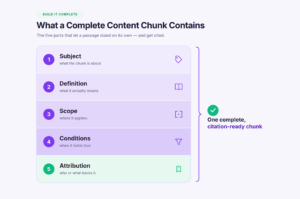
A self-contained chunk does not need to contain every detail from the surrounding article. It needs the specific information that determines how its claim should be understood. The required context can vary by topic, but four elements commonly matter.
Subject and Entity Context
Identify the main entity and explain its relevant relationship to the claim. This makes clear who or what the statement concerns instead of leaving the subject to surrounding text.
Definitions and Scope
Clarify terms that are necessary to understand the statement and define the boundaries of the claim when they matter. Scope can include the population, process, feature, or category covered by the statement.
Time, Conditions, and Qualifiers
Preserve dates, conditions, limitations, exceptions, or other qualifiers that can change the meaning of a claim. A result from 2025, for example, should not appear as though it describes an unspecified or current period.
References and Attribution
Keep the relevant source or attribution with the claim when it is needed to establish where the information comes from or how it can be verified. This may include a study, organization, dataset, report, or named source.
How to Set Effective Content Chunk Boundaries
A useful chunk is not defined by a fixed word count. Its boundary should follow the information being communicated. Keep material together when the ideas depend on one another, and create a new chunk when the informational purpose changes.
Separate Distinct Information Needs
A single chunk should not try to answer several unrelated questions at once. If one passage explains what a technology is and another explains how to implement it, separating them creates clearer informational units that can serve different retrieval needs.
Keep Closely Related Information Together
Information that directly supports the same idea should remain within the same chunk. A definition, its immediate explanation, and a condition that changes how it applies may belong together when separating them would fragment the idea.
Split When the Topic or Purpose Changes
A natural boundary appears when the content moves to a different concept, entity, question, or task. For example, a section explaining how an API works can become a separate chunk from one discussing its security risks.
Avoid Splitting Connected Claims
Do not divide information simply to create shorter chunks. If a result depends on a condition, exception, comparison, or explanation immediately attached to it, keeping those elements together preserves the relationship between them.
Designing Chunk Structure for Different Content Types
Different types of information have different structural relationships. A statistical finding does not need the same structure as a process or a conceptual explanation. Chunk design should reflect what the content is trying to communicate.
Factual and Statistical Content
A data-focused chunk should connect the measured subject with the finding and the relevant dataset, period, or population. This keeps the result tied to the conditions under which it was observed.
Definitions and Explanations
A conceptual chunk can introduce the term and explain its meaning, function, or distinction from related concepts. The structure should help the reader understand the concept without requiring a separate explanatory passage.
Processes and Procedures
A process-oriented chunk should preserve the relationship between the action, its purpose, and any important sequence or condition. Steps that depend directly on one another should not be separated arbitrarily.
Comparisons and Evaluations
A comparison chunk should make the entities and comparison dimension explicit. For example, a statement about performance should identify what is being compared and the specific performance factor being discussed, rather than assuming that context from another section will remain available.
Conclusion
Self-contained content is ultimately about preserving meaning when information moves away from its original location. A well-structured chunk should remain useful whether it is read within the full article, surfaced independently, or combined with information from another source.
The key is to treat each important section as a meaningful unit rather than simply dividing a page into arbitrary blocks. When chunk boundaries follow the logic of the information, the content becomes easier to interpret, reuse, and connect with related information.
Frequently Asked Questions
Does content chunking require a fixed word count?
No. A useful chunk can be short or long depending on the complexity of the information. Its boundary should follow the idea being communicated rather than an arbitrary word limit.
Can the same content belong to more than one chunk?
Yes, when a piece of information is relevant to multiple distinct concepts. However, unnecessary duplication can make a page harder to maintain and should be avoided.
Should every webpage use the same chunk structure?
No. A documentation page, research article, product page, and comparison guide may require different chunk structures because their information relationships are different.
Can content chunks overlap with each other?
They can share closely related information when necessary, but excessive overlap can blur the purpose of individual chunks. Each chunk should have a clear informational role.
Does chunking change how long an article should be?
Not necessarily. Chunking concerns how information is organized, not whether an article should be short or long. A long article can contain well-defined chunks, while a short article can still have poorly separated information.
How should chunk boundaries be handled in frequently updated content?
Keep boundaries aligned with stable ideas or information units rather than temporary wording. This makes individual sections easier to update without restructuring unrelated content.

kashish
Passionate about SEO, AI search, and content marketing, sharing practical insights on search trends, AI visibility, and digital growth.