Search Everywhere Optimization is the practice of building brand visibility across every platform where an audience searches, not just Google. It applies the same goal traditional SEO has always had, being the answer when someone asks a question, to AI assistants, video platforms, community forums, and marketplaces.
Search behavior has changed. People no longer rely only on Google to find answers, compare products, or discover brands. They now ask AI assistants, watch YouTube videos, browse Reddit discussions, search on TikTok, and explore marketplaces before making a decision.
Because discovery happens across multiple platforms, visibility can no longer depend on Google rankings alone. Search Everywhere Optimization expands traditional SEO by helping brands become discoverable wherever their audience searches. The goal is not to replace Google SEO but to build consistent visibility, trust, and authority across every search surface that influences buying decisions.
What is Search Everywhere Optimization?
Search Everywhere Optimization is the discipline of making a brand findable, citable, and trustworthy across the full set of channels people now use to search: Google, AI assistants like ChatGPT and Perplexity, YouTube, Reddit, TikTok, Pinterest, marketplaces, and voice assistants.
Each platform has its own ranking mechanics, but the underlying entity being optimized is the same one: the brand and the topics it owns.
How People Search
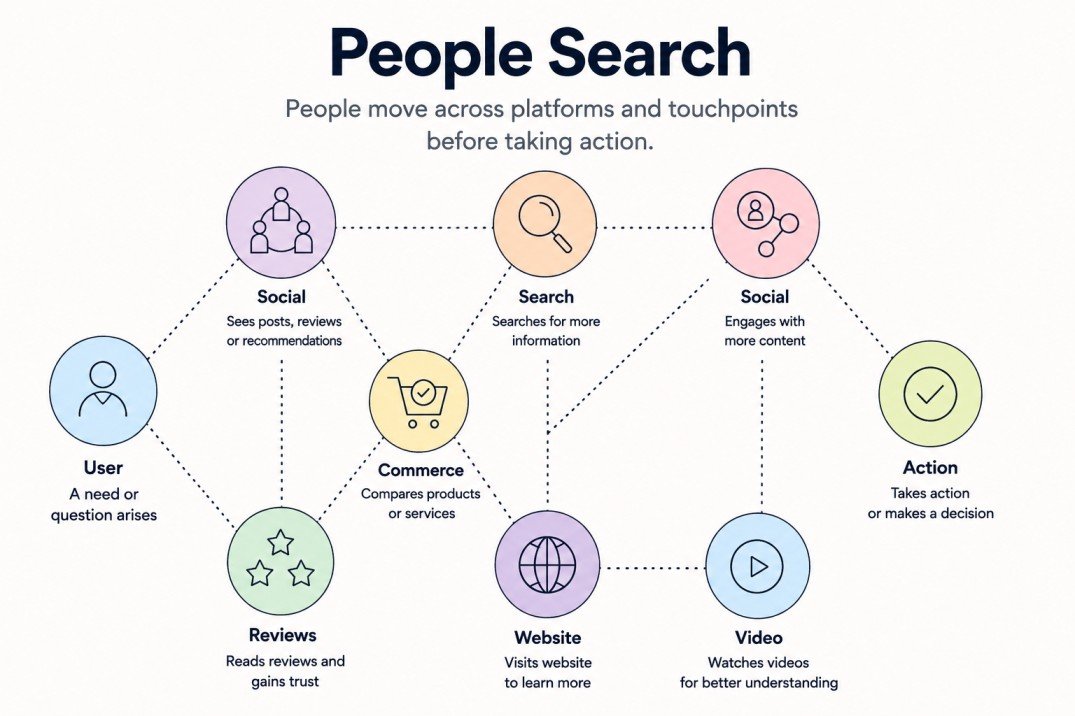
Search used to mean typing a query into Google and scanning ten blue links. That single-path model still exists, but it now sits alongside several others.
A person comparing laptops might ask ChatGPT for a shortlist, watch a YouTube review, check Reddit for owner complaints, and only then search the brand name on Google to buy. The path is no longer linear or single-platform, which is exactly the behavior shift Search Everywhere Optimization is built to address.
How is Search Everywhere Optimization Different From Traditional SEO, GEO, AEO, and LLMO?
Traditional SEO asks how a page ranks higher on Google. Search Everywhere Optimization asks where an audience is actually looking and how a brand shows up there.
Generative Engine Optimization, Answer Engine Optimization, and LLM Optimization describe the AI-assistant slice of that larger question. They are not separate disciplines from SEO. They are the same fundamentals of brand authority, comprehensive content, and extractable structure, applied to a new surface.
What Traditional SEO Optimizes For
Traditional SEO optimizes for ranking a URL in a list of results, earning a top-10 position so a searcher clicks through to the page itself. The signals it relies on, keywords, backlinks, on-page structure, page experience, all exist to prove that one page is the best match for one exact query, and success is measured by click-through rate, organic traffic, and ranking position.
What GEO, AEO, and LLMO Actually Mean
GEO, AEO, and LLMO each describe how a brand gets cited inside an AI-generated answer rather than ranked in a list of links.
The mechanics driving that citation, authoritative mentions, comprehensive content, and clearly structured facts, are extensions of long-standing SEO fundamentals rather than a new playbook.
Where Does Search Happen Now?
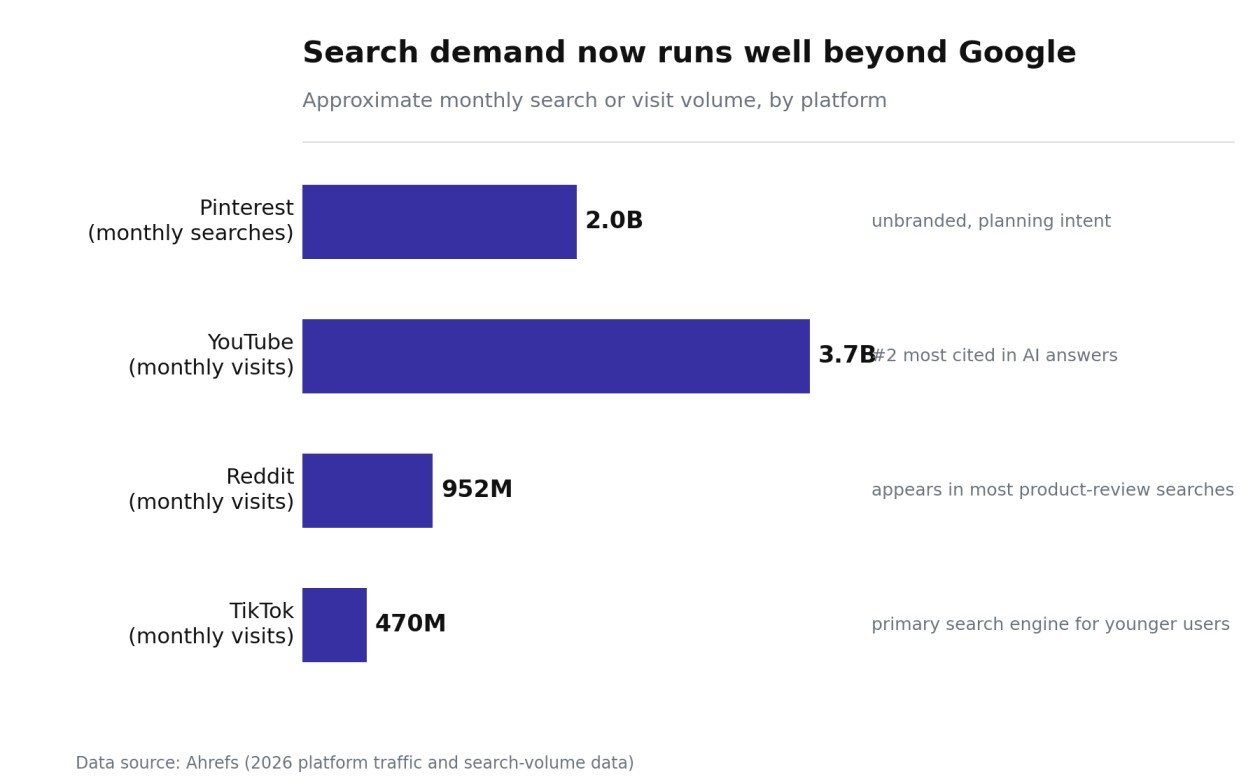
Search now happens across at least six distinct environments, each carrying measurable search demand of its own. A buyer often moves through several of these before ever typing a brand’s name into Google.
AI Assistants
AI-driven traffic to websites has grown roughly 9.7x in the past year, with ChatGPT alone reaching 500 million weekly users by April 2025. Visibility here comes from third-party citations rather than direct visits.
YouTube
YouTube carries close to 3.7 billion monthly organic visits, and viewers are far more likely to watch a tutorial than read the same instructions. See the dedicated YouTube visibility guide for the full platform playbook.
Reddit generates roughly 952 million monthly organic visits and appears in a large majority of Google’s product-review searches. See the dedicated Reddit visibility guide for the full platform playbook.
TikTok
TikTok draws around 470 million visits and functions as a search engine in its own right for a large share of Gen Z users researching product reviews.
Pinterest handles roughly 2 billion monthly searches, most of them unbranded, and serves as where users plan a decision rather than make one immediately.
Marketplaces and Voice Search
Amazon and other marketplaces run closed search engines ranking listings by conversion signals rather than backlinks. Voice assistants return one answer instead of a ranked list, which raises the stakes for local, “near me” visibility. See the dedicated local search guide for the full playbook.
How Does Search Everywhere Optimization Connect Back to Google?
None of these platforms operate independently of Google. YouTube videos rank in Google’s top ten results for billions of keywords. Reddit threads do the same for an even larger keyword set. Visibility built on those platforms often shows up inside Google itself.
AI assistants compound this further. When ChatGPT grounds an answer in live search, the sources it pulls frequently overlap heavily with Google’s own top results. A product discovered on TikTok, researched on YouTube, and validated on Reddit typically ends in a branded Google search anyway, which makes Search Everywhere Optimization a way of feeding Google rather than replacing it.
What are the Core Pillars of a Search Everywhere Optimization Strategy?
A working Search Everywhere Optimization strategy rests on four pillars, and skipping any one of them leaves a gap a competitor can fill on that specific platform. Together they cover how a brand defines itself, how it produces content, how it earns trust, and how it measures the result across every surface listed above.
Entity Clarity
Every platform needs an unambiguous, consistent description of what a brand is, what it does, and how it relates to its category, stated the same way everywhere it appears.
Format-Matched Content
The same core information gets rebuilt in the format each platform rewards: a written explainer for Google, a demonstration video for YouTube, a native community post for Reddit, a short vertical video for TikTok, a visual board for Pinterest.
Trust and Proof Signals
Reviews, citations, and independent mentions function as the modern equivalent of backlinks. AI assistants in particular weight third-party validation heavily when deciding what to cite, often more heavily than a brand’s own site.
Cross-Platform Measurement
A strategy only holds if it tracks AI citation rate, video watch-through, community mentions, and marketplace conversion alongside classic keyword rankings, rather than treating Google as the only scoreboard.
Which Platform Fits Which Product or Business Model?
| Product or Service Type | Best-Performing Channels | Why It Works |
|---|---|---|
| Complex or High-Ticket (B2B software, enterprise services) |
Google, YouTube, LinkedIn | Buyers need detailed information and want to build trust before making a large purchasing decision. |
| Visual or Lifestyle (Fashion, home decor, food, travel) |
Instagram, Pinterest, TikTok | Discovery happens through visual browsing and inspiration instead of traditional keyword searches. |
| Local Services (Restaurants, healthcare, home repair) |
Google Business Profile, Voice Search, Local Social | People search using “near me” queries and rely heavily on local search visibility. |
| Trending or Impulse Purchases (Beauty, gadgets, wellness) |
TikTok, Instagram Reels, Influencer Content | Spontaneous discovery encourages immediate action rather than lengthy research. |
How Do You Build a Search Everywhere Optimization Strategy?
- Start with the audience, not the platform. Interview customers or mine support tickets and sales calls to find which platforms come up before a brand is ever mentioned by name.
- Audit current visibility on each platform. Search core topics inside ChatGPT and Perplexity, YouTube, TikTok, Reddit, and relevant marketplaces to see what currently surfaces.
- Define the entity clearly and consistently. Publish the same unambiguous description of the brand and its category across every platform profile and piece of content.
- Produce format-native content for each priority platform. Match the format to the platform: written pages for Google, demonstration video for YouTube, native discussion for Reddit.
- Build proof. Earn reviews, participate genuinely in community discussion, and secure third-party mentions that AI systems and platform algorithms can cite.
- Instrument measurement across the full footprint. Track AI mentions, AI citation rate, video performance, and marketplace conversion on one shared view, not siloed per channel.
How Do You Measure Search Everywhere Optimization Success?
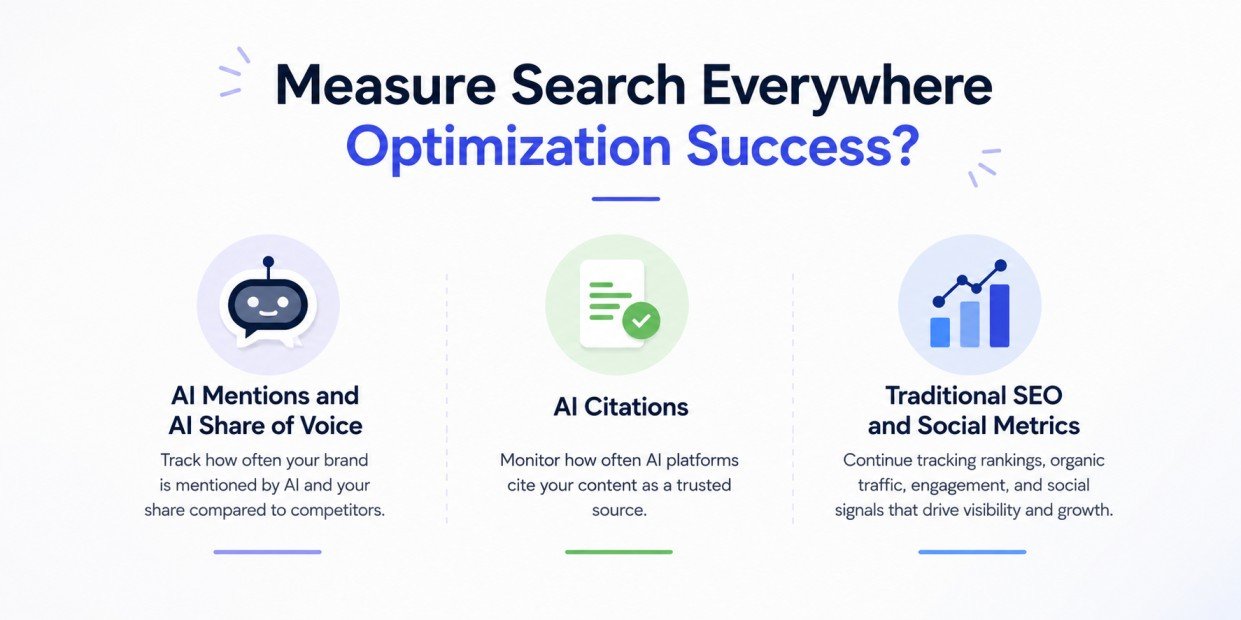
Success shows up across three types of signals: how often AI systems mention a brand, how often they cite it as a source, and how the classic SEO and social metrics move alongside those newer numbers.
AI Mentions and AI Share of Voice
AI mentions count how often a brand appears inside AI assistant answers, whether or not the answer links back to the brand’s site. AI share of voice compares that mention frequency against competitors within the same topic, which shows relative visibility even when raw traffic stays flat.
AI Citations
AI citations track the specific instances where a brand’s content is referenced as a source inside an AI-generated answer. Since a large share of AI mentions carry no link back to the source, citation tracking matters even when it does not translate directly into referral traffic.
Traditional SEO and Social Metrics
Keyword rankings, organic traffic, backlinks, and domain authority still measure Google performance, and follower growth, watch time, and engagement still measure platform-native performance. Search Everywhere Optimization adds AI-specific metrics on top of these rather than replacing them.
What Mistakes Should You Avoid?
The most common mistake is publishing the same piece of content across every platform without reformatting it, which fails on all of them at once because each platform penalizes content that ignores its native format.
The second mistake is inconsistent entity description. A brand that defines itself differently on its website, its YouTube channel, and its Amazon listing gives every platform a reason to trust it less, since inconsistency itself reads as a weak trust signal.
The third mistake is measuring only Google rankings. That metric is easiest to track and easiest to default to, but ignoring AI citation rate and community sentiment misses the exact channels driving the shift this strategy exists to address.
Search Everywhere Optimization as a Content Network
Search Everywhere Optimization works as a system, not a single tactic. The topics inside it, AI visibility audits, coverage-gap analysis, and platform-specific measurement, function best as a connected network rather than standalone pieces.
A brand that treats entity clarity, format-matched content, trust signals, and cross-platform measurement as one coordinated build earns compounding visibility across every surface covered above, not isolated wins on any single one.
Search Everywhere Optimization FAQ
1.Does Search Everywhere Optimization replace traditional SEO?
No. It adds AI assistants, video, community, and marketplace visibility on top of traditional SEO rather than replacing it, since platforms like YouTube and Reddit still rank inside Google’s own results.
2.Is Search Everywhere Optimization the same as GEO?
No. GEO covers visibility inside AI-generated answers specifically. Search Everywhere Optimization covers GEO plus YouTube, TikTok, Reddit, Pinterest, marketplaces, and voice search as one combined strategy.
3.Which platform should a brand prioritize first?
The platform where the target audience already searches most, confirmed through direct customer research rather than assumption, since platform priority differs by product type and buyer behavior.
4.How long does it take to see results?
Results vary by platform. Community and video visibility can show early signs within weeks, while AI citation frequency and Google ranking gains typically take longer to compound.
5.Does a small brand need to be active on every platform?
No. Prioritizing two or three platforms where the audience already searches produces stronger results than a thin presence spread across every available channel.

Farhan khan
Farhan is an SEO writer covering content strategy, search visibility, and brand discovery across search engines and AI platforms.