

Topical authority is a website’s ability to demonstrate in-depth knowledge of a subject by publishing relevant, useful, and well-connected content. It helps search engines understand what a website covers and gives readers reliable information on the topics they care about.
In this article, you’ll learn what topical authority is, why it matters for SEO, and how to build and measure it. You’ll also learn how topical authority works in large language models (LLMs) and what you can do to improve your brand’s visibility in AI-generated answers.
What is Topical Authority?
Topical authority is the level of knowledge and coverage a website demonstrates on a specific subject. It develops when a website publishes useful content that answers related questions, covers important subtopics, and helps readers understand a subject in depth.
For example, a website covering SEO might publish articles about keyword research, technical SEO, internal linking, content optimization, and link building. When these pages connect naturally and provide useful information, they help establish the website as a reliable resource on SEO.
Topical authority is different from domain authority. Domain authority is a third-party SEO metric used to estimate a website’s potential to rank in search results. Topical authority focuses on how well a website covers a particular subject. Google does not use domain authority as an official ranking factor, and topical authority is not a single, publicly available score used to measure a website’s expertise.
Why is Topical Authority Important for SEO?
Topical authority helps a website build stronger relevance around the subjects it wants to rank for. When pages cover a topic from different angles and answer related user questions, search engines can better understand the content and how it connects to other pages on the website.
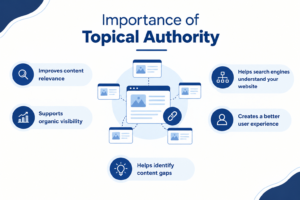
Here is why topical authority matters for SEO:
- Improves content relevance: Covering a subject and its related subtopics helps your content match a wider range of relevant search queries.
- Supports organic visibility: A well-planned content structure gives your website more opportunities to appear for related keywords and specific user questions.
- Helps search engines understand your website: Related articles connected through internal links make it easier to identify relationships between pages and understand the subjects your website covers.
- Creates a better user experience: Readers can move between related articles to find answers without searching for every piece of information separately.
- Helps identify content gaps: Reviewing your topic coverage shows which questions remain unanswered and where new content can provide value.
Building topical authority takes time. Publishing more articles alone will not improve your SEO. Each page needs to serve a clear purpose, answer the reader’s question, and contribute something useful to the overall topic.
How to Build Topical Authority
Building topical authority starts with understanding what your audience wants to know and creating content that answers those questions. Instead of publishing articles around unrelated keywords, focus on a subject and cover its important subtopics in a structured way.
A 2025 study published in Nature introduced OpenScholar, an AI system designed to retrieve and synthesize scientific literature from 45 million open-access papers. On a benchmark of expert-written questions, OpenScholar-8B outperformed GPT-4o by 6.1% in correctness. This shows the value of retrieving relevant research when answering complex questions, supporting the need for well-supported information on a subject.
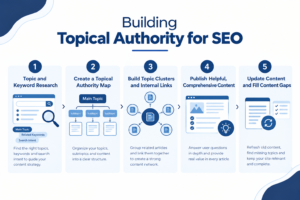
Topic and Keyword Research
Start by identifying the main topics your website should cover based on your audience, products, services, and business goals. Use keyword research to find the questions people ask, the problems they want to solve, and the related searches they make.
Group keywords by search intent and subject. For example, if your main topic is SEO, related keywords might include technical SEO, on-page SEO, keyword research, and link building. This helps you plan content that covers different aspects of the subject without targeting the same intent with multiple pages.
Create a Topical Authority Map
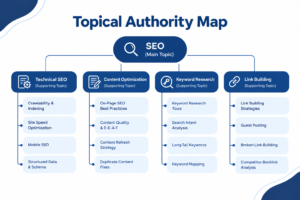
A topical authority map organizes your main subject, supporting topics, and related content into a clear structure. It helps you decide what to publish, how different pages relate to one another, and which areas need more coverage.
Start with a broad topic and break it into smaller subtopics. Then list the articles needed to address each one. For an SEO website, the map could include technical SEO, content optimization, keyword research, and link building, with more specific articles under each category.
Use your topical authority map as a content planning reference. It can help you spot missing topics, avoid unnecessary overlap, and keep new articles connected to your website’s main subject.
Build Topic Clusters and Internal Links
Topic clusters bring related articles together around a central subject. Usually, a main page covers the broader topic, while supporting pages answer more specific questions.
For example, a main page about keyword research could link to supporting articles about keyword difficulty, search intent, long-tail keywords, and competitor keyword analysis. Each supporting article can link back to the main page where it makes sense.
Use descriptive anchor text and link between pages when the connection is useful to readers. This creates a clear content structure and helps search engines discover related pages.
Publish Helpful, Comprehensive Content
Your content should answer the main question clearly and provide enough detail to help readers take the next step. Cover the essential points, explain unfamiliar terms, and use examples when they make a concept easier to understand.
Avoid repeating the same information across several articles just to increase content volume. Each page should address a distinct search intent or provide a useful perspective that other pages on your website do not already cover.
Check whether your content answers the questions readers are likely to have, uses reliable information, and offers practical value. Content depth matters when it helps readers understand a subject, not simply because an article is longer.
Update Content and Fill Content Gaps
Review your existing articles regularly to find outdated information, unanswered questions, missing subtopics, and opportunities to improve internal links. As your industry and audience needs change, updating older content helps keep your website relevant.
Use Google Search Console to identify queries that generate impressions but receive few clicks. Check competing websites to see which relevant questions or subtopics your content has not covered yet. Update existing pages when information needs improvement and create new articles to address genuine content gaps. This helps you maintain useful, up-to-date content and build stronger coverage of your main subject.
How to Measure Topical Authority
Topical authority is not measured by a single score. You can assess it by tracking how well your content covers a subject, performs in search results, earns relevant mentions, and contributes to business goals.
A 2026 study published in Data & Policy analyzed around 14,000 AI conversation logs and found that Gemini provided no clickable citations in 92% of the answers examined. The findings show that appearing in the information retrieved by an AI system does not always lead to a visible citation, making AI visibility worth tracking separately from citations.

1. Organic Rankings, Impressions, and Clicks
Use Google Search Console to track the keywords your website appears for, along with impressions, clicks, and average position. Check whether your pages are gaining visibility for the main topic and its related subtopics over time.
2. Topic Coverage and Content Quality
Review your topical authority map to see whether your website covers the important questions and subtopics within your main subject. Check that each article provides useful information, matches search intent, and adds value instead of repeating content from other pages.
3. Relevant Backlinks and Brand Mentions
Links from relevant, trusted websites can support your website’s credibility. Brand mentions in industry publications and other reliable sources can also help people recognize your expertise. Focus on the relevance and quality of these references rather than simply counting them.
4. AI Visibility and Citations
Check whether AI platforms such as ChatGPT, Perplexity, and Google AI Overviews mention your brand or cite your content when answering questions related to your topic. Track these results across relevant prompts to understand where your brand appears and where visibility is missing.
5. Conversions and Business Outcomes
Measure whether your content attracts the right audience and encourages meaningful actions, such as enquiries, sign-ups, or purchases. Use tools such as Google Analytics to track these outcomes. Strong topical coverage should support your wider business goals, not just increase traffic.
What Is Topical Authority in LLMs?
Topical authority in large language models (LLMs) refers to how well a brand or website is recognized as a relevant, credible source of information on a particular subject. When AI platforms such as ChatGPT, Claude, and Perplexity generate answers, they may draw on information from websites and other sources to explain a topic or respond to a question.
Consistently publishing useful, accurate content across related subjects can help make your expertise easier to understand. Clear explanations, relevant entities, and consistent information about your brand across trusted sources can also help AI systems connect your brand with the topics you cover. Understanding AI search optimisation can help you further explore how to improve your website’s visibility across AI-powered search platforms.
Topical authority in LLMs does not guarantee that an AI platform will mention or cite your website. AI systems use different methods to retrieve, process, and generate information. The goal is to make your content reliable, relevant, and easy to understand so it has a better chance of contributing to AI-generated answers.
Conclusion
Building topical authority takes a clear content strategy, consistent publishing, and regular performance checks. Research relevant keywords, organize your content with a topical authority map, connect related pages through internal links, and keep your information useful and up to date.
Track your organic search performance, topic coverage, relevant mentions, and AI citations to understand where your website is gaining visibility and where it needs improvement. By focusing on credible information and covering your subject in depth, you can strengthen your website’s relevance across search engines and AI platforms.
Frequently Asked Questions
How long does it take to build topical authority?
The time required depends on your website’s existing content, competition, publishing consistency, and the depth of the topic. A website with relevant content already in place may build stronger topic coverage faster than a new website starting from scratch.
Can a new website build topical authority?
Yes, a new website can build topical authority by focusing on a relevant subject and publishing useful content for its target audience. It does not need to cover every topic at once. Starting with a focused subject allows the website to develop its content library as it grows.
Can a website have topical authority in multiple niches?
Yes, a website can establish expertise across multiple subject areas when each area is relevant to its audience and supported by useful content. The key is to maintain clear content organization and ensure that each topic fits the website’s overall purpose.
Does topical authority matter more for some industries than others?
Its importance can vary by industry, competition, and the type of information users need. In specialized fields, readers may expect detailed, accurate information before trusting a source. In other industries, product availability, local relevance, or other factors may play a larger role in users’ decisions.
Can topical authority help a website rank for competitive keywords?
Strong topic coverage can support a website’s ability to compete for relevant keywords by providing useful information across related subjects. Rankings still depend on several factors, including search intent, content quality, competition, and technical accessibility. Topical authority alone cannot guarantee a high position.