AI Share of Voice (AI SOV) is a way to quantify how strongly a brand is represented across AI-generated answers for a defined set of queries. Instead of looking at individual rankings, it evaluates a brand’s presence relative to other brands appearing in the same AI search landscape.
For an agency like RankingBite, tracking AI SOV can help show how consistently the brand appears across relevant prompts and how its visibility compares with competitors.
Measuring AI SOV requires a consistent methodology. You need a defined prompt set, competitor group, measurement period, and clear rules for recording appearances and sources.
This guide explains how to structure that process, calculate AI SOV, and interpret the results without treating AI responses like traditional search rankings.
What Does AI Share of Voice Actually Measure?
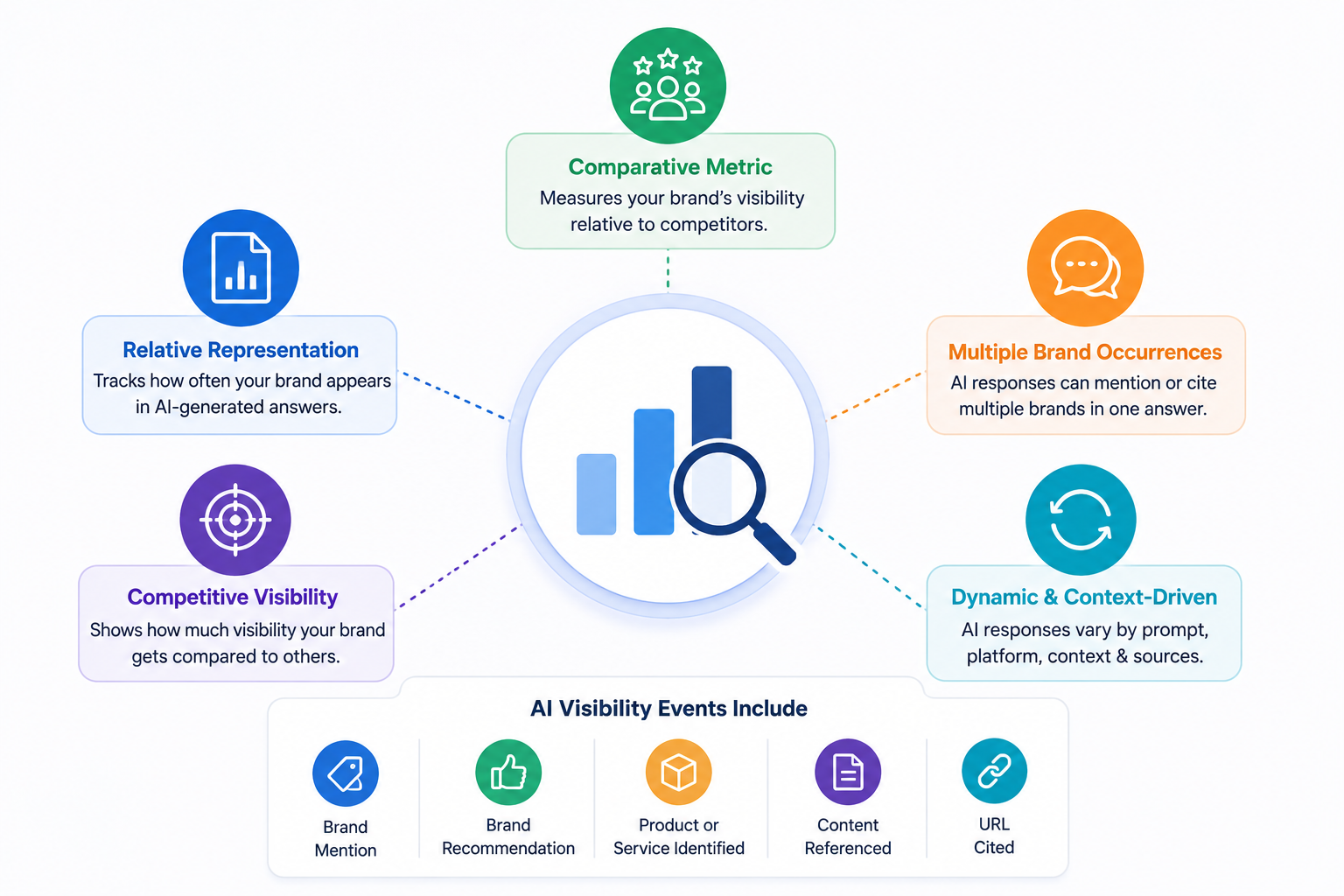
AI Share of Voice measures a brand’s relative representation within a defined set of AI responses. It is useful for understanding how much visibility a brand receives compared with other brands across the same prompts and platforms.
AI Visibility as a Competitive Metric
AI SOV is best viewed as a comparative measurement, not an absolute score. For example, if Brand A appears in 35% of tracked responses and Brand B appears in 20%, Brand A has greater visibility within that dataset.
What Counts as an AI Visibility Event?
An AI visibility event can include:
- A brand being mentioned by name
- A brand being recommended
- A product or service being identified
- A brand’s content being referenced
- A brand’s URL being cited
Define these events before collecting data so results remain consistent.
Why AI Responses Are Different From SERPs
Traditional SERPs generally provide an ordered list of results, while AI responses can combine information from multiple sources and mention several brands in one answer. AI responses can also change based on the prompt, platform, context, and available sources, making consistent sampling essential for meaningful comparison.
How to Build an AI Share of Voice Measurement Framework
A reliable AI Share of Voice measurement framework needs consistent competitors, prompts, and testing periods. Without these controls, results can be difficult to compare over time.
Define Your Competitor Set
Select competitors that target similar customers, services, or search intents. Keep the same core competitor group throughout the measurement period so changes in SOV reflect visibility shifts rather than changing benchmarks.
Create a Representative Prompt Set
Build prompts that reflect real customer research across different intents, such as informational, comparison, commercial, and recommendation queries. Avoid relying on a small group of closely related prompts, as this can distort the results.
Example: An agency could test 50 prompts covering SEO services, industry-specific SEO, agency comparisons, pricing, and problem-based queries.
Establish a Measurement Period
Choose a consistent tracking schedule, such as weekly or monthly, and record results using the same methodology each time. A defined period makes it easier to identify genuine visibility trends rather than reacting to individual AI responses.
How to Calculate AI Share of Voice
AI Share of Voice can be calculated by comparing a brand’s visibility events with the total visibility events recorded across the same prompt set.
Basic AI Share of Voice Formula
AI SOV = (Brand Visibility Events ÷ Total Visibility Events) × 100
Use the same prompts, competitors, and measurement rules for all brands to keep the calculation consistent.
Example Calculation
Suppose you test 100 prompts and record 250 total brand visibility events across all competing agencies. If Agency A appears in 50 of those events:
AI SOV = (50 ÷ 250) × 100 = 20%
This means Agency A accounts for 20% of the recorded visibility events in that dataset.
Weighted AI Share of Voice
Not every visibility event has the same significance. A weighted model can assign different values to events such as mentions, recommendations, and citations.
Example:
- Mention = 1 point
- Recommendation = 2 points
- Citation = 2 points
If Agency A records 20 mentions, 10 recommendations, and 5 citations:
Weighted score = (20 × 1) + (10 × 2) + (5 × 2) = 50 points
The important point is to define your weighting system before measurement and apply it consistently. There is no single industry-standard weighting formula for AI SOV. For more information on how to calculate AI Share of Voice, see our detailed guide on AI SOV measurement.
How to Collect AI Share of Voice Data
Collect AI SOV data using a consistent process so results can be compared across prompts, platforms, and time periods.
Manual Prompt Testing
- Run the same prompt set across selected AI platforms.
- Record mentions, recommendations, citations, competitors, and cited URLs.
- Example: Test 50 prompts monthly and compare results with the previous month.
Automated AI Visibility Tracking
- Automate prompt testing and response collection.
- Monitor competitors and historical visibility at scale.
- Best for: Agencies tracking multiple clients, platforms, or large prompt sets.
Build an AI Visibility Dataset
Record each result using structured fields:
- Date: When the test was performed.
- Platform: ChatGPT, Perplexity, etc.
- Prompt: Query that was tested.
- Brand: Whether the brand appeared.
- Competitors: Other brands mentioned.
- Citation: Whether a source was cited.
- Cited URL: Specific page referenced.
- Notes: Important context or observations.
How to Interpret AI Share of Voice Results
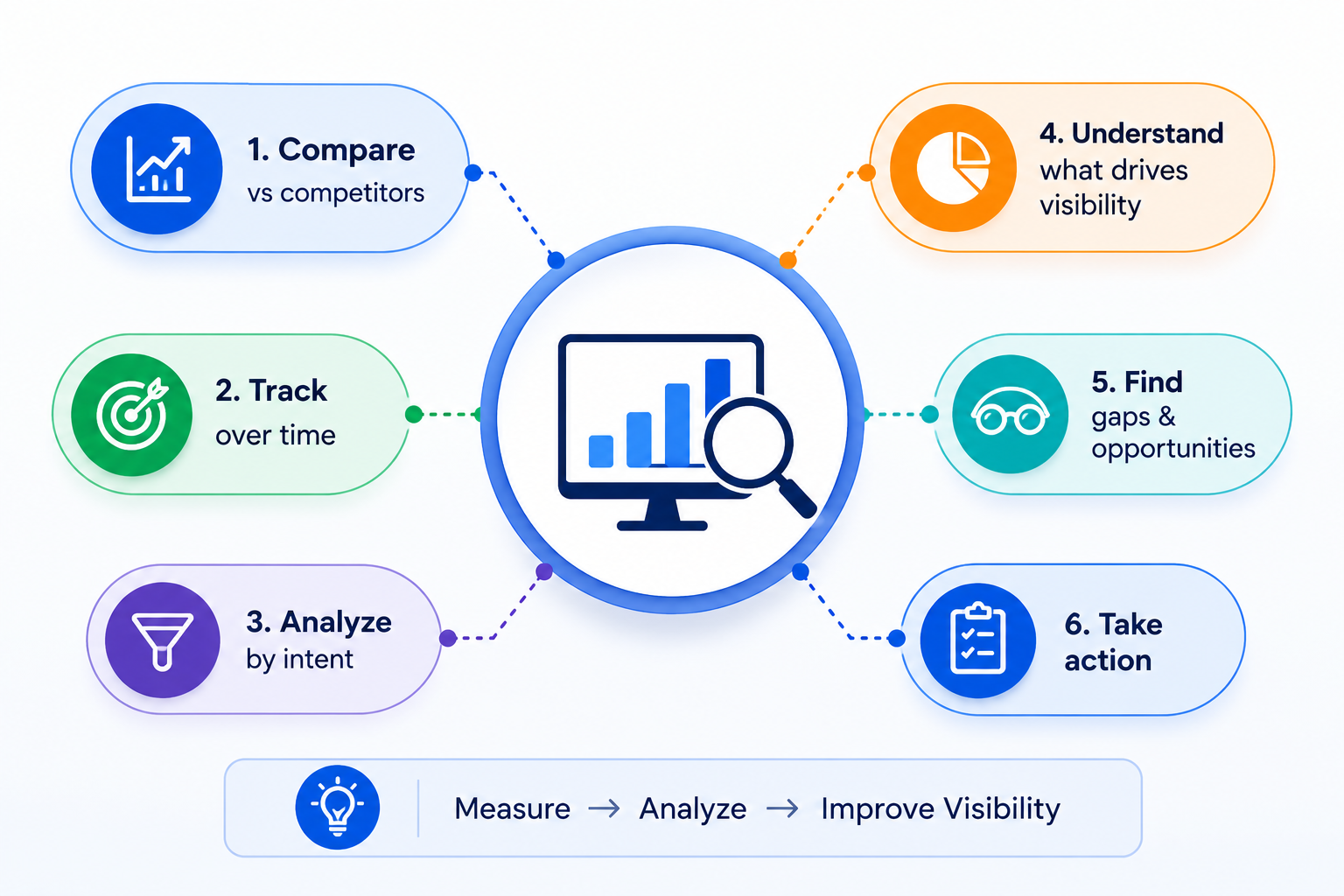
AI Share of Voice is more useful when you analyze different visibility signals together rather than relying on a single metric.
High Mention Rate but Low Citation Presence
A high mention rate with low citation presence means your brand is appearing in AI responses, but your website or content is rarely used as a supporting source. For example, if your agency is mentioned in 40% of responses but your website is cited in only 10%, your brand has visibility but limited source presence.
High Citation Rate but Low Recommendations
A high citation rate with low recommendations can indicate that your content is considered useful for information, while competitors are more frequently suggested as service providers. For example, your research may be cited for SEO statistics, while other agencies are recommended when users ask for an SEO agency.
High Competitor SOV
A higher competitor SOV shows that competing brands have stronger visibility across the tracked prompts. Instead of simply trying to increase content volume, analyze which topics, prompts, and external sources are contributing to their visibility.
What Can Affect AI Share of Voice Measurements?
- Prompt Wording and Variations: Small changes in wording can produce different AI responses. Use consistent prompts for reliable comparisons.
- Platform and Model Differences: ChatGPT and Perplexity may return different results for the same query. Track each platform separately.
- Sampling Size: A small prompt set can produce unreliable results. Use enough representative prompts to identify meaningful patterns.
- Search Context and Location: Location, language, industry, and search intent can influence AI results. Keep testing conditions consistent.
- Changes Over Time: AI responses and available sources change frequently. Measure regularly to identify genuine visibility trends.
How Reliable Is AI Share of Voice?
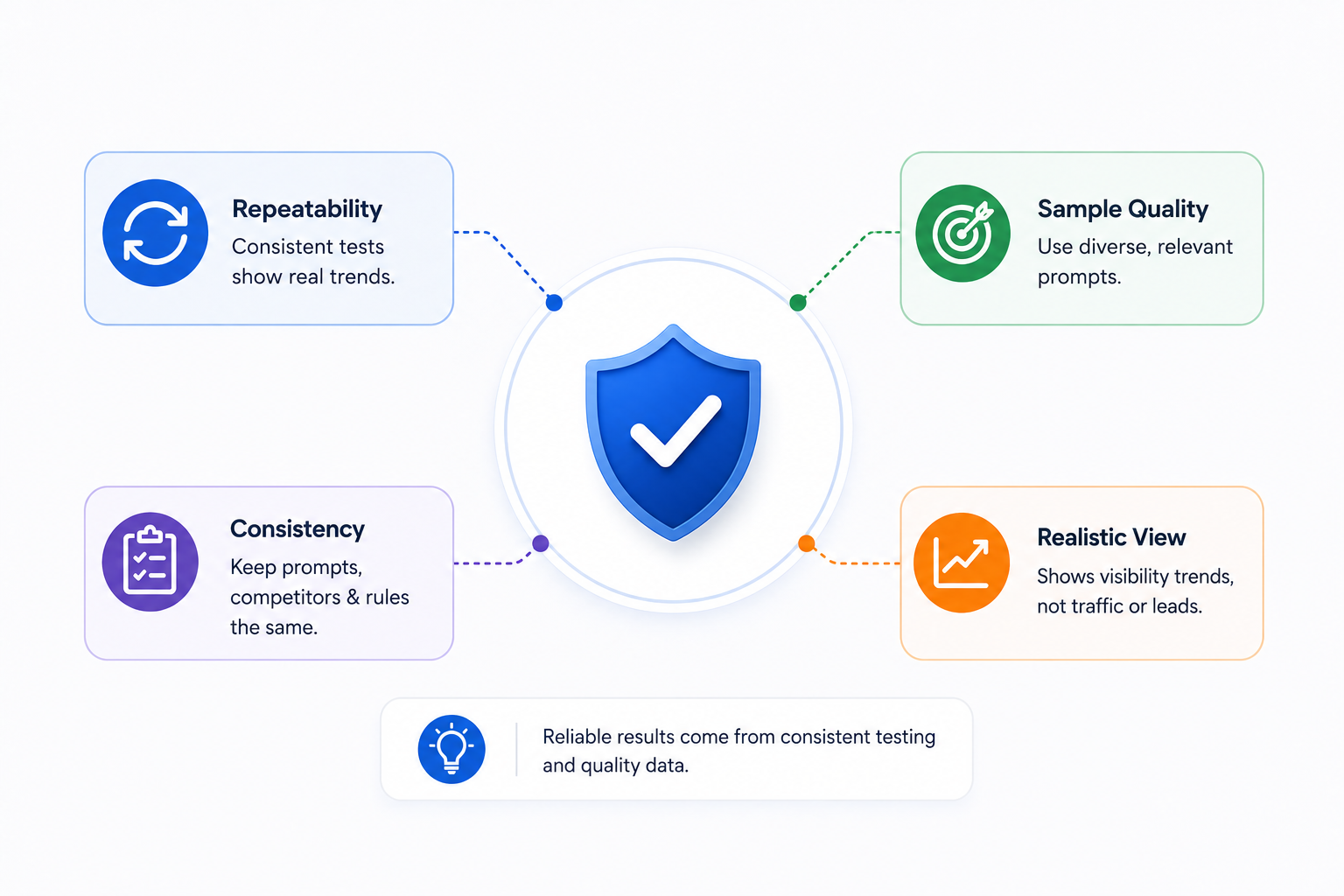
AI Share of Voice is useful for identifying visibility trends and competitive differences, but it should not be treated as a fixed ranking score. Reliable measurement depends on consistent testing and a representative dataset.
Repeatability
Run the same prompts under similar conditions to check whether results remain reasonably consistent.
Example: If an agency appears in 30% of responses this month and 32% next month using the same prompt set, the trend is more meaningful than a single test.
Sample Quality
Use diverse prompts that reflect real customer searches.
Example: Testing only “best SEO agency” may not represent visibility across pricing, services, industries, and comparison queries.
Measurement Consistency
Keep the same prompts, competitors, platforms, and tracking rules when comparing results.
Example: Changing from 50 prompts to 200 prompts can make month-to-month SOV comparisons misleading.
What AI SOV Can and Cannot Tell You
AI SOV can show relative visibility and competitive trends, but it cannot guarantee traffic, leads, or conversions.
Example: An agency with 40% AI SOV may have strong visibility, but this does not mean 40% of AI users will visit or contact the agency.
AI Share of Voice vs AI Visibility vs AI Citations
These terms describe different parts of AI search performance. AI Visibility measures whether a brand appears, AI Share of Voice compares that visibility with competitors, while AI Citations focus on the sources used to support an AI response.
| Metric | What It Measures | Main Question | Example |
|---|---|---|---|
| AI Visibility | Brand presence in AI responses | Does my brand appear? | Your agency appears in 30% of tested prompts. |
| AI Share of Voice | Visibility compared with competitors | How much visibility do I have? | Your agency has 25% SOV while a competitor has 40%. |
| AI Citations | Sources referenced by AI | Is my content being used as a source? | Your research page is cited in an AI response. |
In simple terms: Visibility tells you whether you appear, Share of Voice tells you how you compare, and citations tell you whether your content is being used as evidence.
Frequently Asked Questions
Can AI Share of Voice change without changing my website?
Yes. Changes in AI systems, indexed sources, competitors, or query context can affect your results even when your website remains unchanged.
Is AI Share of Voice the same across different AI platforms?
No. ChatGPT, Perplexity, and other platforms can produce different results for the same prompts, so platform-level data should be analyzed separately.
How many prompts are enough to measure AI Share of Voice?
There is no universal number. Use enough diverse, relevant prompts to represent your target audience and reduce the impact of individual responses.
Should branded prompts be included in AI SOV measurement?
They can be tracked separately, but non-branded prompts are generally more useful for evaluating competitive discovery and category visibility.
Can AI Share of Voice be measured for a specific service?
Yes. Create a focused prompt set around that service and measure your brand’s visibility against relevant competitors within the same dataset.
Conclusion
AI Share of Voice provides a practical way to evaluate how a brand is represented across AI-generated search results. For an agency like RankingBite, it can help measure how consistently the brand appears across relevant AI prompts and how its visibility compares with competitors.
The goal is not to treat AI SOV as a fixed ranking, but to use it as a comparative visibility metric. Regular measurement can help reveal where your brand is gaining visibility, where competitors have an advantage, and where further optimization may be needed.

Shanya
Hi, I'm Shanya, an SEO and content writer at RankingBite. I specialize in creating SEO-focused content around search, AI, cybersecurity, and digital marketing. I enjoy turning complex topics into clear, useful content that helps brands build visibility, connect with their audience, and grow their digital presence.