
Guest posting has long been viewed as one of the most reliable ways to build backlinks and improve search rankings. But as AI-powered search engines and answer engines become more influential, marketers are beginning to question whether guest posts still contribute to online visibility in the same way.
A common assumption is that publishing more guest posts automatically increases the chances of being cited by AI. It rarely does. Here’s the harder truth: most guest posting is never cited by name or link. Its influence is usually indirect, shaping how AI models associate a brand with a topic over time rather than producing one traceable citation event. If you’re counting direct mentions to measure success, you’re likely missing most of what guest posting actually does.
So what makes a post “AI-citation-worthy”? Content that’s entity-specific, matched to real search intent, and valuable enough on its own that an AI system could plausibly lift it into an answer, not because it’s a guest post, but because it’s genuinely useful. That’s the core argument here: guest posting drives AI visibility only when it offers trustworthy, original information, and even then, success looks different than it did in backlink-era SEO.
We’ll start with why guest posting still matters, then get specific about what separates a citation-worthy post from an invisible one and how to measure the difference.
Why Guest Posting Still Matters in the AI Search Era
Beyond Link Building
Guest posting used to be judged almost entirely by one metric: the backlink. A placement was worth pursuing if the site had enough domain authority to pass along some ranking power. That calculus has changed. AI-powered search doesn’t parse the web by counting links between pages; it synthesizes answers by drawing on the content it finds most useful, relevant, and trustworthy on a given topic. A guest post can still carry a backlink, but that’s no longer the primary reason it’s worth writing.
Topical Authority and Entity Signals
What guest posting still does well is build topical authority establishing a brand as a recognized voice within a specific subject area and strengthening entity signals, the associations an AI model forms between a brand, its products, and the concepts it’s connected to. A well-placed guest post on a relevant, respected site reinforces those associations every time it’s published, read, and referenced elsewhere, even without a single click-through.
What AI Actually Values
The data backs this up directly. An Ahrefs study of 75,000 brands found that brand web mentions correlate three times more strongly with AI Overview visibility than backlinks do. In other words, being talked about is now doing more work than being linked to. That’s the real shift guest posting needs to account for: AI systems reward authoritative, useful content and the brand associations it builds, not backlinks in isolation.
Why Most Guest Posting Never Influences AI Citations
Common Failure Points
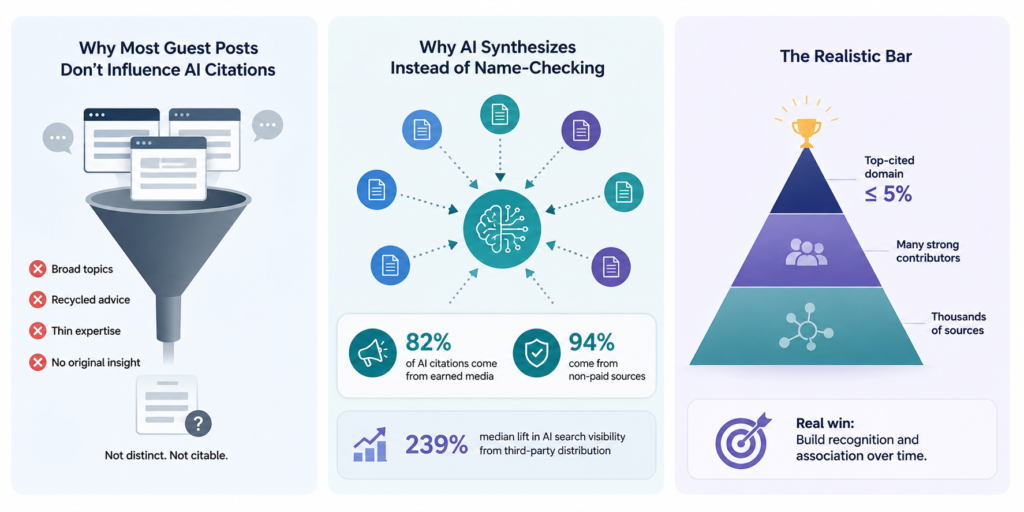 Most guest posts fail to move the needle for a simple reason: they don’t say anything an AI system hasn’t already read a hundred times elsewhere. Broad topics, recycled advice, thin expertise, and a lack of original insight are the usual culprits. When a post could have been written by anyone about anything, there’s no reason for an AI model to treat it as a distinct, citable source rather than one more instance of the same generic advice.
Why AI Synthesizes Instead of Name-Checking
Even well-written guest posts rarely get pulled as a direct citation, and the reason has less to do with quality than with how these systems work. AI models don’t name-check a single article; they synthesize an answer from many sources at once.
Muck Rack’s analysis of more than a million AI citations found that 82% came from earned media and 94% from non-paid sources, and a Stacker/Scrunch study found that distributing content across third-party outlets produced a 239% median lift in AI search visibility.
In practice, this means reach and repetition across many trusted sources matter more than any single placement. Think of a guest post as one data point among thousands an AI model has read on a topic not a billboard it will quote back.
The Realistic Bar
That distribution pattern sets a more realistic bar for what “success” looks like. Even the most-cited domain on any AI platform rarely accounts for more than 5% of total citations, so no single guest post however good is likely to dominate an AI-generated answer on its own. The real win isn’t a guaranteed citation; it’s a measurable contribution to how AI models understand and associate your brand with a topic over time.
What Makes Guest Posting Worth Citing by AI
 Trust Signals AI Looks For
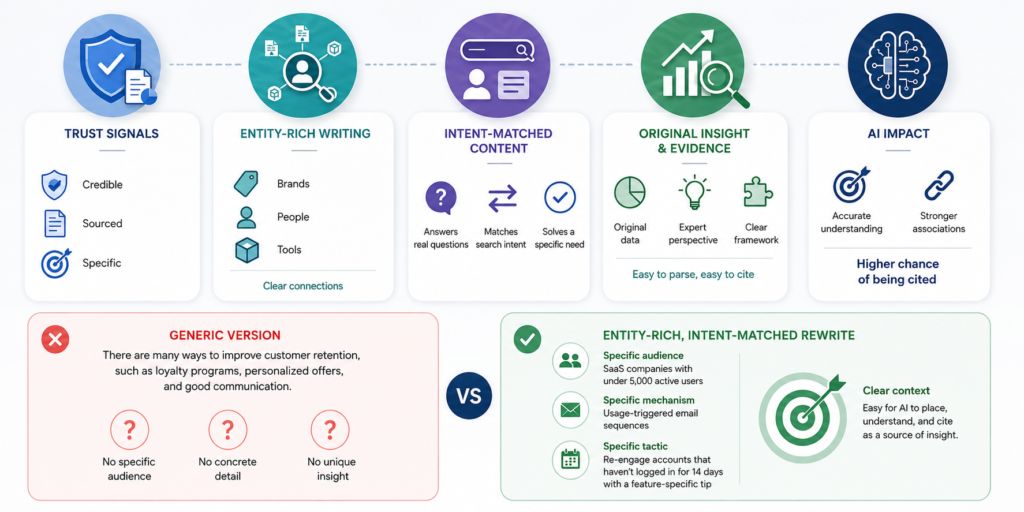
AI systems favor content that reads as credible on its own terms, clear sourcing, specific claims, and a demonstrated understanding of the topic rather than surface-level familiarity. The qualities that make a human reader trust a piece are largely the same ones that make an AI system treat it as a reliable source to draw from.
Entity-Rich Writing
Trust alone isn’t enough if the content is vague about who and what it’s actually about. Entity-rich writing names specific brands, products, people, tools, and concepts, and draws clear connections between them, instead of relying on generic descriptions. That specificity is what allows an AI model to place the content correctly within its understanding of a topic.
Intent-Matched Content
The most citable guest posts answer a real question someone is actually asking, rather than covering a topic broadly. Content built around specific search intent, a comparison, a how-to, a decision someone needs to make is far more likely to match what a user is prompting an AI system to answer.
Original Insight and Evidence
Finally, the content needs to bring something the AI system hasn’t already seen elsewhere: original data, a distinct expert perspective, a concrete example, or a clear framework. Structure matters too, content that’s easy to parse is easier to cite accurately.
The difference in practice:
Generic version: There are many ways to improve customer retention, such as loyalty programs, personalized offers, and good communication.
Entity-rich, intent-matched rewrite: For SaaS companies with under 5,000 active users, retention improves fastest through usage-triggered email sequences for example, re-engaging accounts that haven’t logged in for 14 days with a feature-specific tip rather than a generic discount.
The first version could apply to almost any business in any industry; there’s nothing here for an AI system to attach to a specific brand, audience, or use case. The second version names a specific audience, a specific mechanism, and a specific tactic, which is exactly the kind of detail that lets AI systems place it accurately and treat it as a genuine source of insight rather than restated advice.
Generic Guest Posting vs. AI-Citation-Worthy Guest Posting
The qualities above look different side by side.
| Factor | Generic Guest Posting | AI-Citation-Worthy Guest Posting |
|---|---|---|
| Primary Objective | Earn a backlink. | Build topical authority and entity recognition. |
| Topic Specificity | Broad, generalized topics. | Narrow, well-defined topics targeting a specific subject. |
| Search Intent Alignment | Loosely related to the topic. | Directly answers a specific user question or intent. |
| Entity Coverage | Vague references with few named entities. | Explicitly mentions brands, tools, roles, products, and concepts. |
| Original Insights | Restates commonly available advice. | Introduces unique perspectives, proprietary frameworks, or original data. |
| Evidence & Examples | Minimal or generic examples. | Uses concrete, verifiable examples and supporting evidence. |
| Brand Visibility | Depends primarily on users clicking the backlink. | Brand recognition persists through entity mentions, even without click-throughs. |
| Likelihood of AI Citation | Low. | Low to moderate, but consistently strengthens brand associations over time. |
| Long-Term Authority Value | Minimal; typically declines as the post ages. | Compounds over time as entity relationships and topical authority grow. |
How to Do Guest Posting That AI Can Actually Use
Choose Relevance Over Domain Authority
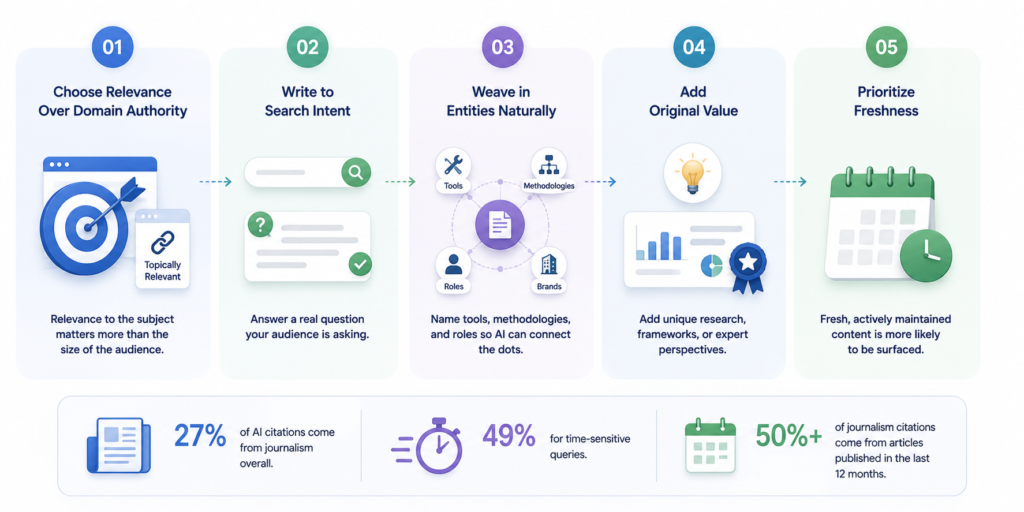
Start with where you publish. A high-Domain-Authority site with loosely related content does less for AI visibility than a smaller, tightly focused site that AI systems already treat as a trusted source on your exact topic. Relevance to the subject matters more than the size of the audience.
Write to Search Intent
Once you’ve picked the right site, the next lever is what the post is actually about. Write toward a real question your audience is asking, rather than a broad overview of the category the more specific the question, the more likely the content matches an actual prompt someone sends an AI system.
Weave in Entities Naturally
From there, be specific about who and what the post covers. Naming particular tools, methodologies, and roles gives an AI system something concrete to attach to your brand vague references to “a busy professional” or “the right software” don’t.
Put together, this looks like: a post pitched to a niche industry blog, built around a specific comparison question (not a generic listicle), and written with named tools and roles woven throughout rather than generic placeholders.
Add Original Value
None of this matters if the content doesn’t offer something new. Include original research, a unique framework, or a genuine expert perspective, something an AI system hasn’t already read a version of elsewhere. A useful gut check: would this post still be worth reading if the byline link were removed entirely? If the answer is no, the content isn’t carrying its own weight yet.
Prioritize Freshness
Finally, timing matters more than it used to. Journalistic content accounts for 27% of AI citations overall, rising to 49% for queries that imply time-sensitivity, and more than half of journalism citations come from articles published within the last 12 months. Guest posts benefit from the same pattern; recently, actively maintained content is more likely to be surfaced than something published once and left untouched.
 How to Measure Whether Guest Posting Improves AI Visibility
Why Direct Tracking Falls Short
Direct citation tracking will usually undercount guest posting’s real impact, since most of its influence is indirect. A citation doesn’t even need a clickable link to matter being named in an AI-generated recommendation, linked or not, still puts a brand in front of someone at the moment they’re deciding. Backlinks and referral traffic sit even further from that real signal.
Better Proxy Metrics
Since direct citations alone won’t capture the full picture, track proxies instead: AI citations where they do occur, entity mentions across AI-generated answers, growth in topical authority, and lift in branded search volume over time. Together, these give a far more accurate read on whether guest posting is actually working.
Auditing Your Guest Posting Program
To see where your own program stands, run a structured audit of your guest posting output against these metrics our guide, Does Your Link-Building Program Produce Any AI Visibility? (An Audit), walks through exactly how.
Guest Posting Is One Part of Building AI Authority
AI Draws from Multiple Sources
No single guest post, however well-written, builds AI authority on its own. AI models form their understanding of a brand from many sources over time not one article in isolation. Guest posting works best as one input among several, not a standalone strategy.
What Complements Guest Posting
The strongest AI visibility comes from combining guest posting with original research, digital PR, case studies, and strong on-site content. Each reinforces the same entity signals from a different angle, which is what actually compounds authority over time.
FAQ
Does guest posting still help SEO in 2026?
Yes, but its value has shifted. Guest posting now matters less for direct backlinks and more for building topical authority and entity associations that AI systems draw on when generating answers. Treat it as a brand-visibility strategy, not just a link-building one.
How do I know if AI is citing my guest posting content?
Direct citations are hard to track and rare by design, so watch broader proxies instead: mentions of your brand or entities in AI-generated answers, growth in branded search volume, and any direct AI citations that do occur. Tools built for AI citation tracking can help monitor this over time.
Guest posting vs. digital PR;which builds AI visibility faster?
Digital PR through major earned-media placements tends to move faster, since AI systems favor high-authority, widely-referenced sources. Guest posting works on a longer timeline, building authority gradually through consistent, topically relevant placements the two work best combined rather than as alternatives.
Conclusion
Guest posting still has value but only when it contributes something genuinely worth citing. Quality, relevance, and authority matter far more than publishing volume ever did.
Most guest posts won’t produce a visible AI citation, and that’s not a flaw in your strategy. The data throughout this piece backs that up structurally: citations are a long tail by nature, and a single post was never likely to dominate an AI-generated answer on its own. Its real job is quieter reinforcing the entity signals that support visibility elsewhere.
The shift worth making is a mental one: stop optimizing for links, and start optimizing for authority. AI cites content because it’s useful and trustworthy not because it’s a guest post, and not always in a way you can directly trace.
